
Verwandte Artikel zu Other Modernities: Gendered Yearnings in China after...
Inhaltsangabe
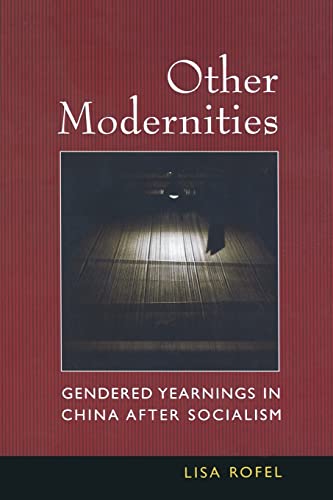
In this analysis of three generations of women in a Chinese silk factory, Lisa Rofel brilliantly interweaves the intimate details of her observations with a broad-ranging critique of the meaning of modernity in a postmodern age.
The author based her study at a silk factory in the city of Hangzhou in eastern China. She compares the lives of three generations of women workers: those who entered the factory right around the Communist revolution in 1949, those who were youths during the Cultural Revolution of the 1970s, and those who have come of age in the Deng era. Exploring attitudes toward work, marriage, society, and culture, she convincingly connects the changing meanings of the modern in official discourse to the stories women tell about themselves and what they make of their lives.
One of the first studies to take up theoretically sophisticated issues about gender, modernity, and power based on a solid ethnographic ground, this much-needed cross-generational study will be a model for future anthropological work around the world.
Die Inhaltsangabe kann sich auf eine andere Ausgabe dieses Titels beziehen.
Über die Autorin bzw. den Autor
Lisa Rofel is Assistant Professor of Anthropology at the University of California, Santa Cruz.
Von der hinteren Coverseite
"Cogent, evocative, and theoretically rigorous. I know of no one else who has so artfully delineated the complex, heterogeneous effects of political mobilization on the formation of collective and individual subjectivities."—Dorinne Kondo, author of Crafting Selves
Auszug. © Genehmigter Nachdruck. Alle Rechte vorbehalten.
Other Modernities
Gendered Yearnings in ChinaBy Lisa RofelUniversity of California Press
Copyright © 1999 Lisa RofelAll right reserved.
ISBN: 9780520210790
1?
Liberation Stories
We were enjoying the midday break for cadres. Yu Shifu, Tang Shan, and I had gathered in our customary spot, Zhenfu's cramped reception office. Though I spent the bulk of my days in the workshops with women workers, the cadres responsible for me at Zhenfu urged me to lunch with them during their hour in the dining hall rather than in the earlier rushed and noisy half hour when workers hurriedly gulped down their food. My lunches were, relative to workers', luxurious stretches of quiet time.
With economic reform in full swing, Zhenfu's reception office had the air of a train station, what with factory staff running in to use one of the few available phones, or with visiting engineers and cadres, at Zhenfu for collaborative meetings, coming in to grab teacups and thermoses of boiled water. But at this moment, when most cadres were resting after lunch, the office was unusually still.
Tang Shan was then an earnest twenty-seven-year-old who had been a former worker and had the unusual fortune to be promoted to cadre. She had been assigned to take care of my needs. Yu Shifu, then in her late forties, was also a former prep worker as well as weaver. She had been in the factory much longer, indeed since before the socialist revolution, for she had entered Zhenfu as a child laborer. Some ten years earlier she had managed to secure the much less onerous position of factory receptionist. Yu Shifu averred that the factory leadership had "looked after" her because she had become tired and weak. Others confided that Yu Shifu had previously had a position in the weaving shopnext to the woman who was the current party secretary. During the Cultural Revolution, Yu Shifu had sided with her when the radical faction had attacked; the receptionist's job was her reward.
Many at Zhenfu gave Yu Shifu the unofficial title of "backbone cadre" in recognition of her long years of devotion to the party. Some said it with admiration and others with a barely perceptible sardonic tone. Yu Shifu, like Tang Shan, was one of the few who stood by the party. In the mid-1980s, Yu Shifu persisted in invoking the socialist guiding phrase "Serve the people," and she dressed in the simple, unadorned blue jacket and pants that signified an earlier era of class politics. No one could have leveled against her the increasingly common accusation about party cadres: corruption of politics for personal gain. On her own initiative, Yu Shifu had assumed toward me the position of surrogate mother and ideological guide. When I arrived at the factory in the morning, she offered me tea to ward off the winter chill; during the day she kept a check on my movements and contacts within Zhenfu; and, occasionally, she sang the praises of the party to me.
Over the weeks, I realized that Yu Shifu was exerting great effort to do "thought work" (sixiang gongzuo ) with me, to educate and convince me, the outsider, about all the positive transformations in China since Liberation. One point on which she held especially strong views was the liberation of women in China. "Women and men are equal now in China," she would insist to me over lunch, during walks, while we sipped our tea. "Women can go out and work, just like men." "Women have been liberated," she would continue in a slightly anxious and overly eager tone.
I silently disagreed with Yu Shifu, but I always politely nodded my head. I took her comments with an equal measure of respectful interest and political frustration. Anthropologists have laid to rest the myth of the classic participant-observer who merely listens and records. Through numerous self-reflexive descriptions, we have acknowledged that the anthropologist's presence is inevitably a complicated matter of involvement.1 Yet much experimental ethnography portrays the anthropological encounter as a dialogue that ultimately culminates in a relation of equitable and harmonious exchange. Challenging Yu Shifu, I knew, couldbe a much more acrimonious affair. I was well aware of how closely the question of women's liberation in China was tied to a defense of the nation. Any challenge to her would operate through a long history of asymmetrical engagements between China and the West.
But that day in the office the strain of anthropological and political disinterest had become too great. I decided to engage her. I was moved to do so, in part, because of the pervasive controversies I was hearing in the silk factories about the effects of the new modernization policies?debates in which women's voices were vociferous. In addition, just the previous day I had been a bemused bystander to a playful argument between Yu Shifu and one of the inspection shop's rakish young men over whether women or men had a more burdensome life. Yu Shifu claimed that women were more burdened, what with shopping at the crack of dawn, cooking time-consuming meals, washing everyone's clothes by hand, and then having to go to work besides. Her interlocutor, in the midst of languidly cleaning his bicycle, pointed at his vehicle, arguing that men had to shoulder all the dirty work women couldn't handle. (Cleaning bicycles, not unlike waxing cars in the United States, is considered "men's work.")
Yu Shifu's convictions about women seemed to me starkly contradictory. I decided to be direct. "If women and men are equal," I challenged, "how is it that there are so many competent women in this factory who don't get promoted to be managers?" My question took her by surprise, less because of its content than its tone. We had negotiated a careful but nonetheless warm relationship over the weeks. My directness suddenly intruded, threatening to break the tentative threads of cautious friendship. The atmosphere in the office changed from one of placid sociability to tense wariness. "Men and women are equal," Yu Shifu replied. "But they are different. Men are more suited to managerial work." I pressed the point, asking bluntly what those different qualities were. My bluntness, I could see, further chilled the air. "Men are stronger than women," Yu Shifu slowly answered, obviously trying to weigh where I was taking the conversation. Assuming she referred to biological traits, I countered that "strength does not lead to intelligence." Shifting the framework of discussion, I pointed out that "since the Cultural Revolution, everyonehas gone to great pains to emphasize the difference between physical and intellectual talents." (This was part of a wider repudiation of class labels and class struggle, together with support for the ascension of intellectuals.) Yu Shifu appeared to be without a response. Or perhaps she thought the situation had skidded dangerously close to a breach of the relatively unconstrained relationship we had built. Whatever the reason, she broke off the discussion. Tang Shan, who had stood watching silently from the sidelines, looked both amused at my comments and slightly appalled at my brazen challenge, which might easily have caused Yu Shifu to lose face.
The issue of women's liberation provided one of the most critical terrains on which China endeavored to construct its modernity. At a certain moment, Chinese women's liberation also figured centrally within western feminism as a means for structuring its own forms of knowledge and politics. This chapter explores the multiple deployments of meaning and power constituting "women's liberation" as it reconsiders the heterogeneous processes through which a small group of...
„Über diesen Titel“ kann sich auf eine andere Ausgabe dieses Titels beziehen.
Suchergebnisse für Other Modernities: Gendered Yearnings in China after...

Beispielbild für diese ISBN
Other Modernities: Gendered Yearnings in China after Socialism
Verlag:
University of California Press, 1999
ISBN 10: 0520210794
ISBN 13: 9780520210790
Gebraucht
Paperback
Anbieter: World of Books (was SecondSale), Montgomery, IL, USA
Verkäuferbewertung 5 von 5 Sternen

Paperback. Zustand: Good. In this analysis of three generations of women in a Chinese silk factory, Lisa Rofel brilliantly interweaves the intimate details of her observations with a broad-ranging critique of the meaning of modernity in a postmodern age. The author based her study at a silk factory in the city of Hangzhou in eastern China. She compares the lives of three generations of women workers: those who entered the factory right around the Communist revolution in 1949, those who were youths during the Cultural Revolution of the 1970s, and those who have come of age in the Deng era. Exploring attitudes toward work, marriage, society, and culture, she convincingly connects the changing meanings of the modern in official discourse to the stories women tell about themselves and what they make of their lives. One of the first studies to take up theoretically sophisticated issues about gender, modernity, and power based on a solid ethnographic ground, this much-needed cross-generational study will be a model for future anthropological work around the world. Bestandsnummer des Verkäufers 00081483838
Gebraucht kaufen
EUR 5,95
Versand gratis
Versand innerhalb von USA
Versand innerhalb von USA
Anzahl: 1 verfügbar
Beispielbild für diese ISBN
Other Modernities: Gendered Yearnings in China After Socialism
Verlag:
University of California Press, 1999
ISBN 10: 0520210794
ISBN 13: 9780520210790
Gebraucht
Paperback
Anbieter: ThriftBooks-Reno, Reno, NV, USA
Verkäuferbewertung 5 von 5 Sternen
Paperback. Zustand: Very Good. No Jacket. May have limited writing in cover pages. Pages are unmarked. ~ ThriftBooks: Read More, Spend Less. Bestandsnummer des Verkäufers G0520210794I4N00
Gebraucht kaufen
EUR 5,96
Versand gratis
Versand innerhalb von USA
Versand innerhalb von USA
Anzahl: 1 verfügbar
Beispielbild für diese ISBN
Other Modernities: Gendered Yearnings in China After Socialism
Verlag:
University of California Press, 1999
ISBN 10: 0520210794
ISBN 13: 9780520210790
Gebraucht
Paperback
Anbieter: ThriftBooks-Atlanta, AUSTELL, GA, USA
Verkäuferbewertung 5 von 5 Sternen
Paperback. Zustand: Very Good. No Jacket. May have limited writing in cover pages. Pages are unmarked. ~ ThriftBooks: Read More, Spend Less. Bestandsnummer des Verkäufers G0520210794I4N00
Gebraucht kaufen
EUR 5,96
Versand gratis
Versand innerhalb von USA
Versand innerhalb von USA
Anzahl: 1 verfügbar
Beispielbild für diese ISBN
Other Modernities: Gendered Yearnings in China After Socialism
Verlag:
University of California Press, 1999
ISBN 10: 0520210794
ISBN 13: 9780520210790
Gebraucht
Paperback
Anbieter: ThriftBooks-Dallas, Dallas, TX, USA
Verkäuferbewertung 5 von 5 Sternen
Paperback. Zustand: Fair. No Jacket. Readable copy. Pages may have considerable notes/highlighting. ~ ThriftBooks: Read More, Spend Less. Bestandsnummer des Verkäufers G0520210794I5N00
Gebraucht kaufen
EUR 5,96
Versand gratis
Versand innerhalb von USA
Versand innerhalb von USA
Anzahl: 1 verfügbar
Beispielbild für diese ISBN
Other Modernities: Gendered Yearnings in China After Socialism
Verlag:
University of California Press, 1999
ISBN 10: 0520210794
ISBN 13: 9780520210790
Gebraucht
Paperback
Anbieter: ThriftBooks-Atlanta, AUSTELL, GA, USA
Verkäuferbewertung 5 von 5 Sternen
Paperback. Zustand: Fair. No Jacket. Readable copy. Pages may have considerable notes/highlighting. ~ ThriftBooks: Read More, Spend Less. Bestandsnummer des Verkäufers G0520210794I5N00
Gebraucht kaufen
EUR 5,96
Versand gratis
Versand innerhalb von USA
Versand innerhalb von USA
Anzahl: 1 verfügbar
Beispielbild für diese ISBN
Other Modernities: Gendered Yearnings in China After Socialism
Verlag:
University of California Press, 1999
ISBN 10: 0520210794
ISBN 13: 9780520210790
Gebraucht
Paperback
Anbieter: ThriftBooks-Dallas, Dallas, TX, USA
Verkäuferbewertung 5 von 5 Sternen
Paperback. Zustand: Good. No Jacket. Pages can have notes/highlighting. Spine may show signs of wear. ~ ThriftBooks: Read More, Spend Less. Bestandsnummer des Verkäufers G0520210794I3N00
Gebraucht kaufen
EUR 5,96
Versand gratis
Versand innerhalb von USA
Versand innerhalb von USA
Anzahl: 1 verfügbar
Beispielbild für diese ISBN
Other Modernities: Gendered Yearnings in China After Socialism
Verlag:
University of California Press, 1999
ISBN 10: 0520210794
ISBN 13: 9780520210790
Gebraucht
Paperback
Anbieter: ThriftBooks-Dallas, Dallas, TX, USA
Verkäuferbewertung 5 von 5 Sternen
Paperback. Zustand: Very Good. No Jacket. May have limited writing in cover pages. Pages are unmarked. ~ ThriftBooks: Read More, Spend Less. Bestandsnummer des Verkäufers G0520210794I4N00
Gebraucht kaufen
EUR 5,96
Versand gratis
Versand innerhalb von USA
Versand innerhalb von USA
Anzahl: 1 verfügbar
Beispielbild für diese ISBN
Other Modernities: Gendered Yearnings in China after Socialism
Verlag:
University of California Press, 1999
ISBN 10: 0520210794
ISBN 13: 9780520210790
Gebraucht
paperback
Anbieter: HPB-Emerald, Dallas, TX, USA
Verkäuferbewertung 5 von 5 Sternen
paperback. Zustand: Very Good. Connecting readers with great books since 1972! Used books may not include companion materials, and may have some shelf wear or limited writing. We ship orders daily and Customer Service is our top priority! Bestandsnummer des Verkäufers S_475247589
Gebraucht kaufen
EUR 3,67
EUR 3,34 Versand
Versand innerhalb von USA
Versand innerhalb von USA
Anzahl: 1 verfügbar
Beispielbild für diese ISBN
Other Modernities : Gendered Yearnings in China after Socialism
Verlag:
University of California Press, 1999
ISBN 10: 0520210794
ISBN 13: 9780520210790
Gebraucht
Softcover
Erstausgabe
Anbieter: Better World Books, Mishawaka, IN, USA
Verkäuferbewertung 5 von 5 Sternen
Zustand: Good. 1st Edition. Pages intact with minimal writing/highlighting. The binding may be loose and creased. Dust jackets/supplements are not included. Stock photo provided. Product includes identifying sticker. Better World Books: Buy Books. Do Good. Bestandsnummer des Verkäufers 5203560-6
Gebraucht kaufen
EUR 7,38
Versand gratis
Versand innerhalb von USA
Versand innerhalb von USA
Anzahl: 2 verfügbar
Beispielbild für diese ISBN
Other Modernities : Gendered Yearnings in China after Socialism
Verlag:
University of California Press, 1999
ISBN 10: 0520210794
ISBN 13: 9780520210790
Gebraucht
Softcover
Erstausgabe
Anbieter: Better World Books, Mishawaka, IN, USA
Verkäuferbewertung 5 von 5 Sternen
Zustand: Very Good. 1st Edition. Pages intact with possible writing/highlighting. Binding strong with minor wear. Dust jackets/supplements may not be included. Stock photo provided. Product includes identifying sticker. Better World Books: Buy Books. Do Good. Bestandsnummer des Verkäufers 4783418-6
Gebraucht kaufen
EUR 7,38
Versand gratis
Versand innerhalb von USA
Versand innerhalb von USA
Anzahl: 1 verfügbar