
Verwandte Artikel zu The History of Human Rights: From Ancient Times to...
Inhaltsangabe
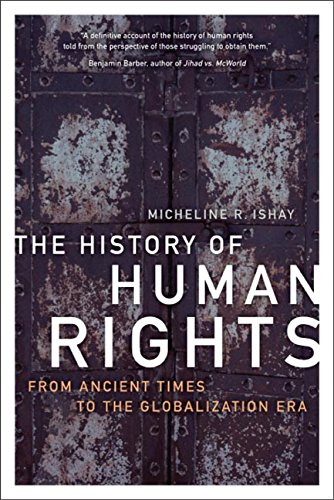
Micheline Ishay recounts the dramatic struggle for human rights across the ages in a book that brilliantly synthesizes historical and intellectual developments from the Mesopotamian Codes of Hammurabi to today's era of globalization. As she chronicles the clash of social movements, ideas, and armies that have played a part in this struggle, Ishay illustrates how the history of human rights has evolved from one era to the next through texts, cultural traditions, and creative expression. Writing with verve and extraordinary range, she develops a framework for understanding contemporary issues from the debate over globalization to the intervention in Kosovo to the climate for human rights after September 11, 2001. The only comprehensive history of human rights available, the book will be essential reading for anyone concerned with humankind's quest for justice and dignity.
Ishay structures her chapters around six core questions that have shaped human rights debate and scholarship: What are the origins of human rights? Why did the European vision of human rights triumph over those of other civilizations? Has socialism made a lasting contribution to the legacy of human rights? Are human rights universal or culturally bound? Must human rights be sacrificed to the demands of national security? Is globalization eroding or advancing human rights? As she explores these questions, Ishay also incorporates notable documents—writings, speeches, and political statements—from activists, writers, and thinkers throughout history.
Ishay structures her chapters around six core questions that have shaped human rights debate and scholarship: What are the origins of human rights? Why did the European vision of human rights triumph over those of other civilizations? Has socialism made a lasting contribution to the legacy of human rights? Are human rights universal or culturally bound? Must human rights be sacrificed to the demands of national security? Is globalization eroding or advancing human rights? As she explores these questions, Ishay also incorporates notable documents—writings, speeches, and political statements—from activists, writers, and thinkers throughout history.
Die Inhaltsangabe kann sich auf eine andere Ausgabe dieses Titels beziehen.
Über die Autorin bzw. den Autor
Micheline R. Ishay is Professor and Director of the International Human Rights Program at the Graduate School of International Studies at the University of Denver. She is the author of Internationalism and Its Betrayal (1995), editor of The Human Rights Reader: Major Speeches, Essays, and Documents from the Bible to the Present (1997), and coeditor of The Nationalism Reader (1995).
Von der hinteren Coverseite
"A definitive account of the history of human rights told from the perspective of those struggling to obtain them. Using the Enlightenment, industrialization, war, national self-determination, and globalization as lenses through which to look at their evolution, Ishay brings both historical context and conceptual acuity to modern debates about the role of human rights in a multicultural world. Her encompassing and compassionate approach issues in a book equally valuable to scholars, students, and citizens."—Benjamin Barber, University of Maryland, author of Jihad vs. McWorld
"This well-written book, chock-full of knowledge, presents a history of the idea, or ideas, of human rights through the prism of the author's thoughtful views on key controversies that bedevil human rights discourse to this day."—Professor Sir Nigel Rodley, Chair, University of Essex Human Rights Centre; Member, (UN) Human Rights Committee
"The first account of human rights as embedded in the history of political theory, relating it to the basic issues of Liberty, Equality and Fraternity. Erudite and non-dogmatic, Ishay reaches beyond individual human rights to issues of economic, cultural and national rights, and shows how the campaign for human rights was instrumental in bringing down oppressive regimes in the last decades... Humane and generous in its approach, brilliant in its conception and presentation."—Shlomo Avineri, The Hebrew University of Jerusalem
"This well-written book, chock-full of knowledge, presents a history of the idea, or ideas, of human rights through the prism of the author's thoughtful views on key controversies that bedevil human rights discourse to this day."—Professor Sir Nigel Rodley, Chair, University of Essex Human Rights Centre; Member, (UN) Human Rights Committee
"The first account of human rights as embedded in the history of political theory, relating it to the basic issues of Liberty, Equality and Fraternity. Erudite and non-dogmatic, Ishay reaches beyond individual human rights to issues of economic, cultural and national rights, and shows how the campaign for human rights was instrumental in bringing down oppressive regimes in the last decades... Humane and generous in its approach, brilliant in its conception and presentation."—Shlomo Avineri, The Hebrew University of Jerusalem
Aus dem Klappentext
"A definitive account of the history of human rights told from the perspective of those struggling to obtain them. Using the Enlightenment, industrialization, war, national self-determination, and globalization as lenses through which to look at their evolution, Ishay brings both historical context and conceptual acuity to modern debates about the role of human rights in a multicultural world. Her encompassing and compassionate approach issues in a book equally valuable to scholars, students, and citizens."—Benjamin Barber, University of Maryland, author of Jihad vs. McWorld
"This well-written book, chock-full of knowledge, presents a history of the idea, or ideas, of human rights through the prism of the author's thoughtful views on key controversies that bedevil human rights discourse to this day."—Professor Sir Nigel Rodley, Chair, University of Essex Human Rights Centre; Member, (UN) Human Rights Committee
"The first account of human rights as embedded in the history of political theory, relating it to the basic issues of Liberty, Equality and Fraternity. Erudite and non-dogmatic, Ishay reaches beyond individual human rights to issues of economic, cultural and national rights, and shows how the campaign for human rights was instrumental in bringing down oppressive regimes in the last decades... Humane and generous in its approach, brilliant in its conception and presentation."—Shlomo Avineri, The Hebrew University of Jerusalem
"This well-written book, chock-full of knowledge, presents a history of the idea, or ideas, of human rights through the prism of the author's thoughtful views on key controversies that bedevil human rights discourse to this day."—Professor Sir Nigel Rodley, Chair, University of Essex Human Rights Centre; Member, (UN) Human Rights Committee
"The first account of human rights as embedded in the history of political theory, relating it to the basic issues of Liberty, Equality and Fraternity. Erudite and non-dogmatic, Ishay reaches beyond individual human rights to issues of economic, cultural and national rights, and shows how the campaign for human rights was instrumental in bringing down oppressive regimes in the last decades... Humane and generous in its approach, brilliant in its conception and presentation."—Shlomo Avineri, The Hebrew University of Jerusalem
Auszug. © Genehmigter Nachdruck. Alle Rechte vorbehalten.
THE HISTORY OF HUMAN RIGHTS
FROM ANCIENT TIMES TO THE GLOBALIZATION ERABy MICHELINE R. ISHAYISBN: 0-520-23497-9Chapter One
Early Ethical Contributions to Human Rights
There are no universal ethics. This was at least what the Greek historian Herodotus argued more than two thousand years ago, illustrating his point with a story about the Persian king Darius. The king, wrote Herodotus, summoned several Greeks and asked them how much money it would take for them to eat the dead bodies of their fathers. Outraged, they proclaimed their refusal to perform such a gruesome act at any price, adding that cremation of the dead was a sacred obligation. Darius then called upon some Indians, who by custom ate their deceased parents, and asked them if they would consider burning the bodies of their fathers. Insulted, they replied that such an act would be a horrible crime. The lesson, concluded Herodotus, was simply that each nation regards its own customs as superior.
Through the ages, Herodotus's observation seemed an apt characterization of humankind's immersion in war after war, its dark implications nowhere more apparent than in the twentieth century's near triumph of Nazism and fascism, in which doctrines of national supremacy were used to justify the annihilation of presumably inferior cultures and races. When those forces were finally turned back after five years of brutal world war, the survivors were determined as never before to resurrect a lasting universal ethics from the ashes of unprecedented destruction. At Dumbarton Oaks in 1945, the victorious Allied powers set the stage for a new international order; at San Francisco that same year, they unveiled their plan for an international organization that would secure peace and human rights; and in New York three years later, the General Assembly of the United Nations ratified the Universal Declaration of Human Rights.
Overcoming obstacles posed by divergent cultures and deeply rooted ideological divisions, the source of so much bloodshed across the centuries, would hardly be an easy task. None were more aware of that challenge than the members of the Human Rights Commission, which had been charged in 1945 with the drafting of the declaration. After all, the commission members themselves, under the leadership of Eleanor Roosevelt (1884-1962), represented starkly contrasting cultural backgrounds and philosophies. One may wonder how the Chinese Confucian philosopher, diplomat, and commission vice-chairman Pen-Chung Chang (1892-1957), the Lebanese existentialist philosopher and rapporteur Charles Malik (1906-1987), and the French legal scholar and later Nobel Prize laureate Ren Cassin (1887-1976) were able to arrive at a common understanding of human rights. Yet despite constant philosophical rivalries between Malik and Chang, coupled with the political tension between Cassin, a Jew who had lost twenty-nine relatives in the Holocaust and who was a supporter of the creation of a Jewish state, and Malik, a spokesperson for the Arab League (formed in 1945), these strong personalities managed to work together toward the drafting of the declaration. One might also wonder how the eight delegates representing states embroiled in armed conflict with each other found a way to put their differences aside. Remarkably, all of the human rights commissioners, deeply committed to their mission, responded to their historical mandate by transcending the myriad differences that set them apart.
Struggling to find a common language, they commissioned the United Nations Educational, Scientific and Cultural Organization (UNESCO) to conduct an inquiry into the diversity of human rights viewpoints across the globe. UNESCO in turn circulated a questionnaire to various thinkers and writers from member states, seeking their particular understandings of human rights, as drawn from their religious, cultural and intellectual backgrounds. "How," asked one of UNESCO's participants, the French Thomist philosopher Jacques Maritain (1882-1973), "can we imagine an agreement of minds between men who come from the four corners of the globe and who not only belong to different cultures and civilizations, but are of antagonistic spiritual associations and schools of thought?" Yet finding such an agreement was the mandate of the Human Rights Commission as it began to derive a common language of human rights from a host of cultural, religious, and political traditions.
In their search for a new universal ethics, the commission members affirmed that the history of the philosophic tradition of human rights extended beyond the "narrow limits of the Western tradition and [that] its beginning in the West as well as in the East coincides with the beginning of philosophy." In that sense, from the onset of their work, they challenged the premise that universal human rights were purely a Western invention traceable to the eighteenth-century European Enlightenment. Instead, they would look to all the world's great religions and cultures for the universal notions of the common good that had inspired the Enlightenment's human rights visionaries. The outcome of their discussions culminated in the development and ratification, on December 10, 1948, of the Universal Declaration of Human Rights, the preeminent document of international rights summarizing secular and religious notions of rights that had evolved throughout the centuries. The first nineteen articles of the declaration captured rights related to various personal liberties (life, security of one's person, diverse protections against cruel treatment, equality before the law, etc.), rights that had been fought for during the Enlightenment; articles 20-26 addressed rights related to social and economic equity (social security, the right to work, the right to just remuneration, the freedom to join trade unions, limitation of working hours, periodic holidays with pay, the right to education, etc.) championed during the industrial revolutionary era; and articles 27-28 focused on rights associated with communal and national solidarity, advocated during the late nineteenth century and early twentieth century and throughout the post-colonial era.
According to Ren Cassin, these clusters of rights embodied generations of rights, each summed up, in chronological order, by one of the three words of the famous French revolutionary motto "Libert, galit, fraternit." Not only does this legendary tripartite slogan help lay out the main themes of this book, it also contributes to the structure of this chapter. Elaborating on UNESCO participants' views, this chapter stresses early ethical contributions to the spirit that informed the Universal Declaration. It highlights ancient texts that informed the drafting of this document, rather than the historical events (of the contradictions between theory and historical reality) on which subsequent chapters are based. It begins with a general discussion of religious and secular universalism, followed by a look at ancient understandings of liberty, then by an assessment of old texts on equality and an overview of ancient thought on the promotion of justice, and ends with a discussion of the pre-Enlightenment question Fraternity for whom?
RELIGIOUS AND SECULAR NOTIONS OF UNIVERSALISM
Despite the many controversies regarding the origins of human rights, one should note that few of the drafters of the Universal Declaration and few of UNESCO's respondents disputed that religious humanism and ancient traditions influence our secular and modern understanding of rights. Putting aside the issue of divine revelation, which has at various times led to arbitrary interpretations and applications, most religious...
„Über diesen Titel“ kann sich auf eine andere Ausgabe dieses Titels beziehen.
Suchergebnisse für The History of Human Rights: From Ancient Times to...

Beispielbild für diese ISBN
History of Human Rights From
Verlag:
University of California Press, 2004
ISBN 10: 0520234979
ISBN 13: 9780520234970
Gebraucht
Softcover
Anbieter: World of Books (was SecondSale), Montgomery, IL, USA
Verkäuferbewertung 5 von 5 Sternen

Zustand: Good. Item in good condition and has highlighting/writing on text. Used texts may not contain supplemental items such as CDs, info-trac etc. Bestandsnummer des Verkäufers 00103583444
Gebraucht kaufen
EUR 4,84
Versand gratis
Versand innerhalb von USA
Versand innerhalb von USA
Anzahl: 1 verfügbar
Beispielbild für diese ISBN
History of Human Rights From
Verlag:
University of California Press, 2004
ISBN 10: 0520234979
ISBN 13: 9780520234970
Gebraucht
Softcover
Anbieter: World of Books (was SecondSale), Montgomery, IL, USA
Verkäuferbewertung 5 von 5 Sternen
Zustand: Acceptable. Item in acceptable condition! Textbooks may not include supplemental items i.e. CDs, access codes etc. Bestandsnummer des Verkäufers 00103737457
Gebraucht kaufen
EUR 4,84
Versand gratis
Versand innerhalb von USA
Versand innerhalb von USA
Anzahl: 1 verfügbar
Beispielbild für diese ISBN
The History of Human Rights: From Ancient Times to the Globalization Era
Verlag:
University of California Press, 2004
ISBN 10: 0520234979
ISBN 13: 9780520234970
Gebraucht
Paperback
Anbieter: ThriftBooks-Atlanta, AUSTELL, GA, USA
Verkäuferbewertung 5 von 5 Sternen
Paperback. Zustand: Good. No Jacket. Pages can have notes/highlighting. Spine may show signs of wear. ~ ThriftBooks: Read More, Spend Less. Bestandsnummer des Verkäufers G0520234979I3N00
Gebraucht kaufen
EUR 5,90
Versand gratis
Versand innerhalb von USA
Versand innerhalb von USA
Anzahl: 1 verfügbar
Beispielbild für diese ISBN
The History of Human Rights : From Ancient Times to the Globalization Era
Verlag:
University of California Press, 2004
ISBN 10: 0520234979
ISBN 13: 9780520234970
Gebraucht
Softcover
Erstausgabe
Anbieter: Better World Books, Mishawaka, IN, USA
Verkäuferbewertung 5 von 5 Sternen
Zustand: Very Good. 1st Edition. Pages intact with possible writing/highlighting. Binding strong with minor wear. Dust jackets/supplements may not be included. Stock photo provided. Product includes identifying sticker. Better World Books: Buy Books. Do Good. Bestandsnummer des Verkäufers 3318252-75
Gebraucht kaufen
EUR 6,14
Versand gratis
Versand innerhalb von USA
Versand innerhalb von USA
Anzahl: 1 verfügbar
Beispielbild für diese ISBN
The History of Human Rights : From Ancient Times to the Globalization Era
Verlag:
University of California Press, 2004
ISBN 10: 0520234979
ISBN 13: 9780520234970
Gebraucht
Softcover
Erstausgabe
Anbieter: Better World Books, Mishawaka, IN, USA
Verkäuferbewertung 5 von 5 Sternen
Zustand: Good. 1st Edition. Former library copy. Pages intact with minimal writing/highlighting. The binding may be loose and creased. Dust jackets/supplements are not included. Includes library markings. Stock photo provided. Product includes identifying sticker. Better World Books: Buy Books. Do Good. Bestandsnummer des Verkäufers GRP9415293
Gebraucht kaufen
EUR 6,14
Versand gratis
Versand innerhalb von USA
Versand innerhalb von USA
Anzahl: 1 verfügbar
Beispielbild für diese ISBN
The History of Human Rights : From Ancient Times to the Globalization Era
Verlag:
University of California Press, 2004
ISBN 10: 0520234979
ISBN 13: 9780520234970
Gebraucht
Softcover
Erstausgabe
Anbieter: Better World Books, Mishawaka, IN, USA
Verkäuferbewertung 5 von 5 Sternen
Zustand: Good. 1st Edition. Pages intact with minimal writing/highlighting. The binding may be loose and creased. Dust jackets/supplements are not included. Stock photo provided. Product includes identifying sticker. Better World Books: Buy Books. Do Good. Bestandsnummer des Verkäufers 3318251-6
Gebraucht kaufen
EUR 6,14
Versand gratis
Versand innerhalb von USA
Versand innerhalb von USA
Anzahl: 1 verfügbar
Beispielbild für diese ISBN
The History of Human Rights : From Ancient Times to the Globalization Era
Verlag:
University of California Press, 2004
ISBN 10: 0520234979
ISBN 13: 9780520234970
Gebraucht
Softcover
Erstausgabe
Anbieter: Better World Books, Mishawaka, IN, USA
Verkäuferbewertung 5 von 5 Sternen
Zustand: Very Good. 1st Edition. Former library copy. Pages intact with possible writing/highlighting. Binding strong with minor wear. Dust jackets/supplements may not be included. Includes library markings. Stock photo provided. Product includes identifying sticker. Better World Books: Buy Books. Do Good. Bestandsnummer des Verkäufers GRP27985663
Gebraucht kaufen
EUR 6,14
Versand gratis
Versand innerhalb von USA
Versand innerhalb von USA
Anzahl: 1 verfügbar
Beispielbild für diese ISBN
The History of Human Rights: From Ancient Times to the Globalization Era
Verlag:
University of California Press, 2004
ISBN 10: 0520234979
ISBN 13: 9780520234970
Gebraucht
Paperback
Anbieter: HPB Inc., Dallas, TX, USA
Verkäuferbewertung 5 von 5 Sternen
Paperback. Zustand: Very Good. Connecting readers with great books since 1972! Used books may not include companion materials, and may have some shelf wear or limited writing. We ship orders daily and Customer Service is our top priority! Bestandsnummer des Verkäufers S_468697103
Gebraucht kaufen
EUR 3,55
EUR 3,23 Versand
Versand innerhalb von USA
Versand innerhalb von USA
Anzahl: 1 verfügbar
Beispielbild für diese ISBN
The History of Human Rights: From Ancient Times to the Globalization Era
Verlag:
University of California Press, 2004
ISBN 10: 0520234979
ISBN 13: 9780520234970
Gebraucht
Paperback
Anbieter: Midtown Scholar Bookstore, Harrisburg, PA, USA
Verkäuferbewertung 5 von 5 Sternen
Paperback. Zustand: Very Good. Very Good - Crisp, clean, unread book with some shelfwear/edgewear, may have a remainder mark - NICE Standard-sized. Bestandsnummer des Verkäufers M0520234979Z2
Gebraucht kaufen
EUR 2,66
EUR 5,17 Versand
Versand innerhalb von USA
Versand innerhalb von USA
Anzahl: Mehr als 20 verfügbar
Beispielbild für diese ISBN
The History of Human Rights: From Ancient Times to the Globalization Era
Verlag:
University of California Press, 2004
ISBN 10: 0520234979
ISBN 13: 9780520234970
Gebraucht
Paperback
Anbieter: Midtown Scholar Bookstore, Harrisburg, PA, USA
Verkäuferbewertung 5 von 5 Sternen
Paperback. Zustand: Good. Good - Bumped and creased book with tears to the extremities, but not affecting the text block, may have remainder mark or previous owner's name - GOOD PAPERBACK Standard-sized. Bestandsnummer des Verkäufers M0520234979Z3
Gebraucht kaufen
EUR 3,77
EUR 5,17 Versand
Versand innerhalb von USA
Versand innerhalb von USA
Anzahl: 1 verfügbar