
Verwandte Artikel zu The Fire: Collected Essays of Robin Blaser
Inhaltsangabe
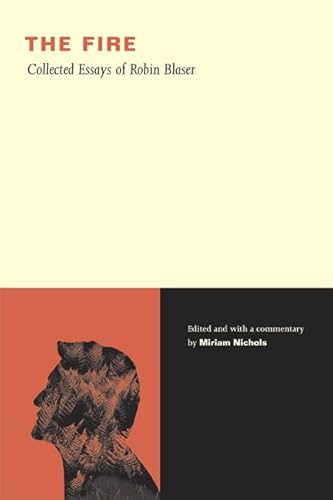
Spanning four decades of meditation on the avant-garde in poetry, art, and philosophy, the essays collected in The Fire reveal Robin Blaser's strikingly fresh perspective on "New American" poets, deconstructive philosophies, current events, and the state of humanities now. The essays, gathered in one volume for the first time, include commentaries on Jack Spicer, Charles Olson, Robert Duncan, Mary Butts, George Bowering, Louis Dudek, Christos Dikeakos, and J. S. Bach.
Blaser emerged from the "Berkeley Renaissance" of the 1940s and 1950s having studied under legendary medieval scholar Ernst Kantorowicz and having been a major participant in the burgeoning literary scene. His response to the cultural and political events of his time has been to construct a poetic voice that offers a singular perspective on a shareable world—and to pose that voice alongside others as a source of countermemory and potential agency. Conceived as conversations, these essays brilliantly reflect that ethos as they re-read the cultural events of the past fifty years.
Blaser emerged from the "Berkeley Renaissance" of the 1940s and 1950s having studied under legendary medieval scholar Ernst Kantorowicz and having been a major participant in the burgeoning literary scene. His response to the cultural and political events of his time has been to construct a poetic voice that offers a singular perspective on a shareable world—and to pose that voice alongside others as a source of countermemory and potential agency. Conceived as conversations, these essays brilliantly reflect that ethos as they re-read the cultural events of the past fifty years.
Die Inhaltsangabe kann sich auf eine andere Ausgabe dieses Titels beziehen.
Über die Autorin bzw. den Autor
Robin Blaser is Professor Emeritus at Simon Fraser University. Among his many books are The Holy Forest (UC Press), Pell Mell, and Syntax. Miriam Nichols is College Professor at University College of the Fraser Valley and editor of Even on Sunday: Essays, Readings, and Archival Materials on the Poetry and Poetics of Robin Blaser.
Von der hinteren Coverseite
"In his exquisite articulations of the flowers of associational thinking, Robin Blaser has turned knowledge into nowledge, the 'wild logos' of the cosmic companionship of the real."—Charles Bernstein, author of Republics of Reality: 1975-1995
"This is a landmark publication in American poetics."—Peter Gizzi, author of Some Values of Landscape and Weather
" Blaser is a fine poet and a superb representative of a tradition that is still undervalued. His work is very important."—Charles Altieri
"This is a landmark publication in American poetics."—Peter Gizzi, author of Some Values of Landscape and Weather
" Blaser is a fine poet and a superb representative of a tradition that is still undervalued. His work is very important."—Charles Altieri
Aus dem Klappentext
"In his exquisite articulations of the flowers of associational thinking, Robin Blaser has turned knowledge into nowledge, the 'wild logos' of the cosmic companionship of the real."Charles Bernstein, author ofRepublics of Reality: 1975-1995
"This is a landmark publication in American poetics."Peter Gizzi, author of Some Values of Landscape and Weather
" Blaser is a fine poet and a superb representative of a tradition that is still undervalued. His work is very important."Charles Altieri
"This is a landmark publication in American poetics."Peter Gizzi, author of Some Values of Landscape and Weather
" Blaser is a fine poet and a superb representative of a tradition that is still undervalued. His work is very important."Charles Altieri
Auszug. © Genehmigter Nachdruck. Alle Rechte vorbehalten.
The Fire
Collected Essays of Robin BlaserBy Robin BlaserUniversity of California Press
Copyright © 2006 Robin BlaserAll right reserved.
ISBN: 9780520245112
Chapter One
The Fireespecially for Ebbe Borregaard
I am here writing about my poetry in relation to poetry. The writing had an occasion: for a few in San Francisco, where I read it last March 8th [1967]. I want to talk about the personalism and the so-called obscurity of my poems in relation to the sight, sound, and intellect that compose them. "The test of poetry," in Zukofsky's words, "is the range of pleasure it affords as sight, sound, and intellection."
One difficulty I want to describe is that I'm haunted by a sense of the invisibility of everything that comes into me (aware that nothing is more invisible than emotion-by emotion, I mean the heat of one's sense of the war, or a place, or a body, or of the extensions of these, the earth, the existence of gods, and so forth-the I-have-seen-what-I-have-seen, recorded by Pound in "Canto II"). I believe there is a reality, which, given the leisure to live for it, is neither conceptual and systemized in the ordinary sense of these words-nor imageless. There are many times when, forced by exhaustion, I take the lazy way of the conceptual and imageless, but it is a kind of desire which leads me to write of that other, outside world. Because the personal stake in companionship becomes so great in the way I live, I am sometimes lost when a reader finds me uninteresting or too obscure, his interest too soon exhausted to come to any meeting. I am literal about that other reality. It is, I think, the purest storytelling to try to catch that light-and the difficulty of it, the loss of it, is personal. If I see the light, even fragmentarily, and lose it, that too is subject matter, and leads to a kind of heartless poem, for it is not the elegiac loss which interests me, but the difficulty, the activity, of holding on to it. Burning up myself, I would leave fire behind me.
To hold an image within the line by sound and heat is to have caught something that passed out there. The psychological accuracy of this perception is not enough; the sculptural imagistic quality is not enough; and the very aesthetic quality of taking the one image, or even three images as a whole, the beauty of the idea that you can write a single poem, is a lie. The processional aspect of the world has to be caught in the language also. The body hears the world, and the power of the earth over the body, the city over the body, is in terms of rhythms, meters, phrasing, picked up-the body's own rhythms compose those or it would shake to pieces.-The music of the spheres is quite real, but the sound of the earth must meet it. I suppose I want to say that the real business of poetry is cosmology, and I'm claiming my own stake in this. And this is the activity of telling the story-the necessity is chemical-it is not invented, but it is original, personal, singular, and even domestic. If one man gives up his life for the world, the energy of it is not symbolical: it is the story of one man tied to the heaven and hell he recognizes. No symbols.
My friend Stan Persky was reading to me one night when a passage turned up that is so much to my purpose, slightly re-worded, that I won't give the author credit: it is in that meeting entirely mine: "What we describe as imagination is no free play of the soul, but a real meeting with real elements that are outside of us, and what matters is not the surrender to the images of fantasy that appear, but to redeem those elements themselves. What we suppose we effect merely in our souls, in reality we effect on the destiny of the world."-Here, I wish to say that it is not language which is the source: it is the record of the meeting, and the magical structure of sight, sound, and intellect is indeed a personal responsibility. Language is given to us and in the most insidious way it controls sight, sound, and intellect, but it is also the medium which can be shaped.-Metaphor as a focus is an immediate escape from the ordinary focus, which rots for some reason I can't explain, and keeps me always from using the word we, though there is a kind of we that I hope to earn the right to use. But the poem offers a field of energy and activity-to be met by whatever companion can be found. If you imagine, as I do, that, at any waking moment, you are a corpuscle in the left wrist of god, then any reality is precisely to be found in the flow of corpuscles in that vast body.
In the constant interruption that it is to go to work every day, to talk in generalities of things that can only be known in specifics, this time guiding others through American writing, I'm struck by this thing called cosmology: Poe wanders off into a long prose piece, Eureka, which he calls a poem, and it is, drawing on all the contemporary science he can digest to record a cosmology; Emerson drops poetry and heads into poetically structured essays, wherein he can describe a cosmology; Thoreau drops poetry to write two strangely structured books, where, as in Walden, the detailed attention given to the seasons is cosmological; Melville goes about it backwards-in Moby-Dick, myths had to be reset so that they could say what they should say about origins, where he is, then later the poetry clanks along unable to hold on to what he wants; Whitman comes in with a new line, as open as he could make it; Henry Adams moves from the well-formed novel to the work on the great Virgin of the 13th century to tell in detail the story of a unified world; Pound puts it in the Cantos when he says the first thing was to break the iambic pentameter. It seems to me that the whole marvelous thing of open form is a traditional and an American problem-"hung up" on form because it was so difficult to open it. The whole thing came in a geography where the traditional forms would no longer hold our purposes. I was very moved when, some years ago, I was reading a scholarly book by Jo Miles in which she is making an argument for the sublime poem, which oddly has something to do with the public poem, and she begins to talk about the narrative of the spirit. I think the key word here is narrative-the story of persons, events, activities, images, which tell the tale of the spirit.
I'm interested in a particular kind of narrative-what Jack Spicer and I agreed to call in our own work the serial poem-this is a narrative which refuses to adopt an imposed story line, and completes itself only in the sequence of poems, if, in fact, a reader insists upon a definition of completion which is separate from the activity of the poems themselves. The poems tend to act as a sequence of energies which run out when so much of a tale is told. I like to describe this in Ovidian terms, as a carmen perpetuum, a continuous song in which the fragmented subject matter is only apparently disconnected. Ovid's words are:
to tell of bodies transformed into new shapes you gods, whose power worked all transformations, help the poet's breathing, lead my continuous song from the beginning to the present world In nova fert animus mutatas dicere formas corpora: di, coeptis (nam vos mutastis et illas) adspirate meis, primaque ab origine mundi ad meo perpetuum deducite tempora carmen!
The sequence of energies may involve all kinds of things-anger may open a window, a sound from another world may completely reshape the present moment, the destruction of a friendship may destroy a whole...
„Über diesen Titel“ kann sich auf eine andere Ausgabe dieses Titels beziehen.
Suchergebnisse für The Fire: Collected Essays of Robin Blaser

Beispielbild für diese ISBN
The Fire Collected Essays of Robin Blaser
Verlag:
University of California Press, c.2006,, 2006
ISBN 10: 0520245113
ISBN 13: 9780520245112
Gebraucht
paperback,
Anbieter: Harry Alter, Sylva, NC, USA
Verkäuferbewertung 5 von 5 Sternen

paperback, Zustand: Very Good, University of California Press, c.2006, 1st.trade paperbk.prtg., 516pp., VG $. Bestandsnummer des Verkäufers 106629
Gebraucht kaufen
EUR 48,72
EUR 3,40 Versand
Versand innerhalb von USA
Versand innerhalb von USA
Anzahl: 1 verfügbar
Beispielbild für diese ISBN
The Fire: Collected Essays of Robin Blaser
Verlag:
University of California Press, 2006
ISBN 10: 0520245113
ISBN 13: 9780520245112
Gebraucht
Soft cover
Erstausgabe
Anbieter: FITZ BOOKS AND WAFFLES, Buffalo, NY, USA
Verkäuferbewertung 5 von 5 Sternen
Soft cover. Zustand: Fine. 1st Edition. Literary Studies. First Printing. This is a clean, unmarked, undamaged copy. Bestandsnummer des Verkäufers ABE-1752347380197
Gebraucht kaufen
EUR 53,15
EUR 3,44 Versand
Versand innerhalb von USA
Versand innerhalb von USA
Anzahl: 1 verfügbar
Beispielbild für diese ISBN
The Fire: Collected Essays of Robin Blaser
Verlag:
University of California Press, Berkeley/London, 2006
ISBN 10: 0520245113
ISBN 13: 9780520245112
Gebraucht
Soft cover
Erstausgabe
Anbieter: Companion Books, Burnaby, BC, Kanada
Verkäuferbewertung 4 von 5 Sternen

Soft cover. Zustand: Very Good. 1st Edition. The book is in very good condition, little shelf rubbing apparent, text and images inside appear clean and clear throughout. 'Spanning four decades of meditation on the avant-garde in poetry, art, and philosophy, the essays collected in The Fire reveal Robin Blaser's strikingly fresh perspective on "New American" poets, deconstructive philosophies, current events, and the state of humanities now. The essays, gathered in one volume for the first time, include commentaries on Jack Spicer, Charles Olson, Robert Duncan, Mary Butts, George Bowering, Louis Dudek, Christos Dikeakos, and J. S. Bach. Blaser emerged from the "Berkeley Renaissance" of the 1940s and 1950s having studied under legendary medieval scholar Ernst Kantorowicz and having been a major participant in the burgeoning literary scene. His response to the cultural and political events of his time has been to construct a poetic voice that offers a singular perspective on a shareable world-and to pose that voice alongside others as a source of countermemory and potential agency. Conceived as conversations, these essays brilliantly reflect that ethos as they re-read the cultural events of the past fifty years.' xvii+516 pages. 6 x 9 inches. May require additional postage. Size: 8vo - over 7¾ - 9¾" tall. Book. Bestandsnummer des Verkäufers 051593
Gebraucht kaufen
EUR 53,10
EUR 11,57 Versand
Versand von Kanada nach USA
Versand von Kanada nach USA
Anzahl: 1 verfügbar
Beispielbild für diese ISBN
The Fire : Collected Essays
Verlag:
University of California Press, Berkeley, CA, 2006
ISBN 10: 0520245113
ISBN 13: 9780520245112
Gebraucht
Original Wraps
Erstausgabe
Signiert
Anbieter: Tony Power, Books, North Vancouver, BC, Kanada
Verkäuferbewertung 3 von 5 Sternen

Original Wraps. Zustand: Very Fine. First Softcover Edition (INSCRIBED). Very fine -- illus. wraps, title page INSCRIBED by author ('for [-] / with pleasure in our meeting / Robin Blaser'). 516 pp. Edited and with a commentary by Miriam Nichols. The simultaneous softcover. Inscribed & Signed by Author. Bestandsnummer des Verkäufers 008030
Gebraucht kaufen
EUR 84,15
EUR 20,85 Versand
Versand von Kanada nach USA
Versand von Kanada nach USA
Anzahl: 1 verfügbar
Beispielbild für diese ISBN
The Fire: Collected Essays of Robin Blaser
Verlag:
University of California Press, 2006
ISBN 10: 0520245113
ISBN 13: 9780520245112
Neu
Paperback
Anbieter: The Book Spot, Sioux Falls, MN, USA
Verkäuferbewertung 5 von 5 Sternen
Paperback. Zustand: New. Bestandsnummer des Verkäufers Abebooks119924