
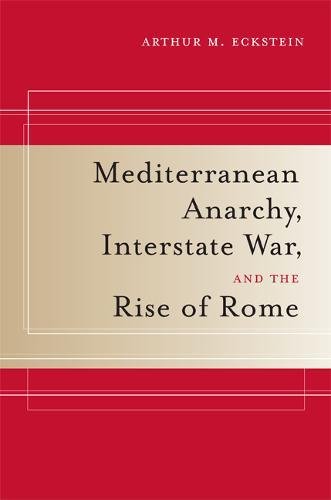
Mediterranean Anarchy, Interstate War, And the Rise of Rome (Hellenistic Culture & Society, 48, Band 48) - Hardcover
Inhaltsangabe
This ground-breaking study is the first to employ modern international relations theory to place Roman militarism and expansion of power within the broader Mediterranean context of interstate anarchy. Arthur M. Eckstein challenges claims that Rome was an exceptionally warlike and aggressive state—not merely in modern but in ancient terms—by arguing that intense militarism and aggressiveness were common among all Mediterranean polities from ca 750 B.C. onwards.
In his wide-ranging and masterful narrative, Eckstein explains that international politics in the ancient Mediterranean world was, in political science terms, a multipolar anarchy: international law was minimal, and states struggled desperately for power and survival by means of warfare. Eventually, one state, the Republic of Rome, managed to create predominance and a sort of peace. Rome was certainly a militarized and aggressive state, but it was successful not because it was exceptional in its ruthlessness, Eckstein convincingly argues; rather, it was successful because of its exceptional ability to manage a large network of foreign allies, and to assimilate numerous foreigners within the polity itself. This book shows how these characteristics, in turn, gave Rome incomparably large resources for the grim struggle of states fostered by the Mediterranean anarchy—and hence they were key to Rome's unprecedented success.
In his wide-ranging and masterful narrative, Eckstein explains that international politics in the ancient Mediterranean world was, in political science terms, a multipolar anarchy: international law was minimal, and states struggled desperately for power and survival by means of warfare. Eventually, one state, the Republic of Rome, managed to create predominance and a sort of peace. Rome was certainly a militarized and aggressive state, but it was successful not because it was exceptional in its ruthlessness, Eckstein convincingly argues; rather, it was successful because of its exceptional ability to manage a large network of foreign allies, and to assimilate numerous foreigners within the polity itself. This book shows how these characteristics, in turn, gave Rome incomparably large resources for the grim struggle of states fostered by the Mediterranean anarchy—and hence they were key to Rome's unprecedented success.
Die Inhaltsangabe kann sich auf eine andere Ausgabe dieses Titels beziehen.
Über die Autorin bzw. den Autor
Arthur M. Eckstein is Professor of History at the University of Maryland, College Park, and the author of Moral Vision in the Histories of Polybius and Senate and General: Individual Decision Making and Roman Foreign Relations, 264-194 B.C., both from UC Press.
Von der hinteren Coverseite
"A major contribution to the study of Roman imperialism and ancient international relations."—John Rich, University of Nottingham
Aus dem Klappentext
"A major contribution to the study of Roman imperialism and ancient international relations."John Rich, University of Nottingham
Auszug. © Genehmigter Nachdruck. Alle Rechte vorbehalten.
Mediterranean Anarchy, Interstate War, and the Rise of Rome
By Arthur M. EcksteinUniversity of California Press
Copyright © 2006 The Regents of the University of CaliforniaAll right reserved.
ISBN: 978-0-520-24618-8
Contents
Acknowledgments............................................................................................................ixAbbreviations..............................................................................................................xiMaps.......................................................................................................................xviii1. Political Science and Roman History.....................................................................................12. Realist Paradigms of Interstate Behavior................................................................................123. The Anarchic Structure of Interstate Relations in Classical Greece......................................................374. The Anarchic Structure of Interstate Relations in the Hellenistic Age...................................................795. Terrores Multi: The Rivals of Rome for Power in Italy and the Western Mediterranean.....................................1186. Rome and Roman Militarism within the Anarchic Interstate System.........................................................1817. Roman Exceptionalism and Nonexceptionalism..............................................................................244Appendix to Chapter 6: Roman Commanding Generals Killed in Battle with Foreign Enemies, 340s-140s B.C......................317Bibliography...............................................................................................................319Index......................................................................................................................343
Chapter One
Political Science and Roman History
International politics in the ancient Mediterranean world was long a multipolar anarchy-a world containing a plurality of powerful states, contending with each other for hegemony, within a situation where international law was minimal and in any case unenforceable. None of these powerful states ever achieved lasting hegemony around the shores of the great sea: not Persia, not Athens, not Sparta; not Tarentum, not Syracuse, not Carthage. Alexander III the Great, the fearsome king of Macedon, might have established a permanent political entity encompassing the entire Mediterranean, but the conqueror of Asia died prematurely in Babylon in 323 B.C., at age 32, and the empire he had created almost immediately fell apart. During the chaos that followed Alexander's death, several of his generals founded great territorial states themselves, Macedonian dynasties with worldwide ambitions, each in bitter competition for power with the others: the Ptolemaic regime based in Egypt; the Seleucids based in Syria and Mesopotamia; the Antigonids based in Macedon. But despite the brilliance, vigor, and ruthlessness of the founders-and the brilliance, vigor, and ruthlessness of some of their successors-none of these monarchies was ever able to establish universal domination. The world of multipolarity and unstable balances of power continued in the Mediterranean-along with the prevalence of war and the absence of international law.
Eventually, however, one state did create predominance throughout the Mediterranean world: the Republic of Rome. By the 180s B.C., although there still remained in existence several important states other than Rome, the Mediterranean finally had only one political and military focus, and only one dominant actor; there was a preponderance of power in the hands of a single state. In political-science terminology, a system of unipolarity had replaced the long-standing multipolar anarchy. Samuel Huntington sets higher standards of dominance for the presence of a unipolar situation, defining unipolarity as a system where there is "one superpower, no significant major powers, and many minor powers," in which the dominant power has the capability to "resolve important international issues alone," and where no combination of other states has the power to prevent it from doing so. Even by this stricter definition the Mediterranean was beginning to approach that situation by the 180s, and had definitely achieved it by the 160s. It should be emphasized that although Rome in this period had begun direct administration of some areas in the West (Sicily; Sardinia and Corsica; the eastern regions of Spain), it was still far from converting this new international situation into anything like a formal empire on a Mediterranean-wide basis. There was, even in the 160s, not the slightest direct and formal Roman administration in the Greek East. But in political-science terminology the Mediterranean had now become a unipolar system instead of a multipolar world; and so it would remain for the next six hundred years.
The central questions with which modern historians of Rome contend in the period of enormous expansion in Roman power and influence from the 340s B.C. have been (1) the motivations behind Roman expansion, and (2) the reasons for Roman hegemonic success. Clearly Roman motives were complex, and the reasons for the exceptional success of the Republic were similarly multiple. The analytical situation is made much more difficult because our knowledge of events is far from complete. One theme, however, has come to dominate modern scholarship on this problem: that Rome was exceptionally successful within its world because Roman society and culture, and Rome's stance toward other states, were exceptionally warlike, exceptionally aggressive, and exceptionally violent-and not merely in modern terms but in ancient terms as well. The most influential work here is that of W.V. Harris, especially in his brilliant and groundbreaking book War and Imperialism in Republican Rome. On this model, Rome was a vicious and voracious predator, in political-science terminology a "revolutionary" or "unlimited revisionist state" in the successive and ever larger state-systems in which it participated; the other Italian states and then the other Mediterranean states were its victims. On such a model, the rise to world power of exceptionally militaristic and bellicose Rome is self-explanatory.
The present study takes a different approach. It applies to other ancient states the insights and method of analysis pioneered by Harris concerning Rome. It finds militarism, bellicosity, and diplomatic aggressiveness rife throughout the polities of the ancient Mediterranean both east and west. And it argues that while Rome was certainly a harshly militaristic, warlike, aggressive, and expansionist state from a modern perspective, so too were all Rome's competitors, in an environment that was an exceptionally cruel interstate anarchy. Moreover, the present study finds the origins of the harsh characteristics of state and culture now shown to be not just Roman but common to all the ancient Mediterranean great powers, all the second-rank powers, and even many minor states as well, not so much within the specific pathological development of each state (what the political scientists call "unit-attribute" theory), but rather proposes that these characteristics were caused primarily (though not solely) by the severe pressures on all states deriving from the harsh nature of the interstate world in which they were forced to exist.
In other words: the cruel characteristics of the interstate system exerted significant pressures, over time, both upon the internal cultures and upon the...
„Über diesen Titel“ kann sich auf eine andere Ausgabe dieses Titels beziehen.
Weitere beliebte Ausgaben desselben Titels

Suchergebnisse für Mediterranean Anarchy, Interstate War, And the Rise...

Beispielbild für diese ISBN
Mediterranean Anarchy, Interstate War, and the Rise of Rome
Verlag:
University of California Press, 2007
ISBN 10: 0520246187
ISBN 13: 9780520246188
Gebraucht
Hardcover
Anbieter: Better World Books Ltd, Dunfermline, Vereinigtes Königreich
Verkäuferbewertung 5 von 5 Sternen

Zustand: Good. Former library copy. Pages intact with minimal writing/highlighting. The binding may be loose and creased. Dust jackets/supplements are not included. Includes library markings. Stock photo provided. Product includes identifying sticker. Better World Books: Buy Books. Do Good. Bestandsnummer des Verkäufers 14280545-20
Gebraucht kaufen
EUR 56,52
EUR 5,78 Versand
Versand von Vereinigtes Königreich nach USA
Versand von Vereinigtes Königreich nach USA
Anzahl: 1 verfügbar