
Verwandte Artikel zu Why Geology Matters: Decoding the Past, Anticipating...
Inhaltsangabe
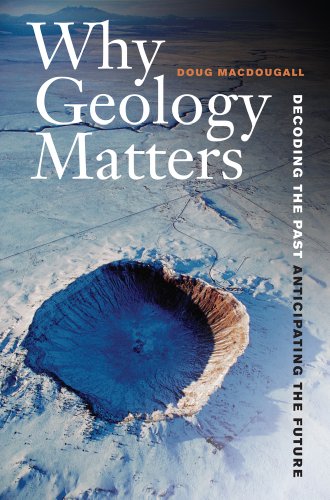
Volcanic dust, climate change, tsunamis, earthquakes—geoscience explores phenomena that profoundly affect our lives. But more than that, as Doug Macdougall makes clear, the science also provides important clues to the future of the planet. In an entertaining and accessibly written narrative, Macdougall gives an overview of Earth’s astonishing history based on information extracted from rocks, ice cores, and other natural archives. He explores such questions as: What is the risk of an asteroid striking Earth? Why does the temperature of the ocean millions of years ago matter today? How are efforts to predict earthquakes progressing? Macdougall also explains the legacy of greenhouse gases from Earth’s past and shows how that legacy shapes our understanding of today’s human-caused climate change. We find that geoscience in fact illuminates many of today’s most pressing issues—the availability of energy, access to fresh water, sustainable agriculture, maintaining biodiversity—and we discover how, by applying new technologies and ideas, we can use it to prepare for the future.
Die Inhaltsangabe kann sich auf eine andere Ausgabe dieses Titels beziehen.
Über die Autorin bzw. den Autor
Doug Macdougall is Professor Emeritus of Earth Sciences at Scripps Institution of Oceanography, University of California, San Diego. He is the author of Nature’s Clocks: How Scientists Measure the Age of Almost Everything; Frozen Earth: The Once and Future Story of Ice Ages (both from UC Press); and A Short History of Planet Earth.
Von der hinteren Coverseite
“Macdougall does a masterful job of exploring the questions, dilemmas, and insights that have led to today’s scientific understanding of the composition of our planet. His approach is not “rocks on a shelf” science; it’s a compelling, interdisciplinary peek at Earth’s prehistory—including those processes that support so much of modern civilization.”-Ernest Zebrowski, author of Global Climate Change and Category 5: The Story of Camille
“The story of Earth is told in such geologic forms as rock strata, volcanic eruptions, meteor craters, fossils, ocean currents, and ice flows. Macdougall gives these disparate elements voice and puts them into a perspective that emphasizes why Earth science is important in our understanding of both the planet’s history and our role in its tomorrow.”-Jeff Kanipe, author of The Cosmic Connection: How Astronomical Events Impact Life on Earth
“The story of Earth is told in such geologic forms as rock strata, volcanic eruptions, meteor craters, fossils, ocean currents, and ice flows. Macdougall gives these disparate elements voice and puts them into a perspective that emphasizes why Earth science is important in our understanding of both the planet’s history and our role in its tomorrow.”-Jeff Kanipe, author of The Cosmic Connection: How Astronomical Events Impact Life on Earth
Aus dem Klappentext
Macdougall does a masterful job of exploring the questions, dilemmas, and insights that have led to today s scientific understanding of the composition of our planet. His approach is not rocks on a shelf science; it s a compelling, interdisciplinary peek at Earth s prehistoryincluding those processes that support so much of modern civilization. -Ernest Zebrowski, author ofGlobal Climate Change and Category 5: The Story of Camille
The story of Earth is told in such geologic forms as rock strata, volcanic eruptions, meteor craters, fossils, ocean currents, and ice flows. Macdougall gives these disparate elements voice and puts them into a perspective that emphasizes why Earth science is important in our understanding of both the planet s history and our role in its tomorrow. -Jeff Kanipe, author ofThe Cosmic Connection: How Astronomical Events Impact Life on Earth
The story of Earth is told in such geologic forms as rock strata, volcanic eruptions, meteor craters, fossils, ocean currents, and ice flows. Macdougall gives these disparate elements voice and puts them into a perspective that emphasizes why Earth science is important in our understanding of both the planet s history and our role in its tomorrow. -Jeff Kanipe, author ofThe Cosmic Connection: How Astronomical Events Impact Life on Earth
Auszug. © Genehmigter Nachdruck. Alle Rechte vorbehalten.
Why Geology Matters
Decoding the Past, Anticipating the Future
By Doug MacdougallUNIVERSITY OF CALIFORNIA PRESS
Copyright © 2011 The Regents of the University of California
All rights reserved.
ISBN: 978-0-520-26642-1All rights reserved.
Contents
List of Illustrations, ix,
Preface, xi,
Acknowledgments, xv,
1. Set in Stone, 1,
2. Building Our Planet, 21,
3. Close Encounters, 35,
4. The First Two Billion Years, 63,
5. Wandering Plates, 81,
6. Shaky Foundations, 101,
7. Mountains, Life, and the Big Chill, 126,
8. Cold Times, 147,
9. The Great Warming, 168,
10. Reading LIPs, 188,
11. Restless Giants, 206,
12. Swimming, Crawling, and Flying toward the Present, 225,
13. Why Geology Matters, 249,
Bibliography and Further Reading, 269,
Index, 279,
CHAPTER 1
Set in Stone
In 1969, when I was a student in California, there was a rash of predictions from astrologers, clairvoyants, and evangelists that there would be a devastating earthquake and the entire state—or at least a large part of it—would fall into the ocean. The seers claimed this would happen during April, although they were not in agreement about the precise date. A few people took the news very seriously, sold their houses, and moved elsewhere. Others, a bit less cautious, simply sought out high ground on April 4, the date of the Big One according to several of the predictors. Cartoonists and newspaper columnists had a field day poking fun at the earthquake scare, and for us geology students the hubbub was amusing but also seemed a bit bizarre. Police and fire stations, along with university geology departments, got thousands of anxious telephone calls from nervous citizens. Ronald Reagan, then the state's governor, had to explain that his out-of-state vacation that month had been planned long in advance and had nothing to do with earthquakes. The mayor of San Francisco planned an anti-earthquake party for April 18, the sixty-third anniversary of the great 1906 San Francisco earthquake. He assured the public that it would be held on dry ground.
California didn't fall into the sea in 1969, of course, nor was there a huge earthquake (although there were earthquakes, as there are every year, most of them quite small). Astrologers can't predict earthquakes (or much else). Even earth scientists, with the best geological information and most up-to-date instrumentation, find precise earthquake prediction elusive, as we will see later in this book. However, the prognosis is much better for many other geological phenomena. And at the core of this geological prediction lies the kind of work geologists have traditionally done: decoding the past.
But how, exactly, do they do that? Where do earth scientists look to find clues to the details of our planet's history, and how do they interpret them? Those questions are at the heart of this book, and the answers are hinted at in the title of this chapter: the clues are found, for the most part, in the stones at the Earth's surface. (There are also many other natural archives of Earth history, such as tree rings and Antarctic ice. Ice cores in particular provide invaluable information about past climates. But these other records tell us only about the relatively recent geological past. Rocks allow us to probe back billions of years.)
To the uninitiated a rock is just a rock, a hard, inanimate object to kick down the road or throw into a pond. Look a little closer and ask the right questions, however, and it becomes more—sometimes much more. Every single rock on the Earth's surface has a story to tell. How did the rock form? When did it form? What is it made of? What is its history? How did it get here, and where did it come from? Why is this kind of rock common in one region and not in another? For a long time in the predominantly Christian countries of the West, answers to questions like these were constrained by religion. The biblical flood was thought to have been especially important in shaping the present-day landscape, and explanations for many geological features had to be built around the presumed reality of this event. However, as the ideas of the Enlightenment took hold during the seventeenth and eighteenth centuries, and as close observation of the natural world became ever more crucial for those seeking to understand the Earth, the sway of religion diminished and more rational explanations began to emerge. For geology especially, a field with its roots in the search for and extraction of mineral resources from the Earth, the pressure of commerce was also important. Those with the best understanding of how gold veins formed, or with the best knowledge of the kinds of geological settings likely to contain such veins, had the best chance of finding the next gold mine.
I will not dwell at length here on the history of geology's development as a science, or on the details of how early geological ideas evolved; these things have been dealt with in many other books. But it is worth pointing out a few key early concepts that revolutionized the way everyone—not just scientists—thought about our planet. Most of these intellectual breakthroughs arose in Europe (especially in Britain) in the eighteenth and early nineteenth centuries, and although there had been independent thinkers in the Middle East and elsewhere who had arrived at similar conclusions much earlier, the European versions would form the bedrock(!) of the emerging field of earth science.
What were these ideas and how did they come about? Without exception they stemmed from examination of rock outcroppings in the field together with observations of ongoing geological processes. One of the new concepts was that different rock types have quite different origins, something that seems obvious enough to us today. But in the eighteenth century a popular concept was that all rocks were formed by precipitation, either from a primordial global ocean or from the waters of the biblical flood. Those who championed this idea were dubbed—for obvious reasons—Neptunists, and they did not give up their theory easily. However, observations like those of Scottish geologist James Hutton, who described outcrops showing clear evidence that some rocks had once been molten, eventually turned the tables. The rock outcrops told Hutton a vivid story: flowing liquid material, now solid rock, had intruded into, and disrupted and heated up, preexisting rock strata. Hutton's descriptions of these once-molten rocks—not to mention the presence of active volcanoes like Vesuvius and Etna in southern Europe—led to the realization that there must be reservoirs of great heat in the planet's interior.
A second important early concept was that slow, inexorable geological processes that can readily be observed (rainwater dissolving rocks, rivers cutting valleys, sedimentary particles settling to the seafloor) follow the laws of physics and chemistry. Once again this seems an obvious conclusion in hindsight, but its implication—this was the revolutionary part for early geologists—was that geological processes in the distant past must have followed these very same laws. This meant that the physical and chemical characteristics of ancient rocks could be interpreted by observing present-day processes. Charles Lyell, the foremost British geologist of his day, promoted this idea as a way of understanding the Earth's history in his best-selling book Principles of Geology, first published in 1830. (The book was so popular it...
„Über diesen Titel“ kann sich auf eine andere Ausgabe dieses Titels beziehen.
Suchergebnisse für Why Geology Matters: Decoding the Past, Anticipating...

Beispielbild für diese ISBN
Why Geology Matters : Decoding the Past, Anticipating the Future
Verlag:
University of California Press, 2011
ISBN 10: 0520266420
ISBN 13: 9780520266421
Gebraucht
Hardcover
Erstausgabe
Anbieter: Better World Books, Mishawaka, IN, USA
Verkäuferbewertung 5 von 5 Sternen

Zustand: Good. 1st Edition. Former library copy. Pages intact with minimal writing/highlighting. The binding may be loose and creased. Dust jackets/supplements are not included. Includes library markings. Stock photo provided. Product includes identifying sticker. Better World Books: Buy Books. Do Good. Bestandsnummer des Verkäufers 611817-75
Gebraucht kaufen
EUR 9,82
Versand gratis
Versand innerhalb von USA
Versand innerhalb von USA
Anzahl: 1 verfügbar
Beispielbild für diese ISBN
Why Geology Matters: Decoding the Past, Anticipating the Future
Verlag:
University of California Press, 2011
ISBN 10: 0520266420
ISBN 13: 9780520266421
Gebraucht
Hardcover
Anbieter: ThriftBooks-Atlanta, AUSTELL, GA, USA
Verkäuferbewertung 5 von 5 Sternen
Hardcover. Zustand: Fair. No Jacket. Readable copy. Pages may have considerable notes/highlighting. ~ ThriftBooks: Read More, Spend Less. Bestandsnummer des Verkäufers G0520266420I5N00
Gebraucht kaufen
EUR 11,87
Versand gratis
Versand innerhalb von USA
Versand innerhalb von USA
Anzahl: 1 verfügbar
Beispielbild für diese ISBN
Why Geology Matters: Decoding the Past, Anticipating the Future
Verlag:
University of California Press, 2011
ISBN 10: 0520266420
ISBN 13: 9780520266421
Gebraucht
Hardcover
Anbieter: ThriftBooks-Dallas, Dallas, TX, USA
Verkäuferbewertung 5 von 5 Sternen
Hardcover. Zustand: Very Good. No Jacket. Former library book; May have limited writing in cover pages. Pages are unmarked. ~ ThriftBooks: Read More, Spend Less. Bestandsnummer des Verkäufers G0520266420I4N10
Gebraucht kaufen
EUR 11,87
Versand gratis
Versand innerhalb von USA
Versand innerhalb von USA
Anzahl: 1 verfügbar
Beispielbild für diese ISBN
Why Geology Matters: Decoding the Past, Anticipating the Future
Verlag:
University of California Press, 2011
ISBN 10: 0520266420
ISBN 13: 9780520266421
Gebraucht
Hardcover
Anbieter: Books-R-Keen, DuBois, PA, USA
Verkäuferbewertung 4 von 5 Sternen

hardcover. Zustand: Good. Used items may contain, highlighting, writing, and other previous signs of use. Used items may not contain CD's. access codes and other accompanying items when applicable. Bestandsnummer des Verkäufers 52E49798
Gebraucht kaufen
EUR 21,48
EUR 3,55 Versand
Versand innerhalb von USA
Versand innerhalb von USA
Anzahl: 1 verfügbar
Beispielbild für diese ISBN
Why Geology Matters; Decoding the Past, Anticipating the Future
Verlag:
University of California Press, 2011
ISBN 10: 0520266420
ISBN 13: 9780520266421
Gebraucht
Hardcover
Anbieter: Skoob-ebooks, Pontiac, QC, Kanada
Verkäuferbewertung 5 von 5 Sternen
Hardcover. Zustand: Very Good. Zustand des Schutzumschlags: Very Good-. Minor wear only. The pages are clean and crisp with no highlighting or writing detected. The DJ has little shelf wear with edges mostly straight and crisp. Satisfaction guaranteed with 30-day returns. Ships from Canada.; 6 X 1 X 9 inches; 285 pages; R0 2.8m/2.8m s0. Bestandsnummer des Verkäufers 15270
Gebraucht kaufen
EUR 25,62
EUR 11,54 Versand
Versand von Kanada nach USA
Versand von Kanada nach USA
Anzahl: 1 verfügbar
Beispielbild für diese ISBN
Why Geology Matters: Decoding the Past, Anticipating the Future
Verlag:
University of California Press, 2011
ISBN 10: 0520266420
ISBN 13: 9780520266421
Gebraucht
Hardcover
Anbieter: YESIBOOKSTORE, MIAMI, FL, USA
Verkäuferbewertung 5 von 5 Sternen
hardcover. Zustand: As New. Bestandsnummer des Verkäufers 0520266420-VB
Gebraucht kaufen
EUR 53,01
Versand gratis
Versand innerhalb von USA
Versand innerhalb von USA
Anzahl: 1 verfügbar
Beispielbild für diese ISBN
Why Geology Matters: Decoding the Past, Anticipating the Future
Verlag:
University of California Press, Berkeley, 2011
ISBN 10: 0520266420
ISBN 13: 9780520266421
Gebraucht
Hardcover
Anbieter: Edmonton Book Store, Edmonton, AB, Kanada
Verkäuferbewertung 4 von 5 Sternen
Zustand: very good. Zustand des Schutzumschlags: very good. 8vo pp.285. book. Bestandsnummer des Verkäufers 318029
Gebraucht kaufen
EUR 15,56
EUR 50,65 Versand
Versand von Kanada nach USA
Versand von Kanada nach USA
Anzahl: 1 verfügbar