
Verwandte Artikel zu The Gothic Enterprise: A Guide to Understanding the...
Inhaltsangabe
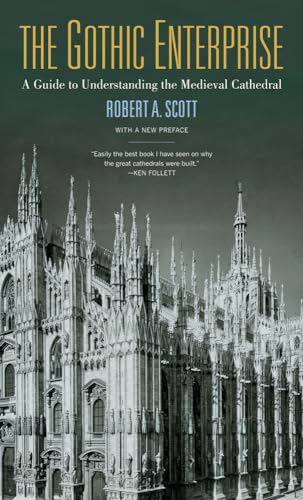
The great Gothic cathedrals of Europe are among the most astonishing achievements of Western culture. Evoking feelings of awe and humility, they make us want to understand what inspired the people who had the audacity to build them. This engrossing book surveys an era that has fired the historical imagination for centuries. In it Robert A. Scott explores why medieval people built Gothic cathedrals, how they built them, what conception of the divine lay behind their creation, and how religious and secular leaders used cathedrals for social and political purposes. As a traveler’s companion or a rich source of knowledge for the armchair enthusiast, The Gothic Enterprise helps us understand how ordinary people managed such tremendous feats of physical and creative energy at a time when technology was rudimentary, famine and disease were rampant, the climate was often harsh, and communal life was unstable and incessantly violent.
While most books about Gothic cathedrals focus on a particular building or on the cathedrals of a specific region, The Gothic Enterprise considers the idea of the cathedral as a humanly created space. Scott discusses why an impoverished people would commit so many social and personal resources to building something so physically stupendous and what this says about their ideas of the sacred, especially the vital role they ascribed to the divine as a protector against the dangers of everyday life.
Scott’s narrative offers a wealth of fascinating details concerning daily life during medieval times. The author describes the difficulties master-builders faced in scheduling construction that wouldn’t be completed during their own lifetimes, how they managed without adequate numeric systems or paper on which to make detailed drawings, and how climate, natural disasters, wars, variations in the hours of daylight throughout the year, and the celebration of holy days affected the pace and timing of work. Scott also explains such things as the role of relics, the quarrying and transporting of stone, and the incessant conflict cathedral-building projects caused within their communities. Finally, by drawing comparisons between Gothic cathedrals and other monumental building projects, such as Stonehenge, Scott expands our understanding of the human impulses that shape our landscape.
While most books about Gothic cathedrals focus on a particular building or on the cathedrals of a specific region, The Gothic Enterprise considers the idea of the cathedral as a humanly created space. Scott discusses why an impoverished people would commit so many social and personal resources to building something so physically stupendous and what this says about their ideas of the sacred, especially the vital role they ascribed to the divine as a protector against the dangers of everyday life.
Scott’s narrative offers a wealth of fascinating details concerning daily life during medieval times. The author describes the difficulties master-builders faced in scheduling construction that wouldn’t be completed during their own lifetimes, how they managed without adequate numeric systems or paper on which to make detailed drawings, and how climate, natural disasters, wars, variations in the hours of daylight throughout the year, and the celebration of holy days affected the pace and timing of work. Scott also explains such things as the role of relics, the quarrying and transporting of stone, and the incessant conflict cathedral-building projects caused within their communities. Finally, by drawing comparisons between Gothic cathedrals and other monumental building projects, such as Stonehenge, Scott expands our understanding of the human impulses that shape our landscape.
Die Inhaltsangabe kann sich auf eine andere Ausgabe dieses Titels beziehen.
Über die Autorin bzw. den Autor
Robert A. Scott is Associate Director Emeritus of the Center for Advanced Study in the Behavioral Sciences at Stanford University, and was previously Professor of Sociology at Princeton University for 18 years. He is the coauthor of Why Sociology Does Not Apply (1979); author of Making of Blind Men (1969); editor of several collections of essays about stigma, deviancy, and social control; and author of numerous articles, book chapters, and essays on related topics.
Von der hinteren Coverseite
"This is easily the best book I have seen on why the great cathedrals were built. The breadth of Scott’s scholarship is astonishing. As well as art history and architecture, he brings to bear his knowledge of subjects as wide apart as engineering, the sociology of religion, and the medieval economy. Only a handful of books truly throw light on the mystery of the cathedrals, and this is one of them."—Ken Follett, author of Pillars of the Earth
"Written in a lucid style and illustrated by dozens of sketches and photographs, this interdisciplinary survey is the best introduction to its subject now in print."—Gene Brucker, author of Florence: The Golden Age, 1138–1737
"Scott has given us a book of wonderful breadth and erudition with a refreshingly light touch. He describes vividly the social, political, and religious background to the great flowering of the Gothic cathedrals of Europe in the thirteenth and fourteenth centuries, and the strange mixture of motives that drove this astonishing building program. He is equally interested in the hard practical mechanics of hewing timber, erecting scaffolding, quarrying stone, transporting and hauling these materials as he is in the religious and liturgical symbolisms and conceptual schemes of the architects and their royal paymasters. Gothic cathedrals are astounding monuments to the aspirations of the human spirit reaching out to the divine, and this is a splendid introduction to the medieval worlds that produced them, written by an enthusiastic guide who really knows his subject and loves it."—Hugh Dickinson, Dean Emeritus of Salisbury Cathedral
"Gothic architecture is notoriously difficult to represent verbally, but in Scott’s book the joy so many people find in discovering these breathtakingly beautiful monuments is palpable."—Stephen Murray, author of Notre Dame, Cathedral of Amiens: The Power of Change in Gothic
"In this splendid book Scott writes precisely, clearly, and with a love for both words and his readers. Those who read these pages will come away enlightened, inspired, and with a more profound grasp of our civilization."—Neil J. Smelser, University Professor of Sociology, Emeritus, University of California, Berkeley
"Written in a lucid style and illustrated by dozens of sketches and photographs, this interdisciplinary survey is the best introduction to its subject now in print."—Gene Brucker, author of Florence: The Golden Age, 1138–1737
"Scott has given us a book of wonderful breadth and erudition with a refreshingly light touch. He describes vividly the social, political, and religious background to the great flowering of the Gothic cathedrals of Europe in the thirteenth and fourteenth centuries, and the strange mixture of motives that drove this astonishing building program. He is equally interested in the hard practical mechanics of hewing timber, erecting scaffolding, quarrying stone, transporting and hauling these materials as he is in the religious and liturgical symbolisms and conceptual schemes of the architects and their royal paymasters. Gothic cathedrals are astounding monuments to the aspirations of the human spirit reaching out to the divine, and this is a splendid introduction to the medieval worlds that produced them, written by an enthusiastic guide who really knows his subject and loves it."—Hugh Dickinson, Dean Emeritus of Salisbury Cathedral
"Gothic architecture is notoriously difficult to represent verbally, but in Scott’s book the joy so many people find in discovering these breathtakingly beautiful monuments is palpable."—Stephen Murray, author of Notre Dame, Cathedral of Amiens: The Power of Change in Gothic
"In this splendid book Scott writes precisely, clearly, and with a love for both words and his readers. Those who read these pages will come away enlightened, inspired, and with a more profound grasp of our civilization."—Neil J. Smelser, University Professor of Sociology, Emeritus, University of California, Berkeley
Aus dem Klappentext
"This is easily the best book I have seen on why the great cathedrals were built. The breadth of Scott s scholarship is astonishing. As well as art history and architecture, he brings to bear his knowledge of subjects as wide apart as engineering, the sociology of religion, and the medieval economy. Only a handful of books truly throw light on the mystery of the cathedrals, and this is one of them." Ken Follett, author of Pillars of the Earth
"Written in a lucid style and illustrated by dozens of sketches and photographs, this interdisciplinary survey is the best introduction to its subject now in print." Gene Brucker, author of Florence: The Golden Age, 1138 1737
"Scott has given us a book of wonderful breadth and erudition with a refreshingly light touch. He describes vividly the social, political, and religious background to the great flowering of the Gothic cathedrals of Europe in the thirteenth and fourteenth centuries, and the strange mixture of motives that drove this astonishing building program. He is equally interested in the hard practical mechanics of hewing timber, erecting scaffolding, quarrying stone, transporting and hauling these materials as he is in the religious and liturgical symbolisms and conceptual schemes of the architects and their royal paymasters. Gothic cathedrals are astounding monuments to the aspirations of the human spirit reaching out to the divine, and this is a splendid introduction to the medieval worlds that produced them, written by an enthusiastic guide who really knows his subject and loves it." Hugh Dickinson, Dean Emeritus of Salisbury Cathedral
"Gothic architecture is notoriously difficult to represent verbally, but in Scott s book the joy so many people find in discovering these breathtakingly beautiful monuments is palpable." Stephen Murray, author of Notre Dame, Cathedral of Amiens: The Power of Change in Gothic
"In this splendid book Scott writes precisely, clearly, and with a love for both words and his readers. Those who read these pages will come away enlightened, inspired, and with a more profound grasp of our civilization." Neil J. Smelser, University Professor of Sociology, Emeritus, University of California, Berkeley
"Written in a lucid style and illustrated by dozens of sketches and photographs, this interdisciplinary survey is the best introduction to its subject now in print." Gene Brucker, author of Florence: The Golden Age, 1138 1737
"Scott has given us a book of wonderful breadth and erudition with a refreshingly light touch. He describes vividly the social, political, and religious background to the great flowering of the Gothic cathedrals of Europe in the thirteenth and fourteenth centuries, and the strange mixture of motives that drove this astonishing building program. He is equally interested in the hard practical mechanics of hewing timber, erecting scaffolding, quarrying stone, transporting and hauling these materials as he is in the religious and liturgical symbolisms and conceptual schemes of the architects and their royal paymasters. Gothic cathedrals are astounding monuments to the aspirations of the human spirit reaching out to the divine, and this is a splendid introduction to the medieval worlds that produced them, written by an enthusiastic guide who really knows his subject and loves it." Hugh Dickinson, Dean Emeritus of Salisbury Cathedral
"Gothic architecture is notoriously difficult to represent verbally, but in Scott s book the joy so many people find in discovering these breathtakingly beautiful monuments is palpable." Stephen Murray, author of Notre Dame, Cathedral of Amiens: The Power of Change in Gothic
"In this splendid book Scott writes precisely, clearly, and with a love for both words and his readers. Those who read these pages will come away enlightened, inspired, and with a more profound grasp of our civilization." Neil J. Smelser, University Professor of Sociology, Emeritus, University of California, Berkeley
Auszug. © Genehmigter Nachdruck. Alle Rechte vorbehalten.
The Gothic Enterprise
A Guide to Understanding the Medieval Cathedral
By Robert A. ScottUNIVERSITY OF CALIFORNIA PRESS
Copyright © 2011 The Regents of the University of California
All rights reserved.
ISBN: 978-0-520-26999-6All rights reserved.
Contents
Preface to the 2011 Edition, ix,
Acknowledgments, xvii,
Introduction: A Personal Journey, 1,
PART I: A GRAND UNDERTAKING,
1 What Is the Gothic Enterprise?, 11,
2 How Were the Cathedrals Built?, 17,
PART II: HISTORY,
3 Kings, Feudal Lords, and Great Monasteries, 47,
4 The Age of Cathedral-Building, 65,
5 The Initial Vision, 76,
6 "The Cathedral Crusade", 91,
PART III: THE GOTHIC LOOK,
7 What Is the Gothic Look?, 103,
8 An Image of Heaven, 121,
9 A Pragmatic View of Cathedral-Building, 134,
PART IV: THE RELIGIOUS EXPERIENCE,
10 Sacred Force and Sacred Space, 147,
11 Imagining the Cathedral, 171,
12 Honoring the Dead, 183,
PART V: THE GOTHIC COMMUNITY,
13 Medieval Living Conditions, 211,
14 The Spiritual Brokers—Priests and Monarchs, 219,
15 Cathedrals and Community, 233,
Conclusion: Learning from Stonehenge, 237,
Appendix: Terminology, 251,
Notes, 255,
Bibliography, 269,
List of Illustrations and Credits, 281,
Index, 285,
CHAPTER 1
What Is the Gothic Enterprise?
The movement I call the Gothic enterprise began in the first half of the twelfth century in the Greater Paris Basin. In fits and starts, it continued for the next four hundred years throughout Europe. By the mid-fifteenth century Gothic cathedrals could be found from Scandinavia in the north to the Iberian Peninsula in the south, and from Wales in the west to the far reaches of Central Europe in the east. I know of no comprehensive list of medieval Gothic cathedrals, but the total would surely be in the hundreds. In addition, thousands of abbey churches were built during this period (more than five hundred just in France), plus tens of thousands of small parish churches. One authority, Jean Gimpel, estimates that between 1050 and 1350, more stone was cut in France alone than at any period in the entire history of Egypt. Gimpel also reckons that there was one church for every 200 inhabitants of France and England, and that the English cities of Norwich, Lincoln, and York, with populations in the range of 5,000 to 10,000, each had forty to fifty churches. Another authority, Richard Morris, estimates that of the nearly 19,000 ecclesiastical buildings in existence in England and Wales today, nearly half date to the medieval period. Imagine all the quarrying, carving, and laying of stone, the harvesting of timber, the mining of lead, and the assembling of other materials required to build these structures. This was clearly the greatest, most sustained ecclesiastical building campaign in the history of Christendom.
The earliest Gothic great church was the Abbey Church of St. Denis, located seven miles north of Paris. Under the direction of St. Denis's famous and influential Abbot Suger, work on erecting a Gothic-style west front began in 1137, quickly followed by the renovation of its choir to the new style in 1141. Though St. Denis was not a cathedral (see box), the work there appears to have stimulated renovation to the new Gothic style of a large number of Romanesque cathedrals in the surrounding Greater Paris Basin (see Map 1). These included the cathedral churches at Sens (1140s), Senlis (1151), Reims (1150s), Laon (1160), Noyon (1160), Notre Dame of Paris (1160), Chartres (1194), Amiens (1220), Troyes (1220), and Beauvais (1226), to name just a few.
The Greater Paris Basin proved fertile ground for Gothic cathedral-building for good reason. Unlike other regions of France, such as Flanders, Burgundy, and Champagne, where powerful counts supported the construction of monasteries and cathedrals, the vicinity of Paris had seen precious little church-building during the previous century because of the general weakness and financial impoverishment of the monarchy. But once the monarchy began to gain strength (see Chapter 5), the absence of a recent regional style, combined with the fact that most abbeys and cathedrals in the Greater Paris Basin were old and in disrepair, created an opportunity for wholesale renewal of churches that could not have arisen elsewhere.
The new style of the west front and choir of St. Denis was not an abrupt departure from the earlier style; rather, it involved a liberal borrowing of the most advanced features of the Romanesque great churches that were being built in adjacent provinces of northern France. But even if none of its constituent elements was novel, the elements were employed and coordinated in fresh ways. The renovation of St. Denis in turn jump-started great-church-building campaigns throughout northern France and elsewhere, although considerable time elapsed before the Gothic style emerged as predominant. Moreover, what appeared were not carbon copies of the west front, choir, and planned nave of St. Denis, but projects that explored the implications of Abbot Suger's ideas. Over time, the Gothic style transformed the earlier Romanesque into something new, a style that would become the antithesis of Romanesque architecture. (See Chapters 7 and 8 for a detailing of the Gothic style and its differences from Romanesque architecture.)
Initially, the new style received its warmest reception in northern France and, slightly later, in England. This pairing should not surprise us because the cultural, political, economic, and ecclesiastical ties between England and France ran deep. A great many of the leading prelates of twelfth-century England were French, and those who were English by birth had been educated at the great cathedral schools of France, such as Chartres and Notre Dame. By 1140 English kings had greater influence in certain regions of France than did the nominal suzerains of the French monarchy, and French had been the first language of English elites since the Norman Conquest of 1066. It seems natural that the new style of architecture being developed in and around Paris inspired the building of great churches in England—especially as the timing was right. The burst of cathedral-and great-church-building after the Norman Conquest had lulled by the mid-1100s, creating an opportunity for a new style to take root.
Elements of Gothic design appeared in widely dispersed places throughout England. One was in the great Cistercian abbeys of the north, such as those in Ripon (1160), Byland (1170), and York Minster (1150). Another was in the southeast, where the pivotal development was the rebuilding of the choir at Canterbury following its destruction by fire in 1174. As seat of the head of the Church of England, Canterbury Cathedral galvanized the Gothic church-building movement in England. Its immediate progeny included cathedral churches at Rochester (c. 1179) and Wells (1180), the great abbey church at Glastonbury (1184), and cathedrals at Chichester (c. 1187), Winchester (c. 1190), Lincoln (c. 1192), and Llandaff, Wales (c. 1193).
The new style quickly found its way to other parts of Europe. In Sweden, work on Uppsala Cathedral began in the 1230s, and in Germany cathedrals were begun at Strasburg and Cologne in 1240 and 1248 respectively. In Germany, initially, the use of Gothic elements in cathedral design was generally cautious; such elements were insinuated into preexisting Romanesque structures in such a way as to preserve the integrity and harmony of the early style rather than to...
„Über diesen Titel“ kann sich auf eine andere Ausgabe dieses Titels beziehen.
Suchergebnisse für The Gothic Enterprise: A Guide to Understanding the...

Beispielbild für diese ISBN
The Gothic Enterprise: A Guide to Understanding the Medieval Cathedral
Verlag:
University of California Press, 2011
ISBN 10: 0520269993
ISBN 13: 9780520269996
Gebraucht
Paperback
Anbieter: World of Books (was SecondSale), Montgomery, IL, USA
Verkäuferbewertung 5 von 5 Sternen

Paperback. Zustand: Very Good. The great Gothic cathedrals of Europe are among the most astonishing achievements of Western culture. This title explores why medieval people built Gothic cathedrals, how they built them, what conception of the divine lay behind their creation, and how religious and secular leaders used cathedrals for social and political purposes. Bestandsnummer des Verkäufers CIN0520269993VG
Gebraucht kaufen
EUR 5,82
Versand gratis
Versand innerhalb von USA
Versand innerhalb von USA
Anzahl: 1 verfügbar
Beispielbild für diese ISBN
The Gothic Enterprise: A Guide to Understanding the Medieval Cathedral
Verlag:
University of California Press, 2011
ISBN 10: 0520269993
ISBN 13: 9780520269996
Gebraucht
Paperback
Anbieter: World of Books Inc, Montgomery, IL, USA
Verkäuferbewertung 4 von 5 Sternen

Paperback. Zustand: Very Good. The great Gothic cathedrals of Europe are among the most astonishing achievements of Western culture. This title explores why medieval people built Gothic cathedrals, how they built them, what conception of the divine lay behind their creation, and how religious and secular leaders used cathedrals for social and political purposes. Bestandsnummer des Verkäufers CIN0520269993VG
Gebraucht kaufen
EUR 7,66
Versand gratis
Versand innerhalb von USA
Versand innerhalb von USA
Anzahl: 1 verfügbar
Foto des Verkäufers
The Gothic Enterprise: A Guide to Understanding the Medieval Cathedral
Verlag:
University of California Press, 2011
ISBN 10: 0520269993
ISBN 13: 9780520269996
Gebraucht
Softcover
Anbieter: Bay State Book Company, North Smithfield, RI, USA
Verkäuferbewertung 5 von 5 Sternen
Zustand: very_good. Bestandsnummer des Verkäufers BSM.1FB1D
Gebraucht kaufen
EUR 7,91
Versand gratis
Versand innerhalb von USA
Versand innerhalb von USA
Anzahl: 1 verfügbar
Beispielbild für diese ISBN
The Gothic Enterprise: A Guide to Understanding the Medieval Cathedral
Verlag:
University of California Press, 2011
ISBN 10: 0520269993
ISBN 13: 9780520269996
Gebraucht
Paperback
Anbieter: ThriftBooks-Dallas, Dallas, TX, USA
Verkäuferbewertung 5 von 5 Sternen
Paperback. Zustand: Very Good. No Jacket. May have limited writing in cover pages. Pages are unmarked. ~ ThriftBooks: Read More, Spend Less. Bestandsnummer des Verkäufers G0520269993I4N00
Gebraucht kaufen
EUR 9,48
Versand gratis
Versand innerhalb von USA
Versand innerhalb von USA
Anzahl: 1 verfügbar
Beispielbild für diese ISBN
The Gothic Enterprise: A Guide to Understanding the Medieval Cathedral
Verlag:
University of California Press, 2011
ISBN 10: 0520269993
ISBN 13: 9780520269996
Gebraucht
paperback
Anbieter: Midtown Scholar Bookstore, Harrisburg, PA, USA
Verkäuferbewertung 5 von 5 Sternen
paperback. Zustand: Acceptable. Acceptable - This is a significantly damaged book. It should be considered a reading copy only. Please order this book only if you are interested in the content and not the condition. May be ex-library. Oversized. PAPERBACK. Bestandsnummer des Verkäufers M0520269993Z4
Gebraucht kaufen
EUR 5,15
EUR 5,36 Versand
Versand innerhalb von USA
Versand innerhalb von USA
Anzahl: 1 verfügbar
Beispielbild für diese ISBN
The Gothic Enterprise: A Guide to Understanding the Medieval Cathedral
Verlag:
University of California Press, 2011
ISBN 10: 0520269993
ISBN 13: 9780520269996
Gebraucht
paperback
Anbieter: Textbooks_Source, Columbia, MO, USA
Verkäuferbewertung 5 von 5 Sternen
paperback. Zustand: Good. First Edition, With a New Preface. Ships same day or next business day! UPS shipping available (Priority Mail for AK/HI/APO/PO Boxes). Used sticker and some writing and/or highlighting. Used books may not include working access code. Used books will not include dust jackets. Bestandsnummer des Verkäufers 001122827U
Gebraucht kaufen
EUR 11,47
EUR 3,56 Versand
Versand innerhalb von USA
Versand innerhalb von USA
Anzahl: 2 verfügbar
Foto des Verkäufers
Gothic Enterprise : A Guide to Understanding the Medieval Cathedral
Verlag:
University of California Press, 2011
ISBN 10: 0520269993
ISBN 13: 9780520269996
Gebraucht
Softcover
Anbieter: GreatBookPrices, Columbia, MD, USA
Verkäuferbewertung 5 von 5 Sternen
Zustand: good. May show signs of wear, highlighting, writing, and previous use. This item may be a former library book with typical markings. No guarantee on products that contain supplements Your satisfaction is 100% guaranteed. Twenty-five year bookseller with shipments to over fifty million happy customers. Bestandsnummer des Verkäufers 11682954-5
Gebraucht kaufen
EUR 12,70
EUR 2,36 Versand
Versand innerhalb von USA
Versand innerhalb von USA
Anzahl: 2 verfügbar
Beispielbild für diese ISBN
The Gothic Enterprise: A Guide to Understanding the Medieval Cathedral
Verlag:
University of California Press, 2011
ISBN 10: 0520269993
ISBN 13: 9780520269996
Gebraucht
Softcover
Anbieter: Arbor Scout, Ann Arbor, MI, USA
Verkäuferbewertung 4 von 5 Sternen
Zustand: Used: Like New. Bestandsnummer des Verkäufers JB-STKA-NC32
Gebraucht kaufen
EUR 14,71
EUR 5,35 Versand
Versand innerhalb von USA
Versand innerhalb von USA
Anzahl: 1 verfügbar
Foto des Verkäufers
Gothic Enterprise : A Guide to Understanding the Medieval Cathedral
Verlag:
University of California Press, 2011
ISBN 10: 0520269993
ISBN 13: 9780520269996
Gebraucht
Softcover
Anbieter: GreatBookPrices, Columbia, MD, USA
Verkäuferbewertung 5 von 5 Sternen
Zustand: As New. Unread book in perfect condition. Bestandsnummer des Verkäufers 11682954
Gebraucht kaufen
EUR 17,79
EUR 2,36 Versand
Versand innerhalb von USA
Versand innerhalb von USA
Anzahl: 1 verfügbar
Beispielbild für diese ISBN
The Gothic Enterprise: A Guide to Understanding the Medieval Cathedral
Verlag:
University of California Press, 2011
ISBN 10: 0520269993
ISBN 13: 9780520269996
Gebraucht
Paperback
Anbieter: WorldofBooks, Goring-By-Sea, WS, Vereinigtes Königreich
Verkäuferbewertung 5 von 5 Sternen
Paperback. Zustand: Very Good. The book has been read, but is in excellent condition. Pages are intact and not marred by notes or highlighting. The spine remains undamaged. Bestandsnummer des Verkäufers GOR011905900
Gebraucht kaufen
EUR 20,37
EUR 6,62 Versand
Versand von Vereinigtes Königreich nach USA
Versand von Vereinigtes Königreich nach USA
Anzahl: 1 verfügbar