
Verwandte Artikel zu New World History: A Field Guide for Teachers and Researcher...
New World History: A Field Guide for Teachers and Researchers (California World History Library, 23, Band 23) - Softcover
Buch 21 von 27: California World History Library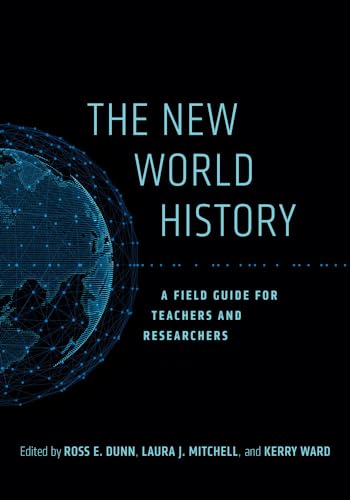
Inhaltsangabe
The New World History is a comprehensive volume of essays selected to enrich world history teaching and scholarship in this rapidly expanding field. The forty-four articles in this book take stock of the history, evolving literature, and current trajectories of new world history. These essays, together with the editors' introductions to thematic chapters, encourage educators and students to reflect critically on the development of the field and to explore concepts, approaches, and insights valuable to their own work. The selections are organized in ten chapters that survey the history of the movement, the seminal ideas of founding thinkers and today's practitioners, changing concepts of world historical space and time, comparative methods, environmental history, the "big history" movement, globalization, debates over the meaning of Western power, and ongoing questions about the intellectual premises and assumptions that have shaped the field.
Die Inhaltsangabe kann sich auf eine andere Ausgabe dieses Titels beziehen.
Über die Autorin bzw. den Autor
Ross E. Dunn is Professor Emeritus of History at San Diego State University, author of The Adventures of Ibn Battuta: A Muslim Traveler of the Fourteenth Century, and coauthor of Panorama: A World History.
Laura J. Mitchell is Associate Professor of History at the University of California, Irvine, author of Belongings: Property, Family, and Identity in Colonial South Africa, and coauthor of Panorama: A World History. Kerry Ward is Associate Professor of History at Rice University and author of Networks of Empire: Forced Migration in the Dutch East India Company.Von der hinteren Coverseite
"Archive, GPS, orientation device—this collection is a godsend for anyone trying to navigate the intellectual ferment and terminological maze of 'world histories.' Mirroring the polycentricity and multivocality of the field itself, the editors and contributors model the limits and possibilities of global thinking as it applies to historical research and especially history teaching. Whether you are a first-time instructor or a scholar with deep roots in the field, there is something of value here for you."—Antoinette Burton, Director, Illinois Program for Research in the Humanities
"Dunn, Mitchell, and Ward have given teachers and scholars of world history a wonderful gift in gathering together these scholars and these essays, and then putting them in conversation with each other. The New World History is brilliantly structured and thoughtfully curated. More than just a marvelous and indispensable resource for beginning and experienced teachers of world history, it is a veritable seminar taught by leading scholars, past and present."—Bob Bain, University of Michigan, School of Education and Department of History
"Dunn, Mitchell, and Ward have given teachers and scholars of world history a wonderful gift in gathering together these scholars and these essays, and then putting them in conversation with each other. The New World History is brilliantly structured and thoughtfully curated. More than just a marvelous and indispensable resource for beginning and experienced teachers of world history, it is a veritable seminar taught by leading scholars, past and present."—Bob Bain, University of Michigan, School of Education and Department of History
Aus dem Klappentext
"Archive, GPS, orientation device—this collection is a godsend for anyone trying to navigate the intellectual ferment and terminological maze of 'world histories.' Mirroring the polycentricity and multivocality of the field itself, the editors and contributors model the limits and possibilities of global thinking as it applies to historical research and especially history teaching. Whether you are a first-time instructor or a scholar with deep roots in the field, there is something of value here for you."—Antoinette Burton, Director, Illinois Program for Research in the Humanities
"Dunn, Mitchell, and Ward have given teachers and scholars of world history a wonderful gift in gathering together these scholars and these essays, and then putting them in conversation with each other. The New World History is brilliantly structured and thoughtfully curated. More than just a marvelous and indispensable resource for beginning and experienced teachers of world history, it is a veritable seminar taught by leading scholars, past and present."—Bob Bain, University of Michigan, School of Education and Department of History
Auszug. © Genehmigter Nachdruck. Alle Rechte vorbehalten.
The New World History
A Field Guide for Teachers and Researchers
By Ross E. Dunn, Laura J. Mitchell, Kerry WardUNIVERSITY OF CALIFORNIA PRESS
Copyright © 2016 The Regents of the University of California
All rights reserved.
ISBN: 978-0-520-28989-5All rights reserved.
Contents
Preface, xiii,
INTRODUCTION, 1,
Further Reading, 15,
CHAPTER 1 WORLD HISTORY OVER TIME: THE EVOLUTION OF AN INTELLECTUAL AND PEDAGOGICAL MOVEMENT,
CHAPTER 2 DEFINING WORLD HISTORY: SOME KEY STATEMENTS,
CHAPTER 3 REGIONS IN WORLD-HISTORICAL CONTEXT,
CHAPTER 4 RETHINKING WORLD-HISTORICAL SPACE,
CHAPTER 5 RETHINKING WORLD-HISTORICAL TIME,
CHAPTER 6 WORLD HISTORY AS COMPARISON,
CHAPTER 7 DEBATING THE QUESTION OF WESTERN POWER,
CHAPTER 8 WORLD HISTORY, BIG HISTORY, AND THE GLOBAL ENVIRONMENT,
CHAPTER 9 GLOBAL HISTORY AND GLOBALIZATION,
CHAPTER 10 CRITIQUES AND QUESTIONS,
Teaching World History, Further Reading, 613,
Credits, 615,
Index, 619,
CHAPTER 1
WORLD HISTORY OVER TIME
The Evolution of an Intellectual and Pedagogical Movement
INTRODUCTION
The earliest world histories were stories ancient people told of how the earth was formed and human beings came to inhabit it. Many of these creation stories have endured. The Jewish, Christian, and Muslim traditions share the main lines of the world history told in the book of Genesis. In that account, God first made the earth and furnished it with the seas, land, and all manner of plants and animals. Then he fashioned man and woman and gave them dominion over the earth and all its creatures. But because Adam and Eve sinned by eating of the tree of life in the Garden of Eden, God condemned them to mortality and drove them from the garden to bear children in sorrow. Thus, the populating of the world got under way. According to the Yoruba creation story told in West Africa, the supreme deity, Olodumare, dispatched his vice regent to form the earth with help from a pigeon and a five-toed hen. Then God sent Oduduwa, another of his agents, to shape human beings from clay. The first human community arose in Yorubaland, and from there people went out to settle other parts of the world.
These creation stories have a universal character. They recount the origins of the world, not just a particular place in the world, and the human species, not just a particular ethnic group. The first humans do not remain confined to the place of their creation but go forth to populate the globe. Traditional creation stories express the urge that Homo sapiens has to explain itself to itself — where did we come from, how long have we been here, how did the world get to be the way it is, what is our destiny?
In the agrarian age, when societies grew larger and interactions among them more complex, chroniclers who had the benefit of writing systems recorded much more detailed universal histories. Their accounts typically started with the creation of the world at the hands of a divine power but then described the course of what they regarded as important events up to their own era. A number of historians of premodern centuries chronicled not only their own societies but also neighboring ones, universalizing their accounts in both time and space to the extent that available knowledge of foreign lands allowed them to do it. In those centuries, networks of interregional communication carried increasing quantities of cultural and historical information from one society to another. But the knowledge flow still remained erratic and piecemeal. No scholar in any region of the world could richly incorporate knowledge of the culture and history of all other regions. Historians defined the world as the places they could in some measure comprehend, passing over the rest as unknowable. In the case of Eurasian, American, and Australasian societies, they had no awareness of one another at all before 1500 or later. Universal history could only be the history of the writer's "known world."
Inevitably, historians also filtered their knowledge through cultural lenses, which further constrained their global vision. Just as the Yoruba origin story placed God's creation of human beings and the starting point of human history in Yorubaland, so Christian and Muslim writers conceived of events in their own parts of the world as rich with purpose and meaning, as manifestations of God's plan for the world. From these ethnocentric perspectives, exotic peoples inhabiting remote climes could justifiably be ignored because their ways were presumed to be both unfathomable and heathenish. From the earliest encounters between Europeans and American peoples, Spanish theologians wrote admiringly about Indian societies. But they filtered their admiration through a lens that discerned traces of divine intervention and potential conversion to Christianity. In the eighteenth century, European thinkers began to disengage their historical studies from Christian doctrine. Some scholars, writing from a secular perspective, expressed their approval of what travelers reported about distant regions, notably China. Nevertheless, universal historians of the Enlightenment era located the development of human rationality and creative spirit, for them the historical narrative that most mattered, squarely in Europe, starting with the blossoming of reason, individualism, and liberty in ancient Rome and Greece.
From the nineteenth century, European scholars who tried their hand at world history faced a growing chorus of intellectual disapproval. Historical writing, like so many other occupations in the era of the Industrial Revolution, became professionalized and specialized. Scholars, notably in Germany, proclaimed the advent of a "new history." They admonished all historians to eschew philosophizing or speculating and instead to study the past scientifically by gathering evidence, mainly from written documents, and to analyze it rigorously to determine objectively "what actually happened." Most inquiries founded on this method had inevitably to limit their subject matter in time and space. Indeed, scholars took eagerly to the study of particular nations and to local developments within nations, including mastery of the languages in which those peoples recorded historical information. Leaders of sovereign states — and in the twentieth century nationalist organizations in colonial dependencies — recruited intellectuals to recover the historical origins and development of the presumed national community, even though such projects often served the mission of creating a national identity where none had existed previously. Moreover, because the richest places in which to unearth documentary evidence of the national past were among the papers stacked in government or church archives, nationalism and historical professionalism neatly reinforced each other. As that synergy developed, most academic specialists came to regard writers of universal history as intellectual speculators oblivious to rules of evidence. As Gilbert Allardyce writes in this chapter, historians "reared on specialized research, learned to hold world history in suspicion as something outmoded, overblown, and metahistorical. Whoever said world history, said amateurism."
If professional scholars thought that universal history was unsound, the great majority of them also insisted that peoples other than Europeans, and their cultural offspring in the Americas and a few other regions, either had no history at all or had reached a state of historical stasis some time in the ancient past. Even though...
„Über diesen Titel“ kann sich auf eine andere Ausgabe dieses Titels beziehen.
Suchergebnisse für New World History: A Field Guide for Teachers and Researcher...

Foto des Verkäufers
The New World History: A Field Guide for Teachers and Researchers (California World History Library) (Volume 23)
Verlag:
University of California Press, 2016
ISBN 10: 0520289897
ISBN 13: 9780520289895
Gebraucht
Softcover
Anbieter: Greenworld Books, Arlington, TX, USA
Verkäuferbewertung 5 von 5 Sternen

Zustand: very_good. Fast Free Shipping â" Very Good condition book with a firm cover and clean pages. Shows normal use and some light wear or limited notes markings. A solid, nice copy to enjoy. Bestandsnummer des Verkäufers GWV.0520289897.VG
Gebraucht kaufen
EUR 13,50
Versand gratis
Versand innerhalb von USA
Versand innerhalb von USA
Anzahl: 1 verfügbar
Beispielbild für diese ISBN
The New World History: A Field Guide for Teachers and Researchers (Volume 23) (California World History Library)
Verlag:
University of California Press, 2016
ISBN 10: 0520289897
ISBN 13: 9780520289895
Gebraucht
Paperback
Anbieter: HPB-Red, Dallas, TX, USA
Verkäuferbewertung 5 von 5 Sternen
Paperback. Zustand: Good. Connecting readers with great books since 1972! Used textbooks may not include companion materials such as access codes, etc. May have some wear or writing/highlighting. We ship orders daily and Customer Service is our top priority! Bestandsnummer des Verkäufers S_478286891
Gebraucht kaufen
EUR 10,48
EUR 3,34 Versand
Versand innerhalb von USA
Versand innerhalb von USA
Anzahl: 1 verfügbar
Foto des Verkäufers
The New World History: A Field Guide for Teachers and Researchers (California World History Library) (Volume 23)
Verlag:
University of California Press, 2016
ISBN 10: 0520289897
ISBN 13: 9780520289895
Gebraucht
Softcover
Anbieter: Goodbooks Company, Springdale, AR, USA
Verkäuferbewertung 5 von 5 Sternen
Zustand: good. Has a sturdy binding with some shelf wear. May have some markings or highlighting. Used copies may not include access codes or Cd's. Slight bending may be present. Bestandsnummer des Verkäufers GBV.0520289897.G
Gebraucht kaufen
EUR 9,57
EUR 4,44 Versand
Versand innerhalb von USA
Versand innerhalb von USA
Anzahl: 1 verfügbar
Foto des Verkäufers
The New World History: A Field Guide for Teachers and Researchers (Volume 23) (California World History Library)
Verlag:
University of California Press, 2016
ISBN 10: 0520289897
ISBN 13: 9780520289895
Gebraucht
Softcover
Anbieter: Upward Bound Books, VALRICO, FL, USA
Verkäuferbewertung 5 von 5 Sternen
Zustand: acceptable. Fully readable with visible signs of use. Cover may have creases, dents, or edge wear. Pages may include writing, highlighting, or folded corners. Binding remains intact. Dust jacket included if originally issued with hardcover. Supplemental items e.g., CDs, codes, or inserts are not guaranteed. We ship daily, Monday through Friday excluding weekends and holidays , in a protective poly mailer for secure delivery. Bestandsnummer des Verkäufers UBV.0520289897.A
Gebraucht kaufen
EUR 10,21
EUR 3,82 Versand
Versand innerhalb von USA
Versand innerhalb von USA
Anzahl: 1 verfügbar
Beispielbild für diese ISBN
The New World History : A Field Guide for Teachers and Researchers
Verlag:
University of California Press, 2016
ISBN 10: 0520289897
ISBN 13: 9780520289895
Gebraucht
Softcover
Anbieter: Better World Books, Mishawaka, IN, USA
Verkäuferbewertung 5 von 5 Sternen
Zustand: Very Good. Pages intact with possible writing/highlighting. Binding strong with minor wear. Dust jackets/supplements may not be included. Stock photo provided. Product includes identifying sticker. Better World Books: Buy Books. Do Good. Bestandsnummer des Verkäufers 17282242-6
Gebraucht kaufen
EUR 16,00
Versand gratis
Versand innerhalb von USA
Versand innerhalb von USA
Anzahl: 1 verfügbar
Beispielbild für diese ISBN
The New World History: A Field Guide for Teachers and Researchers (California World History Library) (Volume 23)
Verlag:
University of California Press, 2016
ISBN 10: 0520289897
ISBN 13: 9780520289895
Gebraucht
paperback
Anbieter: A Team Books, Conway, AR, USA
Verkäuferbewertung 5 von 5 Sternen
paperback. Zustand: Good. Used books may not include access codes or one time use codes. Proven Seller with Excellent Customer Service. Choose expedited shipping and get it FAST. Bestandsnummer des Verkäufers sun0000054919
Gebraucht kaufen
EUR 13,75
EUR 2,67 Versand
Versand innerhalb von USA
Versand innerhalb von USA
Anzahl: 3 verfügbar
Beispielbild für diese ISBN
The New World History: A Field Guide for Teachers and Researchers (Volume 23) (California World History Library)
Verlag:
University of California Press, 2016
ISBN 10: 0520289897
ISBN 13: 9780520289895
Gebraucht
Softcover
Anbieter: World of Books (was SecondSale), Montgomery, IL, USA
Verkäuferbewertung 5 von 5 Sternen
Zustand: Very Good. Item in very good condition! Textbooks may not include supplemental items i.e. CDs, access codes etc. Bestandsnummer des Verkäufers 00108679265
Gebraucht kaufen
EUR 19,12
Versand gratis
Versand innerhalb von USA
Versand innerhalb von USA
Anzahl: 1 verfügbar
Beispielbild für diese ISBN
The New World History: A Field Guide for Teachers and Researchers (California World History Library) (Volume 23)
Verlag:
University of California Press, 2016
ISBN 10: 0520289897
ISBN 13: 9780520289895
Neu
paperback
Anbieter: A Team Books, Conway, AR, USA
Verkäuferbewertung 5 von 5 Sternen
paperback. Zustand: New. Brand New! Proven Seller with Excellent Customer Service. Choose expedited shipping and get it FAST. Bestandsnummer des Verkäufers sun0000054920
Neu kaufen
EUR 37,55
EUR 2,67 Versand
Versand innerhalb von USA
Versand innerhalb von USA
Anzahl: 2 verfügbar
Foto des Verkäufers
New World History : A Field Guide for Teachers and Researchers
Verlag:
University of California Press, 2016
ISBN 10: 0520289897
ISBN 13: 9780520289895
Neu
Softcover
Anbieter: GreatBookPrices, Columbia, MD, USA
Verkäuferbewertung 5 von 5 Sternen
Zustand: New. Bestandsnummer des Verkäufers 26292975-n
Neu kaufen
EUR 37,87
EUR 2,35 Versand
Versand innerhalb von USA
Versand innerhalb von USA
Anzahl: 14 verfügbar
Beispielbild für diese ISBN
The New World History
Anbieter: PBShop.store US, Wood Dale, IL, USA
Verkäuferbewertung 5 von 5 Sternen
PAP. Zustand: New. New Book. Shipped from UK. Established seller since 2000. Bestandsnummer des Verkäufers WF-9780520289895