Affine Analysis of Image Sequences: 10 (Distinguished Dissertations in Computer Science, Series Number 10) - Softcover
Inhaltsangabe
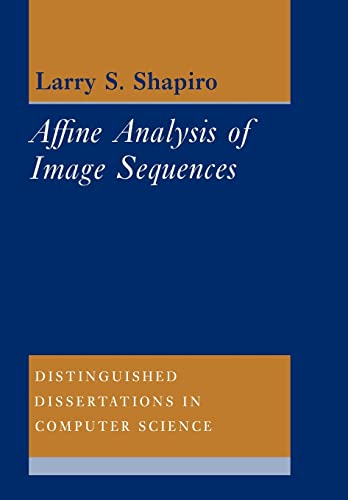
Based on his award winning thesis, Dr Shapiro presents a new computer vision framework for interpreting time-varying imagery.
Die Inhaltsangabe kann sich auf eine andere Ausgabe dieses Titels beziehen.
Über die Autorin bzw. den Autor
Charlotte y Peter Fiell son dos autoridades en historia, teoría y crítica del diseño y han escrito más de sesenta libros sobre la materia, muchos de los cuales se han convertido en éxitos de ventas. También han impartido conferencias y cursos como profesores invitados, han comisariado exposiciones y asesorado a fabricantes, museos, salas de subastas y grandes coleccionistas privados de todo el mundo. Los Fiell han escrito numerosos libros para TASCHEN, entre los que se incluyen 1000 Chairs, Diseño del siglo XX, El diseño industrial de la A a la Z, Scandinavian Design y Diseño del siglo XXI.
„Über diesen Titel“ kann sich auf eine andere Ausgabe dieses Titels beziehen.
Weitere beliebte Ausgaben desselben Titels

Suchergebnisse für Affine Analysis of Image Sequences: 10 (Distinguished...

Beispielbild für diese ISBN
Affine Analysis of Image Sequences (Distinguished Dissertations in Computer Science, Series Number 10)
Anbieter: Lucky's Textbooks, Dallas, TX, USA
Verkäuferbewertung 5 von 5 Sternen

Zustand: New. Bestandsnummer des Verkäufers ABLIING23Feb2215580238716
Neu kaufen
EUR 45,71
Versand:
EUR 3,44
Innerhalb der USA
Anzahl: Mehr als 20 verfügbar
Beispielbild für diese ISBN
Affine Analysis of Image Sequences (Paperback)
Verlag:
Cambridge University Press, Cambridge, 2005
ISBN 10: 0521019788
ISBN 13: 9780521019781
Neu
Paperback
Anbieter: Grand Eagle Retail, Bensenville, IL, USA
Verkäuferbewertung 5 von 5 Sternen
Paperback. Zustand: new. Paperback. Computer vision is a rapidly growing field which aims to make computers 'see' as effectively as humans. In this book Dr Shapiro presents a new computer vision framework for interpreting time-varying imagery. This is an important task, since movement reveals valuable information about the environment. The fully-automated system operates on long, monocular image sequences containing multiple, independently-moving objects, and demonstrates the practical feasibility of recovering scene structure and motion in a bottom-up fashion. Real and synthetic examples are given throughout, with particular emphasis on image coding applications. Novel theory is derived in the context of the affine camera, a generalisation of the familiar scaled orthographic model. Analysis proceeds by tracking 'corner features' through successive frames and grouping the resulting trajectories into rigid objects using new clustering and outlier rejection techniques. The three-dimensional motion parameters are then computed via 'affine epipolar geometry', and 'affine structure' is used to generate alternative views of the object and fill in partial views. The use of all available features (over multiple frames) and the incorporation of statistical noise properties substantially improves existing algorithms, giving greater reliability and reduced noise sensitivity. Computer vision is a rapidly growing field which aims to make computers ?see? as effectively as humans. In this book Dr Shapiro presents a new computer vision framework for interpreting time-varying imagery. This is an important task, since movement reveals valuable information about the environment. The fully-automated system operates on long, monocular image sequences containing multiple, independently-moving objects, and demonstrates the practical feasibility of recovering scene structure and motion in a bottom-up fashion. Real and synthetic examples are given throughout, with particular emphasis on image coding applications. Novel theory is derived in the context of the affine camera, a generalisation of the familiar scaled orthographic model. Analysis proceeds by tracking 'corner features' through successive frames and grouping the resulting trajectories into rigid objects using new clustering and outlier rejection techniques. The three-dimensional motion parameters are then computed via ?affine epipolar geometry?, and ?affine structure? is used to generate alternative views of the object and fill in partial views. The use of all available features (over multiple frames) and the incorporation of statistical noise properties substantially improves existing algorithms, giving greater reliability and reduced noise sensitivity. Shipping may be from multiple locations in the US or from the UK, depending on stock availability. Bestandsnummer des Verkäufers 9780521019781
Beispielbild für diese ISBN
Affine Analysis of Image Sequences
Print-on-DemandAnbieter: Revaluation Books, Exeter, Vereinigtes Königreich
Verkäuferbewertung 5 von 5 Sternen
Paperback. Zustand: Brand New. 210 pages. 10.00x7.00x0.50 inches. In Stock. This item is printed on demand. Bestandsnummer des Verkäufers __0521019788
Neu kaufen
EUR 48,48
Versand:
EUR 11,38
Von Vereinigtes Königreich nach USA
Anzahl: 1 verfügbar
Beispielbild für diese ISBN
Affine Analysis of Image Sequences (Distinguished Dissertations in Computer Science, Series Number 10)
Anbieter: Ria Christie Collections, Uxbridge, Vereinigtes Königreich
Verkäuferbewertung 5 von 5 Sternen
Zustand: New. In. Bestandsnummer des Verkäufers ria9780521019781_new
Neu kaufen
EUR 49,59
Versand:
EUR 13,63
Von Vereinigtes Königreich nach USA
Anzahl: Mehr als 20 verfügbar
Beispielbild für diese ISBN
Affine Analysis of Image Sequences
Anbieter: Chiron Media, Wallingford, Vereinigtes Königreich
Verkäuferbewertung 4 von 5 Sternen

PF. Zustand: New. Bestandsnummer des Verkäufers 6666-IUK-9780521019781
Neu kaufen
EUR 47,34
Versand:
EUR 17,63
Von Vereinigtes Königreich nach USA
Anzahl: 10 verfügbar
Beispielbild für diese ISBN
Affine Analysis of Image Sequences
Verlag:
Cambridge University Press, 2005
ISBN 10: 0521019788
ISBN 13: 9780521019781
Neu
Paperback / softback
Anbieter: THE SAINT BOOKSTORE, Southport, Vereinigtes Königreich
Verkäuferbewertung 5 von 5 Sternen
Paperback / softback. Zustand: New. This item is printed on demand. New copy - Usually dispatched within 5-9 working days 400. Bestandsnummer des Verkäufers C9780521019781
Neu kaufen
EUR 52,03
Versand:
EUR 16,79
Von Vereinigtes Königreich nach USA
Anzahl: Mehr als 20 verfügbar
Beispielbild für diese ISBN
Affine Analysis of Image Sequences
Verlag:
Cambridge University Press CUP, 2005
ISBN 10: 0521019788
ISBN 13: 9780521019781
Neu
Softcover
Anbieter: Books Puddle, New York, NY, USA
Verkäuferbewertung 4 von 5 Sternen
Zustand: New. pp. 228. Bestandsnummer des Verkäufers 26553479
Beispielbild für diese ISBN
Affine Analysis of Image Sequences
Print-on-DemandAnbieter: Majestic Books, Hounslow, Vereinigtes Königreich
Verkäuferbewertung 4 von 5 Sternen
Zustand: New. Print on Demand pp. 228 Illus. Bestandsnummer des Verkäufers 8375768
Neu kaufen
EUR 73,66
Versand:
EUR 7,40
Von Vereinigtes Königreich nach USA
Anzahl: 4 verfügbar
Beispielbild für diese ISBN
Affine Analysis of Image Sequences
Print-on-DemandAnbieter: Biblios, Frankfurt am main, HESSE, Deutschland
Verkäuferbewertung 4 von 5 Sternen
Zustand: New. PRINT ON DEMAND pp. 228. Bestandsnummer des Verkäufers 18553485
Neu kaufen
EUR 74,50
Versand:
EUR 9,95
Von Deutschland nach USA
Anzahl: 4 verfügbar
Beispielbild für diese ISBN
Affine Analysis of Image Sequences (Paperback)
Verlag:
Cambridge University Press, Cambridge, 2005
ISBN 10: 0521019788
ISBN 13: 9780521019781
Neu
Paperback
Anbieter: CitiRetail, Stevenage, Vereinigtes Königreich
Verkäuferbewertung 5 von 5 Sternen
Paperback. Zustand: new. Paperback. Computer vision is a rapidly growing field which aims to make computers 'see' as effectively as humans. In this book Dr Shapiro presents a new computer vision framework for interpreting time-varying imagery. This is an important task, since movement reveals valuable information about the environment. The fully-automated system operates on long, monocular image sequences containing multiple, independently-moving objects, and demonstrates the practical feasibility of recovering scene structure and motion in a bottom-up fashion. Real and synthetic examples are given throughout, with particular emphasis on image coding applications. Novel theory is derived in the context of the affine camera, a generalisation of the familiar scaled orthographic model. Analysis proceeds by tracking 'corner features' through successive frames and grouping the resulting trajectories into rigid objects using new clustering and outlier rejection techniques. The three-dimensional motion parameters are then computed via 'affine epipolar geometry', and 'affine structure' is used to generate alternative views of the object and fill in partial views. The use of all available features (over multiple frames) and the incorporation of statistical noise properties substantially improves existing algorithms, giving greater reliability and reduced noise sensitivity. Computer vision is a rapidly growing field which aims to make computers ?see? as effectively as humans. In this book Dr Shapiro presents a new computer vision framework for interpreting time-varying imagery. This is an important task, since movement reveals valuable information about the environment. The fully-automated system operates on long, monocular image sequences containing multiple, independently-moving objects, and demonstrates the practical feasibility of recovering scene structure and motion in a bottom-up fashion. Real and synthetic examples are given throughout, with particular emphasis on image coding applications. Novel theory is derived in the context of the affine camera, a generalisation of the familiar scaled orthographic model. Analysis proceeds by tracking 'corner features' through successive frames and grouping the resulting trajectories into rigid objects using new clustering and outlier rejection techniques. The three-dimensional motion parameters are then computed via ?affine epipolar geometry?, and ?affine structure? is used to generate alternative views of the object and fill in partial views. The use of all available features (over multiple frames) and the incorporation of statistical noise properties substantially improves existing algorithms, giving greater reliability and reduced noise sensitivity. This item is printed on demand. Shipping may be from our UK warehouse or from our Australian or US warehouses, depending on stock availability. Bestandsnummer des Verkäufers 9780521019781
Neu kaufen
EUR 56,25
Versand:
EUR 42,11
Von Vereinigtes Königreich nach USA
Anzahl: 1 verfügbar