
Verwandte Artikel zu The Fruits of Revolution: Property Rights, Litigation...
The Fruits of Revolution: Property Rights, Litigation and French Agriculture, 1700–1860 (Political Economy of Institutions and Decisions) - Softcover
Buch 45 von 81: Political Economy of Institutions and Decisions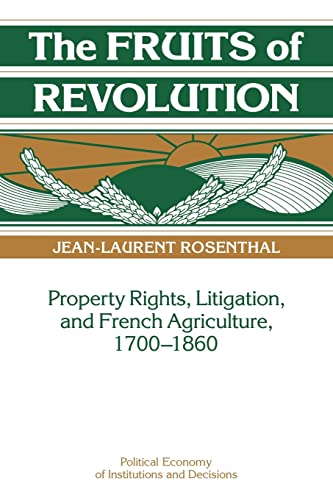
Inhaltsangabe
The Fruits of Revolution examines the impact of revolution on French agricultural development.
Die Inhaltsangabe kann sich auf eine andere Ausgabe dieses Titels beziehen.
Von der hinteren Coverseite
In The Fruits of Revolution Jean-Laurent Rosenthal investigates two central questions in French economic history: To what extent did institutions hold back agricultural development under the Old Regime, and did reforms carried out during the French Revolution significantly improve the structure of property rights in agriculture? Both questions have been the subject of much debate. Historians have touched on them in a number of local studies, yet usually they have been more concerned with community conflict than with economic development. Economists generally have researched the performance of the French economy without paying much attention to the impact of institutions on specific areas of the economy. This book attempts to utilize the best of both approaches: It focuses on broad questions of economic change, yet it is based on detailed archival investigations of the impact of property rights on water control. Part I provides both an introduction to French economic history between 1700 and 1860 and an introduction to the economic literature on property rights and institutions. Part II first looks at water control from a national perspective and then examines two case studies, one of drainage in Normandy and one of irrigation in Provence. The national evidence shows that most water control efforts failed before 1789, whereas 1820-60 were boom years for irrigation and drainage. Quantitative and qualitative evidence suggests that neither technology nor relative prices were responsible for the failure to develop agriculture under the Old Regime; rather, ambiguous property rights, divided authority, and endless litigation all conspired to reduce the efficacy of water control. The Revolutionsolved important institutional problems for the countryside by centralizing authority over eminent domain, reforming the judiciary, and clarifying property rights to land water. As a result, after 1820 water control flourished. Part III of the book is devoted to explaining why inefficient property rights arose in the Middle Ages and prevailed until 1789. A set of theoretical models is analyzed to argue that ill-defined property rights were part of the very structure of the Old Regime--a fact that made reform impossible without a revolution.
„Über diesen Titel“ kann sich auf eine andere Ausgabe dieses Titels beziehen.
Suchergebnisse für The Fruits of Revolution: Property Rights, Litigation...

Beispielbild für diese ISBN
The Fruits of Revolution: Property Rights, Litigation and French Agriculture, 1700 1860
Print-on-DemandAnbieter: Chiron Media, Wallingford, Vereinigtes Königreich
Verkäuferbewertung 5 von 5 Sternen

PF. Zustand: New. This item is printed on demand. Brand new book, sourced directly from publisher. Dispatch time is 6-7 days from our warehouse. Book will be sent in robust, secure packaging to ensure it reaches you securely. Bestandsnummer des Verkäufers 6666-IUK-9780521103121
Neu kaufen
EUR 44,80
EUR 5,98 Versand
Versand von Vereinigtes Königreich nach USA
Versand von Vereinigtes Königreich nach USA
Anzahl: 20 verfügbar
Beispielbild für diese ISBN
The Fruits of Revolution: Property Rights, Litigation and French Agriculture, 1700-1860 (Political Economy of Institutions and Decisions)
Anbieter: California Books, Miami, FL, USA
Verkäuferbewertung 5 von 5 Sternen
Zustand: New. Bestandsnummer des Verkäufers I-9780521103121
Neu kaufen
EUR 51,38
EUR 2,72 Versand
Versand innerhalb von USA
Versand innerhalb von USA
Anzahl: Mehr als 20 verfügbar
Beispielbild für diese ISBN
The Fruits of Revolution: Property Rights, Litigation and French Agriculture, 1700-1860 (Political Economy of Institutions and Decisions)
Anbieter: Kennys Bookshop and Art Galleries Ltd., Galway, GY, Irland
Verkäuferbewertung 5 von 5 Sternen
Zustand: New. The Fruits of Revolution examines the impact of revolution on French agricultural development. Series: Political Economy of Institutions and Decisions. Num Pages: 236 pages, black & white illustrations. BIC Classification: 1DDF; 3JF; 3JH; KCP; KNAC. Category: (UP) Postgraduate, Research & Scholarly. Dimension: 230 x 152 x 16. Weight in Grams: 386. . 2009. Reissue. paperback. . . . . Bestandsnummer des Verkäufers V9780521103121
Neu kaufen
EUR 50,66
EUR 9,50 Versand
Versand von Irland nach USA
Versand von Irland nach USA
Anzahl: Mehr als 20 verfügbar
Beispielbild für diese ISBN
The Fruits of Revolution: Property Rights, Litigation and French Agriculture, 1700-1860 (Political Economy of Institutions and Decisions)
Anbieter: Ria Christie Collections, Uxbridge, Vereinigtes Königreich
Verkäuferbewertung 5 von 5 Sternen
Zustand: New. In English. Bestandsnummer des Verkäufers ria9780521103121_new
Neu kaufen
EUR 53,78
EUR 13,44 Versand
Versand von Vereinigtes Königreich nach USA
Versand von Vereinigtes Königreich nach USA
Anzahl: Mehr als 20 verfügbar
Beispielbild für diese ISBN
The Fruits of Revolution: Property Rights, Litigation and French Agriculture, 1700?1860 (Political Economy of Institutions and Decisions)
Anbieter: Kennys Bookstore, Olney, MD, USA
Verkäuferbewertung 4 von 5 Sternen

Zustand: New. The Fruits of Revolution examines the impact of revolution on French agricultural development. Series: Political Economy of Institutions and Decisions. Num Pages: 236 pages, black & white illustrations. BIC Classification: 1DDF; 3JF; 3JH; KCP; KNAC. Category: (UP) Postgraduate, Research & Scholarly. Dimension: 230 x 152 x 16. Weight in Grams: 386. . 2009. Reissue. paperback. . . . . Books ship from the US and Ireland. Bestandsnummer des Verkäufers V9780521103121
Neu kaufen
EUR 65,15
EUR 9,52 Versand
Versand innerhalb von USA
Versand innerhalb von USA
Anzahl: Mehr als 20 verfügbar
Beispielbild für diese ISBN
The Fruits of Revolution
Verlag:
Cambridge University Press CUP, 2009
ISBN 10: 0521103126
ISBN 13: 9780521103121
Neu
Softcover
Anbieter: Books Puddle, Woodside, NY, USA
Verkäuferbewertung 4 von 5 Sternen
Zustand: New. pp. 236. Bestandsnummer des Verkäufers 26526436
Neu kaufen
EUR 71,25
EUR 3,62 Versand
Versand innerhalb von USA
Versand innerhalb von USA
Anzahl: 4 verfügbar
Beispielbild für diese ISBN
The Fruits of Revolution
Print-on-DemandAnbieter: Majestic Books, Hounslow, Vereinigtes Königreich
Verkäuferbewertung 4 von 5 Sternen
Zustand: New. Print on Demand pp. 236 2:B&W 6 x 9 in or 229 x 152 mm Perfect Bound on Creme w/Gloss Lam. Bestandsnummer des Verkäufers 8370107
Neu kaufen
EUR 70,51
EUR 7,79 Versand
Versand von Vereinigtes Königreich nach USA
Versand von Vereinigtes Königreich nach USA
Anzahl: 4 verfügbar
Beispielbild für diese ISBN
The Fruits of Revolution
Print-on-DemandAnbieter: Biblios, Frankfurt am main, HESSE, Deutschland
Verkäuferbewertung 4 von 5 Sternen
Zustand: New. PRINT ON DEMAND pp. 236. Bestandsnummer des Verkäufers 18526446
Neu kaufen
EUR 70,13
EUR 9,95 Versand
Versand von Deutschland nach USA
Versand von Deutschland nach USA
Anzahl: 4 verfügbar
Foto des Verkäufers
The Fruits of Revolution: Property Rights Litigation and French Agriculture 1700-1860 (Political Economy of Institutions and Decisions)
Verlag:
Cambridge University Press, 1992
ISBN 10: 0521103126
ISBN 13: 9780521103121
Gebraucht
Softcover
Anbieter: crealivres, La fontennelle, Frankreich
Verkäuferbewertung 5 von 5 Sternen
Zustand: Fine. Envoi rapide Très bon état avec sa jaquette intérieur propre bonne tenue. in8. 1992. Cartonné jaquette. 236 pages. Fine. Bestandsnummer des Verkäufers 100137376
Gebraucht kaufen
EUR 67,00
EUR 14,00 Versand
Versand von Frankreich nach USA
Versand von Frankreich nach USA
Anzahl: 1 verfügbar
Beispielbild für diese ISBN
The Fruits of Revolution (Paperback)
Verlag:
Cambridge University Press, Cambridge, 2009
ISBN 10: 0521103126
ISBN 13: 9780521103121
Neu
Paperback
Anbieter: CitiRetail, Stevenage, Vereinigtes Königreich
Verkäuferbewertung 5 von 5 Sternen
Paperback. Zustand: new. Paperback. In The Fruits of Revolution Jean-Laurent Rosenthal investigates two central questions in French economic history: To what extent did institutions hold back agricultural development under the Old Regime, and did reforms carried out during the French Revolution significantly improve the structure of property rights in agriculture? Both questions have been the subject of much debate. Historians have touched on them in a number of local studies, yet usually they have been more concerned with community conflict than with economic development. Economists generally have researched the performance of the French economy without paying much attention to the impact of institutions on specific areas of the economy. This book attempts to utilize the best of both approaches: It focuses on broad questions of economic change, yet it is based on detailed archival investigations of the impact of property rights on water control. Based on an in-depth study of the effect of property rights on water control, The Fruits of Revolution examines the impact of revolution on French agricultural development. The book focuses on broad questions of economic change, yet it is based on detailed archival investigations of the impact of property rights on water control. This item is printed on demand. Shipping may be from our UK warehouse or from our Australian or US warehouses, depending on stock availability. Bestandsnummer des Verkäufers 9780521103121
Neu kaufen
EUR 54,32
EUR 44,35 Versand
Versand von Vereinigtes Königreich nach USA
Versand von Vereinigtes Königreich nach USA
Anzahl: 1 verfügbar