
Verwandte Artikel zu The Sources of Normativity: Ed. by Onora O'Neill
Inhaltsangabe
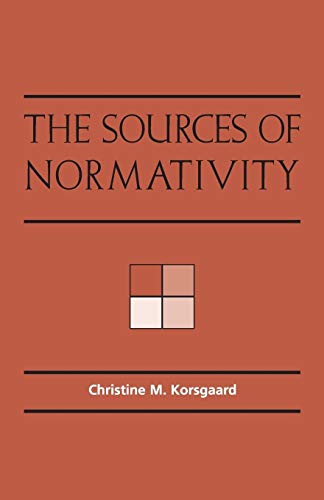
Korsgaard's discussion of the source of normativity is followed by commentary from four distinguished philosophers.
Die Inhaltsangabe kann sich auf eine andere Ausgabe dieses Titels beziehen.
Suchergebnisse für The Sources of Normativity: Ed. by Onora O'Neill

Beispielbild für diese ISBN
The Sources of Normativity
Verlag:
Cambridge University Press, 2014
ISBN 10: 052155960X
ISBN 13: 9780521559607
Gebraucht
Soft cover
Anbieter: Mesquite Booksellers, Tucson, AZ, USA
Verkäuferbewertung 5 von 5 Sternen

Soft cover. Zustand: Fine. xv,273. This copy was printed on demand (13 March 2024). Minor ordinary shelfwear to the covers and edges. This is a special sale item which will be shipped in an envelope, not a box. If you order this from outside the United States, we will request an additional payment to help cover the postage. Every order includes tracking and originates in Tucson, AZ. ~Mesquite Booksellers. Bestandsnummer des Verkäufers 1271
Gebraucht kaufen
EUR 11,08
EUR 2,69 Versand
Versand innerhalb von USA
Versand innerhalb von USA
Anzahl: 1 verfügbar
Foto des Verkäufers
The Sources of Normativity
Verlag:
Cambridge University Press, 1996
ISBN 10: 052155960X
ISBN 13: 9780521559607
Gebraucht
Softcover
Anbieter: Bay State Book Company, North Smithfield, RI, USA
Verkäuferbewertung 5 von 5 Sternen
Zustand: acceptable. The book is complete and readable, with all pages and cover intact. Dust jacket, shrink wrap, or boxed set case may be missing. Pages may have light notes, highlighting, or minor water exposure, but nothing that affects readability. May be an ex-library copy and could include library markings or stickers. Bestandsnummer des Verkäufers BSM.1D5FR
Gebraucht kaufen
EUR 16,34
Versand gratis
Versand innerhalb von USA
Versand innerhalb von USA
Anzahl: 1 verfügbar
Beispielbild für diese ISBN
The Sources of Normativity
Verlag:
Cambridge University Press, 1996
ISBN 10: 052155960X
ISBN 13: 9780521559607
Gebraucht
Paperback
Anbieter: World of Books (was SecondSale), Montgomery, IL, USA
Verkäuferbewertung 5 von 5 Sternen
Paperback. Zustand: Good. Ethical concepts are, or purport to be, normative. They make claims on us: they command, oblige, recommend, or guide. Or at least when we invoke them, we make claims on one another; but where does their authority over us - or ours over one another - come from? Christine Korsgaard identifies four accounts of the source of normativity that have been advocated by modern moral philosophers: voluntarism, realism, reflective endorsement, and the appeal to autonomy. She traces their history, showing how each developed in response to the prior one and comparing their early versions with those on the contemporary philosophical scene. Kant's theory that normativity springs from our own autonomy emerges as a synthesis of the other three, and Korsgaard concludes with her own version of the Kantian account. Her discussion is followed by commentary from G. A. Cohen, Raymond Geuss, Thomas Nagel, and Bernard Williams, and a reply by Korsgaard. Bestandsnummer des Verkäufers CIN052155960XG
Gebraucht kaufen
EUR 16,39
Versand gratis
Versand innerhalb von USA
Versand innerhalb von USA
Anzahl: 2 verfügbar
Beispielbild für diese ISBN
The Sources of Normativity
Verlag:
Cambridge University Press, 1996
ISBN 10: 052155960X
ISBN 13: 9780521559607
Gebraucht
Paperback
Anbieter: World of Books Inc, Montgomery, IL, USA
Verkäuferbewertung 4 von 5 Sternen

Paperback. Zustand: Good. Ethical concepts are, or purport to be, normative. They make claims on us: they command, oblige, recommend, or guide. Or at least when we invoke them, we make claims on one another; but where does their authority over us - or ours over one another - come from? Christine Korsgaard identifies four accounts of the source of normativity that have been advocated by modern moral philosophers: voluntarism, realism, reflective endorsement, and the appeal to autonomy. She traces their history, showing how each developed in response to the prior one and comparing their early versions with those on the contemporary philosophical scene. Kant's theory that normativity springs from our own autonomy emerges as a synthesis of the other three, and Korsgaard concludes with her own version of the Kantian account. Her discussion is followed by commentary from G. A. Cohen, Raymond Geuss, Thomas Nagel, and Bernard Williams, and a reply by Korsgaard. Bestandsnummer des Verkäufers CIN052155960XG
Gebraucht kaufen
EUR 18,24
Versand gratis
Versand innerhalb von USA
Versand innerhalb von USA
Anzahl: 2 verfügbar
Beispielbild für diese ISBN
The Sources of Normativity
Verlag:
Cambridge University Press (edition ), 1996
ISBN 10: 052155960X
ISBN 13: 9780521559607
Gebraucht
Paperback
Anbieter: BooksRun, Philadelphia, PA, USA
Verkäuferbewertung 5 von 5 Sternen
Paperback. Zustand: Fair. The item might be beaten up but readable. May contain markings or highlighting, as well as stains, bent corners, or any other major defect, but the text is not obscured in any way. Bestandsnummer des Verkäufers 052155960X-7-1
Gebraucht kaufen
EUR 18,84
Versand gratis
Versand innerhalb von USA
Versand innerhalb von USA
Anzahl: 1 verfügbar
Beispielbild für diese ISBN
The Sources of Normativity
Verlag:
Cambridge University Press, 1996
ISBN 10: 052155960X
ISBN 13: 9780521559607
Gebraucht
Paperback
Anbieter: World of Books (was SecondSale), Montgomery, IL, USA
Verkäuferbewertung 5 von 5 Sternen
Paperback. Zustand: Very Good. Ethical concepts are, or purport to be, normative. They make claims on us: they command, oblige, recommend, or guide. Or at least when we invoke them, we make claims on one another; but where does their authority over us - or ours over one another - come from? Christine Korsgaard identifies four accounts of the source of normativity that have been advocated by modern moral philosophers: voluntarism, realism, reflective endorsement, and the appeal to autonomy. She traces their history, showing how each developed in response to the prior one and comparing their early versions with those on the contemporary philosophical scene. Kant's theory that normativity springs from our own autonomy emerges as a synthesis of the other three, and Korsgaard concludes with her own version of the Kantian account. Her discussion is followed by commentary from G. A. Cohen, Raymond Geuss, Thomas Nagel, and Bernard Williams, and a reply by Korsgaard. Bestandsnummer des Verkäufers 00110722558
Gebraucht kaufen
EUR 20,22
Versand gratis
Versand innerhalb von USA
Versand innerhalb von USA
Anzahl: 2 verfügbar
Beispielbild für diese ISBN
The Sources of Normativity
Verlag:
Cambridge University Press, 1996
ISBN 10: 052155960X
ISBN 13: 9780521559607
Gebraucht
Paperback
Anbieter: HPB-Emerald, Dallas, TX, USA
Verkäuferbewertung 5 von 5 Sternen
Paperback. Zustand: Very Good. Connecting readers with great books since 1972! Used books may not include companion materials, and may have some shelf wear or limited writing. We ship orders daily and Customer Service is our top priority! Bestandsnummer des Verkäufers S_487813332
Gebraucht kaufen
EUR 18,45
EUR 3,36 Versand
Versand innerhalb von USA
Versand innerhalb von USA
Anzahl: 1 verfügbar
Foto des Verkäufers
Sources of Normativity
Anbieter: GreatBookPrices, Columbia, MD, USA
Verkäuferbewertung 5 von 5 Sternen
Zustand: New. Bestandsnummer des Verkäufers 433835-n
Neu kaufen
EUR 23,91
EUR 2,37 Versand
Versand innerhalb von USA
Versand innerhalb von USA
Anzahl: Mehr als 20 verfügbar
Foto des Verkäufers
The Sources of Normativity (Paperback or Softback)
Verlag:
Cambridge University Press 6/28/1996, 1996
ISBN 10: 052155960X
ISBN 13: 9780521559607
Neu
Paperback or Softback
Anbieter: BargainBookStores, Grand Rapids, MI, USA
Verkäuferbewertung 5 von 5 Sternen
Paperback or Softback. Zustand: New. The Sources of Normativity. Book. Bestandsnummer des Verkäufers BBS-9780521559607
Foto des Verkäufers
The Sources of Normativity
Verlag:
Cambridge University Press, GB, 1996
ISBN 10: 052155960X
ISBN 13: 9780521559607
Neu
Paperback
Anbieter: Rarewaves USA, HEBRON, KY, USA
Verkäuferbewertung 5 von 5 Sternen
Paperback. Zustand: New. Ethical concepts are, or purport to be, normative. They make claims on us: they command, oblige, recommend, or guide. Or at least when we invoke them, we make claims on one another; but where does their authority over us - or ours over one another - come from? Christine Korsgaard identifies four accounts of the source of normativity that have been advocated by modern moral philosophers: voluntarism, realism, reflective endorsement, and the appeal to autonomy. She traces their history, showing how each developed in response to the prior one and comparing their early versions with those on the contemporary philosophical scene. Kant's theory that normativity springs from our own autonomy emerges as a synthesis of the other three, and Korsgaard concludes with her own version of the Kantian account. Her discussion is followed by commentary from G. A. Cohen, Raymond Geuss, Thomas Nagel, and Bernard Williams, and a reply by Korsgaard. Bestandsnummer des Verkäufers LU-9780521559607
Neu kaufen
EUR 27,98
Versand gratis
Versand innerhalb von USA
Versand innerhalb von USA
Anzahl: Mehr als 20 verfügbar