Faith and Boundaries: Colonists, Christianity, and Community Among the Wampanoag Indians of Martha’s Vineyard, 1600-1871 (Studies in North American Indian History) - Hardcover
Buch 3 von 10: Studies in North American Indian History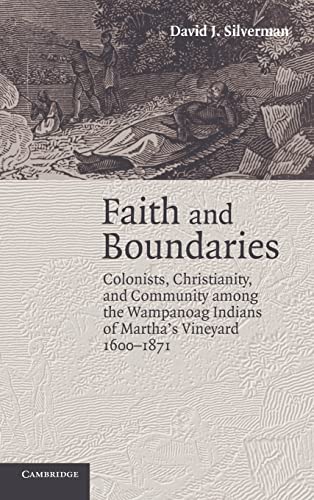
Inhaltsangabe
Examines the Wampanoag Indians of Martha's Vineyard and their interaction with the English settlements and religious culture.
Die Inhaltsangabe kann sich auf eine andere Ausgabe dieses Titels beziehen.
Über die Autorin bzw. den Autor
David J. Silverman is Associate Professor of History at the George Washington University. His several articles include 'Indians, Missionaries, and Religious Translation', which won the Lester J. Cappon award for best essay of 2005 in the William and Mary Quarterly. He completed this book as a Mellon Post-Dissertation Fellow at the American Antiquarian Society.
„Über diesen Titel“ kann sich auf eine andere Ausgabe dieses Titels beziehen.
Weitere beliebte Ausgaben desselben Titels

Suchergebnisse für Faith and Boundaries: Colonists, Christianity, and...

Beispielbild für diese ISBN
Faith and Boundaries: Colonists, Christianity, and Community among the Wampanoag Indians of Martha's Vineyard, 1600-1871 (Studies in North American Indian History)
Verlag:
Cambridge University Press, 2005
ISBN 10: 0521842808
ISBN 13: 9780521842808
Gebraucht
Hardcover
Anbieter: World of Books (was SecondSale), Montgomery, IL, USA
Verkäuferbewertung 5 von 5 Sternen

Zustand: Good. Item in good condition. Textbooks may not include supplemental items i.e. CDs, access codes etc. Bestandsnummer des Verkäufers 00092925498
Beispielbild für diese ISBN
Faith and Boundaries: Colonists, Christianity, and Community among the Wampanoag Indians of Martha's Vineyard, 1600-1871 (Studies in North American Indian History)
Verlag:
Cambridge University Press, New York, NY, 2005
ISBN 10: 0521842808
ISBN 13: 9780521842808
Gebraucht
Hardcover
Erstausgabe
Anbieter: Conover Books, Martinsville, VA, USA
Verkäuferbewertung 5 von 5 Sternen
Hardcover. Zustand: Good. Zustand des Schutzumschlags: Very Good. 1st Edition. Minor edge and corner wear to the dj; lightly scuffed and scratched; some underlining in ink throughout the book; corners are gently bumped and rubbed; some light shelf wear; overall a nice used copy! Brown boards with gilt lettering on the spine. 303 informative and historical pages nicely enhanced by black and white photographs and illustrations! "This book examines how the Wamapanoag Indians' adoption of Christianity and other selective borrowing from English culture contributed to Indian/English coexistence and the long-term survival of Wamapanoag communities on the island of Martha's Vineyard, even as the racial barrier between peoples grew more rigid. On an island marked by centralized English authority, missionary commitment, and an Indian majority, the Wampanoags' adaptation to English culture, especially Christianity, checked violence while safeguarding their land, community, and ironically, even customs. Yet the colonists' exploitation of Indian land and labor exposed the limits of Christian fellowship and thus hardened racial division.". Bestandsnummer des Verkäufers 050963
Beispielbild für diese ISBN
Faith and Boundaries: Colonists, Christianity, and Community among the Wampanoag Indians of Martha's Vineyard, 1600?1871 (Studies in North American Indian History)
Verlag:
Cambridge University Press, 2005
ISBN 10: 0521842808
ISBN 13: 9780521842808
Gebraucht
Hardcover
Anbieter: Patrico Books, Apollo Beach, FL, USA
Verkäuferbewertung 5 von 5 Sternen
hardcover. Zustand: Good. No dust jacket. Ships Out Tomorrow! Bestandsnummer des Verkäufers 241130002
Beispielbild für diese ISBN
Faith and Boundaries Colonists, Christianity, and Community Among The Wampanoag Indians Of Martha's Vineyard, 1600-1871
Verlag:
Cambridge University Press 2005,, 2005
ISBN 10: 0521842808
ISBN 13: 9780521842808
Gebraucht
Hardcover
Anbieter: Sutton Books, Norwich, VT, USA
Verkäuferbewertung 4 von 5 Sternen

Hardcover. Zustand: As New. Zustand des Schutzumschlags: As New. Hbk 303pp illustr an unread copy excellent clean tight unmarked in sleeve-protected dj as new. Bestandsnummer des Verkäufers MA75
Beispielbild für diese ISBN
Faith and Boundaries: Colonists, Christianity, and Community among the Wampanoag Indians of Martha's Vineyard, 1600â"1871 (Studies in North American Indian History)
Anbieter: Toscana Books, AUSTIN, TX, USA
Verkäuferbewertung 5 von 5 Sternen
Hardcover. Zustand: new. Excellent Condition.Excels in customer satisfaction, prompt replies, and quality checks. Bestandsnummer des Verkäufers Scanned0521842808
Beispielbild für diese ISBN
Faith and Boundaries: Colonists, Christianity, and Community among the Wampanoag Indians of Martha's Vineyard, 1600-1871 (Studies in North American Indian History)
Anbieter: Lucky's Textbooks, Dallas, TX, USA
Verkäuferbewertung 5 von 5 Sternen
Zustand: New. Bestandsnummer des Verkäufers ABLIING23Feb2416190017845
Neu kaufen
EUR 93,96
Versand:
EUR 3,43
Innerhalb der USA
Anzahl: Mehr als 20 verfügbar
Beispielbild für diese ISBN
Faith and Boundaries: Colonists, Christianity, and Community among the Wampanoag Indians of Martha's Vineyard, 1600?1871 (Studies in North American Indian History)
Anbieter: BennettBooksLtd, San Diego, NV, USA
Verkäuferbewertung 5 von 5 Sternen
hardcover. Zustand: New. In shrink wrap. Looks like an interesting title! Bestandsnummer des Verkäufers Q-0521842808
Beispielbild für diese ISBN
Faith and Boundaries: Colonists, Christianity, and Community among the Wampanoag Indians of Martha's Vineyard, 1600-1871 (Studies in North American Indian History)
Anbieter: California Books, Miami, FL, USA
Verkäuferbewertung 5 von 5 Sternen
Zustand: New. Bestandsnummer des Verkäufers I-9780521842808
Neu kaufen
EUR 106,15
Versand:
Gratis
Innerhalb der USA
Anzahl: Mehr als 20 verfügbar
Beispielbild für diese ISBN
Faith and Boundaries: Colonists, Christianity, and Community among the Wampanoag Indians of Martha's Vineyard, 1600-1871 (Studies in North American Indian History)
Anbieter: Ria Christie Collections, Uxbridge, Vereinigtes Königreich
Verkäuferbewertung 5 von 5 Sternen
Zustand: New. In. Bestandsnummer des Verkäufers ria9780521842808_new
Neu kaufen
EUR 97,03
Versand:
EUR 13,71
Von Vereinigtes Königreich nach USA
Anzahl: Mehr als 20 verfügbar
Beispielbild für diese ISBN
Faith and Boundaries (Hardcover)
Verlag:
Cambridge University Press, Cambridge, 2005
ISBN 10: 0521842808
ISBN 13: 9780521842808
Neu
Hardcover
Anbieter: Grand Eagle Retail, Bensenville, IL, USA
Verkäuferbewertung 5 von 5 Sternen
Hardcover. Zustand: new. Hardcover. It was indeed possible for Indians and Europeans to live peacefully in early America and for Indians to survive as distinct communities. Faith and Boundaries uses the story of Martha's Vineyard Wampanoags to examine how. On an island marked by centralized English authority, missionary commitment, and an Indian majority, the Wampanoags' adaptation to English culture, especially Christianity, checked violence while safeguarding their land, community, and ironically, even customs. Yet the colonists' exploitation of Indian land and labor exposed the limits of Christian fellowship and thus hardened racial division. The Wampanoags learned about race through this rising bar of civilization - every time they met demands to reform, colonists moved the bar higher until it rested on biological difference. Under the right circumstances, like those on Martha's Vineyard, religion could bridge wide difference between the peoples of early America, but its transcendent power was limited by the divisiveness of race. Examines how the Wampanoag Indians' adoption of Christianity and other selective borrowing from English culture contributed to Indian/English coexistence and the long-term survival of Wampanoag communities on the island of Martha's Vineyard, even as the racial barrier between peoples grew more rigid. Shipping may be from multiple locations in the US or from the UK, depending on stock availability. Bestandsnummer des Verkäufers 9780521842808