
Verwandte Artikel zu The First Major: The Inside Story of the 2016 Ryder...
Inhaltsangabe
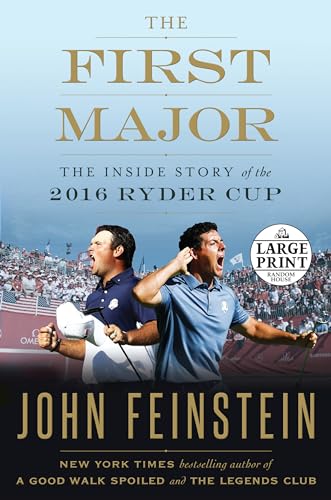
From the #1 New York Times bestselling author of A Good Walk Spoiled, a dramatic chronicle of the bitterly-fought 2016 Ryder Cup pitting a U.S. team out for revenge against the Europeans determined to keep the Cup out of American hands.
Coming into 2016, the Americans had lost an astounding six out of the last seven Ryder Cup matches, and tensions were running high for the showdown that took place in October, 2016 in Hazeltine, Minnesota, just days after American legend Arnold Palmer had died. What resulted was one of the most raucous and heated three days in the Cup's long history. Award-winning author John Feinstein takes readers behind the scenes, providing an inside view of the dramatic stories as they unfolded: veteran Phil Mickelson's two-year roller-coaster as he upended the American preparation process and helped assemble a superb team; superstar Rory McIlroy becoming the clear-cut emotional leader of the European team, and his reasons for wanting to beat the US team so badly this time around; the raucous matches between McIlroy and American Patrick Reed - resulting in both incredible golf, and several moments that threatened to come to blows; the return of Tiger Woods not as a player but an assistant captain, and his obsession with helping the US win - which was never the case when he was playing. John Feinstein's classic bestseller, A Good Walk Spoiled, set the bar for golf books. Now Feinstein provides his unique take on the Ryder Cup, which has clearly become golf's most intense and emotional event...it's 'first Major.'
Die Inhaltsangabe kann sich auf eine andere Ausgabe dieses Titels beziehen.
Über die Autorin bzw. den Autor
JOHN FEINSTEIN is the #1 New York Times bestselling author of the classics sports books A Season on the Brink and A Good Walk Spoiled, along with many other bestsellers including The Legends Club and Where Nobody Knows Your Name. He currently writes for The Washington Post and Golf Digest and is a regular contributor to the Golf Channel, Comcast Sports Regional Networks, and he hosts a college basketball show and a golf show on SiriusXM Radio.
Auszug. © Genehmigter Nachdruck. Alle Rechte vorbehalten.
One
Remarkably, the ending was almost quiet. After arguably the three most raucous days in golf history, the final meaningful stroke was a 20-foot birdie putt on the 18th green at Hazeltine National Golf Club that Ryan Moore cozied to within a foot of the cup.
From there he had two putts to clinch the Ryder Cup for the United States. Lee Westwood wasn’t going to make him bother with a tap-in. He conceded the putt—and their match—and, for the first time in eight years, the U.S. had won the Ryder Cup.
It was 4:11 p.m. Central time on a bright, breezy, early fall afternoon in the southwestern corner of Minnesota, and an American quest—one that had, at times, felt like Don Quixote tilting at the windmill—was finally over.
Moore was thirty-six, arguably the quietest member of the American team, an eleven-year PGA Tour veteran who, a week earlier, had been the last player selected by U.S. captain Davis Love III. Given that he had been 2 down with three holes to play and had rallied to win his match and clinch the Cup, he might have been expected to leap into someone’s arms.
Instead, he took his cap off and shook hands with Westwood. The crowd applauded and some broke into what felt like the millionth “USA!” chant of the weekend. Love, who had been given a second chance to captain a Ryder Cup team, gave Moore a heartfelt hug. Others lined up to do the same.
There were hugs all around for the American players, caddies, and wives. But there was no singing—as there always is when Europe wins the Cup—and no splashing of champagne. That would come later. Although Moore’s win had given the Americans the point that clinched the Cup, there were still three uncompleted matches on the golf course, and, since Ryder Cup tradition holds that all matches are played to completion, the six players involved kept on playing.
Watching the quiet American celebration, Rory McIlroy was a little bit surprised.
“It was almost weird,” McIlroy said later. “They waited so long, worked so hard, and played so well. I expected more.” He paused. “Maybe they were just relieved.”
Love noticed it too. “Honestly, for a second I thought, ‘Hang on, am I wrong, did we not just win? Is it possible that it’s not over? But then I looked around, and everyone—I mean everyone—had tears in their eyes. Some guys were just sobbing. Everyone had worked so hard for almost two years to get to that moment that the reaction was actually beyond joy or elation—it was more than that. It was like seeing your child graduate from college when you just well up with so much pride and relief and memories that you don’t cheer, you break down and cry.”
Relief. Joy. Catharsis. Every emotion was understandable. No American Ryder Cup team had ever been under the kind of pressure that Love’s team faced at Hazeltine. It wasn’t just three straight losses; six out of seven or eight out of ten—dating to 1995. It wasn’t just playing on home ground, after an extraordinary meltdown the last time the matches had been played in the U.S., or the fact that Europe was playing six Ryder Cup rookies—on the road.
There was more—much more. There was the infamous “task force,” which the PGA of America had formed in the wake of an embarrassing and acrimonious—among the Americans—loss in Scotland in 2014. There was Phil Mickelson’s feud with Tom Watson, the American captain in Scotland. There was Love’s labeling of his team as “maybe the best team ever assembled,” the week before everyone made the trip north to Minnesota.
And finally, there was Mickelson’s baffling decision to publicly take down 2004 U.S. captain Hal Sutton two days before the 2016 matches began.
“It’s almost as if they’re trying to figure out a way to help Europe win,” said Chubby Chandler, agent and best friend of European captain Darren Clarke. “I have no idea what they’re thinking over there.”
Love had brought up New England Patriots coach Bill Belichick, whom he had spent a little time with during one of the thousands (or so it seemed) of public appearances he had made as U.S. captain. Normally one of the most open and honest people in golf, Love had actually been a little bit cagey when answering questions leading up to Hazeltine.
“I’m channeling Coach Belichick,” he had said, smiling, on several occasions.
In truth, he was channeling Belichick—and many other successful coaches—but not by being circumspect with the media. It was all about creating an us-against-them mentality in his team room. There were twelve players, one captain, five vice captains, and—to a lesser extent— wives and partners, caddies and past Ryder Cup captains, who had been invited for the week. That was us. Everyone else was them. Even the fans, because Love knew they would turn on his players in a heartbeat if they didn’t play well—especially after all the prematch rhetoric and the past failures.
There was no better example of that us-against-them mentality than Love’s reaction to an on-air argument between Golf Channel analysts Brandel Chamblee and David Duval, on Tuesday night before Friday’s start to the Ryder Cup.
Duval had played on two Ryder Cup teams—the one that came from 10–6 down at Brookline in 1999 to win and the one that lost at the Belfry in 2002. He was a former number one player in the world and a major champion—having won the Open Championship at Royal Lytham & St. Annes in 2001. In short, he’d been a star.
Chamblee was a solid tour player, who won once in his PGA Tour career—at the 1998 Greater Vancouver Open. He got his degree from Texas in speech communications and has used his ability to communicate, along with a remarkable work ethic, to become the star on the Golf Channel in the last dozen years.
Because he’s never afraid to express an opinion, Chamblee isn’t terribly popular among the current players, most of whom believe that former players should never be critical of current players. Like Chamblee, Duval has his college degree—most tour players don’t graduate from college—and is one of the few ex-players who can stand toe to toe with Chamblee intellectually.
The questions asked on-air on the first full day of practice rounds leading up to Friday morning’s start of the matches were: Who’s to blame for the U.S.’s past failures in the Ryder Cup? And was it lack of leadership?
Chamblee, as usual, was direct and prepared. He blamed the failures of the American team on the two men who had been the leaders of those losing teams—Tiger Woods and Phil Mickelson.
“A team takes on the personality of its leadership,” Chamblee said. “If there’s apathetic leadership, there will be apathetic play.”
Duval adamantly disagreed. “You can’t assign losses to certain players,” he said. “It’s not about leadership, it’s about execution.”
The two argued vehemently for almost ten minutes—with Frank Nobilo stuck in the middle, literally and figuratively. When Nobilo finally did get a chance to speak, he sided with Duval. At one point, Duval said to Chamblee, “I realize you’re never wrong, I understand that.”
The anger was genuine—not staged for TV. By the time Golf Channel’s re-air of the evening show came on, word had spread—largely on the Internet and social media—about...
„Über diesen Titel“ kann sich auf eine andere Ausgabe dieses Titels beziehen.
Weitere beliebte Ausgaben desselben Titels

Suchergebnisse für The First Major: The Inside Story of the 2016 Ryder...

Beispielbild für diese ISBN
The First Major : The Inside Story of the 2016 Ryder Cup
Anbieter: Better World Books: West, Reno, NV, USA
Verkäuferbewertung 5 von 5 Sternen

Zustand: Good. Large Print. Former library copy. Pages intact with minimal writing/highlighting. The binding may be loose and creased. Dust jackets/supplements are not included. Includes library markings. Stock photo provided. Product includes identifying sticker. Better World Books: Buy Books. Do Good. Bestandsnummer des Verkäufers 40509634-75
Gebraucht kaufen
EUR 6,58
Versand gratis
Versand innerhalb von USA
Versand innerhalb von USA
Anzahl: 1 verfügbar
Beispielbild für diese ISBN
The First Major : The Inside Story of the 2016 Ryder Cup
Anbieter: Better World Books, Mishawaka, IN, USA
Verkäuferbewertung 5 von 5 Sternen
Zustand: Very Good. Large Print. Pages intact with possible writing/highlighting. Binding strong with minor wear. Dust jackets/supplements may not be included. Stock photo provided. Product includes identifying sticker. Better World Books: Buy Books. Do Good. Bestandsnummer des Verkäufers 55566358-6
Gebraucht kaufen
EUR 6,58
Versand gratis
Versand innerhalb von USA
Versand innerhalb von USA
Anzahl: 1 verfügbar
Beispielbild für diese ISBN
The First Major: The Inside Story of the 2016 Ryder Cup
Verlag:
Random House Large Print Publishing, 2017
ISBN 10: 0525528113
ISBN 13: 9780525528111
Gebraucht
Paperback
Anbieter: ThriftBooks-Atlanta, AUSTELL, GA, USA
Verkäuferbewertung 5 von 5 Sternen
Paperback. Zustand: Good. No Jacket. Pages can have notes/highlighting. Spine may show signs of wear. ~ ThriftBooks: Read More, Spend Less. Bestandsnummer des Verkäufers G0525528113I3N00
Gebraucht kaufen
EUR 8,15
Versand gratis
Versand innerhalb von USA
Versand innerhalb von USA
Anzahl: 1 verfügbar
Beispielbild für diese ISBN
The First Major: The Inside Story of the 2016 Ryder Cup
Verlag:
Random House Large Print October 2017, 2017
ISBN 10: 0525528113
ISBN 13: 9780525528111
Gebraucht
Trade Paperback
Anbieter: R Bookmark, Youngtown, AZ, USA
Verkäuferbewertung 5 von 5 Sternen
Trade Paperback. Zustand: Used - Good. Cover is wrapped in plastic protective cover. LARGE PRINT. Bestandsnummer des Verkäufers 189802
Gebraucht kaufen
EUR 3,97
EUR 5,25 Versand
Versand innerhalb von USA
Versand innerhalb von USA
Anzahl: 1 verfügbar
Beispielbild für diese ISBN
The First Major: The Inside Story of the 2016 Ryder Cup
Verlag:
Random House Large Print, 2017
ISBN 10: 0525528113
ISBN 13: 9780525528111
Gebraucht
paperback
Anbieter: Half Price Books Inc., Dallas, TX, USA
Verkäuferbewertung 5 von 5 Sternen
paperback. Zustand: Very Good. Connecting readers with great books since 1972! Used books may not include companion materials, and may have some shelf wear or limited writing. We ship orders daily and Customer Service is our top priority! Bestandsnummer des Verkäufers S_465333558
Gebraucht kaufen
EUR 6,83
EUR 2,99 Versand
Versand innerhalb von USA
Versand innerhalb von USA
Anzahl: 1 verfügbar
Beispielbild für diese ISBN
The First Major: The Inside Story of the 2016 Ryder Cup
Verlag:
Random House Large Print, 2017
ISBN 10: 0525528113
ISBN 13: 9780525528111
Gebraucht
paperback
Anbieter: HPB-Emerald, Dallas, TX, USA
Verkäuferbewertung 5 von 5 Sternen
paperback. Zustand: Very Good. Connecting readers with great books since 1972! Used books may not include companion materials, and may have some shelf wear or limited writing. We ship orders daily and Customer Service is our top priority! Bestandsnummer des Verkäufers S_470162182
Gebraucht kaufen
EUR 6,83
EUR 3,21 Versand
Versand innerhalb von USA
Versand innerhalb von USA
Anzahl: 1 verfügbar
Beispielbild für diese ISBN
The First Major: The Inside Story of the 2016 Ryder Cup
Verlag:
Random House Large Print, 2017
ISBN 10: 0525528113
ISBN 13: 9780525528111
Neu
paperback
Erstausgabe
Anbieter: Book Lover's Warehouse, Johnson City, TN, USA
Verkäuferbewertung 4 von 5 Sternen

paperback. Zustand: New. First Edition. FAST SHIPPING & FREE TRACKING! Bestandsnummer des Verkäufers 212139