
Verwandte Artikel zu Resetting the Table: Straight Talk About the Food We...
Inhaltsangabe
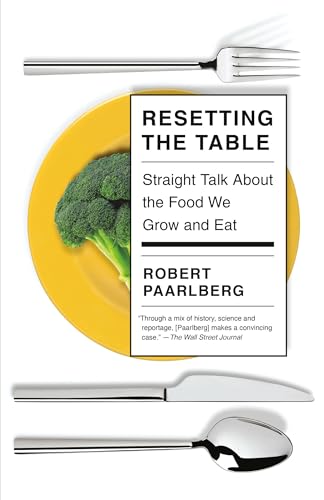
A bold, science-based corrective to the groundswell of misinformation about food and how it's produced, examining in detail local and organic food, food companies, nutrition labeling, ethical treatment of animals, environmental impact, and every other aspect from farm to table.
Consumers want to know more about their food—including the farm from which it came, the chemicals used to grow it, its nutritional value, how the animals were treated, and the costs to the environment. They are being told that buying organic foods, unprocessed and sourced from small local farms, is the most healthful and sustainable option. But what if we’re wrong? In Resetting the Table, Robert Paarlberg reviews the evidence and finds abundant reason to disagree. He delineates the ways in which global food markets have in fact improved our diet, and how "industrial" farming has recently turned green, thanks to GPS-guided precision methods that cut energy use and chemical pollution. He makes clear that America's serious obesity crisis does not come from farms, or from food deserts, but instead from "food swamps" created by food companies, retailers, and restaurant chains. And he explains how, though animal welfare is lagging behind, progress can be made through continued advocacy, more progressive regulations, and perhaps plant-based imitation meat. He finds solutions that can make sense for farmers and consumers alike and provides a road map through the rapidly changing worlds of food and farming, laying out a practical path to bring the two together.
Die Inhaltsangabe kann sich auf eine andere Ausgabe dieses Titels beziehen.
Über die Autorin bzw. den Autor
ROBERT PAARLBERG is adjunct professor of public policy at the Harvard Kennedy School and an associate at Harvard's Weatherhead Center. He has been a member of the Board of Agriculture and Natural Resources at the National Research Council, a member of the Board of Directors at Winrock International, and a consultant to the International Food Policy Research Institute, the U.S. Agency for International Development, and the Bill and Melinda Gates Foundation. He is the author of Starved for Science, Food Politics, and The United States of Excess. He lives in Massachusetts.
Auszug. © Genehmigter Nachdruck. Alle Rechte vorbehalten.
Introduction
In 2008, I was attending a panel discussion on “sustainable food” at Harvard University, in the storied Faculty Room of University Hall. The purpose of the panel was to promote and celebrate good food, so we were served tasty hors d’oeuvres carefully sourced from local farmers and fishermen, beginning with demitasse cups of a delicious scallop chowder from Cape Cod Bay. The featured speakers were a celebrity restaurateur from the San Francisco Bay Area, a playwright from New York, and the young leader of Slow Food USA. It didn’t take long for all three to reach a lockstep conclusion: In the future, they said, sustainable food would have to be organic, local, and “slow,” definitely not fast or industrial.
Those at the event nodded their heads in assent, but I had a different take, having just returned from a research trip to rural Africa. I had been interviewing farmers in Uganda who were trapped inside a food system that was entirely organic, local, and slow. The women I had spoken with (most African farmers are women) did not know it, but they were living an extreme version of the Harvard dream. They were organic because they could not afford any nitrogen fertilizer; their food was all local because the rutted dirt roads made transport almost impossible during the rainy season; and their daily food preparation tasks were laboriously slow. Before cooking a porridge meal for their family these women had to strip, soak, dry, and then pound the maize kernels into flour, then carry in wood to build a fire plus water for the pot. Despite these efforts, many of their children were stunted from poor nutrition.
Farmers are important to me for personal as well as professional reasons. Both of my parents were from a farming background, and as a young teenager in the summer months I worked on my uncle’s Indiana farm, alongside my older brother and two cousins. We got up early to feed the cattle and hogs in the dark, before sitting down to our own breakfast. My cousins were still too young to drive a car, but they were handling powered machinery, working with animals four times their size, and they already knew things about farming well beyond the ken of most playwrights or big-city restaurateurs.
Discussions of food today can quickly turn into discussions about farming. Consumers not only want food to be tasty, safe, nutritious, and affordable; they also want it to come from farms that protect the natural environment, respect the welfare of animals, help sustain rural communities, and give hired workers a living wage. I share all of these goals, but my prescriptions differ from the Harvard panel’s dream. My research experience tells me not to yearn for an organic, local, or slow food system, since that would mean abandoning a century’s worth of modern science. It would force farmers to accept more toil and less income, consumers would be given fewer nutritious food choices, and greater destruction would be done to the natural environment. All this will be explained.
The use of modern science is broadly welcomed in medicine, transport, and communications, yet it has become strangely controversial in food production. Many of my friends in Massachusetts, where I live and work, hold a view that modern farming has become far too “industrial.” They agree with Mark Bittman, a former New York Times columnist, who blames industrial farming for having “spawned an obesity crisis, poisoned countless volumes of land and water, wasted energy, tortured billions of animals.” They would also agree with Philip Lymbery, the author of Farmageddon, who concludes that “every day there is a new confirmation of how destructive, inefficient, wasteful, cruel and unhealthy the industrial agriculture machine is. We need a total rethink of our food and farming systems before it’s too late.”
As their preferred alternative, many of my friends imagine a return to small, local, and chemical-free (organic) farms. These farms should produce a traditional mix of both crops and animals, as opposed to the specialized, industrial-scale farms that today produce just one or two crops and probably have no animals at all. When it comes to buying food, my friends would rather not be seen shopping in supermarkets, since too many items on the shelf are heavily processed or have traveled too many “food miles.” Their ideal, when they have plenty of time, is to buy unprocessed foods directly from local growers at a farmers market, or from a community supported agriculture (CSA) farm. They admire Alice Waters, proprietor of the acclaimed Chez Panisse restaurant in Berkeley (she was one of the speakers on the 2008 Harvard panel), who states with pride that she has not set foot in a supermarket for the past twenty-five years.
I hear all this, but I’m not persuaded. I want a food solution that works for all, including people who live on a budget and those without a lot of spare time. Dinners at Chez Panisse must be a wonderful experience, but they start at more than a hundred dollars, not including the wine. Buying fresh produce at a farmers market is rewarding in season, but even then it means a separate trip to get needed products local farms don’t grow. Assembling healthy meals from fresh, unprocessed ingredients is a joy for many, but the time required for shopping, preparation, and cleanup may be too much for a single parent with school-age kids.
parent with school-age kids. Food solutions should also make sense for farmers. Here is where the organic approach creates problems, since it tells farmers they cannot use manufactured nitrogen fertilizers. True, all farming worked that way before synthetic fertilizers were first developed early in the twentieth century—but it made food production less abundant and needlessly laborious. Most farmers in the United States don’t want to turn the clock back, which is why only 1 percent of their land has been converted to organic production methods.
Problems would also arise if we “relocalized” our food system. Dietary health would decline because fresh fruits and vegetables would become scarce for many consumers in the cold winter months. Because transport costs have continued to fall, the dominant food system trend continues to be globalization, not localization. Traditional methods might at least seem a better way to protect the welfare of farm animals, given the abuses they suffer inside today’s “factory farm” confinement systems, but these traditional methods could not begin to meet today’s greatly expanded market demand for animal products. Total meat consumption in the United States is now five times as high as it was in 1940, and trying to meet this demand with traditional pasture and barnyard methods would be impossible. It will be better to follow Europe’s example and tighten welfare regulations for the farm animals we raise indoors, all the while developing better imitation meat products to reverse the growth of the livestock industry.
My realistic approach to such matters is one I learned from my father, who grew up on a small family farm in Indiana. After starting college late, he went on to earn a Ph.D. in agricultural economics, in order to learn why making a living on farms had suddenly become more difficult in the 1930s. My dad could be sentimental, but he always warned me not to romanticize the hard physical labor required by traditional farming.
My own career choice was also shaped by an early life experience, a trip to India and Nepal to visit my brother, who was serving in the Peace Corps. I had seen poverty in America, mostly in cities, but the extreme rural poverty I encountered on...
„Über diesen Titel“ kann sich auf eine andere Ausgabe dieses Titels beziehen.
Suchergebnisse für Resetting the Table: Straight Talk About the Food We...

Foto des Verkäufers
Resetting the Table: Straight Talk About the Food We Grow and Eat
Anbieter: Books for Life, LAUREL, MD, USA
Verkäuferbewertung 5 von 5 Sternen

Zustand: good. Book is in good condition. Minimal signs of wear. It May have markings or highlights, but kept to only a few pages. May not come with supplemental materials if applicable. Bestandsnummer des Verkäufers LFM.7PHP
Gebraucht kaufen
EUR 4,81
Versand gratis
Versand innerhalb von USA
Versand innerhalb von USA
Anzahl: 1 verfügbar
Beispielbild für diese ISBN
Resetting the Table: Straight Talk About the Food We Grow and Eat
Anbieter: World of Books (was SecondSale), Montgomery, IL, USA
Verkäuferbewertung 5 von 5 Sternen
Zustand: Good. Item in good condition. Textbooks may not include supplemental items i.e. CDs, access codes etc. Bestandsnummer des Verkäufers 00105861412
Gebraucht kaufen
EUR 5,37
Versand gratis
Versand innerhalb von USA
Versand innerhalb von USA
Anzahl: 1 verfügbar
Beispielbild für diese ISBN
Resetting the Table: Straight Talk about the Food We Grow and Eat
Anbieter: ThriftBooks-Atlanta, AUSTELL, GA, USA
Verkäuferbewertung 5 von 5 Sternen
Paperback. Zustand: Good. No Jacket. Pages can have notes/highlighting. Spine may show signs of wear. ~ ThriftBooks: Read More, Spend Less. Bestandsnummer des Verkäufers G0525566813I3N00
Gebraucht kaufen
EUR 5,96
Versand gratis
Versand innerhalb von USA
Versand innerhalb von USA
Anzahl: 1 verfügbar
Beispielbild für diese ISBN
Resetting the Table: Straight Talk about the Food We Grow and Eat
Anbieter: ThriftBooks-Dallas, Dallas, TX, USA
Verkäuferbewertung 5 von 5 Sternen
Paperback. Zustand: Good. No Jacket. Pages can have notes/highlighting. Spine may show signs of wear. ~ ThriftBooks: Read More, Spend Less. Bestandsnummer des Verkäufers G0525566813I3N00
Gebraucht kaufen
EUR 5,96
Versand gratis
Versand innerhalb von USA
Versand innerhalb von USA
Anzahl: 1 verfügbar
Beispielbild für diese ISBN
Resetting the Table: Straight Talk about the Food We Grow and Eat
Anbieter: ThriftBooks-Reno, Reno, NV, USA
Verkäuferbewertung 5 von 5 Sternen
Paperback. Zustand: Good. No Jacket. Pages can have notes/highlighting. Spine may show signs of wear. ~ ThriftBooks: Read More, Spend Less. Bestandsnummer des Verkäufers G0525566813I3N00
Gebraucht kaufen
EUR 5,96
Versand gratis
Versand innerhalb von USA
Versand innerhalb von USA
Anzahl: 1 verfügbar
Beispielbild für diese ISBN
Resetting the Table : Straight Talk about the Food We Grow and Eat
Verlag:
Knopf Doubleday Publishing Group, 2022
ISBN 10: 0525566813
ISBN 13: 9780525566816
Gebraucht
Softcover
Anbieter: Better World Books: West, Reno, NV, USA
Verkäuferbewertung 5 von 5 Sternen
Zustand: Good. Pages intact with minimal writing/highlighting. The binding may be loose and creased. Dust jackets/supplements are not included. Stock photo provided. Product includes identifying sticker. Better World Books: Buy Books. Do Good. Bestandsnummer des Verkäufers 68224089-75
Gebraucht kaufen
EUR 9,86
Versand gratis
Versand innerhalb von USA
Versand innerhalb von USA
Anzahl: 1 verfügbar
Foto des Verkäufers
Resetting the Table : Straight Talk About the Food We Grow and Eat
Anbieter: GreatBookPrices, Columbia, MD, USA
Verkäuferbewertung 5 von 5 Sternen
Zustand: As New. Unread book in perfect condition. Bestandsnummer des Verkäufers 43546227
Gebraucht kaufen
EUR 12,48
EUR 2,30 Versand
Versand innerhalb von USA
Versand innerhalb von USA
Anzahl: 15 verfügbar
Beispielbild für diese ISBN
Resetting the Table : Straight Talk About the Food We Grow and Eat
Anbieter: GreatBookPrices, Columbia, MD, USA
Verkäuferbewertung 5 von 5 Sternen
Zustand: New. Bestandsnummer des Verkäufers 43546227-n
Neu kaufen
EUR 12,48
EUR 2,30 Versand
Versand innerhalb von USA
Versand innerhalb von USA
Anzahl: 15 verfügbar
Beispielbild für diese ISBN
ResettingtheTable Format: Paperback
Anbieter: INDOO, Avenel, NJ, USA
Verkäuferbewertung 5 von 5 Sternen
Zustand: As New. Unread copy in mint condition. Bestandsnummer des Verkäufers RH9780525566816
Gebraucht kaufen
EUR 14,85
Versand gratis
Versand innerhalb von USA
Versand innerhalb von USA
Anzahl: Mehr als 20 verfügbar
Beispielbild für diese ISBN
ResettingtheTable Format: Paperback
Anbieter: INDOO, Avenel, NJ, USA
Verkäuferbewertung 5 von 5 Sternen
Zustand: New. Bestandsnummer des Verkäufers 9780525566816
Neu kaufen
EUR 14,85
Versand gratis
Versand innerhalb von USA
Versand innerhalb von USA
Anzahl: Mehr als 20 verfügbar