
Verwandte Artikel zu The End of Science: Facing the Limits of Knowledge...
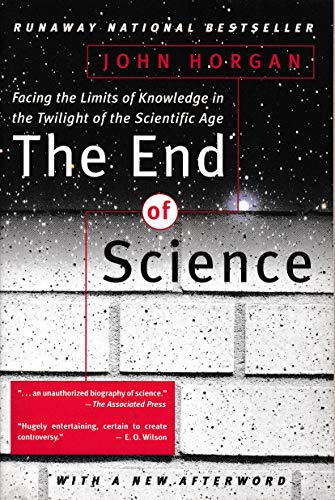
The End of Science: Facing the Limits of Knowledge in the Twilight of the Scientific Age (Helix Books) - Softcover
Inhaltsangabe
Draws on interviews with many of the worlds leading scientists to discuss the possibility that humankind has reached the limits of scientific knowledge
Die Inhaltsangabe kann sich auf eine andere Ausgabe dieses Titels beziehen.
Auszug. © Genehmigter Nachdruck. Alle Rechte vorbehalten.
It was in the summer of 1989, during a trip to upstate New York, that I began to think seriously about the possibility that science, pure science, might be over. I had flown to the University of Syracuse to interview Roger Penrose, a British physicist who was a visiting scholar there. Before meeting Penrose, I had struggled through galleys of his dense, difficult book, The Emperor's New Mind, which to my astonishment became a best-seller several months later, after being praised in the New York Times Book Review. In the book, Penrose cast his eye across the vast panorama of modern science and found it wanting. This knowledge, Penrose asserted, for all its power and richness, could not possibly account for the ultimate mystery of existence, human consciousness.
The key to consciousness, Penrose speculated, might be hidden in the fissure between the two major theories of modern physics: quantum mechanics, which describes electromagnetism and the nuclear forces, and general relativity, Einstein's theory of gravity. Many physicists, beginning with Einstein, had tried and failed to fuse quantum mechanics and general relativity into a single, seamless "unified" theory. In his book, Penrose sketched out what a unified theory might look like and how it might give rise to thought. His scheme, which involved exotic quantum and gravitational effects percolating through the brain, was vague, convoluted, utterly unsupported by evidence from physics or neuroscience. But if it turned out to be in any sense right, it would represent a monumental achievement, a theory that in one stroke would unify physics and solve one of philosophy's most vexing problems, the link between mind and matter. Penrose's ambition alone, I thought, would make him an excellent subject for a profile in Scientific American, which employed me as a staff writer.
When I arrived at the airport in Syracuse, Penrose was waiting for me. He was an elfin man, capped with a shock of black hair, who seemed simultaneously distracted and acutely alert. As he drove us back to the Syracuse campus, he kept wondering aloud if he was going in the right direction. He seemed awash in mysteries. I found myself in the disconcerting position of recommending that he take this exit, or make that turn, although I had never been in Syracuse before. In spite of our combined ignorance, we managed to make our way without incident to the building where Penrose worked. On entering Penrose's office we discovered that a colleague had left a brightly colored aerosol can labeled Superstring on his desk. When Penrose pushed the button on the top of the can, a lime green spaghetti-like strand shot across the room.
Penrose smiled at this little insider's joke. Superstring is the name not only of a child's toy, but also of an extremely small and extremely hypothetical stringlike particle posited by a popular theory of physics. According to the theory, the wriggling of these strings in a 10-dimensional hyperspace generates all the matter and energy in the universe and even space and time. Many of the world's leading physicists felt that superstring theory might turn out to be the unified theory they had sought for so long; some even called it a theory of everything. Penrose was not among the faithful. "It couldn't be right," he told me. "It's just not the way I'd expect the answer to be." I began to realize, as Penrose spoke, that to him "the answer" was more than a mere theory of physics, a way of organizing data and predicting events. He was talking about The Answer: the secret of life, the solution to the riddle of the universe.
Penrose is an admitted Platonist. Scientists do not invent the truth; they discover it. Genuine truths exude a beauty, a rightness, a self-evident quality that gives them the power of revelation. Superstring theory did not possess these traits, in Penrose's mind. He conceded that the "suggestion" he set forth in The Emperor's New Mind--it did not merit the term theory yet, he admitted--was rather ungainly. It might turn out to be wrong, certainly in its details. But he felt sure that it was closer to the truth than was superstring theory. In saying that, I asked, was Penrose implying that one day scientists would find The Answer and thus bring their quest to an end?
Unlike some prominent scientists, who seem to equate tentativity with weakness, Penrose actually thinks before he responds, and even as he responds. "I don't think we're close," he said slowly, squinting out his of office window, "but it doesn't mean things couldn't move fast at some stage." He cogitated some more. "I guess this is rather suggesting that there is an answer," he continued, "although perhaps that's too pessimistic." This final comment stopped me short. What is so pessimistic, I asked, about a truth seeker thinking that the truth is attainable? "Solving mysteries is a wonderful thing to do," Penrose replied. "And if they were all solved, somehow, that would be rather boring." Then he chuckled, as if struck by the oddness of his own words.
Long after leaving Syracuse, I mulled over Penrose's remarks. Was it possible that science could come to an end? Could scientists, in effect, learn everything there is to know? Could they banish mystery from the universe? It was hard for me to imagine a world without science, and not only because my job depended on it. I had become a science writer in large part because I considered science--pure science, the search for knowledge for its own sake--to be the noblest and most meaningful of human endeavors. We are here to figure out why we are here. What other purpose is worthy of us?
I had not always been so enamored of science. In college, I passed through a phase during which literary criticism struck me as the most thrilling of intellectual endeavors. Late one night, however, after too many cups of coffee, too many hours spent slogging through yet another interpretation of James Joyce's Ulysses, I had a crisis of faith. Very smart people had been arguing for decades over the meaning of Ulysses. But one of the messages of modern criticism, and of modern literature, was that all texts are "ironic": they have multiple meanings, none of them definitive. Oedipus Rex, The Inferno, even the Bible are in a sense "just kidding," not to be taken too literally. Arguments over meaning can never be resolved, since the only true meaning of a text is the text itself. Of course, this message applied to the critics, too. One was left with an infinite regress of interpretations, none of which represented the final word. But everyone still kept arguing! To what end? For each critic to be more clever, more interesting, than the rest? It all began to seem pointless.
Although I was an English major, I took at least one course in science or mathematics every semester. Working on a problem in calculus or physics represented a pleasant change of pace from messy humanities assignments; I found great satisfaction in arriving at the correct answer to a problem. The more frustrated I became with the ironic outlook of literature...
„Über diesen Titel“ kann sich auf eine andere Ausgabe dieses Titels beziehen.
Suchergebnisse für The End of Science: Facing the Limits of Knowledge...

Beispielbild für diese ISBN
The End Of Science: Facing The Limits Of Knowledge In The Twilight Of The Scientific Age
Anbieter: More Than Words, Waltham, MA, USA
Verkäuferbewertung 5 von 5 Sternen

Zustand: Good. A sound copy with only light wear. Overall a solid copy at a great price! Bestandsnummer des Verkäufers BOS-L-03h-01829
Gebraucht kaufen
EUR 0,92
EUR 3,55 Versand
Versand innerhalb von USA
Versand innerhalb von USA
Anzahl: 2 verfügbar
Beispielbild für diese ISBN
The End Of Science: Facing The Limits Of Knowledge In The Twilight Of The Scientific Age
Anbieter: World of Books (was SecondSale), Montgomery, IL, USA
Verkäuferbewertung 5 von 5 Sternen
Zustand: Good. Item in good condition. Textbooks may not include supplemental items i.e. CDs, access codes etc. Bestandsnummer des Verkäufers 00059858889
Gebraucht kaufen
EUR 4,50
Versand gratis
Versand innerhalb von USA
Versand innerhalb von USA
Anzahl: 4 verfügbar
Beispielbild für diese ISBN
The End Of Science: Facing The Limits Of Knowledge In The Twilight Of The Scientific Age
Anbieter: World of Books (was SecondSale), Montgomery, IL, USA
Verkäuferbewertung 5 von 5 Sternen
Zustand: Acceptable. Item in acceptable condition! Textbooks may not include supplemental items i.e. CDs, access codes etc. Bestandsnummer des Verkäufers 00098018188
Gebraucht kaufen
EUR 4,50
Versand gratis
Versand innerhalb von USA
Versand innerhalb von USA
Anzahl: 1 verfügbar
Foto des Verkäufers
The End Of Science: Facing The Limits Of Knowledge In The Twilight Of The Scientific Age
Anbieter: Greenworld Books, Arlington, TX, USA
Verkäuferbewertung 5 von 5 Sternen
Zustand: very_good. Fast Free Shipping â" Very Good condition book with a firm cover and clean pages. Shows normal use and some light wear or limited notes markings. A solid, nice copy to enjoy. Bestandsnummer des Verkäufers GWV.0553061747.VG
Gebraucht kaufen
EUR 4,51
Versand gratis
Versand innerhalb von USA
Versand innerhalb von USA
Anzahl: 1 verfügbar
Beispielbild für diese ISBN
The End Of Science: Facing The Limits Of Knowledge In The Twilight Of The Scientific Age
Verlag:
Broadway Books (edition Reprint), 1997
ISBN 10: 0553061747
ISBN 13: 9780553061741
Gebraucht
Paperback
Anbieter: BooksRun, Philadelphia, PA, USA
Verkäuferbewertung 5 von 5 Sternen
Paperback. Zustand: Fair. Reprint. The item might be beaten up but readable. May contain markings or highlighting, as well as stains, bent corners, or any other major defect, but the text is not obscured in any way. Bestandsnummer des Verkäufers 0553061747-7-22
Gebraucht kaufen
EUR 4,91
Versand gratis
Versand innerhalb von USA
Versand innerhalb von USA
Anzahl: 1 verfügbar
Beispielbild für diese ISBN
The End Of Science: Facing The Limits Of Knowledge In The Twilight Of The Scientific Age
Verlag:
Broadway Books (edition Reprint), 1997
ISBN 10: 0553061747
ISBN 13: 9780553061741
Gebraucht
Paperback
Anbieter: BooksRun, Philadelphia, PA, USA
Verkäuferbewertung 5 von 5 Sternen
Paperback. Zustand: Very Good. Reprint. It's a well-cared-for item that has seen limited use. The item may show minor signs of wear. All the text is legible, with all pages included. It may have slight markings and/or highlighting. Bestandsnummer des Verkäufers 0553061747-11-1
Gebraucht kaufen
EUR 5,29
Versand gratis
Versand innerhalb von USA
Versand innerhalb von USA
Anzahl: 1 verfügbar
Beispielbild für diese ISBN
The End of Science
Anbieter: Better World Books: West, Reno, NV, USA
Verkäuferbewertung 5 von 5 Sternen
Zustand: Good. Reprint. Pages intact with minimal writing/highlighting. The binding may be loose and creased. Dust jackets/supplements are not included. Stock photo provided. Product includes identifying sticker. Better World Books: Buy Books. Do Good. Bestandsnummer des Verkäufers 650545-6
Gebraucht kaufen
EUR 6,16
Versand gratis
Versand innerhalb von USA
Versand innerhalb von USA
Anzahl: 1 verfügbar
Beispielbild für diese ISBN
The End of Science
Anbieter: Better World Books, Mishawaka, IN, USA
Verkäuferbewertung 5 von 5 Sternen
Zustand: Good. Reprint. Pages intact with minimal writing/highlighting. The binding may be loose and creased. Dust jackets/supplements are not included. Stock photo provided. Product includes identifying sticker. Better World Books: Buy Books. Do Good. Bestandsnummer des Verkäufers 650545-6
Gebraucht kaufen
EUR 6,16
Versand gratis
Versand innerhalb von USA
Versand innerhalb von USA
Anzahl: 1 verfügbar
Beispielbild für diese ISBN
The End Of Science: Facing The Limits Of Knowledge In The Twilight Of The Scientific Age
Anbieter: Wonder Book, Frederick, MD, USA
Verkäuferbewertung 5 von 5 Sternen
Zustand: Good. Good condition. A copy that has been read but remains intact. May contain markings such as bookplates, stamps, limited notes and highlighting, or a few light stains. Bestandsnummer des Verkäufers T07D-02446
Gebraucht kaufen
EUR 6,40
Versand gratis
Versand innerhalb von USA
Versand innerhalb von USA
Anzahl: 3 verfügbar
Beispielbild für diese ISBN
The End Of Science: Facing The Limits Of Knowledge In The Twilight Of The Scientific Age
Anbieter: HPB-Ruby, Dallas, TX, USA
Verkäuferbewertung 5 von 5 Sternen
paperback. Zustand: Very Good. Connecting readers with great books since 1972! Used books may not include companion materials, and may have some shelf wear or limited writing. We ship orders daily and Customer Service is our top priority! Bestandsnummer des Verkäufers S_473226785
Gebraucht kaufen
EUR 3,42
EUR 3,33 Versand
Versand innerhalb von USA
Versand innerhalb von USA
Anzahl: 1 verfügbar