
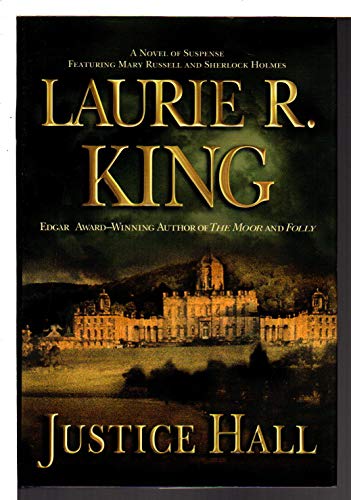
Inhaltsangabe
Mary Russell and her famed sleuthing spouse, Sherlock Holmes, journey to one of Britain's stately homes as they investigate a dark secret whose origins reach deep into the very soul of England. By the author of The Beekeeper's Apprentice. 40,000 first printing.
Die Inhaltsangabe kann sich auf eine andere Ausgabe dieses Titels beziehen.
Über die Autorin bzw. den Autor
Laurie R. King lives with her family in the hills above Monterey Bay in northern California. Her background includes such diverse interests as Old Testament theology and construction work, and she has been writing crime fiction since 1987. The winner of the Edgar, the Nero, and the John Creasey awards, her most recent novel is Folly.
Aus dem Klappentext
Dazzling readers and critics alike, Laurie R. King's bestselling mystery series featuring Mary Russell and her partner-in-crime Sherlock Holmes has been described by The New York Times as a lively adventure in the very best of intellectual company.
Author of The Moor, The Beekeeper s Apprentice, and O Jerusalem, King the first writer since Patricia Cornwell to win the most prized mystery awards in both the United States and England for a debut novel (A Grave Talent) brings back Russell and her famous mentor to solve a case that may prove their undoing.
Justice Hall
Just hours after Holmes and Russell return from solving the murky riddle of The Moor, a bloodied but oddly familiar stranger pounds desperately on their front door, pleads for their help, and then collapses. When he recovers, he lays before them the story of the enigmatic Marsh Hughenfort, younger brother of the Duke of Beauville, returned to England upon his brother s death.Not until Holmes and Russell arrive in the village of Arley Holt can they fully understand Marsh s dilemma.
For Justice Hall is a home of dizzying beauty and unearthly perfection, set in a garden modeled on Paradise. Russell longs for what it represents: permanence, history, the kind of roots that reach back for centuries. But Holmes senses the burdens echoed in the family motto, Justitia fortitudo mea est. And as Marsh seeks to live by the words, Righteousness is my strength, he is determined to learn the truth about the untimely death of Justice Hall s expected heir...a puzzle he is convinced only Holmes and Russell can solve.
It s a mystery that begins during the Great War of 1918, when young Gabriel Hughenfort, the late Duke s only son, died amidst scandalous rumors that have haunted the family ever since. While Holmes heads to London to uncover the truth of Gabriel s war record, Russell joins an ill-fated shooting party. A missing diary, a purloined bundle of letters, and a trail of ominous clues comprise a mystery that will call for Holmes s cleverest disguises and Russell s most daring journeys into the unknown...from an English hamlet to the city of Paris to the wild prairie of the New World. The trap is set, the game is afoot, but can they catch an elusive villain in the act of murder before they become
his next victims?
A brilliant blend of traditional Holmesian myth, startling originality, complex plotting, and unforgettable characters set against a fully realized early-twentieth-century world, Justice Hall will delight readers with a mystery as intelligent as it is engagingly devious.
Auszug. © Genehmigter Nachdruck. Alle Rechte vorbehalten.
CHAPTER ONE
Home, my soul sighed. I stood on the worn flagstones and breathed in the many and varied fragrances of the old flint-walled cottage: Fresh beeswax and lavender told me that Mrs. Hudson had indulged in an orgy of housecleaning in the freedom of our prolonged absence; the smoke from the wood fire seemed cleaner than the heavy peat-tinged air I'd been inhaling in recent weeks; the month-old pipe tobacco was a ghost of its usual self; and beneath it all the faint, dangerous, seductive tang of chemicals from the laboratory overhead.
And scones.
Holmes grumbled his way past, jostling me from my reverie. I stepped back out into the crisp, sea-scented afternoon to thank my farm manager, Patrick, for meeting us at the station, but he was already away down the drive, so I closed the heavy door, slid its two-hundred-year-old bolt, and leant my back against the wood with all the mingled relief and determination of a feudal lord shutting out an unruly mob.
Domus, my mind offered. Familia, my heart replied. Home.
"Mrs. Hudson!" Holmes shouted from the main room. "We're home." His unnecessary declaration (she knew we were coming; else why the fresh baking?) was accompanied by the characteristic thumps and cracks of possessions being shed onto any convenient surface, freshly polished or not. At the sound of her voice answering from the kitchen, I had to smile. How many times had I returned here, to that ritual exchange? Dozens: following an absence of two days in London when the only things shed were furled umbrella and silk hat, or after three months in Europe when two burly men had helped to haul inside our equipage, consisting of a trunk filled with mud-caked climbing equipment, three crates of costumes, many arcane and ancient volumes of worldly wisdom, and two-thirds of a motor-cycle.
The only time I had come to this house with less than joy was the day when Holmes and my nineteen-year-old self had been acting out a play of alienation, and I could see in his haggard features the toll it was taking on him. Other than that time, to enter the house was to feel the touch of comforting hands. Home.
I caught up my discarded rucksack and followed Holmes through to the fire; to tea, and buttered scones, and welcome.
Hot tea and scalding baths, conversations with Mrs. Hudson, and the accumulated post carried us to dinner: urgent enquiries from my solicitor regarding a property sale in California; a cheerful letter from Holmes' old comrade-at-arms, Dr Watson, currently on holiday in Egypt; a demand from Scotland Yard for pieces of evidence in regard to a case over the summer. Over the dinner table, however, the momentum of normality came to its peak over Mrs. Hudson's fiery curry, faltered with the apple tart, and then receded, leaving us washed up in our chairs before the fire, listening to the silence.
I sighed to myself. Each time, I managed to forget this phase--or not forget, exactly, just to hope the interim would be longer, the transition less of a jolt. Instead, the drear aftermath of a case came down with all the gentleness of a collapsing wall.
One would think that, following several taut, urgent weeks of considerable physical discomfort on Dartmoor, a person would sink into the undemanding Downland quiet with a bone-deep pleasure, wrapping indolence around her like a fur coat, welcoming a period of blank inertia, the gears of the mind allowed to move slowly, if at all. One would think.
Instead of which, every time we had come away from a case there had followed a period of bleak, hungry restlessness, characterised by shortness of temper, an inability to settle to a task, and the need for distraction--for which long, difficult walks or hard physical labour, experience taught me, were the only relief. And now, following not one but two, back-to-back cases, with the client of the summer's case long dead and that of the autumn now taken to his Dartmoor deathbed, this looked to be a grim time indeed. To this point, the worst such dark mood that I had experienced was that same joyless period just under five years before, when I was nineteen and we had returned from two months of glorious, exhilarating freedom wandering Palestine under the unwilling tutelage of a pair of infuriating Arabs, Ali and Mahmoud Hazr, only to return to an English winter, a foe after our skins, and a necessary pretence of emotional divorcement from Holmes. I am no potential suicide, but I will say that acting one at the time would not have proved difficult.
Hard work, as I say, helped; intense experiences helped, too: scalding baths, swims through an icy sea, spicy food (such as the curry Mrs. Hudson had given us: How well she knew Holmes!), bright colours. My skin still tingled from the hot water, and I had donned a robe of brilliant crimson, but the coffee in my cup was suddenly insipid. I jumped up and went into the kitchen, coming back ten minutes later with two cups of steaming hot sludge that had caused Mrs. Hudson to look askance, although she had said nothing. I put one cup beside Holmes' brandy glass and settled down on a cushion in front of the fire with the other, wrapping both hands around it and breathing in the powerful fragrance.
"What do you call this?" Holmes asked sharply.
"A weak imitation of Arab coffee," I told him. "Although I think Mahmoud used cardamom, and the closest Mrs. Hudson had was cinnamon."
He raised a thoughtful eyebrow at me, peered dubiously into the murky depths of the cup, and sipped tentatively. It was not the real thing, but it was strong and vivid on the palate, and for a moment the good English oak beams over our heads were replaced by the ghost of a goat's hair tent, and the murmur of the flames seemed to hold the ebb and flow of a foreign tongue. New flavours, new dangers, and the sun of an ancient land, the land of my people; trials and a time of great personal discovery; our Bedu companions, Mahmoud the rock and Ali the flame. Odd, I thought, how the taciturn older brother had possessed such a subtle hand at the cook-fire, and had made such an art of the coffee ritual.
No, the dark substance in our cups was by no means the real thing, but both of us drank to the dregs, while images from the weeks in Palestine flickered through the edges of my mind: dawn over the Holy City and mid-night in its labyrinthine bazaar; the ancient stones of the Western Wall and the great cavern quarry undermining the city's northern quarter; Ali polishing the dust from his scarlet Egyptian boots; Mahmoud's odd, slow smile of approval; Holmes' bloody back when we rescued him from his tormentor; General Allenby and the well-suited Bentwiches and the fair head of T. E. Lawrence, and--and then Holmes rattled his newspaper and the images vanished. I fluffed my fingers through my drying hair and picked up my book. Silence reigned, but for the crackle of logs and the turn of pages. After a few minutes, I chuckled involuntarily. Holmes looked up, startled.
"What on earth are you reading?" he demanded.
"It's not the book, Holmes, it's the situation. All you need is an aged retriever lying across your slippers, we'd be a portrait of family life. The artist could call it After a Long Day; he'd sell hundreds of copies."
"We've had a fair number of long days," he noted, although without complaint. "And I was just reflecting how very pleasant it was, to be without demands. For a short time," he added, as aware as I that the respite would be brief between easy fatigue and the onset of bleak boredom. I smiled at him.
"It is nice, Holmes, I agree."
"I find myself particularly enjoying the delusory and fleeting impression that my wife spends any time at all seated at the feet of her husband. One might almost be led...
„Über diesen Titel“ kann sich auf eine andere Ausgabe dieses Titels beziehen.
Weitere beliebte Ausgaben desselben Titels

Suchergebnisse für Justice Hall: A Mary Russell Novel

Foto des Verkäufers
Justice Hall
Anbieter: Zoom Books East, Glendale Heights, IL, USA
Verkäuferbewertung 5 von 5 Sternen

Zustand: very_good. Book is in very good condition and may include minimal underlining highlighting. The book can also include "From the library of" labels. May not contain miscellaneous items toys, dvds, etc. . We offer 100% money back guarantee and 24 7 customer service. Bestandsnummer des Verkäufers ZEV.0553111132.VG
Gebraucht kaufen
EUR 4,50
Versand gratis
Versand innerhalb von USA
Versand innerhalb von USA
Anzahl: 1 verfügbar
Beispielbild für diese ISBN
Justice Hall A Mary Russell No
Anbieter: World of Books (was SecondSale), Montgomery, IL, USA
Verkäuferbewertung 5 von 5 Sternen
Zustand: Very Good. Item in very good condition! Textbooks may not include supplemental items i.e. CDs, access codes etc. Bestandsnummer des Verkäufers 00095345113
Gebraucht kaufen
EUR 4,98
Versand gratis
Versand innerhalb von USA
Versand innerhalb von USA
Anzahl: 1 verfügbar
Beispielbild für diese ISBN
Justice Hall A Mary Russell No
Anbieter: World of Books (was SecondSale), Montgomery, IL, USA
Verkäuferbewertung 5 von 5 Sternen
Zustand: Good. Item in good condition. Textbooks may not include supplemental items i.e. CDs, access codes etc. Bestandsnummer des Verkäufers 00095606934
Gebraucht kaufen
EUR 4,98
Versand gratis
Versand innerhalb von USA
Versand innerhalb von USA
Anzahl: 3 verfügbar
Beispielbild für diese ISBN
Justice Hall A Mary Russell No
Anbieter: World of Books (was SecondSale), Montgomery, IL, USA
Verkäuferbewertung 5 von 5 Sternen
Zustand: Acceptable. Item in acceptable condition! Textbooks may not include supplemental items i.e. CDs, access codes etc. Bestandsnummer des Verkäufers 00106006013
Gebraucht kaufen
EUR 4,98
Versand gratis
Versand innerhalb von USA
Versand innerhalb von USA
Anzahl: 1 verfügbar
Beispielbild für diese ISBN
Justice Hall
Verlag:
Bantam (edition First Edition), 2002
ISBN 10: 0553111132
ISBN 13: 9780553111132
Gebraucht
Hardcover
Erstausgabe
Anbieter: BooksRun, Philadelphia, PA, USA
Verkäuferbewertung 5 von 5 Sternen
Hardcover. Zustand: Fair. First Edition. With dust jacket. The item might be beaten up but readable. May contain markings or highlighting, as well as stains, bent corners, or any other major defect, but the text is not obscured in any way. Bestandsnummer des Verkäufers 0553111132-7-1-29
Gebraucht kaufen
EUR 5,18
Versand gratis
Versand innerhalb von USA
Versand innerhalb von USA
Anzahl: 1 verfügbar
Foto des Verkäufers
Justice Hall
Anbieter: Greenworld Books, Arlington, TX, USA
Verkäuferbewertung 5 von 5 Sternen
Zustand: good. Fast Free Shipping â" Good condition. It may show normal signs of use, such as light writing, highlighting, or library markings, but all pages are intact and the book is fully readable. A solid, complete copy that's ready to enjoy. Bestandsnummer des Verkäufers GWV.0553111132.G
Gebraucht kaufen
EUR 5,23
Versand gratis
Versand innerhalb von USA
Versand innerhalb von USA
Anzahl: 1 verfügbar
Beispielbild für diese ISBN
Justice Hall
Anbieter: Half Price Books Inc., Dallas, TX, USA
Verkäuferbewertung 5 von 5 Sternen
Hardcover. Zustand: Very Good. Connecting readers with great books since 1972! Used books may not include companion materials, and may have some shelf wear or limited writing. We ship orders daily and Customer Service is our top priority! Bestandsnummer des Verkäufers S_462828240
Gebraucht kaufen
EUR 2,28
EUR 3,05 Versand
Versand innerhalb von USA
Versand innerhalb von USA
Anzahl: 1 verfügbar
Foto des Verkäufers
Justice Hall
Anbieter: ZBK Books, Carlstadt, NJ, USA
Verkäuferbewertung 5 von 5 Sternen
Zustand: good. Fast & Free Shipping â" Good condition. It may show normal signs of use, such as light writing, highlighting, or library markings, but all pages are intact and the book is fully readable. A solid, complete copy that's ready to enjoy. Bestandsnummer des Verkäufers ZWV.0553111132.G
Gebraucht kaufen
EUR 5,35
Versand gratis
Versand innerhalb von USA
Versand innerhalb von USA
Anzahl: 1 verfügbar
Foto des Verkäufers
Justice Hall
Anbieter: Zoom Books East, Glendale Heights, IL, USA
Verkäuferbewertung 5 von 5 Sternen
Zustand: like_new. Book is in like new condition with minimal signs of wear. Pages are clean and free from notes or highlighting. Dust cover is intact. May not contain miscellaneous items toys, dvds, etc. . We offer 100% money back guarantee and 24 7 customer service. Bestandsnummer des Verkäufers ZEV.0553111132.LN
Gebraucht kaufen
EUR 5,44
Versand gratis
Versand innerhalb von USA
Versand innerhalb von USA
Anzahl: 1 verfügbar
Beispielbild für diese ISBN
Justice Hall
Anbieter: HPB-Diamond, Dallas, TX, USA
Verkäuferbewertung 5 von 5 Sternen
Hardcover. Zustand: Very Good. Connecting readers with great books since 1972! Used books may not include companion materials, and may have some shelf wear or limited writing. We ship orders daily and Customer Service is our top priority! Bestandsnummer des Verkäufers S_435851766
Gebraucht kaufen
EUR 2,26
EUR 3,28 Versand
Versand innerhalb von USA
Versand innerhalb von USA
Anzahl: 1 verfügbar