
Verwandte Artikel zu David Copperfield, English edition (Bantam Classics)
Inhaltsangabe
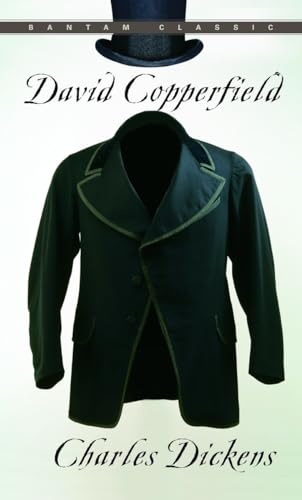
Of all Dickens's novels, David Copperfield most fervently embraces the comic delights, the tender warmth, the tragic horrors of childhood. It is our classic tale of growing up, an enchanting story of a gently orphan discovering life and love in an indifferent adult world. Persecuted by his wrathful stepfather, Mr. Murdstone; deceived by his boyhood idol, the callous, charming Steerforth; driven into mortal combat with the sniveling clerk Uriah Heep; and hurled, pell-mell, into a blizzard of infatuation with the adorably dim-witted Dora, he survives the worst-and the best-with inimitable style, his bafflement tuming to self-awareness and his unbridles young heart growing ever more disciplined and true.
Of this richly autobiographical novel Dickens himself wrote, "like many fond parents, I have in my heart of hearts a favorite child. And his name is David Copperfield."
Die Inhaltsangabe kann sich auf eine andere Ausgabe dieses Titels beziehen.
Über die Autorin bzw. den Autor
Charles Dickens was born in a little house in Landport, Portsea, England, on February 7, 1812. The second of eight children, he grew up in a family frequently beset by financial insecurity. At age eleven, Dickens was taken out of school and sent to work in London backing warehouse, where his job was to paste labels on bottles for six shillings a week. His father John Dickens, was a warmhearted but improvident man. When he was condemned the Marshela Prison for unpaid debts, he unwisely agreed that Charles should stay in lodgings and continue working while the rest of the family joined him in jail. This three-month separation caused Charles much pain; his experiences as a child alone in a huge city–cold, isolated with barely enough to eat–haunted him for the rest of his life.
When the family fortunes improved, Charles went back to school, after which he became an office boy, a freelance reporter and finally an author. With Pickwick Papers (1836-7) he achieved immediate fame; in a few years he was easily the post popular and respected writer of his time. It has been estimated that one out of every ten persons in Victorian England was a Dickens reader. Oliver Twist (1837), Nicholas Nickleby (1838-9) and The Old Curiosity Shop (1840-41) were huge successes. Martin Chuzzlewit (1843-4) was less so, but Dickens followed it with his unforgettable, A Christmas Carol (1843), Bleak House (1852-3), Hard Times (1854) and Little Dorrit (1855-7) reveal his deepening concern for the injustices of British Society. A Tale of Two Cities (1859), Great Expectations (1860-1) and Our Mutual Friend (1864-5) complete his major works.
Dickens’s marriage to Catherine Hoggarth produced ten children but ended in separation in 1858. In that year he began a series of exhausting public readings; his health gradually declined. After putting in a full day’s work at his home at Gads Hill, Kent on June 8, 1870, Dickens suffered a stroke, and he died the following day.
Von der hinteren Coverseite
Of all Dickens's novels, "David Copperfield most fervently embraces the comic delights, the tender warmth, the tragic horrors of childhood. It is our classic tale of growing up, an enchanting story of a gently orphan discovering life and love in an indifferent adult world. Persecuted by his wrathful stepfather, Mr. Murdstone; deceived by his boyhood idol, the callous, charming Steerforth; driven into mortal combat with the sniveling clerk Uriah Heep; and hurled, pell-mell, into a blizzard of infatuation with the adorably dim-witted Dora, he survives the worst--and the best--with inimitable style, his bafflement tuming to self-awareness and his unbridles young heart growing ever more disciplined and true. Of this richly autobiographical novel Dickens himself wrote, "like many fond parents, I have in my heart of hearts a favorite child. And his name is "David Copperfield."
Auszug. © Genehmigter Nachdruck. Alle Rechte vorbehalten.
Chapter One
I Am Born
Whether I shall turn out to be the hero of my own life, or whether that station will be held by anybody else, these pages must show. To begin my life with the beginning of my life, I record that I was born (as I have been informed and believe) on a Friday, at twelve o'clock at night. It was remarked that the clock began to strike, and I began to cry, simultaneously.
In consideration of the day and hour of my birth, it was declared by the nurse, and by some sage women in the neighbourhood who had taken a lively interest in me several months before there was any possibility of our becoming personally acquainted, first, that I was destined to be unlucky in life; and secondly, that I was privileged to see ghosts and spirits; both these gifts inevitably attaching, as they believed, to all unlucky infants of either gender, born towards the small hours on a Friday night.
I need say nothing here on the first head, because nothing can show better than my history whether that prediction was verified or falsified by the result. On the second branch of the question, I will only remark, that unless I ran through that part of my inheritance while I was still a baby, I have not come into it yet. But I do not at all complain of having been kept out of this property; and if anybody else should be in the present enjoyment of it, he is heartily welcome to keep it.
I was born with a caul, which was advertised for sale, in the newspapers, at the low price of fifteen guineas. Whether sea-going people were short of money about that time, or were short of faith and preferred cork jackets, I don't know; all I know is, that there was but one solitary bidding, and that was from an attorney connected with the bill-broking business, who offered two pounds in cash, and the balance in sherry, but declined to be guaranteed from drowning on any higher bargain. Consequently the advertisement was withdrawn at a dead loss-for as to sherry, my poor dear mother's own sherry was in the market then-and ten years afterwards the caul was put up in a raffle down in our part of the country, to fifty members at half a crown a head, the winner to spend five shillings. I was present myself, and I remember to have felt quite uncomfortable and confused, at a part of myself being disposed of in that way. The caul was won, I recollect, by an old lady with a hand-basket, who, very reluctantly, produced from it the stipulated five shillings, all in halfpence, and twopence halfpenny short-as it took an immense time and a great waste of arithmetic, to endeavour without any effect to prove to her. It is a fact which will be long remembered as remarkable down there, that she was never drowned, but died triumphantly in bed, at ninety-two. I have understood that it was, to the last, her proudest boast, that she never had been on the water in her life, except upon a bridge; and that over her tea (to which she was extremely partial) she, to the last, expressed her indignation at the impiety of mariners and others, who had the presumption to go 'meandering' about the world. It was in vain to represent to her that some conveniences, tea perhaps included, resulted from this objectionable practice. She always returned, with greater emphasis and with an instinctive knowledge of the strength of her objection, 'Let us have no meandering.'
Not to meander myself, at present, I will go back to my birth.
I was born at Blunderstone, in Suffolk, or 'thereby,' as they say in Scotland. I was a posthumous child. My father's eyes had closed upon the light of this world six months, when mine opened on it. There is something strange to me, even now, in the reflection that he never saw me; and something stranger yet in the shadowy remembrance that I have of my first childish associations with his white gravestone in the churchyard, and of the indefinable compassion I used to feel for it lying out alone there in the dark night, w
„Über diesen Titel“ kann sich auf eine andere Ausgabe dieses Titels beziehen.
Suchergebnisse für David Copperfield, English edition (Bantam Classics)

Beispielbild für diese ISBN
David Copperfield (Bantam Classics)
Anbieter: World of Books (was SecondSale), Montgomery, IL, USA
Verkäuferbewertung 5 von 5 Sternen

Zustand: Good. Good condition ex-library book with usual library markings and stickers. Bestandsnummer des Verkäufers 00100540264
Gebraucht kaufen
EUR 4,98
Versand gratis
Versand innerhalb von USA
Versand innerhalb von USA
Anzahl: 1 verfügbar
Beispielbild für diese ISBN
David Copperfield (Bantam Classics)
Anbieter: World of Books (was SecondSale), Montgomery, IL, USA
Verkäuferbewertung 5 von 5 Sternen
Zustand: Acceptable. Item in acceptable condition! Textbooks may not include supplemental items i.e. CDs, access codes etc. Bestandsnummer des Verkäufers 00092983555
Gebraucht kaufen
EUR 4,98
Versand gratis
Versand innerhalb von USA
Versand innerhalb von USA
Anzahl: 2 verfügbar
Beispielbild für diese ISBN
David Copperfield (Bantam Classics)
Verlag:
Bantam Classics (edition Reissue), 1981
ISBN 10: 0553211897
ISBN 13: 9780553211894
Gebraucht
Paperback
Anbieter: BooksRun, Philadelphia, PA, USA
Verkäuferbewertung 5 von 5 Sternen
Paperback. Zustand: Fair. Reissue. The item might be beaten up but readable. May contain markings or highlighting, as well as stains, bent corners, or any other major defect, but the text is not obscured in any way. Bestandsnummer des Verkäufers 0553211897-7-1-13
Gebraucht kaufen
EUR 4,99
Versand gratis
Versand innerhalb von USA
Versand innerhalb von USA
Anzahl: 1 verfügbar
Beispielbild für diese ISBN
David Copperfield
Verlag:
Random House Publishing Group, 1981
ISBN 10: 0553211897
ISBN 13: 9780553211894
Gebraucht
Softcover
Anbieter: Better World Books, Mishawaka, IN, USA
Verkäuferbewertung 5 von 5 Sternen
Zustand: Good. Reissue. Pages intact with minimal writing/highlighting. The binding may be loose and creased. Dust jackets/supplements are not included. Stock photo provided. Product includes identifying sticker. Better World Books: Buy Books. Do Good. Bestandsnummer des Verkäufers 4583364-6
Gebraucht kaufen
EUR 6,13
Versand gratis
Versand innerhalb von USA
Versand innerhalb von USA
Anzahl: 4 verfügbar
Beispielbild für diese ISBN
David Copperfield
Verlag:
Random House Publishing Group, 1981
ISBN 10: 0553211897
ISBN 13: 9780553211894
Gebraucht
Softcover
Anbieter: Better World Books, Mishawaka, IN, USA
Verkäuferbewertung 5 von 5 Sternen
Zustand: Good. Reissue. Former library copy. Pages intact with minimal writing/highlighting. The binding may be loose and creased. Dust jackets/supplements are not included. Includes library markings. Stock photo provided. Product includes identifying sticker. Better World Books: Buy Books. Do Good. Bestandsnummer des Verkäufers GRP89340525
Gebraucht kaufen
EUR 6,13
Versand gratis
Versand innerhalb von USA
Versand innerhalb von USA
Anzahl: 1 verfügbar
Beispielbild für diese ISBN
David Copperfield (Bantam Classics)
Anbieter: Wonder Book, Frederick, MD, USA
Verkäuferbewertung 5 von 5 Sternen
Zustand: Very Good. Very Good condition. A copy that may have a few cosmetic defects. May also contain light spine creasing or a few markings such as an owner's name, short gifter's inscription or light stamp. Bestandsnummer des Verkäufers I08B-04600
Gebraucht kaufen
EUR 6,20
Versand gratis
Versand innerhalb von USA
Versand innerhalb von USA
Anzahl: 4 verfügbar
Beispielbild für diese ISBN
David Copperfield (Bantam Classics)
Anbieter: Greenworld Books, Arlington, TX, USA
Verkäuferbewertung 5 von 5 Sternen
Zustand: very_good. Fast Free Shipping â" Very Good condition book with a firm cover and clean pages. Shows normal use and some light wear or limited notes markings. A solid, nice copy to enjoy. Bestandsnummer des Verkäufers GWV.0553211897.VG
Gebraucht kaufen
EUR 6,24
Versand gratis
Versand innerhalb von USA
Versand innerhalb von USA
Anzahl: 1 verfügbar
Beispielbild für diese ISBN
David Copperfield (Bantam Classics)
Anbieter: HPB-Diamond, Dallas, TX, USA
Verkäuferbewertung 5 von 5 Sternen
Paperback. Zustand: Very Good. Connecting readers with great books since 1972! Used books may not include companion materials, and may have some shelf wear or limited writing. We ship orders daily and Customer Service is our top priority! Bestandsnummer des Verkäufers S_456426219
Gebraucht kaufen
EUR 3,21
EUR 3,23 Versand
Versand innerhalb von USA
Versand innerhalb von USA
Anzahl: 1 verfügbar
Beispielbild für diese ISBN
David Copperfield (Bantam Classics)
Anbieter: HPB-Ruby, Dallas, TX, USA
Verkäuferbewertung 5 von 5 Sternen
Paperback. Zustand: Very Good. Connecting readers with great books since 1972! Used books may not include companion materials, and may have some shelf wear or limited writing. We ship orders daily and Customer Service is our top priority! Bestandsnummer des Verkäufers S_470842688
Gebraucht kaufen
EUR 3,22
EUR 3,23 Versand
Versand innerhalb von USA
Versand innerhalb von USA
Anzahl: 1 verfügbar
Beispielbild für diese ISBN
David Copperfield (Bantam Classics)
Anbieter: Kollectible & Rare Books, Bartlesville, OK, USA
Verkäuferbewertung 5 von 5 Sternen
Paperback. Zustand: Good. Good clean copy. Edge wear. Tanning along fore edges. Rubbing and bumping to covers. Bestandsnummer des Verkäufers krb12222
Gebraucht kaufen
EUR 1,33
EUR 5,38 Versand
Versand innerhalb von USA
Versand innerhalb von USA
Anzahl: 1 verfügbar