
Verwandte Artikel zu Hunger of Memory: The Education of Richard Rodriguez
Inhaltsangabe
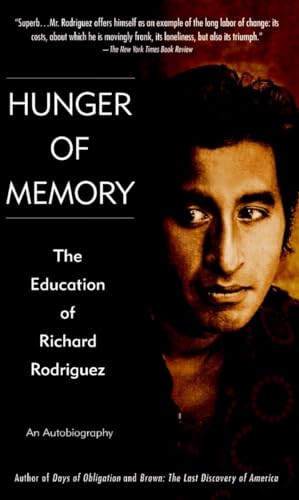
Hunger of Memory is the story of Mexican-American Richard Rodriguez, who begins his schooling in Sacramento, California, knowing just 50 words of English, and concludes his university studies in the stately quiet of the reading room of the British Museum.
Here is the poignant journey of a “minority student” who pays the cost of his social assimilation and academic success with a painful alienation — from his past, his parents, his culture — and so describes the high price of “making it” in middle-class America.
Provocative in its positions on affirmative action and bilingual education, Hunger of Memory is a powerful political statement, a profound study of the importance of language ... and the moving, intimate portrait of a boy struggling to become a man.
Die Inhaltsangabe kann sich auf eine andere Ausgabe dieses Titels beziehen.
Über die Autorin bzw. den Autor
Richard Rodriguez has authored a “trilogy” on American public life and his private life—Hunger of Memory, Days of Obligation, and Brown—concerned, respectively, with class, ethnicity, and race in America. He has also worked as a journalist on television and in print. Most recently he wrote Darling, a meditation on the Abrahamic religions after 9/11.
Von der hinteren Coverseite
Hunger of Memory is the story of Mexican-American Richard Rodriguez, who begins his schooling in Sacramento, California, knowing just 50 words of English, and concludes his university studies in the stately quiet of the reading room of the British Museum.
Here is the poignant journey of a "minority student" who pays the cost of his social assimilation and academic success with a painful alienation -- from his past, his parents, his culture -- and so describes the high price of "making it" in middle-class America.
Provocative in its positions on affirmative action and bilingual education, Hunger of Memory is a powerful political statement, a profound study of the importance of language ... and the moving, intimate portrait of a boy struggling to become a man.
Auszug. © Genehmigter Nachdruck. Alle Rechte vorbehalten.
Chapter One
I remember to start with that day in Sacramento-a California now nearly thirty years past-when I first entered a classroom, able to understand some fifty stray English words.
The third of four children, I had been preceded to a neighborhood Roman Catholic school by an older brother and sister. But neither of them had revealed very much about their classroom experiences. Each afternoon they returned, as they left in the morning, always together, speaking in Spanish as they climbed the five steps of the porch. And their mysterious books, wrapped in shopping-bag paper, remained on the table next to the door, closed firmly behind them.
An accident of geography sent me to a school where all my classmates were white, many the children of doctors and lawyers and business executives. All my classmates certainly must have been uneasy on that first day of school-as most children are uneasy-to find themselves apart from their families in the first institution of their lives. But I was astonished.
The nun said, in a friendly but oddly impersonal voice, 'Boys and girls, this is Richard Rodriguez.' (I heard her sound out: Rich-heard Road-ree-guess.) It was the first time I had heard anyone name me in English. 'Richard,' the nun repeated more slowly, writing my name down in her black leather book. Quickly I turned to see my mother's face dissolve in a watery blur behind the pebbled glass door.
***
Many years later there is something called bilingual education-a scheme proposed in the late 1960s by Hispanic-American social activists, later endorsed by a congressional vote. It is a program that seeks to permit non-English-speaking children, many from lower-class homes, to use their family language as the language of school. (Such is the goal its supporters announce.) I hear them and am forced to say no: It is not possible for a child-any child-ever to use his family's language in school. Not to understand this is to misunderstand the public uses of schooling and to trivialize the nature of intimate life-a family's 'language.'
Memory teaches me what I know of these matters; the boy reminds the adult. I was a bilingual child, a certain kind-socially disadvantaged-the son of working-class parents, both Mexican immigrants.
In the early years of my boyhood, my parents coped very well in America. My father had steady work. My mother managed at home. They were nobody's victims. Optimism and ambition led them to a house (our home) many blocks from the Mexican south side of town. We lived among gringos and only a block from the biggest, whitest houses. It never occurred to my parents that they couldn't live wherever they chose. Nor was the Sacramento of the fifties bent on teaching them a contrary lesson. My mother and father were more annoyed than intimidated by those two or three neighbors who tried initially to make us unwelcome. ('Keep your brats away from my sidewalk!') But despite all they achieved, perhaps because they had so much to achieve, any deep feeling of ease, the confidence of 'belonging' in public was withheld from them both. They regarded the people at work, the faces in crowds, as very distant from us. They were the others, los gringos. That term was interchangeable in their speech with another, even more telling, los americanos.
I grew up in a house where the only regular guests were my relations. For one day, enormous families of relatives would visit and there would be so many people that the noise and the bodies would spill out to the backyard and front porch. Then, for weeks, no one came by. (It was usually a salesman who rang the doorbell.) Our house stood apart. A gaudy yellow in a row of white bungalows. We were the people with the noisy dog. The people who raised pigeons and chickens. We were the foreigners on the block. A few neighbors smiled and waved. We waved back. But no one in the family knew the names of the old couple who lived next door; until I was seven years old, I did not know the names of the kids who lived across the street.
In public, my father and mother spoke a hesitant, accented, not always grammatical English. And they would have to strain-their bodies tense-to catch the sense of what was rapidly said by los gringos. At home they spoke Spanish. The language of their Mexican past sounded in counterpoint to the English of public society. The words would come quickly, with ease. Conveyed through those sounds was the pleasing, soothing, consoling reminder of being at home.
During those years when I was first conscious of hearing, my mother and father addressed me only in Spanish; in Spanish I learned to reply. By contrast, English (ingles), rarely heard in the house, was the language I came to associate with gringos. I learned my first words of English overhearing my parents speak to strangers. At five years of age, I knew just enough English for my mother to trust me on errands to stores one block away. No more.
I was a listening child, careful to hear the very different sounds of Spanish and English. Wide-eyed with hearing, I'd listen to sounds more than words. First, there were English (gringo) sounds. So many words were still unknown that when the butcher or the lady at the drugstore said something to me, exotic polysyllabic sounds would bloom in the midst of their sentences. Often, the speech of people in public seemed to me very loud, booming with confidence. The man behind the counter would literally ask, 'What can I do for you?' But by being so firm and so clear, the sound of his voice said that he was a gringo; he belonged in public society.
I would also hear then the high nasal notes of middle-class American speech. The air stirred with sound. Sometimes, even now, when I have been traveling abroad for several weeks, I will hear what I heard as a boy. In hotel lobbies or airports, in Turkey or Brazil, some Americans will pass, and suddenly I will hear it again-the high sound of American voices. For a few seconds I will hear it with pleasure, for it is now the sound of my society-a reminder of home. But inevitably-already on the flight headed for home-the sound fades with repetition. I will be unable to hear it anymore.
When I was a boy, things were different. The accent of los gringos was never pleasing nor was it hard to hear. Crowds at Safeway or at bus stops would be noisy with sound. And I would be forced to edge away from the chirping chatter above me.
I was unable to hear my own sounds, but I knew very well that I spoke English poorly. My words could not stretch far enough to form complete thoughts. And the words I did speak I didn't know well enough to make into distinct sounds. (Listeners would usually lower their heads, better to hear what I was trying to say.) But it was one thing for me to speak English with difficulty. It was more troubling for me to hear my parents speak in public: their high-whining vowels and guttural consonants; their sentences that got stuck with 'eh' and 'ah' sounds; the confused syntax; the hesitant rhythm of sounds so different from the way gringos spoke. I'd notice, moreover, that my parents' voices were softer than those of gringos we'd meet.
I am tempted now to say that none of this mattered. In adulthood I am embarrassed by childhood fears. And, in a way, it didn't matter very much that my parents could not speak English with ease. Their linguistic difficulties had no serious consequences. My mother and father made themselves understood at the county hospital clinic and at government offices. And yet, in another way, it mattered very much-it was unsettling to hear my parents struggle with English. Hearing them, I'd grow nervous, my clutching trust in their protection and power weakened.
There were many times like the night at a brightly lit gasoline station (a blaring white memory) when I stood uneasily, hearing my father. He was talking to a...
„Über diesen Titel“ kann sich auf eine andere Ausgabe dieses Titels beziehen.
Suchergebnisse für Hunger of Memory: The Education of Richard Rodriguez

Beispielbild für diese ISBN
Hunger of Memory: The Education of Richard Rodriguez
Anbieter: World of Books (was SecondSale), Montgomery, IL, USA
Verkäuferbewertung 5 von 5 Sternen

Zustand: Fair. Hunger of Memory is the story of Mexican-American Richard Rodriguez, who begins his schooling in Sacramento, California, knowing just 50 words of English, and concludes his university studies in the stately quiet of the reading room of the British Museum. Here is the poignant journey of a minority student who pays the cost of his social assimilation and academic success with a painful alienation -- from his past, his parents, his culture -- and so describes the high price of making it in middle-class America. Provocative in its positions on affirmative action and bilingual education, Hunger of Memory is a powerful political statement, a profound study of the importance of language . and the moving, intimate portrait of a boy struggling to become a man. From the Paperback edition. Bestandsnummer des Verkäufers 00087264958
Gebraucht kaufen
EUR 3,73
Versand gratis
Versand innerhalb von USA
Versand innerhalb von USA
Anzahl: Mehr als 20 verfügbar
Beispielbild für diese ISBN
Hunger of Memory: The Education of Richard Rodriguez
Anbieter: World of Books (was SecondSale), Montgomery, IL, USA
Verkäuferbewertung 5 von 5 Sternen
Zustand: Good. Hunger of Memory is the story of Mexican-American Richard Rodriguez, who begins his schooling in Sacramento, California, knowing just 50 words of English, and concludes his university studies in the stately quiet of the reading room of the British Museum. Here is the poignant journey of a minority student who pays the cost of his social assimilation and academic success with a painful alienation -- from his past, his parents, his culture -- and so describes the high price of making it in middle-class America. Provocative in its positions on affirmative action and bilingual education, Hunger of Memory is a powerful political statement, a profound study of the importance of language . and the moving, intimate portrait of a boy struggling to become a man. From the Paperback edition. Bestandsnummer des Verkäufers 00086053808
Gebraucht kaufen
EUR 3,73
Versand gratis
Versand innerhalb von USA
Versand innerhalb von USA
Anzahl: Mehr als 20 verfügbar
Beispielbild für diese ISBN
Hunger of Memory : The Education of Richard Rodriguez
Anbieter: Gulf Coast Books, Cypress, TX, USA
Verkäuferbewertung 5 von 5 Sternen
Mass Market Paperback. Zustand: Fair. Bestandsnummer des Verkäufers 0553272934-4-18630112
Gebraucht kaufen
EUR 3,74
Versand gratis
Versand innerhalb von USA
Versand innerhalb von USA
Anzahl: 1 verfügbar
Beispielbild für diese ISBN
Hunger of Memory : The Education of Richard Rodriguez
Anbieter: Orion Tech, Kingwood, TX, USA
Verkäuferbewertung 5 von 5 Sternen
Mass Market Paperback. Zustand: Fair. Bestandsnummer des Verkäufers 0553272934-4-18471820
Gebraucht kaufen
EUR 3,74
Versand gratis
Versand innerhalb von USA
Versand innerhalb von USA
Anzahl: 1 verfügbar
Beispielbild für diese ISBN
Hunger of Memory : The Education of Richard Rodriguez
Anbieter: Your Online Bookstore, Houston, TX, USA
Verkäuferbewertung 5 von 5 Sternen
Mass Market Paperback. Zustand: Very Good. Bestandsnummer des Verkäufers 0553272934-2-18773370
Gebraucht kaufen
EUR 3,74
Versand gratis
Versand innerhalb von USA
Versand innerhalb von USA
Anzahl: 5 verfügbar
Beispielbild für diese ISBN
Hunger of Memory : The Education of Richard Rodriguez
Anbieter: Orion Tech, Kingwood, TX, USA
Verkäuferbewertung 5 von 5 Sternen
Mass Market Paperback. Zustand: As New. Bestandsnummer des Verkäufers 0553272934-1-20974511
Gebraucht kaufen
EUR 3,74
Versand gratis
Versand innerhalb von USA
Versand innerhalb von USA
Anzahl: 1 verfügbar
Beispielbild für diese ISBN
Hunger of Memory : The Education of Richard Rodriguez
Anbieter: Gulf Coast Books, Cypress, TX, USA
Verkäuferbewertung 5 von 5 Sternen
Mass Market Paperback. Zustand: Very Good. Bestandsnummer des Verkäufers 0553272934-2-18634998
Gebraucht kaufen
EUR 3,74
Versand gratis
Versand innerhalb von USA
Versand innerhalb von USA
Anzahl: 3 verfügbar
Beispielbild für diese ISBN
Hunger of Memory : The Education of Richard Rodriguez
Anbieter: Your Online Bookstore, Houston, TX, USA
Verkäuferbewertung 5 von 5 Sternen
Mass Market Paperback. Zustand: As New. Bestandsnummer des Verkäufers 0553272934-1-20576727
Gebraucht kaufen
EUR 3,74
Versand gratis
Versand innerhalb von USA
Versand innerhalb von USA
Anzahl: 1 verfügbar
Beispielbild für diese ISBN
Hunger of Memory : The Education of Richard Rodriguez
Anbieter: Orion Tech, Kingwood, TX, USA
Verkäuferbewertung 5 von 5 Sternen
Mass Market Paperback. Zustand: Very Good. Bestandsnummer des Verkäufers 0553272934-2-20791929
Gebraucht kaufen
EUR 3,74
Versand gratis
Versand innerhalb von USA
Versand innerhalb von USA
Anzahl: 2 verfügbar
Beispielbild für diese ISBN
Hunger of Memory : The Education of Richard Rodriguez
Anbieter: Gulf Coast Books, Cypress, TX, USA
Verkäuferbewertung 5 von 5 Sternen
Mass Market Paperback. Zustand: As New. Bestandsnummer des Verkäufers 0553272934-1-36182957
Gebraucht kaufen
EUR 3,74
Versand gratis
Versand innerhalb von USA
Versand innerhalb von USA
Anzahl: 1 verfügbar