
Verwandte Artikel zu Rendezvous with Rama
Inhaltsangabe
Winner of the Hugo and Nebula Awards • “[Arthur] Clarke is quite splendid. . . . We experience that chilling touch of the alien, the not-quite-knowable, that distinguishes SF at its most technically imaginative.”—The New York Times
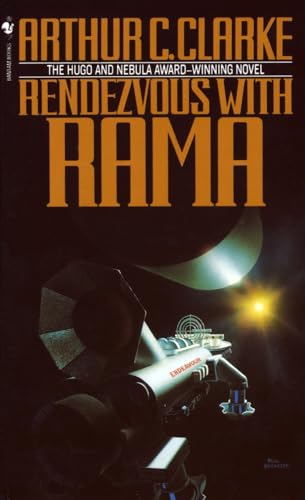
At first, only a few things are known about the celestial object that astronomers dub Rama. It is huge, weighing more than ten trillion tons. And it is hurtling through the solar system at inconceivable speed. Then a space probe confirms the unthinkable: Rama is no natural object. It is, incredible, an interstellar spacecraft. Space explorers and planet-bound scientists alike prepare for mankind's first encounter with alien intelligence. It will kindle their wildest dreams . . . and fan their darkest fears. For no one knows who the Ramans are or why they have come. And now the moment of rendezvous awaits—just behind a Raman airlock door.
Die Inhaltsangabe kann sich auf eine andere Ausgabe dieses Titels beziehen.
Über die Autorin bzw. den Autor
Arthur C. Clarke has long been considered the greatest science fiction writer of all time and was an international treasure in many other ways, including the fact that an article by him in 1945 led to the invention of satellite technology. Books by Clarke—both fiction and nonfiction—have sold more than one hundred million copies worldwide. He died in 2008.
Aus dem Klappentext
At first, only a few things are known about the celestial object that astronomers dub Rama. It is huge, weighing more than ten trillion tons. And it is hurtling through the solar system at inconceivable speed. Then a space probe confirms the unthinkable: Rama is no natural object. It is, incredible, an interstellar spacecraft. Space explorers and planet-bound scientists alike prepare for mankind's first encounter with alien intelligence. It will kindle their wildest dreams... and fan their darkest fears. For no one knows who the Ramans are or why they have come. And now the moment of rendezvous awaits -- just behind a Raman airlock door.
Auszug. © Genehmigter Nachdruck. Alle Rechte vorbehalten.
Spaceguard
Sooner or later, it was bound to happen. On June 30, 1908, Moscow escaped destruction by three hours and four thousand kilometers--a margin invisibly small by the Stan•dards of the universe. On February 12, 1947, another Russian city had a still narrower escape, when the second great meteorite of the twentieth century detonated less than four hundred kilometers from Vladivostok, with an explosion rivaling that of the newly invented uranium bomb.
In those days there was nothing that men could do to protect themselves against the last random shots in the cosmic bombardment that had once scarred the face of the Moon. The meteorites of 1908 and 1947 had struck uninhabited wilderness; but by the end of the twenty-first century there was no region left on Earth that could be safely used for celestial target practice. The human race had spread from pole to pole. And so, inevitably
At 0946 GMT on the morning of September 11 in the exceptionally beautiful summer of the year 2077, most of the inhabitants of Europe saw a dazzling fireball appear in the eastern sky. Within seconds it was brighter than the Sun, and as it moved across the heavens-at first in utter silence-it left behind it a churning column of dust and smoke.
Somewhere above Austria it began to disintegrate, producing a series of concussions so violent that more than a million people had their hearing permanently damaged. They were the lucky ones.
Moving at fifty kilometers a second, a thousand tons of rock and metal impacted on the plains of northern Italy, destroying in a few flaming moments the labor of centuries. The cities of Padua and Verona were wiped from the face of the Earth; and the last glories of Venice sank forever beneath the sea as the waters of the Adriatic came thundering landward after the hammer blow from space.
Six hundred thousand people died, and the total damage was more than a trillion dollars. But the loss to art, to history, to science-to the whole human race, for the rest of time-was beyond all computation. It was as if a great war had been fought and lost in a single morning; and few could draw much pleasure from the fact that, as the dust of destruction slowly settled, for months the whole world witnessed the most splendid dawns and sunsets since Krakatoa.
After the initial shock, mankind reacted with a determination and a unity that no earlier age could have shown. Such a disaster, it was realized, might not occur again for a thousand years-but it might occur tomorrow. And the next time, the consequences could be even worse.
Very well; there would be no next time.
A hundred years earlier, a much poorer world, with far feebler resources, had squandered its wealth attempting to destroy weapons launched, suicidally, by mankind against itself. The effort had never been successful, but the skills acquired then had not been forgotten. Now they could be used for a far nobler purpose, and on an infinitely vaster stage. No meteorite large enough to cause catastrophe would ever again be allowed to breach the defenses of Earth.
So began Project Spaceguard. Fifty years later-and in a way that none of its designers could ever have anticipated -it justified its existence.
Intruder
By the year 2130, the Mars-based radars were discovering new asteroids at the rate of a dozen a day. The Spaceguard computers automatically calculated their orbits and stored the
information in their own enormous memories, so that every few months any interested
astronomer could have a look at the accumulated statistics. These were now quite impressive.
It had taken more than 120 years to collect the first thousand asteroids, since the discovery of Ceres, largest of these tiny worlds, on the very first day of the nineteenth century. Hundreds had been found and lost and found again; they existed in such swarms that one exasperated astronomer had christened them "vermin of the skies." He would have been appalled to know that Spaceguard was now keeping track of half a million.
Only the five giants-Ceres, Pallas, Juno, Eunomia, and Vesta-were more than two hundred kilometers in diameter; the vast majority were merely oversized boulders that would fit into a small park. Almost all moved in orbits that lay beyond Mars. Only the few that came far enough sunward to be a possible danger to Earth were the concern of Spaceguard. And not one in a thousand of these, during the entire future history of the solar system, would pass within a million kilometers of Earth.
The object first catalogued as 31/439, according to the year and the order of its discovery, was detected while it was still outside the orbit of Jupiter. There was nothing unusual about its location; many asteroids went beyond Saturn before turning once more toward their distant master, the Sun. And Thule II, most far-ranging of all, traveled so close to Uranus that it might
well be a lost moon of that planet.
But a first radar contact at such a distance was unprecedented; clearly, 31/439 must be of
exceptional size. From the strength of the echo, the computers deduced a diameter of at least
forty kilometers. Such a giant had not been discovered for a hundred years. That it had been
overlooked for so long seemed incredible.
Then the orbit was calculated, and the mystery was resolved-to be replaced by a greater one.
31/439 was not traveling on a normal asteroidal path, along an ellipse which it retraced with clockwork precision every few years. It was a lonely wanderer among the stars, making its first and last visit to the solar system-for it was moving so swiftly that the gravitational field of the Sun could never capture it. It would flash inward past the orbits of Jupiter, Mars, Earth, Venus, and Mercury, gaining speed as it did so, until it rounded the Sun and headed out once again into the unknown.
It was at this point that the computers started flashing their "We have something interesting" sign, and, for the first time, 31/439 came to the attention of human beings. There was a brief flurry of excitement at Spaceguard headquarters, and the interstellar vagabond was quickly dignified by a name instead of a mere number. Long ago, the astronomers had exhausted Greek and Roman mythology; now they were working through the Hindu pantheon. And so 31/439 was christened Rama.
For a few days, the news media made a fuss over the visitor, but they were badly handicapped by the sparsity of information. Only two facts were known about Rama: its unusual orbit and its approximate size. Even this last was merely an educated guess, based upon the strength of the radar echo. Through the telescope, Rama still appeared as a faint, fifteenth-magnitude star-much too small to show a visible disc. But as it plunged in toward the heart of the solar system, it would grow brighter and larger month by month; before it vanished forever, the orbiting observatories would be able to gather more precise information about its shape and size. There was plenty of time, and perhaps during the next few years some spaceship on its ordinary business might be routed close enough to get good photographs. An actual rendezvous was most unlikely; the energy cost would be far too great to permit physical contact with an object cutting across the orbits of the planets at more than a hundred thousand kilometers an hour.
So the world soon forgot about Rama. But the astronomers did not. Their excitement grew with the passing months as the new asteroid presented them with more and more puzzles.
First of all, there was the problem of Rama's light curve. It didn't have one.
All known asteroids, without exception, showed a slow variation in their brilliance, waxing and waning in a period of a few hours. It had been recognized for more than...
„Über diesen Titel“ kann sich auf eine andere Ausgabe dieses Titels beziehen.
Suchergebnisse für Rendezvous with Rama

Beispielbild für diese ISBN
Rendezvous with Rama
Verlag:
Spectra (edition ), 1990
ISBN 10: 0553287893
ISBN 13: 9780553287899
Gebraucht
Mass Market Paperback
Anbieter: BooksRun, Philadelphia, PA, USA
Verkäuferbewertung 5 von 5 Sternen

Mass Market Paperback. Zustand: Fair. The item might be beaten up but readable. May contain markings or highlighting, as well as stains, bent corners, or any other major defect, but the text is not obscured in any way. Bestandsnummer des Verkäufers 0553287893-7-1-13
Gebraucht kaufen
EUR 6,59
Versand gratis
Versand innerhalb von USA
Versand innerhalb von USA
Anzahl: 1 verfügbar
Beispielbild für diese ISBN
Rendezvous with Rama
Verlag:
Spectra (edition ), 1990
ISBN 10: 0553287893
ISBN 13: 9780553287899
Gebraucht
Mass Market Paperback
Anbieter: BooksRun, Philadelphia, PA, USA
Verkäuferbewertung 5 von 5 Sternen
Mass Market Paperback. Zustand: Fair. The item might be beaten up but readable. May contain markings or highlighting, as well as stains, bent corners, or any other major defect, but the text is not obscured in any way. Bestandsnummer des Verkäufers 0553287893-7-1
Gebraucht kaufen
EUR 6,78
Versand gratis
Versand innerhalb von USA
Versand innerhalb von USA
Anzahl: 1 verfügbar
Beispielbild für diese ISBN
Rendezvous with Rama
Anbieter: ThriftBooks-Atlanta, AUSTELL, GA, USA
Verkäuferbewertung 5 von 5 Sternen
Paperback. Zustand: Fair. No Jacket. Former library book; Readable copy. Pages may have considerable notes/highlighting. ~ ThriftBooks: Read More, Spend Less. Bestandsnummer des Verkäufers G0553287893I5N10
Gebraucht kaufen
EUR 7,79
Versand gratis
Versand innerhalb von USA
Versand innerhalb von USA
Anzahl: 1 verfügbar
Beispielbild für diese ISBN
Rendezvous with Rama
Anbieter: ThriftBooks-Atlanta, AUSTELL, GA, USA
Verkäuferbewertung 5 von 5 Sternen
Paperback. Zustand: Good. No Jacket. Pages can have notes/highlighting. Spine may show signs of wear. ~ ThriftBooks: Read More, Spend Less. Bestandsnummer des Verkäufers G0553287893I3N00
Gebraucht kaufen
EUR 7,79
Versand gratis
Versand innerhalb von USA
Versand innerhalb von USA
Anzahl: 1 verfügbar
Beispielbild für diese ISBN
Rendezvous with Rama
Anbieter: ThriftBooks-Atlanta, AUSTELL, GA, USA
Verkäuferbewertung 5 von 5 Sternen
Paperback. Zustand: Fair. No Jacket. Readable copy. Pages may have considerable notes/highlighting. ~ ThriftBooks: Read More, Spend Less. Bestandsnummer des Verkäufers G0553287893I5N00
Gebraucht kaufen
EUR 7,79
Versand gratis
Versand innerhalb von USA
Versand innerhalb von USA
Anzahl: 5 verfügbar
Beispielbild für diese ISBN
Rendezvous with Rama
Anbieter: ThriftBooks-Reno, Reno, NV, USA
Verkäuferbewertung 5 von 5 Sternen
Paperback. Zustand: Good. No Jacket. Pages can have notes/highlighting. Spine may show signs of wear. ~ ThriftBooks: Read More, Spend Less. Bestandsnummer des Verkäufers G0553287893I3N00
Gebraucht kaufen
EUR 7,79
Versand gratis
Versand innerhalb von USA
Versand innerhalb von USA
Anzahl: 1 verfügbar
Beispielbild für diese ISBN
Rendezvous with Rama
Anbieter: ThriftBooks-Reno, Reno, NV, USA
Verkäuferbewertung 5 von 5 Sternen
Paperback. Zustand: Fair. No Jacket. Readable copy. Pages may have considerable notes/highlighting. ~ ThriftBooks: Read More, Spend Less. Bestandsnummer des Verkäufers G0553287893I5N00
Gebraucht kaufen
EUR 7,79
Versand gratis
Versand innerhalb von USA
Versand innerhalb von USA
Anzahl: 4 verfügbar
Beispielbild für diese ISBN
Rendezvous with Rama
Anbieter: ThriftBooks-Dallas, Dallas, TX, USA
Verkäuferbewertung 5 von 5 Sternen
Paperback. Zustand: Fair. No Jacket. Former library book; Readable copy. Pages may have considerable notes/highlighting. ~ ThriftBooks: Read More, Spend Less. Bestandsnummer des Verkäufers G0553287893I5N10
Gebraucht kaufen
EUR 7,79
Versand gratis
Versand innerhalb von USA
Versand innerhalb von USA
Anzahl: 1 verfügbar
Beispielbild für diese ISBN
Rendezvous with Rama
Anbieter: ThriftBooks-Dallas, Dallas, TX, USA
Verkäuferbewertung 5 von 5 Sternen
Paperback. Zustand: Fair. No Jacket. Readable copy. Pages may have considerable notes/highlighting. ~ ThriftBooks: Read More, Spend Less. Bestandsnummer des Verkäufers G0553287893I5N00
Gebraucht kaufen
EUR 7,79
Versand gratis
Versand innerhalb von USA
Versand innerhalb von USA
Anzahl: 5 verfügbar
Beispielbild für diese ISBN
Rendezvous with Rama
Anbieter: ThriftBooks-Dallas, Dallas, TX, USA
Verkäuferbewertung 5 von 5 Sternen
Paperback. Zustand: Good. No Jacket. Pages can have notes/highlighting. Spine may show signs of wear. ~ ThriftBooks: Read More, Spend Less. Bestandsnummer des Verkäufers G0553287893I3N00
Gebraucht kaufen
EUR 7,79
Versand gratis
Versand innerhalb von USA
Versand innerhalb von USA
Anzahl: 1 verfügbar