
Verwandte Artikel zu Mindless Eating: Why We Eat More Than We Think
Inhaltsangabe
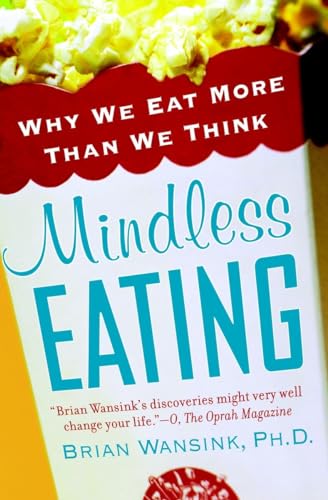
This book will literally change the way you think about your next meal.
Food psychologist Brian Wansink revolutionizes our awareness of how much, what, and why we’re eating—often without realizing it. His findings will astound you.
• Can the size of your plate really influence your appetite?
• Why do you eat more when you dine with friends?
• What “hidden persuaders” are used by restaurants and supermarkets to get us to overeat?
• How does music or the color of the room influence how much—and how fast—we eat?
• How can we “mindlessly” lose—instead of gain—up to twenty pounds in the coming year?
Starting today, you can make more mindful, enjoyable, and healthy choices at the dinner table, in the supermarket, at the office—wherever you satisfy your appetite.
Die Inhaltsangabe kann sich auf eine andere Ausgabe dieses Titels beziehen.
Über die Autorin bzw. den Autor
Brian Wansink, Ph.D., is an Iowa native and earned his doctorate at Stanford University. He is the John S. Dyson Professor of Marketing and of Nutritional Science at Cornell University, where he is Director of the Cornell Food and Brand Lab. The author of three profesional books on food and consumer behavior, he lives with his family in Ithaca, New York, where he enjoys both French food and French fries each week.
Auszug. © Genehmigter Nachdruck. Alle Rechte vorbehalten.
Chapter One
The Mindless Margin
Did you ever eat the last piece of crusty, dried-out chocolate cake even though it tasted like chocolate-scented cardboard? Ever finish eating a bag of French fries even though they were cold, limp, and soggy? It hurts to answer questions like these.
Why do we overeat food that doesn’t even taste good?
We overeat because there are signals and cues around us that tell us to eat. It’s simply not in our nature to pause after every bite and contemplate whether we’re full. As we eat, we unknowingly–mindlessly–look for signals or cues that we’ve had enough. For instance, if there’s nothing remaining on the table, that’s a cue that it’s time to stop. If everyone else has left the table, turned off the lights, and we’re sitting alone in the dark, that’s another cue. For many of us, as long as there are still a few milk-soaked Fruit Loops left in the bottom of the cereal bowl, there is still work to be done. It doesn’t matter if we’re full, and it doesn’t matter if we don’t even really like Fruit Loops. We eat as if it is our mission to finish them.
Stale Popcorn and Frail Willpower
Take movie popcorn, for instance. There is no “right” amount of popcorn to eat during a movie. There are no rules of thumb or FDA guidelines. People eat however much they want depending on how hungry they are and how good it tastes. At least that’s what they say.
My graduate students and I think different. We think that the cues around us–like the size of a popcorn bucket–can provide subtle but powerful suggestions about how much one should eat. These cues can short-circuit a person’s hunger and taste signals, leading them to eat even if they’re not hungry and even if the food doesn’t taste very good.
If you were living in Chicago a few years back, you might have been our guest at a suburban theater matinee. If you lined up to see the 1:05 p.m. Saturday showing of Mel Gibson’s new action movie, Payback, you would have had a surprise waiting for you: a free bucket of popcorn.
Every person who bought a ticket–even though many of them had just eaten lunch–was given a soft drink and either a medium-size bucket of popcorn or a large-size, bigger-than-your-head bucket. They were told that the popcorn and soft drinks were free and that we hoped they would be willing to answer a few concession stand-related questions after the movie.
There was only one catch. This wasn’t fresh popcorn. Unknown to the moviegoers and even to my graduate students, this popcorn had been popped five days earlier and stored in sterile conditions until it was stale enough to squeak when it was eaten.
To make sure it was kept separate from the rest of the theater popcorn, it was transported to the theater in bright yellow garbage bags–the color yellow that screams “Biohazard.” The popcorn was safe to eat, but it was stale enough one moviegoer said it was like eating Styrofoam packing peanuts. Two others, forgetting they had been given it for free, asked for their money back. During the movie, people would eat a couple bites, put the bucket down, pick it up again a few minutes later and have a couple more bites, put it back down, and continue. It might not have been good enough to eat all at once, but they couldn’t leave it alone.
Both popcorn containers–medium and large–had been selected to be big enough that nobody could finish all the popcorn. And each person was given his or her own individual bucket so there would be no sharing.
As soon as the movie ended and the credits began to roll, we asked everyone to take their popcorn with them. We gave them a half-page survey (on bright biohazard-yellow paper) that asked whether they agreed to statements like “I ate too much popcorn,” by circling a number from 1 (strongly disagree) to 9 (strongly agree). As they did this, we weighed their remaining popcorn.
When the people who had been given the large buckets handed their leftover popcorn to us, we said, “Some people tonight were given medium-size buckets of popcorn, and others, like yourself, were given these large-size buckets. We have found that the average person who is given a large-size container eats more than if they are given a medium-size container. Do you think you ate more because you had the large size?” Most disagreed. Many smugly said, “That wouldn’t happen to me,” “Things like that don’t trick me,” or “I’m pretty good at knowing when I’m full.”
That may be what they believed, but it is not what happened.
Weighing the buckets told us that the big-bucket group people ate an average of 173 more calories of popcorn. That is roughly the equivalent of 21 more dips into the bucket. Clearly the quality of food is not what led them to eat. Once these moviegoers started in on their bucket, the taste of the popcorn didn’t matter. Even though some of them had just had lunch, people who were given the big buckets ate an average of 53 percent more than those given medium-size buckets. Give them a lot, and they eat a lot.
And this was five-day-old, stale popcorn!
We’ve run other popcorn studies, and the results were always the same, however we tweaked the details. It didn’t matter if our moviegoers were in Pennsylvania, Illinois, or Iowa, and it didn’t matter what kind of movie was showing, all of our popcorn studies led to the same conclusion. People eat more when you give them a bigger container. Period. It doesn’t matter whether the popcorn is fresh or fourteen days old, or whether they were hungry or full when they sat down for the movie.
Did people eat because they liked the popcorn? No. Did they eat because they were hungry? No. They ate because of all the cues around them–not only the size of the popcorn bucket, but also other factors I’ll discuss later, such as the distracting movie, the sound of people eating popcorn around them, and the eating scripts we take to movie theaters with us. All of these were cues that signaled it was okay to keep on eating and eating.
Does this mean we can avoid mindless eating simply by replacing large bowls with smaller bowls? That’s one piece of the puzzle, but there are a lot more cues that can be engineered out of our lives. As you will see, these hidden persuaders can even take the form of a tasty description on a menu or a classy name on a wine bottle. Simply thinking that a meal will taste good can lead you to eat more. You won’t even know it happened.
As Fine as North Dakota Wine
The restaurant is open only 24 nights a year and serves an inclusive prix-fixe theme dinner each night. A nice meal will cost you less than $25, but to get it you will have to phone for reservations and be seated at either 5:30 or 7:00 sharp. Despite these drawbacks, there is often a waiting list.
Welcome to the Spice Box. The Spice Box looks like a restaurant; it sounds like a restaurant; and it smells like a restaurant. To the people eating there, it is a restaurant. To the people working there, it’s a fine dining lab sponsored by the Department of Food Science and Human Nutrition at the University of Illinois at Urbana-Champaign. The Spice Box is a lab where culinary hopefuls learn whether a new recipe will fly or go down in flames. It’s a lab where waitstaff discover whether a new approach will sizzle or fizzle. It’s also a lab where consumer psychologists have figured out what makes a person nibble a little or inhale it all.
There is a secret and imaginary line down the middle of the...
„Über diesen Titel“ kann sich auf eine andere Ausgabe dieses Titels beziehen.
Suchergebnisse für Mindless Eating: Why We Eat More Than We Think

Beispielbild für diese ISBN
Mindless Eating: Why We Eat Mo
Anbieter: World of Books (was SecondSale), Montgomery, IL, USA
Verkäuferbewertung 5 von 5 Sternen

Zustand: Acceptable. Item in Acceptable condition. Textbooks may not include supplemental items i.e. CDs, access codes etc. Bestandsnummer des Verkäufers 00110213955
Gebraucht kaufen
EUR 3,63
Versand gratis
Versand innerhalb von USA
Versand innerhalb von USA
Anzahl: 1 verfügbar
Beispielbild für diese ISBN
Mindless Eating: Why We Eat Mo
Anbieter: World of Books (was SecondSale), Montgomery, IL, USA
Verkäuferbewertung 5 von 5 Sternen
Zustand: Good. Item in good condition. Textbooks may not include supplemental items i.e. CDs, access codes etc. Bestandsnummer des Verkäufers 00058591015
Gebraucht kaufen
EUR 3,64
Versand gratis
Versand innerhalb von USA
Versand innerhalb von USA
Anzahl: Mehr als 20 verfügbar
Beispielbild für diese ISBN
Mindless Eating: Why We Eat Mo
Anbieter: World of Books (was SecondSale), Montgomery, IL, USA
Verkäuferbewertung 5 von 5 Sternen
Zustand: Very Good. Item in very good condition! Textbooks may not include supplemental items i.e. CDs, access codes etc. Bestandsnummer des Verkäufers 00109785850
Gebraucht kaufen
EUR 3,64
Versand gratis
Versand innerhalb von USA
Versand innerhalb von USA
Anzahl: 1 verfügbar
Beispielbild für diese ISBN
Mindless Eating: Why We Eat Mo
Anbieter: World of Books (was SecondSale), Montgomery, IL, USA
Verkäuferbewertung 5 von 5 Sternen
Zustand: Acceptable. Item in acceptable condition! Textbooks may not include supplemental items i.e. CDs, access codes etc. Bestandsnummer des Verkäufers 00102359837
Gebraucht kaufen
EUR 3,64
Versand gratis
Versand innerhalb von USA
Versand innerhalb von USA
Anzahl: 4 verfügbar
Beispielbild für diese ISBN
Mindless Eating: Why We Eat More Than We Think
Anbieter: Orion Tech, Kingwood, TX, USA
Verkäuferbewertung 5 von 5 Sternen
Paperback. Zustand: Good. Bestandsnummer des Verkäufers 0553384481-3-24008281
Gebraucht kaufen
EUR 3,65
Versand gratis
Versand innerhalb von USA
Versand innerhalb von USA
Anzahl: 1 verfügbar
Beispielbild für diese ISBN
Mindless Eating: Why We Eat More Than We Think
Anbieter: Gulf Coast Books, Cypress, TX, USA
Verkäuferbewertung 5 von 5 Sternen
Paperback. Zustand: Fair. Bestandsnummer des Verkäufers 0553384481-4-22145728
Gebraucht kaufen
EUR 3,65
Versand gratis
Versand innerhalb von USA
Versand innerhalb von USA
Anzahl: 1 verfügbar
Beispielbild für diese ISBN
Mindless Eating: Why We Eat More Than We Think
Anbieter: Your Online Bookstore, Houston, TX, USA
Verkäuferbewertung 5 von 5 Sternen
paperback. Zustand: Fair. Bestandsnummer des Verkäufers 0553384481-4-27737268
Gebraucht kaufen
EUR 3,65
Versand gratis
Versand innerhalb von USA
Versand innerhalb von USA
Anzahl: 1 verfügbar
Beispielbild für diese ISBN
Mindless Eating: Why We Eat More Than We Think
Anbieter: Your Online Bookstore, Houston, TX, USA
Verkäuferbewertung 5 von 5 Sternen
Paperback. Zustand: Good. Bestandsnummer des Verkäufers 0553384481-3-18906615
Gebraucht kaufen
EUR 3,65
Versand gratis
Versand innerhalb von USA
Versand innerhalb von USA
Anzahl: 1 verfügbar
Foto des Verkäufers
Mindless Eating: Why We Eat More Than We Think
Anbieter: 3Brothers Bookstore, Egg harbor township, NJ, USA
Verkäuferbewertung 5 von 5 Sternen
Zustand: good. Books may contain some notes and highlighting. Supplements such as Access Codes, Cd's Dust Jackets, etc. are not guaranteed with used book purchases. Bestandsnummer des Verkäufers EVV.0553384481.G
Gebraucht kaufen
EUR 3,83
Versand gratis
Versand innerhalb von USA
Versand innerhalb von USA
Anzahl: 2 verfügbar
Foto des Verkäufers
Mindless Eating: Why We Eat More Than We Think
Anbieter: 3Brothers Bookstore, Egg harbor township, NJ, USA
Verkäuferbewertung 5 von 5 Sternen
Zustand: acceptable. Books may contain multiple pages with notes and highlighting. Supplements such as Access Codes, Cd's, etc. are not guaranteed with used book purchases. Bestandsnummer des Verkäufers EVV.0553384481.A
Gebraucht kaufen
EUR 3,83
Versand gratis
Versand innerhalb von USA
Versand innerhalb von USA
Anzahl: 1 verfügbar