
Verwandte Artikel zu Word of God in Transition: From Prophet to Exegete...
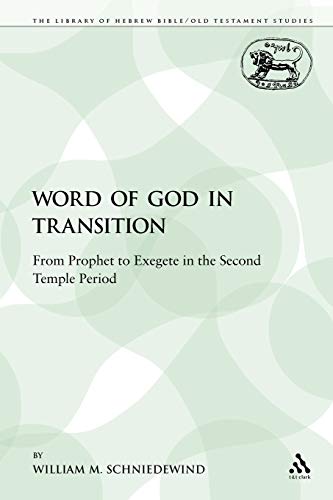
Word of God in Transition: From Prophet to Exegete in the Second Temple Period (The Library of Hebrew Bible/Old Testament Studies: Journal for the Old Testament Supplement, 197, Band 197) - Softcover
Inhaltsangabe
The Chronicler distinguishes between "traditional prophets" and "inspired messengers", and thereby highlights a radical transition in the meaning of the "word of God" which takes place in the post-exilic period. The Chronicler summarizes his perspective in 2 Chron. 36.16, saying that Israel rejected "his prophets", "the messengers of God", and "his word" (i.e. Torah). This distinction is reflected in the forms and functions of prophetic speech in the books of Chronicles. Thus, the prophets speak to the king, and the inspired messengers (e.g. priests, levites) speak to the people. The prophets interpret narrative events for the king; they explain how God acts. The inspired messengers exhort the people, admonishing them how they should act. The prophets' speeches usually do not use any kind of inspiration formula, but the inspired messengers' speeches are prefaced with possession formulas. These possession formulas are not typical of classical prophecy and mark the rise of a new kind of prophecy, namely, the inspired interpretation of texts. These inspired messengers are thus forerunners of the inspired interpreters of scripture in Qumran, early Christianity and Judaism.
Die Inhaltsangabe kann sich auf eine andere Ausgabe dieses Titels beziehen.
Über die Autorin bzw. den Autor
William M. Schniedewind
„Über diesen Titel“ kann sich auf eine andere Ausgabe dieses Titels beziehen.
Suchergebnisse für Word of God in Transition: From Prophet to Exegete...

Foto des Verkäufers
Word of God in Transition : From Prophet to Exegete in the Second Temple Period
Anbieter: GreatBookPrices, Columbia, MD, USA
Verkäuferbewertung 5 von 5 Sternen

Zustand: New. Bestandsnummer des Verkäufers 6591695-n
Neu kaufen
EUR 52,64
EUR 2,36 Versand
Versand innerhalb von USA
Versand innerhalb von USA
Anzahl: Mehr als 20 verfügbar
Foto des Verkäufers
Word of God in Transition : From Prophet to Exegete in the Second Temple Period
Verlag:
Sheffield Academic Press, 2009
ISBN 10: 0567625206
ISBN 13: 9780567625205
Gebraucht
Softcover
Anbieter: GreatBookPrices, Columbia, MD, USA
Verkäuferbewertung 5 von 5 Sternen
Zustand: As New. Unread book in perfect condition. Bestandsnummer des Verkäufers 6591695
Gebraucht kaufen
EUR 52,70
EUR 2,36 Versand
Versand innerhalb von USA
Versand innerhalb von USA
Anzahl: Mehr als 20 verfügbar
Beispielbild für diese ISBN
The Word of God in Transition
Print-on-DemandAnbieter: PBShop.store US, Wood Dale, IL, USA
Verkäuferbewertung 5 von 5 Sternen
PAP. Zustand: New. New Book. Shipped from UK. THIS BOOK IS PRINTED ON DEMAND. Established seller since 2000. Bestandsnummer des Verkäufers L0-9780567625205
Neu kaufen
EUR 55,08
Versand gratis
Versand innerhalb von USA
Versand innerhalb von USA
Anzahl: Mehr als 20 verfügbar
Beispielbild für diese ISBN
The Word of God in Transition
Print-on-DemandAnbieter: PBShop.store UK, Fairford, GLOS, Vereinigtes Königreich
Verkäuferbewertung 5 von 5 Sternen
PAP. Zustand: New. New Book. Delivered from our UK warehouse in 4 to 14 business days. THIS BOOK IS PRINTED ON DEMAND. Established seller since 2000. Bestandsnummer des Verkäufers L0-9780567625205
Neu kaufen
EUR 51,09
EUR 5,93 Versand
Versand von Vereinigtes Königreich nach USA
Versand von Vereinigtes Königreich nach USA
Anzahl: Mehr als 20 verfügbar
Foto des Verkäufers
The Word of God in Transition: From Prophet to Exegete in the Second Temple Period (Paperback or Softback)
Verlag:
Continnuum-3PL 11/1/2009, 2009
ISBN 10: 0567625206
ISBN 13: 9780567625205
Neu
Paperback or Softback
Anbieter: BargainBookStores, Grand Rapids, MI, USA
Verkäuferbewertung 5 von 5 Sternen
Paperback or Softback. Zustand: New. The Word of God in Transition: From Prophet to Exegete in the Second Temple Period. Book. Bestandsnummer des Verkäufers BBS-9780567625205
Beispielbild für diese ISBN
Word of God in Transition: From Prophet to Exegete in the Second Temple Period: 197 (The Library of Hebrew Bible/Old Testament Studies)
Verlag:
T & T Clark International 2009-02-01, 2009
ISBN 10: 0567625206
ISBN 13: 9780567625205
Neu
Paperback
Anbieter: Chiron Media, Wallingford, Vereinigtes Königreich
Verkäuferbewertung 5 von 5 Sternen
Paperback. Zustand: New. Bestandsnummer des Verkäufers 6666-IUK-9780567625205
Neu kaufen
EUR 46,60
EUR 18,30 Versand
Versand von Vereinigtes Königreich nach USA
Versand von Vereinigtes Königreich nach USA
Anzahl: Mehr als 20 verfügbar
Beispielbild für diese ISBN
The Word of God in Transition (Paperback)
Verlag:
Bloomsbury Publishing PLC, London, 2009
ISBN 10: 0567625206
ISBN 13: 9780567625205
Neu
Paperback
Anbieter: Grand Eagle Retail, Bensenville, IL, USA
Verkäuferbewertung 5 von 5 Sternen
Paperback. Zustand: new. Paperback. The Chronicler distinguishes between "traditional prophets" and "inspired messengers", and thereby highlights a radical transition in the meaning of the "word of God" which takes place in the post-exilic period. The Chronicler summarizes his perspective in 2 Chron. 36.16, saying that Israel rejected "his prophets", "the messengers of God", and "his word" (i.e. Torah). This distinction is reflected in the forms and functions of prophetic speech in the books of Chronicles. Thus, the prophets speak to the king, and the inspired messengers (e.g. priests, levites) speak to the people. The prophets interpret narrative events for the king; they explain how God acts. The inspired messengers exhort the people, admonishing them how they should act. The prophets' speeches usually do not use any kind of inspiration formula, but the inspired messengers' speeches are prefaced with possession formulas. These possession formulas are not typical of classical prophecy and mark the rise of a new kind of prophecy, namely, the inspired interpretation of texts. These inspired messengers are thus forerunners of the inspired interpreters of scripture in Qumran, early Christianity and Judaism. The Chronicler distinguishes between "traditional prophets" and "inspired messengers," and thereby highlights a radical transition in the meaning of the "word of God" which takes place in the post-exilic period. The Chronicler summarizes his perspective in 2 Chron. 36.16, saying that Israel rejected "his prophets," "the messengers of God," and "his word" (i.e. Torah). This distinction is reflected in the forms and functions of prophetic speech in the books of Chronicles. Thus, the prophets speak to the king, and the inspired messengers (e.g. priests, levites) speak to the people. The prophets interpret narrative events for the king; they explain how God acts. The inspired messengers exhort the people, admonishing them how they should act. The prophets' speeches usually do not use any kind of inspiration formula, but the inspired messengers' speeches are prefaced with possession formulas. These possession formulas are not typical of classical prophecy and mark the rise of a new kind of prophecy, namely, the inspired interpretation of texts. These inspired messengers are thus forerunners of the inspired interpreters of scripture in Qumran, early Christianity and Judaism. This item is printed on demand. Shipping may be from multiple locations in the US or from the UK, depending on stock availability. Bestandsnummer des Verkäufers 9780567625205
Foto des Verkäufers
Word of God in Transition : From Prophet to Exegete in the Second Temple Period
Anbieter: GreatBookPricesUK, Woodford Green, Vereinigtes Königreich
Verkäuferbewertung 5 von 5 Sternen
Zustand: New. Bestandsnummer des Verkäufers 6591695-n
Neu kaufen
EUR 49,61
EUR 17,72 Versand
Versand von Vereinigtes Königreich nach USA
Versand von Vereinigtes Königreich nach USA
Anzahl: Mehr als 20 verfügbar
Beispielbild für diese ISBN
The Word of God in Transition: From Prophet to Exegete in the Second Temple Period (The Library of Hebrew Bible/Old Testament Studies)
Anbieter: Ria Christie Collections, Uxbridge, Vereinigtes Königreich
Verkäuferbewertung 5 von 5 Sternen
Zustand: New. In English. Bestandsnummer des Verkäufers ria9780567625205_new
Neu kaufen
EUR 55,72
EUR 13,34 Versand
Versand von Vereinigtes Königreich nach USA
Versand von Vereinigtes Königreich nach USA
Anzahl: Mehr als 20 verfügbar
Foto des Verkäufers
Word of God in Transition : From Prophet to Exegete in the Second Temple Period
Verlag:
Sheffield Academic Press, 2009
ISBN 10: 0567625206
ISBN 13: 9780567625205
Gebraucht
Softcover
Anbieter: GreatBookPricesUK, Woodford Green, Vereinigtes Königreich
Verkäuferbewertung 5 von 5 Sternen
Zustand: As New. Unread book in perfect condition. Bestandsnummer des Verkäufers 6591695
Gebraucht kaufen
EUR 55,28
EUR 17,72 Versand
Versand von Vereinigtes Königreich nach USA
Versand von Vereinigtes Königreich nach USA
Anzahl: Mehr als 20 verfügbar