
Verwandte Artikel zu Hiroshima: A New Edition With a Final Chapter, Written...
Inhaltsangabe
Pulitzer Prize-winning journalist and bestselling author John Hersey's seminal work of narrative nonfiction which has defined the way we think about nuclear warfare. “One of the great classics of the war" (The New Republic) that tells what happened in Hiroshima during World War II through the memories of the survivors of the first atomic bomb ever dropped on a city.
"The perspective [Hiroshima] offers from the bomb’s actual victims is the mandatory counterpart to any Oppenheimer viewing." —GQ Magazine
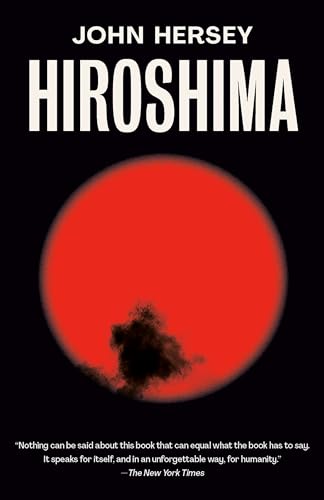
“Nothing can be said about this book that can equal what the book has to say. It speaks for itself, and in an unforgettable way, for humanity.” —The New York Times
Hiroshima is the story of six human beings who lived through the greatest single manmade disaster in history. John Hersey tells what these six -- a clerk, a widowed seamstress, a physician, a Methodist minister, a young surgeon, and a German Catholic priest -- were doing at 8:15 a.m. on August 6, 1945, when Hiroshima was destroyed by the first atomic bomb ever dropped on a city. Then he follows the course of their lives hour by hour, day by day.
The New Yorker of August 31, 1946, devoted all its space to this story. The immediate repercussions were vast: newspapers here and abroad reprinted it; during evening half-hours it was read over the network of the American Broadcasting Company; leading editorials were devoted to it in uncounted newspapers.
Almost four decades after the original publication of this celebrated book John Hersey went back to Hiroshima in search of the people whose stories he had told. His account of what he discovered about them -- the variety of ways in which they responded to the past and went on with their lives -- is now the eloquent and moving final chapter of Hiroshima.
Die Inhaltsangabe kann sich auf eine andere Ausgabe dieses Titels beziehen.
Über die Autorin bzw. den Autor
JOHN HERSEY was born in Tientsin, China, in 1914 and lived there until 1925, when his family returned to the United States. He studied at Yale and Cambridge, served for a time as Sinclair Lewis’s secretary, and then worked several years as a journalist. Beginning in 1947 he devoted his time mainly to writing fiction. He won the Pulitzer Prize, taught for two decades at Yale, and was president of the Authors League of America and Chancellor of the American Academy of Arts and Letters. John Hersey died in 1993.
Auszug. © Genehmigter Nachdruck. Alle Rechte vorbehalten.
ONE
A Noiseless Flash
At exactly fifteen minutes past eight in the morning, on August 6, 1945, Japanese time, at the moment when the atomic bomb flashed above Hiroshima, Miss Toshiko Sasaki, a clerk in the personnel department of the East Asia Tin Works, had just sat down at her place in the plant office and was turning her head to speak to the girl at the next desk. At that same moment, Dr. Masakazu Fujii was settling down cross-legged to read the Osaka Asahi on the porch of his private hospital, overhanging one of the seven deltaic rivers which divide Hiroshima; Mrs. Hatsuyo Nakamura, a tailor’s widow, stood by the window of her kitchen, watching a neighbor tearing down his house because it lay in the path of an air-raid-defense fire lane; Father Wilhelm Kleinsorge, a German priest of the Society of Jesus, reclined in his underwear on a cot on the top floor of his order’s three-story mission house, reading a Jesuit magazine, Stimmen der Zeit; Dr. Terufumi Sasaki, a young member of the surgical staff of the city’s large, modern Red Cross Hospital, walked along one of the hospital corridors with a blood specimen for a Wassermann test in his hand; and the Reverend Mr. Kiyoshi Tanimoto, pastor of the Hiroshima Methodist Church, paused at the door of a rich man’s house in Koi, the city’s western suburb, and prepared to unload a handcart full of things he had evacuated from town in fear of the massive B-29 raid which everyone expected Hiroshima to suffer. A hundred thousand people were killed by the atomic bomb, and these six were among the survivors. They still wonder why they lived when so many others died. Each of them counts many small items of chance or volition—a step taken in time, a decision to go indoors, catching one streetcar instead of the next—that spared him. And now each knows that in the act of survival he lived a dozen lives and saw more death than he ever thought he would see. At the time, none of them knew anything.
The Reverend Mr. Tanimoto got up at five o’clock that morning. He was alone in the parsonage, because for some time his wife had been commuting with their year-old baby to spend nights with a friend in Ushida, a suburb to the north. Of all the important cities of Japan, only two, Kyoto and Hiroshima, had not been visited in strength by B-san, or Mr. B, as the Japanese, with a mixture of respect and unhappy familiarity, called the B-29; and Mr. Tanimoto, like all his neighbors and friends, was almost sick with anxiety. He had heard uncomfortably detailed accounts of mass raids on Kure, Iwakuni, Tokuyama, and other nearby towns; he was sure Hiroshima’s turn would come soon. He had slept badly the night before, because there had been several air-raid warnings. Hiroshima had been getting such warnings almost every night for weeks, for at that time the B-29s were using Lake Biwa, northeast of Hiroshima, as a rendezvous point, and no matter what city the Americans planned to hit, the Superfortresses streamed in over the coast near Hiroshima. The frequency of the warnings and the continued abstinence of Mr. B with respect to Hiroshima had made its citizens jittery; a rumor was going around that the Americans were saving something special for the city.
Mr. Tanimoto was a small man, quick to talk, laugh, and cry. He wore his black hair parted in the middle and rather long; the prominence of the frontal bones just above his eyebrows and the smallness of his mustache, mouth, and chin gave him a strange, old-young look, boyish and yet wise, weak and yet fiery. He moved nervously and fast, but with a restraint which suggested that he was a cautious, thoughtful man. He showed, indeed, just those qualities in the uneasy days before the bomb fell. Besides having his wife spend the nights in Ushida, Mr. Tanimoto had been carrying all the portable things from his church, in the close-packed residential district called Nagaragawa, to a house that belonged to a rayon manufacturer in Koi, two miles from the center of town. The rayon man, a Mr. Matsui, had opened his then unoccupied estate to a large number of his friends and acquaintances, so that they might evacuate whatever they wished to a safe distance from the probable target area. Mr. Tanimoto had had no difficulty in moving chairs, hymnals, Bibles, altar gear, and church records by pushcart himself, but the organ console and an upright piano required some aid. A friend of his named Matsuo had, the day before, helped him get the piano out to Koi; in return, he had promised this day to assist Mr. Matsuo in hauling out a daughter’s belongings. That is why he had risen so early.
Mr. Tanimoto cooked his own breakfast. He felt awfully tired. The effort of moving the piano the day before, a sleepless night, weeks of worry and unbalanced diet, the cares of his parish—all combined to make him feel hardly adequate to the new day’s work. There was another thing, too: Mr. Tanimoto had studied theology at Emory College, in Atlanta, Georgia; he had graduated in 1940; he spoke excellent English; he dressed in American clothes; he had corresponded with many American friends right up to the time the war began; and among a people obsessed with a fear of being spied upon—perhaps almost obsessed himself—he found himself growing increasingly uneasy. The police had questioned him several times, and just a few days before, he had heard that an influential acquaintance, a Mr. Tanaka, a retired officer of the Toyo Kisen Kaisha steamship line, an anti-Christian, a man famous in Hiroshima for his showy philanthropies and notorious for his personal tyrannies, had been telling people that Tanimoto should not be trusted. In compensation, to show himself publicly a good Japanese, Mr. Tanimoto had taken on the chairmanship of his local tonarigumi, or Neighborhood Association, and to his other duties and concerns this position had added the business of organizing air-raid defense for about twenty families.
Before six o’clock that morning, Mr. Tanimoto started for Mr. Matsuo’s house. There he found that their burden was to be a tansu, a large Japanese cabinet, full of clothing and household goods. The two men set out. The morning was perfectly clear and so warm that the day promised to be uncomfortable. A few minutes after they started, the air-raid siren went off—a minute-long blast that warned of approaching planes but indicated to the people of Hiroshima only a slight degree of danger, since it sounded every morning at this time, when an American weather plane came over. The two men pulled and pushed the handcart through the city streets. Hiroshima was a fan-shaped city, lying mostly on the six islands formed by the seven estuarial rivers that branch out from the Ota River; its main commercial and residential districts, covering about four square miles in the center of the city, contained three-quarters of its population, which had been reduced by several evacuation programs from a wartime peak of 380,000 to about 245,000. Factories and other residential districts, or suburbs, lay compactly around the edges of the city. To the south were the docks, an airport, and the island-studded Inland Sea. A rim of mountains runs around the other three sides of the delta. Mr. Tanimoto and Mr. Matsuo took their way through the shopping center, already full of people, and across two of the rivers to the sloping streets of Koi, and up them to the outskirts and foothills. As they started up a valley away from the tight-ranked houses, the all-clear sounded. (The Japanese radar operators, detecting only three planes, supposed that they comprised a reconnaissance.) Pushing the handcart up to the rayon man’s house was tiring, and the men, after they had maneuvered their load into the driveway and to the front steps, paused to rest awhile. They stood with a wing of the house between...
„Über diesen Titel“ kann sich auf eine andere Ausgabe dieses Titels beziehen.
Suchergebnisse für Hiroshima: A New Edition With a Final Chapter, Written...

Beispielbild für diese ISBN
Hiroshima
Anbieter: New Legacy Books, Annandale, NJ, USA
Verkäuferbewertung 5 von 5 Sternen

paperback. Zustand: Good. Fast shipping and order satisfaction guaranteed. A portion of your purchase benefits Non-Profit Organizations, First Aid and Fire Stations! Bestandsnummer des Verkäufers mon0000196882
Gebraucht kaufen
EUR 3,40
EUR 2,22 Versand
Versand innerhalb von USA
Versand innerhalb von USA
Anzahl: 1 verfügbar
Beispielbild für diese ISBN
Hiroshima
Anbieter: ThriftBooks-Atlanta, AUSTELL, GA, USA
Verkäuferbewertung 5 von 5 Sternen
Paperback. Zustand: Fair. No Jacket. Readable copy. Pages may have considerable notes/highlighting. ~ ThriftBooks: Read More, Spend Less. Bestandsnummer des Verkäufers G0593082362I5N00
Gebraucht kaufen
EUR 6,77
Versand gratis
Versand innerhalb von USA
Versand innerhalb von USA
Anzahl: 1 verfügbar
Beispielbild für diese ISBN
Hiroshima
Anbieter: ThriftBooks-Phoenix, Phoenix, AZ, USA
Verkäuferbewertung 5 von 5 Sternen
Paperback. Zustand: Good. No Jacket. Pages can have notes/highlighting. Spine may show signs of wear. ~ ThriftBooks: Read More, Spend Less. Bestandsnummer des Verkäufers G0593082362I3N00
Gebraucht kaufen
EUR 6,77
Versand gratis
Versand innerhalb von USA
Versand innerhalb von USA
Anzahl: 1 verfügbar
Beispielbild für diese ISBN
Hiroshima
Anbieter: ThriftBooks-Dallas, Dallas, TX, USA
Verkäuferbewertung 5 von 5 Sternen
Paperback. Zustand: Fair. No Jacket. Readable copy. Pages may have considerable notes/highlighting. ~ ThriftBooks: Read More, Spend Less. Bestandsnummer des Verkäufers G0593082362I5N00
Gebraucht kaufen
EUR 6,77
Versand gratis
Versand innerhalb von USA
Versand innerhalb von USA
Anzahl: 1 verfügbar
Beispielbild für diese ISBN
Hiroshima
Anbieter: ThriftBooks-Dallas, Dallas, TX, USA
Verkäuferbewertung 5 von 5 Sternen
Paperback. Zustand: Fair. No Jacket. Former library book; Readable copy. Pages may have considerable notes/highlighting. ~ ThriftBooks: Read More, Spend Less. Bestandsnummer des Verkäufers G0593082362I5N10
Gebraucht kaufen
EUR 6,77
Versand gratis
Versand innerhalb von USA
Versand innerhalb von USA
Anzahl: 1 verfügbar
Beispielbild für diese ISBN
Hiroshima
Anbieter: ThriftBooks-Atlanta, AUSTELL, GA, USA
Verkäuferbewertung 5 von 5 Sternen
Paperback. Zustand: Very Good. No Jacket. May have limited writing in cover pages. Pages are unmarked. ~ ThriftBooks: Read More, Spend Less. Bestandsnummer des Verkäufers G0593082362I4N00
Gebraucht kaufen
EUR 6,77
Versand gratis
Versand innerhalb von USA
Versand innerhalb von USA
Anzahl: 1 verfügbar
Beispielbild für diese ISBN
Hiroshima
Anbieter: ThriftBooks-Reno, Reno, NV, USA
Verkäuferbewertung 5 von 5 Sternen
Paperback. Zustand: Good. No Jacket. Pages can have notes/highlighting. Spine may show signs of wear. ~ ThriftBooks: Read More, Spend Less. Bestandsnummer des Verkäufers G0593082362I3N00
Gebraucht kaufen
EUR 6,77
Versand gratis
Versand innerhalb von USA
Versand innerhalb von USA
Anzahl: 1 verfügbar
Beispielbild für diese ISBN
Hiroshima
Anbieter: ThriftBooks-Atlanta, AUSTELL, GA, USA
Verkäuferbewertung 5 von 5 Sternen
Paperback. Zustand: Good. No Jacket. Pages can have notes/highlighting. Spine may show signs of wear. ~ ThriftBooks: Read More, Spend Less. Bestandsnummer des Verkäufers G0593082362I3N00
Gebraucht kaufen
EUR 6,77
Versand gratis
Versand innerhalb von USA
Versand innerhalb von USA
Anzahl: 2 verfügbar
Beispielbild für diese ISBN
Hiroshima
Anbieter: ThriftBooks-Dallas, Dallas, TX, USA
Verkäuferbewertung 5 von 5 Sternen
Paperback. Zustand: Good. No Jacket. Pages can have notes/highlighting. Spine may show signs of wear. ~ ThriftBooks: Read More, Spend Less. Bestandsnummer des Verkäufers G0593082362I3N00
Gebraucht kaufen
EUR 6,77
Versand gratis
Versand innerhalb von USA
Versand innerhalb von USA
Anzahl: 1 verfügbar
Foto des Verkäufers
Hiroshima
Anbieter: Goodwill, Brooklyn Park, MN, USA
Verkäuferbewertung 4 von 5 Sternen

Zustand: good. All pages and cover are intact including the dust cover, if applicable . Spine may show signs of wear. Pages may include limited notes and highlighting. May include "From the library of" labels. Shrink wrap, dust covers, or boxed set case may be missing. Item may be missing bundled media. Bestandsnummer des Verkäufers MINV.0593082362.G
Gebraucht kaufen
EUR 3,27
EUR 3,56 Versand
Versand innerhalb von USA
Versand innerhalb von USA
Anzahl: 1 verfügbar