
Verwandte Artikel zu Dragonfire (An Alex Hawke Novel, Band 11)
Inhaltsangabe
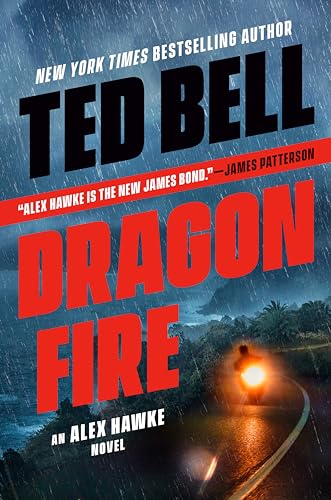
Alex Hawke, British lord and gentleman spy, is looking for the Queen's missing grandson, whose disappearance may be the culmination of a plot almost a century old in this breathtaking new adventure from New York Times bestselling novelist Ted Bell.
December 8, 1941, Washington, D.C.
The new Chinese ambassador to the United States, Tiger Tang, meets with President Roosevelt one day after the attack on Pearl Harbor. For the next four years, China and the U.S. will be wartime allies, but the charming, sophisticated ambassador may be playing his own treacherous game.
Today, The Bahamas
Alex Hawke is recovering from serious injuries incurred during a battle with a malevolent enemy. His recuperation is interrupted by a desperate call from the Queen. Her favorite grandson has disappeared in the Bahamas. Lord Hawke is the only man she trusts with a mission this sensitive. All she knows is that the young prince was last seen at the exclusive Dragonfire nightclub owned by the nefarious Tang brothers, grandsons of Ambassador Tiger Tang.
Die Inhaltsangabe kann sich auf eine andere Ausgabe dieses Titels beziehen.
Über die Autorin bzw. den Autor
Ted Bell is the former chairman of the board and creative director of Young & Rubicam, one of the world's largest advertising agencies. He is the New York Times bestselling author of the Alex Hawke series as well as the YA adventure novels Nick of Time and The Time Pirate. He has recently been writer-in-residence at Cambridge University (U.K.) and visiting scholar at the Department of Politics and International Relations.
Auszug. © Genehmigter Nachdruck. Alle Rechte vorbehalten.
Chapter 1
Washington, D.C.
December 6, 1941
A very good morning to you, gentlemen!" President Franklin Delano Roosevelt said, appearing in the White House cabinet room all hale and hearty.
The president then lit a cigarette and fixed it into a tortoiseshell holder and placed it in his mouth at the jaunty angle that the press liked so much. The act served as a signal for everyone to light up as well. Missy LeHand, the president's secretary and the woman closest to him on the White House staff, handed round the coffee.
Then Roosevelt got right down to cases. Winston Churchill wanted a face-to-face meeting with him as soon as humanly possible. Harry Hopkins had passed on the message and urged FDR to agree to such a meeting.
The president sensed a ripple of unease among the cabinet members, including a deep frown on the face of Secretary of State, Cordell Hull. Old Hopkins had gotten his way again, jamming up the cabinet members' diplomatic channels with his own private agenda.
FDR was well aware that his cabinet resented Hopkins, but then so did all the other politicians in town. He also knew that every man in front of him, on this cold and sunny Saturday morning, was engaged in some sort of feud or other with their own deputies or rivals. He could step in at any time and replace any one of them. And they damn well knew it! So they could listen to what Harry was reporting back and advise their president on what he should do.
He cleared his throat loudly and said, "Well, gentlemen, what do you think?"
One by one, they spoke in turn. Cordell Hull's cautious view was reinforced by an even more negative reaction from Ickes. He said, "What would America gain from such a public meeting, one which would be feted by the British press and interpreted as just one more step down the road to war? Lindbergh and all the other isolationists would absolutely crucify this administration. I'll tell you that much, Mr. President!"
Even Knox, who was the most pro-British, came out against such a meeting. He said, "The merest suggestion that the president was going to such a meeting would only strengthen the isolationist case and swing public opinion further behind them."
When wrapping up a discussion, Roosevelt always made sure that everyone had had their say. He listened carefully to the balance of the men in the room. "Well, does anyone have anything else to add?"
"I certainly do, Mr. President," Cordell Hull said. "I wonder, is that really all that Harry Hopkins had to say?"
"Yes, he said a good deal. Now, anyone got anything else?"
There was silence.
"Good," said the president. "That's decided, then."
Hull fired back, "What's been decided?"
"I've decided that I'm going to think about it," said Roosevelt, looking down his nose at the man.
At 9:30 p.m., on that December 6, a certain Lieutenant Lester Schulz, paunchy and slightly out of breath, arrived at the White House with a locked pouch containing a top secret document. The leather pouch contained thirteen parts of the fourteen-part Japanese reply to the hard-line U.S. proposal presented to Japan in November. The messages had been sent from Tokyo to the Japanese Embassy in Washington, but they had been intercepted by American intelligence. The United States had cracked the Japanese diplomatic code, code-named ÒPurpleÓ in August 1940.
American officials had been reading top secret Japanese messages before her diplomats received them, meaning that President Roosevelt had the advantage of knowing what the Japanese government was doing and saying for the sixteen months prior to the sneak attack on Pearl Harbor. They had not, however, thus far cracked the military code. So, while the U.S. government was aware of Japan's diplomatic maneuvering, it remained cloaked in darkness about the specific movements of Tokyo's Imperial Navy.
Harry Hopkins, former secretary of commerce and one of Roosevelt's speechwriters and his closest confidant, delivered the documents to the president in his study. The president, in a pensive mood, his Scottie Fala perched on his lap, said, "What have we got here, Harry?"
"You'll see," Hopkins said. "It ain't good. I'll tell you that much."
As Hopkins paced back and forth, the president read the fifteen typewritten pages carefully for about ten minutes. Most of it outlined Japan's peaceful intentions in the region and laid the blame for the rising tensions on the United States. The final section of the document announced there was no chance of reaching a diplomatic settlement with the United States "because of American attitudes."
Roosevelt looked up, stared at Hopkins, and said, "This amounts to a declaration of war, Harry. Sooner rather than later. Most likely precipitated by a Japanese attack on British, or possibly Dutch, possessions somewhere in the region. Maybe the Philippines."
Hopkins pulled up a chair and sat. He was doing what he was best at, which was why he was held in the highest esteem by the president and his closest thing to a real friend in Washington.
"Yes, by God. And I think we damn well ought to consider pushing the Pentagon for a preemptive strike against those bastards. Rather than sit back and wait for war to come at the convenience of the Japanese. Strike the first blow at their homeland and prevent any sort of unpleasant surprises. I urge you to immediately get the Navy and Army Air Corps brass over here and-give these bastards a righteous punch."
But Roosevelt was a student of history. And like Lincoln on the eve of the Civil War, he understood the political appeal of having the enemy fire the opening shot.
"No, Harry. No, we can't do that. We are a democracy and a peaceful people." And then, raising his voice, he said somewhat cryptically, "But by God, we have a damn good record when it comes to waging war! And by God and all that's holy, I will take it to them!"
FDR was still in his bed with the newsapers on that frosty Sunday morning when he received notice that his military aide, Admiral Alex Beardall, would be bringing the locked pouch containing the missing fourteenth, and final, part of JapanÕs diplomatic response. The man delivered it to the president at 10:00 a.m. and waited patiently at his bedside while the president read it. Then read it again.
This document, Roosevelt clearly saw, instructed the Japanese ambassador to destroy the code machines at their Washington embassy and to deliver the message to the secretary of state at 1:00 p.m. And said that the "chances of achieving peace in the Pacific were gone, because cooperation with the American government has been lost."
The president turned to the admiral and said, "It looks as though they are breaking off negotiations. They're planning to strike, Alex. But when? And where?"
Roosevelt's first scheduled appointment on Sunday, December 7, was with the outgoing Chinese ambassador, Dr. Hu Shih, at 12:30 p.m. The elderly ambassador had taken the midnight train down from New York for the meeting. They met in the Oval Study. FDR was anxious to let the ambassador know that he had sent a private appeal directly to the Japanese emperor.
He told Dr. Hu: "I want to assure you, sir, that if the Japanese emperor does not intervene and restrain his military, war between the United States and Japan is utterly inevitable. We will be in this fight together, your country and...
„Über diesen Titel“ kann sich auf eine andere Ausgabe dieses Titels beziehen.
Suchergebnisse für Dragonfire (An Alex Hawke Novel, Band 11)

Beispielbild für diese ISBN
Dragonfire (An Alex Hawke Novel)
Anbieter: World of Books (was SecondSale), Montgomery, IL, USA
Verkäuferbewertung 5 von 5 Sternen

Zustand: Acceptable. Item in acceptable condition! Textbooks may not include supplemental items i.e. CDs, access codes etc. Bestandsnummer des Verkäufers 00110447650
Gebraucht kaufen
EUR 3,71
Versand gratis
Versand innerhalb von USA
Versand innerhalb von USA
Anzahl: 1 verfügbar
Beispielbild für diese ISBN
Dragonfire (An Alex Hawke Novel)
Anbieter: World of Books (was SecondSale), Montgomery, IL, USA
Verkäuferbewertung 5 von 5 Sternen
Zustand: Good. Item in good condition. Textbooks may not include supplemental items i.e. CDs, access codes etc. Bestandsnummer des Verkäufers 00108254841
Gebraucht kaufen
EUR 3,71
Versand gratis
Versand innerhalb von USA
Versand innerhalb von USA
Anzahl: 1 verfügbar
Beispielbild für diese ISBN
Dragonfire (An Alex Hawke Novel)
Anbieter: Orion Tech, Kingwood, TX, USA
Verkäuferbewertung 5 von 5 Sternen
hardcover. Zustand: Good. Bestandsnummer des Verkäufers 0593101200-3-27682358
Gebraucht kaufen
EUR 3,73
Versand gratis
Versand innerhalb von USA
Versand innerhalb von USA
Anzahl: 1 verfügbar
Beispielbild für diese ISBN
Dragonfire (An Alex Hawke Novel)
Anbieter: Your Online Bookstore, Houston, TX, USA
Verkäuferbewertung 5 von 5 Sternen
Hardcover. Zustand: Good. Bestandsnummer des Verkäufers 0593101200-3-23672021
Gebraucht kaufen
EUR 3,73
Versand gratis
Versand innerhalb von USA
Versand innerhalb von USA
Anzahl: 1 verfügbar
Foto des Verkäufers
Dragonfire (An Alex Hawke Novel)
Anbieter: Greenworld Books, Arlington, TX, USA
Verkäuferbewertung 5 von 5 Sternen
Zustand: good. Fast Free Shipping â" Good condition. It may show normal signs of use, such as light writing, highlighting, or library markings, but all pages are intact and the book is fully readable. A solid, complete copy that's ready to enjoy. Bestandsnummer des Verkäufers GWV.0593101200.G
Gebraucht kaufen
EUR 4,56
Versand gratis
Versand innerhalb von USA
Versand innerhalb von USA
Anzahl: 1 verfügbar
Foto des Verkäufers
Dragonfire (An Alex Hawke Novel)
Anbieter: Greenworld Books, Arlington, TX, USA
Verkäuferbewertung 5 von 5 Sternen
Zustand: very_good. Fast Free Shipping â" Very Good condition book with a firm cover and clean pages. Shows normal use and some light wear or limited notes markings. A solid, nice copy to enjoy. Bestandsnummer des Verkäufers GWV.0593101200.VG
Gebraucht kaufen
EUR 4,56
Versand gratis
Versand innerhalb von USA
Versand innerhalb von USA
Anzahl: 1 verfügbar
Beispielbild für diese ISBN
Dragonfire (An Alex Hawke Novel)
Anbieter: Idaho Youth Ranch Books, Boise, ID, USA
Verkäuferbewertung 5 von 5 Sternen
Zustand: Good. EX-LIBRARY A copy that has been read, but remains in clean condition. All pages are intact, and the cover is intact (including dust cover, if applicable). The spine may show signs of wear. Pages can include limited notes and highlighting, and the copy can include "From the library of" labels or limited small stickers. Book may have a remainder mark or be a price cutter. Bestandsnummer des Verkäufers DU-03-08-06-0354
Gebraucht kaufen
EUR 1,67
EUR 3,46 Versand
Versand innerhalb von USA
Versand innerhalb von USA
Anzahl: 1 verfügbar
Beispielbild für diese ISBN
Dragonfire
Anbieter: World of Books Inc, Montgomery, IL, USA
Verkäuferbewertung 2 von 5 Sternen

Hardback. Zustand: Good. Alex Hawke is recovering from serious injuries incurred during a battle with a malevolent enemy. His recuperation is interrupted by a desperate call from the Queen. Her favourite grandson has disappeared in the Bahamas. Lord Hawke is the only man she trusts with a mission this sensitive. All she knows is that the young prince was last seen at the exclusive Dragonfire nightclub owned by the nefarious Tang brothers, grandsons of Tiger Tang, Chinese ambassador to the United States during Pearl Harbour. Bestandsnummer des Verkäufers CIN0593101200G
Gebraucht kaufen
EUR 5,50
Versand gratis
Versand innerhalb von USA
Versand innerhalb von USA
Anzahl: 1 verfügbar
Beispielbild für diese ISBN
Dragonfire (An Alex Hawke Novel)
Anbieter: HPB-Red, Dallas, TX, USA
Verkäuferbewertung 5 von 5 Sternen
hardcover. Zustand: Very Good. Connecting readers with great books since 1972! Used textbooks may not include companion materials such as access codes, etc. May have some wear or limited writing/highlighting. We ship orders daily and Customer Service is our top priority! Bestandsnummer des Verkäufers S_439491846
Gebraucht kaufen
EUR 2,68
EUR 3,25 Versand
Versand innerhalb von USA
Versand innerhalb von USA
Anzahl: 1 verfügbar
Beispielbild für diese ISBN
Dragonfire
Verlag:
Penguin Publishing Group, 2020
ISBN 10: 0593101200
ISBN 13: 9780593101209
Gebraucht
Hardcover
Anbieter: Better World Books, Mishawaka, IN, USA
Verkäuferbewertung 5 von 5 Sternen
Zustand: Good. Former library copy. Pages intact with minimal writing/highlighting. The binding may be loose and creased. Dust jackets/supplements are not included. Includes library markings. Stock photo provided. Product includes identifying sticker. Better World Books: Buy Books. Do Good. Bestandsnummer des Verkäufers 19135134-6
Gebraucht kaufen
EUR 6,17
Versand gratis
Versand innerhalb von USA
Versand innerhalb von USA
Anzahl: 3 verfügbar