
Verwandte Artikel zu The Heart of a Great Nation: Timeless Wisdom from Ronald...
Inhaltsangabe
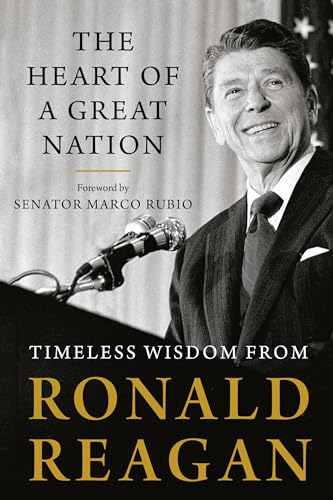
With a foreword from Senator Marco Rubio, a stirring collection of Ronald Reagan's most inspiring speeches, offering his timeless wisdom and guidance for our day.
In his 1989 farewell address, Ronald Reagan said, "I wasn't a great communicator, but I communicated great things, and they didn't spring full bloom from my brow, they came from the heart of a great nation--from our experience, our wisdom, and our belief in principles that have guided us for two centuries."
The Heart of a Great Nation brings together Reagan's most powerful speeches, as relevant to our chaotic world as they were when he first gave them. In a period of our country's history consumed by economic stagnation, national instability, and the looming threat of communism, Reagan spoke directly to the hearts of everyday Americans. His wisdom on matters of family, freedom, and nationhood helped guide the country back to its founding principles and ushered in an era of prosperity and national pride.
Today, as we find our country treading similar ground, Reagan's wisdom speaks to us once again, offering guidance to everyone looking to navigate the present and remember the legacy of this great nation--which can one day be reclaimed.
Die Inhaltsangabe kann sich auf eine andere Ausgabe dieses Titels beziehen.
Über die Autorin bzw. den Autor
RONALD WILSON REAGAN was the 40th president of the United States from 1981 to 1989. In his two terms, he lowered taxes, increased military spending, and enacted policies that led to the demise of communism in the Soviet Union. An influential figure in modern conservatism, he was given the nickname of the "Great Communicator." Reagan passed away on June 5, 2004.
MARCO RUBIO served in the Florida House of Representatives from 2000 to 2008 and was elected to the U.S. Senate in 2010. His committee assignments currently include Commerce, Science and Transportation; For¬eign Relations; Intelligence; and Small Business and Entrepreneurship. He and his wife, Jeanette, have four young children and live in West Miami.
Auszug. © Genehmigter Nachdruck. Alle Rechte vorbehalten.
1
Beginnings
By the time he was elected president in November 1980, Ronald Wilson Reagan had been a sports announcer, a Hollywood actor, a union leader, a longtime corporate spokesman for one of the biggest companies in America, and the twice-elected governor of California. He was a prominent figure in the still-young conservative movement, and his support of conservative Barry Goldwater in the 1964 presidential race, followed by Reagan's own unsuccessful bid for the Republican Party's nomination in 1976, pushed the party to the right.
Reagan's nomination and victory in 1980 cemented the party's conservatism. But his message of hope-he campaigned on a theme of a "new beginning"-had broader electoral appeal. He won the popular vote and the electoral college by wide margins in 1980 and again in 1984.
"An Era of National Renewal"
Just before noon on January 20, 1981, Reagan took the presidential oath of office at the U.S. Capitol-the first time, as he noted in the inaugural address reprinted here in full, that the oath was administered on the building's West Front, the side with the view of the National Mall and the capital's major monuments. His heartening first speech as president set the tone for his administration, explaining the need for major reforms while linking his plans to the country's ideals and its people's dreams. During the inaugural ceremony, fifty-two Americans who had been held hostage in Iran for 444 days were released, but confirmation did not come in time for Reagan to announce the news during his address as he had hoped.
Senator Hatfield, Mr. Chief Justice, Mr. President, Vice President Bush, Vice President Mondale, Senator Baker, Speaker O'Neill, Reverend Moomaw, and my fellow citizens:
To a few of us here today this is a solemn and most momentous occasion, and yet in the history of our nation it is a commonplace occurrence. The orderly transfer of authority as called for in the Constitution routinely takes place, as it has for almost two centuries, and few of us stop to think how unique we really are. In the eyes of many in the world, this every-four-year ceremony we accept as normal is nothing less than a miracle.
Mr. President, I want our fellow citizens to know how much you did to carry on this tradition. By your gracious cooperation in the transition process, you have shown a watching world that we are a united people pledged to maintaining a political system which guarantees individual liberty to a greater degree than any other, and I thank you and your people for all your help in maintaining the continuity which is the bulwark of our republic.
The business of our nation goes forward. These United States are confronted with an economic affliction of great proportions. We suffer from the longest and one of the worst sustained inflations in our national history. It distorts our economic decisions, penalizes thrift, and crushes the struggling young and the fixed-income elderly alike. It threatens to shatter the lives of millions of our people.
Idle industries have cast workers into unemployment, human misery, and personal indignity. Those who do work are denied a fair return for their labor by a tax system which penalizes successful achievement and keeps us from maintaining full productivity.
But great as our tax burden is, it has not kept pace with public spending. For decades we have piled deficit upon deficit, mortgaging our future and our children's future for the temporary convenience of the present. To continue this long trend is to guarantee tremendous social, cultural, political, and economic upheavals.
You and I, as individuals, can, by borrowing, live beyond our means, but for only a limited period of time. Why, then, should we think that collectively, as a nation, we're not bound by that same limitation? We must act today in order to preserve tomorrow. And let there be no misunderstanding: We are going to begin to act, beginning today.
The economic ills we suffer have come upon us over several decades. They will not go away in days, weeks, or months, but they will go away. They will go away because we as Americans have the capacity now, as we've had in the past, to do whatever needs to be done to preserve this last and greatest bastion of freedom.
In this present crisis, government is not the solution to our problem; government is the problem. From time to time we've been tempted to believe that society has become too complex to be managed by self-rule, that government by an elite group is superior to government for, by, and of the people. Well, if no one among us is capable of governing himself, then who among us has the capacity to govern someone else? All of us together, in and out of government, must bear the burden. The solutions we seek must be equitable, with no one group singled out to pay a higher price.
We hear much of special interest groups. Well, our concern must be for a special interest group that has been too long neglected. It knows no sectional boundaries or ethnic and racial divisions, and it crosses political party lines. It is made up of men and women who raise our food, patrol our streets, man our mines and factories, teach our children, keep our homes, and heal us when we're sick-professionals, industrialists, shopkeepers, clerks, cabbies, and truck drivers. They are, in short, "We the People," this breed called Americans.
Well, this administration's objective will be a healthy, vigorous, growing economy that provides equal opportunities for all Americans with no barriers born of bigotry or discrimination. Putting America back to work means putting all Americans back to work. Ending inflation means freeing all Americans from the terror of runaway living costs. All must share in the productive work of this "new beginning," and all must share in the bounty of a revived economy. With the idealism and fair play which are the core of our system and our strength, we can have a strong and prosperous America, at peace with itself and the world.
So, as we begin, let us take inventory. We are a nation that has a government-not the other way around. And this makes us special among the nations of the earth. Our government has no power except that granted it by the people. It is time to check and reverse the growth of government, which shows signs of having grown beyond the consent of the governed.
It is my intention to curb the size and influence of the federal establishment and to demand recognition of the distinction between the powers granted to the federal government and those reserved to the states or to the people. All of us need to be reminded that the federal government did not create the states; the states created the federal government.
Now, so there will be no misunderstanding, it's not my intention to do away with government. It is rather to make it work-work with us, not over us; to stand by our side, not ride on our back. Government can and must provide opportunity, not smother it; foster productivity, not stifle it.
If we look to the answer as to why for so many years we achieved so much, prospered as no other people on earth, it was because here in this land we unleashed the energy and individual genius of man to a greater extent than has ever been done before. Freedom and the dignity of the individual have been more available and assured here than in any other place on earth. The price for this freedom at times has been high, but we have never been unwilling to pay that price.
It is no coincidence that our present troubles parallel and are proportionate to the intervention and intrusion in our lives that result from unnecessary and excessive growth of government. It is time for us to realize that we're too great a...
„Über diesen Titel“ kann sich auf eine andere Ausgabe dieses Titels beziehen.
Suchergebnisse für The Heart of a Great Nation: Timeless Wisdom from Ronald...

Beispielbild für diese ISBN
The Heart of a Great Nation: Timeless Wisdom from Ronald Reagan
Anbieter: World of Books (was SecondSale), Montgomery, IL, USA
Verkäuferbewertung 5 von 5 Sternen

Paperback. Zustand: Fair. Ronald Reagan will always be remembered for his ability to speak directly to the hearts of everyday Americans. Now in a timeless package, The Heart of a Great Nation offers a selection of Reagan's most powerful speeches, as relevant to our world today as they were when he first gave them. With a foreword by Senator Marco Rubio, this book is for everyone who seeks guidance on how to navigate the present -- and to remember the legacy of Reagan's America. Bestandsnummer des Verkäufers 00105260971
Gebraucht kaufen
EUR 4,69
Versand gratis
Versand innerhalb von USA
Versand innerhalb von USA
Anzahl: 1 verfügbar
Beispielbild für diese ISBN
The Heart of a Great Nation: Timeless Wisdom from Ronald Reagan
Anbieter: World of Books (was SecondSale), Montgomery, IL, USA
Verkäuferbewertung 5 von 5 Sternen
Paperback. Zustand: Good. Ronald Reagan will always be remembered for his ability to speak directly to the hearts of everyday Americans. Now in a timeless package, The Heart of a Great Nation offers a selection of Reagan's most powerful speeches, as relevant to our world today as they were when he first gave them. With a foreword by Senator Marco Rubio, this book is for everyone who seeks guidance on how to navigate the present -- and to remember the legacy of Reagan's America. Bestandsnummer des Verkäufers 00102707080
Gebraucht kaufen
EUR 4,69
Versand gratis
Versand innerhalb von USA
Versand innerhalb von USA
Anzahl: 1 verfügbar
Beispielbild für diese ISBN
The Heart of a Great Nation: Timeless Wisdom from Ronald Reagan
Verlag:
Penguin Publishing Group (edition ), 2020
ISBN 10: 0593329759
ISBN 13: 9780593329757
Gebraucht
Paperback
Anbieter: BooksRun, Philadelphia, PA, USA
Verkäuferbewertung 5 von 5 Sternen
Paperback. Zustand: Fair. The item might be beaten up but readable. May contain markings or highlighting, as well as stains, bent corners, or any other major defect, but the text is not obscured in any way. Bestandsnummer des Verkäufers 0593329759-7-1-13
Gebraucht kaufen
EUR 4,70
Versand gratis
Versand innerhalb von USA
Versand innerhalb von USA
Anzahl: 1 verfügbar
Foto des Verkäufers
The Heart of a Great Nation: Timeless Wisdom from Ronald Reagan
Verlag:
Penguin Publishing Group, 2020
ISBN 10: 0593329759
ISBN 13: 9780593329757
Gebraucht
Softcover
Anbieter: Greenworld Books, Arlington, TX, USA
Verkäuferbewertung 5 von 5 Sternen
Zustand: good. Fast Free Shipping â" Good condition. It may show normal signs of use, such as light writing, highlighting, or library markings, but all pages are intact and the book is fully readable. A solid, complete copy that's ready to enjoy. Bestandsnummer des Verkäufers GWV.0593329759.G
Gebraucht kaufen
EUR 5,00
Versand gratis
Versand innerhalb von USA
Versand innerhalb von USA
Anzahl: 1 verfügbar
Beispielbild für diese ISBN
The Heart of a Great Nation : Timeless Wisdom from Ronald Reagan
Verlag:
Penguin Publishing Group, 2020
ISBN 10: 0593329759
ISBN 13: 9780593329757
Gebraucht
Softcover
Anbieter: Better World Books, Mishawaka, IN, USA
Verkäuferbewertung 5 von 5 Sternen
Zustand: Very Good. Former library copy. Pages intact with possible writing/highlighting. Binding strong with minor wear. Dust jackets/supplements may not be included. Includes library markings. Stock photo provided. Product includes identifying sticker. Better World Books: Buy Books. Do Good. Bestandsnummer des Verkäufers 51279409-6
Gebraucht kaufen
EUR 6,08
Versand gratis
Versand innerhalb von USA
Versand innerhalb von USA
Anzahl: 2 verfügbar
Beispielbild für diese ISBN
The Heart of a Great Nation : Timeless Wisdom from Ronald Reagan
Verlag:
Penguin Publishing Group, 2020
ISBN 10: 0593329759
ISBN 13: 9780593329757
Gebraucht
Softcover
Anbieter: Better World Books, Mishawaka, IN, USA
Verkäuferbewertung 5 von 5 Sternen
Zustand: Good. Former library copy. Pages intact with minimal writing/highlighting. The binding may be loose and creased. Dust jackets/supplements are not included. Includes library markings. Stock photo provided. Product includes identifying sticker. Better World Books: Buy Books. Do Good. Bestandsnummer des Verkäufers 40989398-6
Gebraucht kaufen
EUR 6,08
Versand gratis
Versand innerhalb von USA
Versand innerhalb von USA
Anzahl: 1 verfügbar
Beispielbild für diese ISBN
The Heart of a Great Nation: Timeless Wisdom from Ronald Reagan
Anbieter: World of Books Inc, Montgomery, IL, USA
Verkäuferbewertung 4 von 5 Sternen

Paperback. Zustand: Good. Ronald Reagan will always be remembered for his ability to speak directly to the hearts of everyday Americans. Now in a timeless package, The Heart of a Great Nation offers a selection of Reagan's most powerful speeches, as relevant to our world today as they were when he first gave them. With a foreword by Senator Marco Rubio, this book is for everyone who seeks guidance on how to navigate the present -- and to remember the legacy of Reagan's America. Bestandsnummer des Verkäufers CIN0593329759G
Gebraucht kaufen
EUR 6,50
Versand gratis
Versand innerhalb von USA
Versand innerhalb von USA
Anzahl: 1 verfügbar
Beispielbild für diese ISBN
The Heart of a Great Nation: Timeless Wisdom from Ronald Reagan
Anbieter: World of Books Inc, Montgomery, IL, USA
Verkäuferbewertung 4 von 5 Sternen
Paperback. Zustand: Fair. Ronald Reagan will always be remembered for his ability to speak directly to the hearts of everyday Americans. Now in a timeless package, The Heart of a Great Nation offers a selection of Reagan's most powerful speeches, as relevant to our world today as they were when he first gave them. With a foreword by Senator Marco Rubio, this book is for everyone who seeks guidance on how to navigate the present -- and to remember the legacy of Reagan's America. Bestandsnummer des Verkäufers CIN0593329759A
Gebraucht kaufen
EUR 6,50
Versand gratis
Versand innerhalb von USA
Versand innerhalb von USA
Anzahl: 1 verfügbar
Beispielbild für diese ISBN
The Heart of a Great Nation: Timeless Wisdom from Ronald Reagan
Verlag:
Penguin Publishing Group, 2020
ISBN 10: 0593329759
ISBN 13: 9780593329757
Gebraucht
Paperback
Anbieter: ThriftBooks-Dallas, Dallas, TX, USA
Verkäuferbewertung 5 von 5 Sternen
Paperback. Zustand: Good. No Jacket. Pages can have notes/highlighting. Spine may show signs of wear. ~ ThriftBooks: Read More, Spend Less. Bestandsnummer des Verkäufers G0593329759I3N00
Gebraucht kaufen
EUR 6,65
Versand gratis
Versand innerhalb von USA
Versand innerhalb von USA
Anzahl: 1 verfügbar
Beispielbild für diese ISBN
The Heart of a Great Nation: Timeless Wisdom from Ronald Reagan
Verlag:
Penguin Publishing Group, 2020
ISBN 10: 0593329759
ISBN 13: 9780593329757
Gebraucht
Paperback
Anbieter: ThriftBooks-Atlanta, AUSTELL, GA, USA
Verkäuferbewertung 5 von 5 Sternen
Paperback. Zustand: Fair. No Jacket. Readable copy. Pages may have considerable notes/highlighting. ~ ThriftBooks: Read More, Spend Less. Bestandsnummer des Verkäufers G0593329759I5N00
Gebraucht kaufen
EUR 6,65
Versand gratis
Versand innerhalb von USA
Versand innerhalb von USA
Anzahl: 1 verfügbar