
Verwandte Artikel zu The Damnation Game
Inhaltsangabe
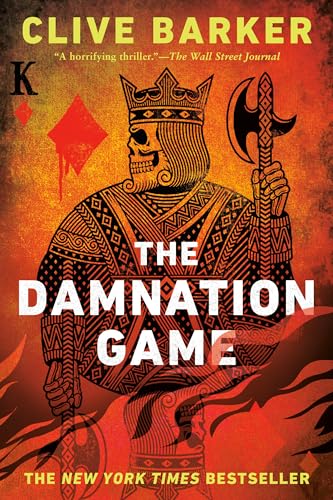
THE NEW YORK TIMES BESTSELLER
“ONE OF THE BEST HORROR NOVELS IN A VERY LONG TIME...do not miss it!”—USA Today
There are things worse than death. There are games so seductively evil, so wondrously vile, no gambler can resist. Amid the shadow-scarred rubble of World War II, Joseph Whitehead dared to challenge the dark champion of life’s ultimate game. Now a millionaire, locked in a terror-shrouded fortress of his own design, Joseph Whitehead has hell to pay. And no soul is safe from this ravaging fear, the resurrected fury, the unspeakable desire of...
THE DAMNATION GAME
Die Inhaltsangabe kann sich auf eine andere Ausgabe dieses Titels beziehen.
Über die Autorin bzw. den Autor
Born in Liverpool in 1952, Clive Barker has written and produced a number of plays, including The History of the Devil and Frankenstein in Love, which are as diverse in style and subject as the fiction he has written since. His volumes of short fiction, Books of Blood, earned him immediate praise from horror fans and literary critics alike. He won both the British and World Fantasy awards, and was nominated for the coveted Booker Prize, Britain’s highest literary award. His bestselling novels include The Damnation Game, Imajica, Coldheart Canyon, The Thief of Always, The Great and Secret Show, Everville, the Abarat series, and The Scarlet Gospels. He is also the creator of the now-classic Hellraiser films as well as Nightbreed and Lord of Illusions.
Auszug. © Genehmigter Nachdruck. Alle Rechte vorbehalten.
1
The air was electric the day the thief crossed the city, certain that tonight, after so many weeks of frustration, he would finally locate the card-player. It was not an easy journey. Eighty-five percent of Warsaw had been leveled, either by the months of mortar bombardment that had preceded the Russian liberation of the city, or by the program of demolition the Nazis had undertaken before their retreat. Several sectors were virtually impassable by vehicle. Mountains of rubble-still nurturing the dead like bulbs ready to sprout as the spring weather warmed-clogged the streets. Even in the more accessible districts the once-elegant fa�ades swooned dangerously, their foundations growling.
But after almost three months of plying his trade here, the thief had become used to navigating this urban wilderness. Indeed, he took pleasure in its desolate splendor: its perspectives tinged lilac by the dust that still settled from the stratosphere, its squares and parkways so unnaturally silent; the sense he had, trespassing here, that this was what the end of the world would be like. By day there were even a few landmarks remaining-forlorn signposts that would be dismantled in time-by which the traveler could chart his route. The gas works beside the Poniatowski Bridge was still recognizable, as was the zoo on the other side of the river; the clock-tower of Central Station showed its head, though the clock had long since disappeared; these and a handful of other pockmarked tributes to Warsaw's civic beauty survived, their trembling presence poignant, even to the thief.
This wasn't his home. He had no home, nor had for a decade. He was a nomad and a scavenger, and for a short space Warsaw offered sufficient pickings to keep him here. Soon, when he'd recovered energies depleted in his recent wanderings, it would be time to move on. But while the first signs of spring murmured in the air he lingered here, enjoying the freedom of the city.
There were hazards certainly, but then where were there not for a man of his profession? And the war years had polished his powers of self-preservation to such brilliance that little intimidated him. He was safer here than the true citizens of Warsaw, the few bewildered survivors of the holocaust who were gradually beginning to filter back into the city, looking for lost homes, lost faces. They scrabbled in the wreckage or stood on street corners listening to the dirge of the river, and waited for the Russians to round them up in the name of Karl Marx. New barricades were being established every day. The military were slowly but systematically reclaiming some order from the confusion, dividing and subdividing the city as they would, in time, the entire country. The curfews and the checkpoints did little to hobble the thief, however. In the lining of his well-cut coat he kept identification papers of every kind-some forged, most stolen-one of which would be suitable for whatever situation arose. What they lacked in credibility he made up for with repartee and cigarettes, both of which he possessed in abundance. They were all a man needed-in that city, in that year-to feel like the lord of creation.
And such creation! No need here for either appetite or curiosity to go unsatisfied. The profoundest secrets of body and spirit were available to anyone with the itch to see. Games were made of them. Only the previous week the thief had heard tell of a young man who played the ancient game of cups and ball (now you see it, now you don't) but substituted, with insanity's wit, three buckets and a baby's head.
That was the least of it; the infant was dead, and the dead don't suffer. There were, however, other pastimes available for hire in the city, delights that used the living as their raw material. For those with the craving and the price of entry, a traffic in human flesh had begun. The occupying army, no longer distracted by battle, had discovered sex again, and there was profit in it. Half a loaf of bread could purchase one of the refugee girls-many so young they scarcely had breasts to knead-to be used and re-used in the covering darkness, their complaints unheard or silenced by a bayonet when they lost their charm. Such casual homicide was overlooked in a city where tens of thousands had died. For a few weeks-between one regime and the next-anything was possible: no act found culpable, no depravity taboo.
A boys' brothel had been opened in the Zoliborz District. Here, in an underground salon hung with salvaged paintings, one could choose from chicks of six or seven up, all fetchingly slimmed by malnutrition and tight as any connoisseur could wish. It was very popular with the officer class, but too expensive, the thief had heard it muttered, for the noncommissioned ranks. Lenin's tenets of equal choice for all did not stretch, it seemed, to pederasty.
Sport, of a kind, was more cheaply available. Dogfights were a particularly popular attraction that season. Homeless curs, returning to the city to pick at the meat of their masters, were trapped, fed to fighting strength and then pitted against each other to the death. It was an appalling spectacle, but a love of betting took the thief to the fights again and again. He'd made a tidy profit one night by putting his money on a runty but cunning terrier who'd bested a dog three times its size by chewing off its opponent's testicles.
And if, after a time, your taste for dogs or boys or women palled, there were more esoteric entertainments available.
In a crude amphitheater dug from the debris of the Bastion of Holy Mary the thief had seen an anonymous actor singlehandedly perform Goethe's Faust, Parts One and Two. Though the thief's German was far from perfect, the performance had made a lasting impression. The story was familiar enough for him to follow the action-the pact with Mephisto, the debates, the conjuring tricks, and then, as the promised damnation approached, despair and terrors. Much of the argument was indecipherable, but the actor's possession by his twin roles-one moment Tempter, the next Tempted-was so impressive the thief left with his belly churning.
Two days later he had gone back to see the play again, or at least to speak to the actor. But there were to be no encores. The performer's enthusiasm for Goethe had been interpreted as pro-Nazi propaganda; the thief found him hanging, joy decayed, from a telegraph pole. He was naked. His bare feet had been eaten at and his eyes taken out by birds; his torso was riddled with bullet holes. The sight pacified the thief. He saw it as proof that the confused feelings the actor had aroused were iniquitous; if this was the state to which his art had brought him the man had clearly been a scoundrel and a sham. His mouth gaped, but the birds had taken his tongue as well as his eyes. No loss.
Besides, there were far more rewarding diversions. The women the thief could take or leave, and the boys were not to his taste, but the gambling he loved, and always had. So it was back to the dogfights to chance his fortunes on a mongrel. If not there, then to some barrack-room dice game, or-in desperation-betting with a bored sentry on the speed of a passing cloud. The method and the circumstance scarcely concerned him: he cared only to gamble. Since his adolescence it had been his one true vice; it was the indulgence he had become a thief to fund. Before the war he'd played in casinos across Europe; chemin de fer was his game, though he was not averse to roulette. Now he looked back at those years through the veil war had drawn across them, and remembered the contests as he remembered dreams on waking: as something irretrievable, and slipping further away with every breath.
That sense of...
„Über diesen Titel“ kann sich auf eine andere Ausgabe dieses Titels beziehen.
Suchergebnisse für The Damnation Game

Foto des Verkäufers
The Damnation Game
Verlag:
Penguin Publishing Group, 2021
ISBN 10: 0593334973
ISBN 13: 9780593334973
Gebraucht
Softcover
Anbieter: Greenworld Books, Arlington, TX, USA
Verkäuferbewertung 5 von 5 Sternen

Zustand: good. Fast Free Shipping â" Good condition. It may show normal signs of use, such as light writing, highlighting, or library markings, but all pages are intact and the book is fully readable. A solid, complete copy that's ready to enjoy. Bestandsnummer des Verkäufers GWV.0593334973.G
Gebraucht kaufen
EUR 5,22
Versand gratis
Versand innerhalb von USA
Versand innerhalb von USA
Anzahl: 1 verfügbar
Foto des Verkäufers
The Damnation Game
Verlag:
Penguin Publishing Group, 2021
ISBN 10: 0593334973
ISBN 13: 9780593334973
Gebraucht
Softcover
Anbieter: Goodwill, Brooklyn Park, MN, USA
Verkäuferbewertung 4 von 5 Sternen

Zustand: good. All pages and cover are intact including the dust cover, if applicable . Spine may show signs of wear. Pages may include limited notes and highlighting. May include "From the library of" labels. Shrink wrap, dust covers, or boxed set case may be missing. Item may be missing bundled media. Bestandsnummer des Verkäufers MINV.0593334973.G
Gebraucht kaufen
EUR 2,31
EUR 3,44 Versand
Versand innerhalb von USA
Versand innerhalb von USA
Anzahl: 1 verfügbar
Beispielbild für diese ISBN
The Damnation Game
Verlag:
Penguin Publishing Group, 2021
ISBN 10: 0593334973
ISBN 13: 9780593334973
Gebraucht
Paperback
Anbieter: ThriftBooks-Atlanta, AUSTELL, GA, USA
Verkäuferbewertung 5 von 5 Sternen
Paperback. Zustand: Good. No Jacket. Pages can have notes/highlighting. Spine may show signs of wear. ~ ThriftBooks: Read More, Spend Less. Bestandsnummer des Verkäufers G0593334973I3N00
Gebraucht kaufen
EUR 5,84
Versand gratis
Versand innerhalb von USA
Versand innerhalb von USA
Anzahl: 1 verfügbar
Beispielbild für diese ISBN
The Damnation Game
Verlag:
Penguin Publishing Group, 2021
ISBN 10: 0593334973
ISBN 13: 9780593334973
Gebraucht
Paperback
Anbieter: ThriftBooks-Phoenix, Phoenix, AZ, USA
Verkäuferbewertung 5 von 5 Sternen
Paperback. Zustand: Fair. No Jacket. Readable copy. Pages may have considerable notes/highlighting. ~ ThriftBooks: Read More, Spend Less. Bestandsnummer des Verkäufers G0593334973I5N00
Gebraucht kaufen
EUR 5,84
Versand gratis
Versand innerhalb von USA
Versand innerhalb von USA
Anzahl: 1 verfügbar
Beispielbild für diese ISBN
The Damnation Game
Verlag:
Penguin Publishing Group, 2021
ISBN 10: 0593334973
ISBN 13: 9780593334973
Gebraucht
Paperback
Anbieter: ThriftBooks-Atlanta, AUSTELL, GA, USA
Verkäuferbewertung 5 von 5 Sternen
Paperback. Zustand: Fair. No Jacket. Readable copy. Pages may have considerable notes/highlighting. ~ ThriftBooks: Read More, Spend Less. Bestandsnummer des Verkäufers G0593334973I5N00
Gebraucht kaufen
EUR 5,84
Versand gratis
Versand innerhalb von USA
Versand innerhalb von USA
Anzahl: 2 verfügbar
Beispielbild für diese ISBN
The Damnation Game
Verlag:
Penguin Publishing Group, 2021
ISBN 10: 0593334973
ISBN 13: 9780593334973
Gebraucht
Paperback
Anbieter: ThriftBooks-Reno, Reno, NV, USA
Verkäuferbewertung 5 von 5 Sternen
Paperback. Zustand: Fair. No Jacket. Readable copy. Pages may have considerable notes/highlighting. ~ ThriftBooks: Read More, Spend Less. Bestandsnummer des Verkäufers G0593334973I5N00
Gebraucht kaufen
EUR 5,84
Versand gratis
Versand innerhalb von USA
Versand innerhalb von USA
Anzahl: 1 verfügbar
Beispielbild für diese ISBN
The Damnation Game
Verlag:
Penguin Publishing Group, 2021
ISBN 10: 0593334973
ISBN 13: 9780593334973
Gebraucht
Paperback
Anbieter: ThriftBooks-Dallas, Dallas, TX, USA
Verkäuferbewertung 5 von 5 Sternen
Paperback. Zustand: Fair. No Jacket. Readable copy. Pages may have considerable notes/highlighting. ~ ThriftBooks: Read More, Spend Less. Bestandsnummer des Verkäufers G0593334973I5N00
Gebraucht kaufen
EUR 5,84
Versand gratis
Versand innerhalb von USA
Versand innerhalb von USA
Anzahl: 2 verfügbar
Foto des Verkäufers
The Damnation Game
Verlag:
Penguin Publishing Group, 2021
ISBN 10: 0593334973
ISBN 13: 9780593334973
Gebraucht
Softcover
Anbieter: Goodwill Books, Hillsboro, OR, USA
Verkäuferbewertung 5 von 5 Sternen
Zustand: good. Signs of wear and consistent use. Bestandsnummer des Verkäufers GICWV.0593334973.G
Gebraucht kaufen
EUR 2,93
EUR 3,44 Versand
Versand innerhalb von USA
Versand innerhalb von USA
Anzahl: 1 verfügbar
Beispielbild für diese ISBN
The Damnation Game
Verlag:
Penguin Publishing Group, 2021
ISBN 10: 0593334973
ISBN 13: 9780593334973
Gebraucht
Softcover
Anbieter: Hawking Books, Edgewood, TX, USA
Verkäuferbewertung 4 von 5 Sternen
Zustand: Very Good. Very Good Condition. Five star seller - Buy with confidence! Bestandsnummer des Verkäufers X0593334973X2
Gebraucht kaufen
EUR 6,48
Versand gratis
Versand innerhalb von USA
Versand innerhalb von USA
Anzahl: 1 verfügbar
Beispielbild für diese ISBN
The Damnation Game
Anbieter: HPB-Diamond, Dallas, TX, USA
Verkäuferbewertung 5 von 5 Sternen
Paperback. Zustand: Very Good. Connecting readers with great books since 1972! Used books may not include companion materials, and may have some shelf wear or limited writing. We ship orders daily and Customer Service is our top priority! Bestandsnummer des Verkäufers S_478018715
Gebraucht kaufen
EUR 3,90
EUR 3,24 Versand
Versand innerhalb von USA
Versand innerhalb von USA
Anzahl: 1 verfügbar