
Verwandte Artikel zu Exercise of Power: American Failures, Successes, and...
Exercise of Power: American Failures, Successes, and a New Path Forward in the Post-Cold War World - Softcover
Inhaltsangabe
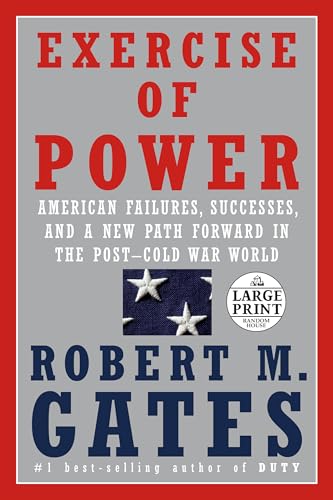
From the former secretary of defense and author of the acclaimed #1 bestselling memoir, Duty, a candid, sweeping examination of power, and how it has been exercised, for good and bad, by American presidents in the post-Cold War world.
Since the end of the Cold War, the global perception of the United States has progressively morphed from dominant international leader to disorganized entity. Robert Gates argues that this transformation is the result of the failure of political leaders to understand the complexity of American power, its expansiveness and its limitations. He makes clear that the successful exercise of power is not limited to the ability to coerce or demand submission, but must also encompass diplomacy, strategic communications, development assistance, intelligence, technology, and ideology. With forthright judgments of the performance of past presidents and their senior-most advisers, insightful firsthand knowledge, and compelling insider stories, Gates’s candid, sweeping examination of power in all its manifestations argues that U.S. national security in the future will require abiding by the lessons of the past, reimagining our approach, and revitalizing nonmilitary instruments of power essential to success and security.
Die Inhaltsangabe kann sich auf eine andere Ausgabe dieses Titels beziehen.
Über die Autorin bzw. den Autor
ROBERT M. GATES is the author of Duty, and A Passion for Leadership. He served as secretary of defense under presidents George W. Bush and Barack Obama. He was an officer in the United States Air Force and worked for the CIA before being appointed director of the agency. A member of the National Security Council staff in four administrations, he served eight presidents of both political parties. He was president of Texas A&M University from 2002 to 2006, is currently chancellor of the College of William & Mary, was national president of the Boy Scouts of America from 2014 to 2016, and has served on several corporate boards of directors. In 2018 he became chairman of Eisenhower Fellowships. He lives in Washington state.
Auszug. © Genehmigter Nachdruck. Alle Rechte vorbehalten.
Prologue
On Christmas Day, 1991, the hammer-and-sickle flag of the Union of Soviet Socialist Republics was lowered for the last time over the Kremlin, and Soviet communism passed into history. On that day, the United States of America stood alone, unchallenged, at the pinnacle of global power. A mighty empire had fallen, the first in history to do so without a major war, leaving America in a position of power unique in modern history.
A year later, I stood at the wall of windows in my office on the seventh floor at CIA headquarters looking out at the Virginia countryside. It was cold and overcast. I was reflecting on my imminent retirement, stepping down as director of central intelligence in less than a month, twenty-six years after joining the agency as a rookie analyst working on the Soviet desk. I had lived through the many crises of the last half of the Cold War, never expecting to witness that conflict’s end. On that wintry day in 1992, I thought about all I had seen and done working for six presidents, and wondered about the shape of the world to come. For someone The Washington Post had once characterized as the Eeyore of national security, able to find the darkest cloud in a silver lining, I was uncharacteristically optimistic.
As Bill Clinton raised his right hand to take the oath of office as our forty-second president on January 20, 1993, the United States singularly dominated the world militarily, economically, politically, and culturally—in every dimension of power. Not since the apogee of the Roman Empire had one country been in that position.
A quarter century later, the United States, while still the planet’s most powerful country militarily and economically, is challenged on every front. China is ascending and likely at some point to surpass the United States economically in terms of gross domestic product; Russia, modernizing its military apace, is aggressively threatening and attempting to destabilize Western democracies and dominate its neighbors; North Korea has become a wild-card nuclear power; the Middle East remains a sinkhole of conflict and terrorism. A savage civil war in Syria and the war against the Islamic State of Iraq and the Levant (ISIL) and its “caliphate” brought troops from Russia, Iran, Turkey, and the United States to the battlefield. After a military intervention led by the United States in 2011, Libya remains divided and engulfed in violence, and Iraq, invaded by the United States in 2003, still strives to create a sustainable, multiethnic government amid the ruins of most of its cities. Iran continues to strengthen its military capabilities, including ballistic missiles, sophisticated drones, cyber threats, and nuclear research, and intensifies its meddling from Lebanon and Syria to Yemen even as its ramps up its contest for religious and regional supremacy with Saudi Arabia. The war in Afghanistan seems endless. Our closest ally, Britain, is leaving the European Union, and authoritarian governments rule our NATO ally Turkey and are rising in Hungary and Poland. The multilateral institutions, alliances, and trade arrangements the United States created in its own self-interest in the decades after World War II have been weakened, in no small part by the very hand that created them, albeit by a president unlike any other. At home, our government is polarized, paralyzed, and seemingly incapable of addressing the manifold problems facing the country.
How did our country go so quickly from unique global power to a country that is widely perceived as no longer willing to bear the costs or accept the responsibility of global leadership—or even capable of governing itself effectively?
Answering how we got to where we are today internationally requires understanding the multiple forms of power that contributed to our achievement of historical singularity, and our earlier leaders’ skill in using those many and diverse forms of power along the road to that high point. The answer lies also in the mistakes of post–Cold War presidents and Congresses and, in particular, their failure to recognize, resource, and use the arsenal of nonmilitary assets that proved of critical importance in the long contest with the Soviet Union. It lies as well in their failure to understand that our place in the world in the decades ahead will depend for certain on a strong military but also on reimagining and rebuilding those nonmilitary tools. The answer is, essentially, the failure of too many of our recent political leaders to understand the complexity of American power, both in its expansiveness and in its limitations.
Dwight D. Eisenhower became president on January 20, 1953. During his two terms, the Soviet Union acquired the hydrogen bomb; there were repeated crises with China over Taiwan and the Taiwan Strait; the Joint Chiefs of Staff twice recommended using nuclear weapons—once to help the French at Dien Bien Phu and once against the Chinese; there was a major war in the Middle East involving three of our closest allies (Britain, France, and Israel). There were revolutions in Soviet-dominated East Germany, Poland, and Hungary; a revolution in Cuba; and many lesser crises. The period was one of great tension in the Cold War with the Soviets. And yet, from the moment Eisenhower signed the armistice agreement ending the Korean War in July 1953 until he left office in January 1961, not one American soldier was killed in combat. American prestige stood high around the world. How did he manage that feat?
Eisenhower was the only post–World War II president who was a career military officer, a five-star general who became commander in chief. He brought to the presidency great personal strengths, strategic insight, and leadership skills. He understood the uncertainties and risks always attendant to military operations. He knew the limits of military power in the nuclear age. He had the experience and confidence—and rank—to tell his generals no. Above all, he grasped the importance of diplomacy, economics, communication, and the many other tools of influence. He understood and wielded power in all its dimensions.
Ronald Reagan was routinely underestimated. Yet, as the Soviet Union began to falter internally in the 1980s, Reagan effectively used every instrument of American power to push the Soviets over the edge, from crisis to collapse. Upon taking office, he began the largest American military buildup in decades. He mobilized the CIA to covertly challenge Soviet adventurism and activities around the world, arming foes of Cuba—which acted as a surrogate for the USSR—in Angola, Ethiopia, and Central America; challenged the Soviets directly in Afghanistan by arming the mujahedin; and supported anticommunist movements such as Solidarity in Poland. Reagan brought economic pressure to bear on the USSR through sanctions and unprecedentedly aggressive efforts to block its acquisition of Western technology and know-how that might assist their weapons programs and their economy. Not since Eisenhower’s and Kennedy’s time did the United States Information Agency and its many channels of communication have such strong presidential support in sending America’s message abroad—a message about the United States and what it stood for, and blunt talk about Soviet tyranny. Reagan also understood the importance of diplomacy and so, in 1984–85, he pivoted, offering an outreached hand to Mikhail Gorbachev. Despite ups and downs, they reached an agreement on eliminating intermediate-range nuclear weapons from Europe and overall dramatically eased tensions. Most important, Reagan’s outstretched hand gave Gorbachev the political space at home to continue his reforms, which were destroying the Soviet...
„Über diesen Titel“ kann sich auf eine andere Ausgabe dieses Titels beziehen.
Suchergebnisse für Exercise of Power: American Failures, Successes, and...

Beispielbild für diese ISBN
Exercise of Power: American Failures, Successes, and a New Path Forward in the Post-Cold War World
Verlag:
Random House Large Print Publishing, 2020
ISBN 10: 0593339088
ISBN 13: 9780593339084
Gebraucht
Paperback
Anbieter: ThriftBooks-Dallas, Dallas, TX, USA
Verkäuferbewertung 5 von 5 Sternen

Paperback. Zustand: Very Good. No Jacket. Former library book; May have limited writing in cover pages. Pages are unmarked. ~ ThriftBooks: Read More, Spend Less. Bestandsnummer des Verkäufers G0593339088I4N10
Gebraucht kaufen
EUR 5,86
Versand gratis
Versand innerhalb von USA
Versand innerhalb von USA
Anzahl: 1 verfügbar
Beispielbild für diese ISBN
Exercise of Power: American Failures, Successes, and a New Path Forward in the Post-Cold War World
Anbieter: World of Books (was SecondSale), Montgomery, IL, USA
Verkäuferbewertung 5 von 5 Sternen
Paperback. Zustand: Very Good. From the former secretary of defense and author of the acclaimed #1 best-selling memoir, Duty, a candid, sweeping examination of power in all its manifestations, and how it has been exercised, for good and bad, by American presidents in the post-Cold War world. Since the end of the Cold War, the global perception of the United States has progressively morphed from dominant international leader to disorganized entity, seemingly unwilling to accept the mantle of leadership or unable to govern itself effectively. Robert Gates argues that this transformation is the result of the failure of political leaders to understand the complexity of American power, its expansiveness, and its limitations. He makes clear that the successful exercise of power is not limited to the use of military might or the ability to coerce or demand submission, but must encompass as well diplomacy, economics, strategic communications, development assistance, intelligence, technology, ideology, and cyber. By analyzing specific challenges faced by the American government in the post-Cold War period--Iran, Iraq, Afghanistan, North Korea, Syria, Libya, Russia, China, and others--Gates deconstructs the ways in which leaders have used the instruments of power available to them. With forthright judgments of the performance of past presidents and their senior-most advisers, firsthand knowledge, and insider stories, Gates argues that U.S. national security in the future will require learning, and abiding by, the lessons of the past, and re-creating those capabilities that the misuse of power has cost the nation. Bestandsnummer des Verkäufers 00105468690
Gebraucht kaufen
EUR 5,92
Versand gratis
Versand innerhalb von USA
Versand innerhalb von USA
Anzahl: 1 verfügbar
Beispielbild für diese ISBN
Exercise of Power: American Failures, Successes, and a New Path Forward in the Post-Cold War World
Anbieter: World of Books (was SecondSale), Montgomery, IL, USA
Verkäuferbewertung 5 von 5 Sternen
Paperback. Zustand: Good. From the former secretary of defense and author of the acclaimed #1 best-selling memoir, Duty, a candid, sweeping examination of power in all its manifestations, and how it has been exercised, for good and bad, by American presidents in the post-Cold War world. Since the end of the Cold War, the global perception of the United States has progressively morphed from dominant international leader to disorganized entity, seemingly unwilling to accept the mantle of leadership or unable to govern itself effectively. Robert Gates argues that this transformation is the result of the failure of political leaders to understand the complexity of American power, its expansiveness, and its limitations. He makes clear that the successful exercise of power is not limited to the use of military might or the ability to coerce or demand submission, but must encompass as well diplomacy, economics, strategic communications, development assistance, intelligence, technology, ideology, and cyber. By analyzing specific challenges faced by the American government in the post-Cold War period--Iran, Iraq, Afghanistan, North Korea, Syria, Libya, Russia, China, and others--Gates deconstructs the ways in which leaders have used the instruments of power available to them. With forthright judgments of the performance of past presidents and their senior-most advisers, firsthand knowledge, and insider stories, Gates argues that U.S. national security in the future will require learning, and abiding by, the lessons of the past, and re-creating those capabilities that the misuse of power has cost the nation. Bestandsnummer des Verkäufers 00097712010
Gebraucht kaufen
EUR 5,92
Versand gratis
Versand innerhalb von USA
Versand innerhalb von USA
Anzahl: 2 verfügbar
Beispielbild für diese ISBN
Exercise of Power : American Failures, Successes, and a New Path Forward in the Post-Cold War World
Anbieter: Better World Books, Mishawaka, IN, USA
Verkäuferbewertung 5 von 5 Sternen
Zustand: Good. Former library copy. Pages intact with minimal writing/highlighting. The binding may be loose and creased. Dust jackets/supplements are not included. Includes library markings. Stock photo provided. Product includes identifying sticker. Better World Books: Buy Books. Do Good. Bestandsnummer des Verkäufers 19121662-6
Gebraucht kaufen
EUR 6,40
Versand gratis
Versand innerhalb von USA
Versand innerhalb von USA
Anzahl: 2 verfügbar
Beispielbild für diese ISBN
Exercise of Power: American Failures, Successes, and a New Path Forward in the Post-Cold War World
Verlag:
Random House Large Print, 2020
ISBN 10: 0593339088
ISBN 13: 9780593339084
Gebraucht
paperback
Anbieter: Once Upon A Time Books, Siloam Springs, AR, USA
Verkäuferbewertung 4 von 5 Sternen

paperback. Zustand: Acceptable. This is a used book in good condition and may show some signs of use or wear . This is a used book. It may contain highlighting/underlining and/or the book may show heavier signs of wear . It may also be ex-library or without dustjacket. Bestandsnummer des Verkäufers mon0001030850
Gebraucht kaufen
EUR 2,95
EUR 3,47 Versand
Versand innerhalb von USA
Versand innerhalb von USA
Anzahl: 1 verfügbar
Beispielbild für diese ISBN
Exercise of Power: American Failures, Successes, and a New Path Forward in the Post-Cold War World
Verlag:
Random House Large Print Publishing, 2020
ISBN 10: 0593339088
ISBN 13: 9780593339084
Gebraucht
Paperback
Anbieter: ThriftBooks-Atlanta, AUSTELL, GA, USA
Verkäuferbewertung 5 von 5 Sternen
Paperback. Zustand: Good. No Jacket. Former library book; Pages can have notes/highlighting. Spine may show signs of wear. ~ ThriftBooks: Read More, Spend Less. Bestandsnummer des Verkäufers G0593339088I3N10
Gebraucht kaufen
EUR 6,55
Versand gratis
Versand innerhalb von USA
Versand innerhalb von USA
Anzahl: 1 verfügbar
Beispielbild für diese ISBN
Exercise of Power: American Failures, Successes, and a New Path Forward in the Post-Cold War World
Verlag:
Random House Large Print Publishing, 2020
ISBN 10: 0593339088
ISBN 13: 9780593339084
Gebraucht
Paperback
Anbieter: ThriftBooks-Reno, Reno, NV, USA
Verkäuferbewertung 5 von 5 Sternen
Paperback. Zustand: Very Good. No Jacket. Former library book; May have limited writing in cover pages. Pages are unmarked. ~ ThriftBooks: Read More, Spend Less. Bestandsnummer des Verkäufers G0593339088I4N10
Gebraucht kaufen
EUR 6,55
Versand gratis
Versand innerhalb von USA
Versand innerhalb von USA
Anzahl: 1 verfügbar
Beispielbild für diese ISBN
Exercise of Power: American Failures, Successes, and a New Path Forward in the Post-Cold War World
Verlag:
Random House Large Print Publishing, 2020
ISBN 10: 0593339088
ISBN 13: 9780593339084
Gebraucht
Paperback
Anbieter: ThriftBooks-Atlanta, AUSTELL, GA, USA
Verkäuferbewertung 5 von 5 Sternen
Paperback. Zustand: Very Good. No Jacket. Former library book; May have limited writing in cover pages. Pages are unmarked. ~ ThriftBooks: Read More, Spend Less. Bestandsnummer des Verkäufers G0593339088I4N10
Gebraucht kaufen
EUR 6,55
Versand gratis
Versand innerhalb von USA
Versand innerhalb von USA
Anzahl: 1 verfügbar
Beispielbild für diese ISBN
Exercise of Power: American Failures, Successes, and a New Path Forward in the Post-Cold War World
Anbieter: World of Books Inc, Montgomery, IL, USA
Verkäuferbewertung 4 von 5 Sternen
Paperback. Zustand: Good. From the former secretary of defense and author of the acclaimed #1 best-selling memoir, Duty, a candid, sweeping examination of power in all its manifestations, and how it has been exercised, for good and bad, by American presidents in the post-Cold War world. Since the end of the Cold War, the global perception of the United States has progressively morphed from dominant international leader to disorganized entity, seemingly unwilling to accept the mantle of leadership or unable to govern itself effectively. Robert Gates argues that this transformation is the result of the failure of political leaders to understand the complexity of American power, its expansiveness, and its limitations. He makes clear that the successful exercise of power is not limited to the use of military might or the ability to coerce or demand submission, but must encompass as well diplomacy, economics, strategic communications, development assistance, intelligence, technology, ideology, and cyber. By analyzing specific challenges faced by the American government in the post-Cold War period--Iran, Iraq, Afghanistan, North Korea, Syria, Libya, Russia, China, and others--Gates deconstructs the ways in which leaders have used the instruments of power available to them. With forthright judgments of the performance of past presidents and their senior-most advisers, firsthand knowledge, and insider stories, Gates argues that U.S. national security in the future will require learning, and abiding by, the lessons of the past, and re-creating those capabilities that the misuse of power has cost the nation. Bestandsnummer des Verkäufers CIN0593339088G
Gebraucht kaufen
EUR 7,73
Versand gratis
Versand innerhalb von USA
Versand innerhalb von USA
Anzahl: 2 verfügbar
Beispielbild für diese ISBN
Exercise of Power: American Failures, Successes, and a New Path Forward in the Post-Cold War World
Anbieter: World of Books Inc, Montgomery, IL, USA
Verkäuferbewertung 4 von 5 Sternen
Paperback. Zustand: Very Good. From the former secretary of defense and author of the acclaimed #1 best-selling memoir, Duty, a candid, sweeping examination of power in all its manifestations, and how it has been exercised, for good and bad, by American presidents in the post-Cold War world. Since the end of the Cold War, the global perception of the United States has progressively morphed from dominant international leader to disorganized entity, seemingly unwilling to accept the mantle of leadership or unable to govern itself effectively. Robert Gates argues that this transformation is the result of the failure of political leaders to understand the complexity of American power, its expansiveness, and its limitations. He makes clear that the successful exercise of power is not limited to the use of military might or the ability to coerce or demand submission, but must encompass as well diplomacy, economics, strategic communications, development assistance, intelligence, technology, ideology, and cyber. By analyzing specific challenges faced by the American government in the post-Cold War period--Iran, Iraq, Afghanistan, North Korea, Syria, Libya, Russia, China, and others--Gates deconstructs the ways in which leaders have used the instruments of power available to them. With forthright judgments of the performance of past presidents and their senior-most advisers, firsthand knowledge, and insider stories, Gates argues that U.S. national security in the future will require learning, and abiding by, the lessons of the past, and re-creating those capabilities that the misuse of power has cost the nation. Bestandsnummer des Verkäufers CIN0593339088VG
Gebraucht kaufen
EUR 7,73
Versand gratis
Versand innerhalb von USA
Versand innerhalb von USA
Anzahl: 1 verfügbar