
Verwandte Artikel zu Hidden Valley Road: Inside the Mind of an American...
Inhaltsangabe
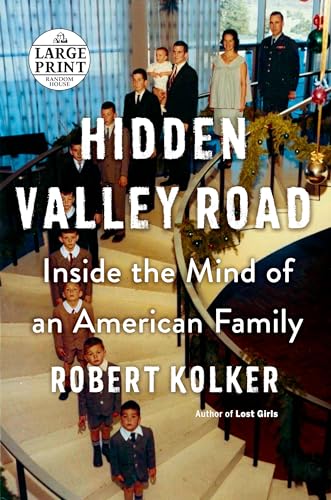
#1 NEW YORK TIMES BESTSELLER • OPRAH’S BOOK CLUB PICK • ONE OF GQ's TOP 50 BOOKS OF LITERARY JOURNALISM IN THE 21st CENTURY • The heartrending story of a midcentury American family with twelve children, six of them diagnosed with schizophrenia, that became science's great hope in the quest to understand the disease.
"Reads like a medical detective journey and sheds light on a topic so many of us face: mental illness." —Oprah Winfrey
Don and Mimi Galvin seemed to be living the American dream. After World War II, Don's work with the Air Force brought them to Colorado, where their twelve children perfectly spanned the baby boom: the oldest born in 1945, the youngest in 1965. In those years, there was an established script for a family like the Galvins--aspiration, hard work, upward mobility, domestic harmony--and they worked hard to play their parts. But behind the scenes was a different story: psychological breakdown, sudden shocking violence, hidden abuse. By the mid-1970s, six of the ten Galvin boys, one after another, were diagnosed as schizophrenic. How could all this happen to one family?
What took place inside the house on Hidden Valley Road was so extraordinary that the Galvins became one of the first families to be studied by the National Institute of Mental Health. Their story offers a shadow history of the science of schizophrenia, from the era of institutionalization, lobotomy, and the schizophrenogenic mother to the search for genetic markers for the disease, always amid profound disagreements about the nature of the illness itself. And unbeknownst to the Galvins, samples of their DNA informed decades of genetic research that continues today, offering paths to treatment, prediction, and even eradication of the disease for future generations.
With clarity and compassion, bestselling and award-winning author Robert Kolker uncovers one family's unforgettable legacy of suffering, love, and hope.
Die Inhaltsangabe kann sich auf eine andere Ausgabe dieses Titels beziehen.
Über die Autorin bzw. den Autor
ROBERT KOLKER is the New York Times bestselling author of Lost Girls, named one of the New York Times's 100 Notable Books and one of Publishers Weekly's Top Ten Books of 2013. As a journalist, his work has appeared in New York magazine, Bloomberg Businessweek, The New York Times Magazine, Wired, GQ, O magazine,and Men's Journal. He is a National Magazine Award finalist and a recipient of the 2011 Harry Frank Guggenheim Award for Excellence in Criminal Justice Reporting from the John Jay College of Criminal Justice in New York.
Auszug. © Genehmigter Nachdruck. Alle Rechte vorbehalten.
Prologue
1972 | Colorado Springs, Colorado
A brother and sister walk out of their house together, through the patio door that opens out from the family kitchen and into their backyard. They’re a strange pair. Donald Galvin is twenty-seven years old with deep-set eyes, his head shaved completely bald, his chin showing off the beginnings of a biblically scruffy beard. Mary Galvin is seven, half his height, with white-blond hair and a button nose.
The Galvin family lives in the Woodmen Valley, an expanse of forest and farmland nestled between the steep hills and sandstone mesas of central Colorado. Their yard smells of sweet pine, fresh and earthy. Near the patio, juncos and blue jays dart around a rock garden where the family’s pet, a goshawk named Atholl, stands guard in a mews their father built years ago. With the little girl leading the way, the sister and brother pass by the mews and climb up a small hill, stepping over lichen-covered rocks they both know by heart.
There are ten children between Mary and Donald in age—twelve Galvin kids in all; enough, their father enjoys joking, for a football team. The others have found excuses to be as far from Donald as possible. Those not old enough to have moved away are playing hockey or soccer or baseball. Mary’s sister, Margaret—the only other girl, and the sibling closest to Mary in age—might be with the Skarke girls next door, or down the road at the Shoptaughs’. But Mary, still in second grade, often has nowhere to go after school but home, and no one to look after her but Donald.
Everything about Donald confounds Mary, starting with his shaved head and continuing with what he likes most to wear: a reddish brown bedsheet, worn in the style of a monk. Sometimes he completes the outfit with a plastic bow and arrow that his little brothers once played with. In any weather, Donald walks the neighborhood dressed this way, mile after mile, all day and into the night—down their street, the unpaved Hidden Valley Road, past the convent and the dairy farm in the Woodmen Valley, along the shoulders and onto the median strips of highways. He often stops at the grounds of the United States Air Force Academy, where their father once worked, and where many people now pretend not to recognize him. And closer to home, Donald has stood sentry as children play in the yard of the local elementary school, announcing in his soft, almost Irish lilt that he is their new teacher. He only stops when the principal demands that he stay away. In those moments, Mary, a second-grader, is sorrier than ever that her world is so small that everyone knows that she is Donald’s sister.
Mary’s mother is well practiced at laughing off moments like these, behaving as if nothing is strange. To do anything else would be the same as admitting that she lacks any real control over the situation—that she cannot understand what is happening in her house, much less know how to stop it. Mary, in turn, has no choice but to not react at all to Donald. She notices how closely both her mother and father monitor all of their children now for warning signs: Peter with his rebellion, Brian and his drugs, Richard getting expelled, Jim picking fights, Michael checking out completely. To complain or cry or show any emotion at all, Mary knows, will send the message that something might be wrong with her, too.
And the fact is that the days when Mary sees Donald in that bedsheet are better than some of the other days. Sometimes after school, she comes home to find Donald in the middle of an undertaking only he can understand—like transplanting every last piece of furniture out of the house and into the backyard, or pouring salt into the aquarium and poisoning all the fish. Other times, he is in the bathroom, vomiting his medications: Stelazine and Thorazine and Haldol and Prolixin and Artane. Sometimes he is sitting in the middle of the living room quietly, completely naked. Sometimes the police are there, summoned by their mother, after hostilities have broken out between Donald and one or more of his brothers.
But most of the time, Donald is consumed by religious matters. Explaining that Saint Ignatius conferred upon him a degree in “spiritual exercise and theology,” he spends much of every day and many nights reciting in full voice the Apostles’ Creed and the Lord’s Prayer and a list of his own devising that he calls Holy Order of Priests, the logic of which is known only to him. D.O.M., Benedictine, Jesuit, Order of the Sacred Heart, Immaculate Conception, Mary, Immaculate Mary, Oblate Order of Priests, May Family, Black Friar, The Holy Ghost, Franciscan at the Convent, One Holy Universal, Apostolic, Trappist . . .
For Mary, the prayers are like a faucet that won’t stop dripping. “Stop it!” she shrieks, and yet Donald never does, pausing barely long enough to breathe. She sees what he’s doing as a rebuke of her entire family, but mostly of their father, a faithful Catholic. Mary idolizes her father. So does every other Galvin child—even Donald did, before he got sick. When Mary sees her father coming and going from the house whenever he likes, she is envious. She thinks about the sense of control that her father must enjoy by working so hard all the time. Hard enough to get out.
It is the way her brother singles Mary out that she finds most unbearable—not because he is cruel but because he is kind, even tender. Her full name is Mary Christine, and so Donald has decided that she is Mary, the sacred virgin and mother of Christ. “I am not!” Mary cries, again and again. She believes that she is being teased. It would not be the first time that one of her brothers has tried to make a fool of her. But Donald is so unmistakably serious—so fervent, so reverential—it only makes Mary angrier. He has made Mary the exalted object of his prayers—bringing her into his world, which is the last place that she would ever want to be. The idea that Mary comes up with, the solution to the problem of Donald, is a direct response to the rage she feels. Her inspiration comes from the sword- and- sandals epics that her mother sometimes watches on television.
The idea starts with her saying, “Let’s go up to the hill.” Donald consents; anything for the sacred virgin. It continues with Mary suggesting that they build a swing on a tree branch. “Let’s bring a rope,” she says. Donald does as she says. And it concludes at the top of the hill, where Mary selects a tree, one of many tall pines, and tells Donald that she’d like to tie him to it. Donald says yes. And hands her the rope.
Even if Mary were to reveal her plan to Donald—to burn him at the stake, like the heretics in the movies—it is doubtful that he would react. He is too busy praying. He stands tightly against the tree trunk, lost in his own stream of words as Mary walks around the tree with the rope, circling and pulling until she believes he cannot break free. Donald does not resist.
She tells herself that no one will miss him when he’s gone—and that no one will ever suspect her. She goes searching for kindling and brings back armfuls of twigs and branches, dropping them at his bare feet.
Donald is ready. If Mary really is who he insists she is, he can hardly say no. He is calm, patient, kind.
He adores her.
But on this day, Mary is serious only to a point. She has no matches, no way to make a fire. More crucially, she is not like her brother. She is grounded, her mind rooted in the real world. If nothing else, Mary is determined to prove that, not just to her mother, but to herself.
So she abandons her plan. She strands Donald on the hill. He stays up...
„Über diesen Titel“ kann sich auf eine andere Ausgabe dieses Titels beziehen.
Suchergebnisse für Hidden Valley Road: Inside the Mind of an American...

Beispielbild für diese ISBN
Hidden Valley Road: Inside the Mind of an American Family
Anbieter: Your Online Bookstore, Houston, TX, USA
Verkäuferbewertung 5 von 5 Sternen

paperback. Zustand: Fair. Bestandsnummer des Verkäufers 0593341449-4-37743501
Gebraucht kaufen
EUR 5,13
Versand gratis
Versand innerhalb von USA
Versand innerhalb von USA
Anzahl: 1 verfügbar
Beispielbild für diese ISBN
Hidden Valley Road: Inside the Mind of an American Family
ISBN 10: 0593341449
ISBN 13: 9780593341445
Gebraucht
Paperback
Anbieter: BooksRun, Philadelphia, PA, USA
Verkäuferbewertung 5 von 5 Sternen
Paperback. Zustand: Fair. Large type / Large print. The item might be beaten up but readable. May contain markings or highlighting, as well as stains, bent corners, or any other major defect, but the text is not obscured in any way. Bestandsnummer des Verkäufers 0593341449-7-1
Gebraucht kaufen
EUR 5,14
Versand gratis
Versand innerhalb von USA
Versand innerhalb von USA
Anzahl: 1 verfügbar
Beispielbild für diese ISBN
Hidden Valley Road: Inside the Mind of an American Family
Anbieter: World of Books (was SecondSale), Montgomery, IL, USA
Verkäuferbewertung 5 von 5 Sternen
Paperback. Zustand: Good. #1 NEW YORK TIMES BESTSELLER * OPRAH'S BOOK CLUB PICK * ONE OF GQ's TOP 50 BOOKS OF LITERARY JOURNALISM IN THE 21st CENTURY * The heartrending story of a midcentury American family with twelve children, six of them diagnosed with schizophrenia, that became science's great hope in the quest to understand the disease. "Reads like a medical detective journey and sheds light on a topic so many of us face: mental illness." --Oprah Winfrey A Kirkus Reviews Best Nonfiction Book of the Century Don and Mimi Galvin seemed to be living the American dream. After World War II, Don's work with the Air Force brought them to Colorado, where their twelve children perfectly spanned the baby boom: the oldest born in 1945, the youngest in 1965. In those years, there was an established script for a family like the Galvins--aspiration, hard work, upward mobility, domestic harmony--and they worked hard to play their parts. But behind the scenes was a different story: psychological breakdown, sudden shocking violence, hidden abuse. By the mid-1970s, six of the ten Galvin boys, one after another, were diagnosed as schizophrenic. How could all this happen to one family? What took place inside the house on Hidden Valley Road was so extraordinary that the Galvins became one of the first families to be studied by the National Institute of Mental Health. Their story offers a shadow history of the science of schizophrenia, from the era of institutionalization, lobotomy, and the schizophrenogenic mother to the search for genetic markers for the disease, always amid profound disagreements about the nature of the illness itself. And unbeknownst to the Galvins, samples of their DNA informed decades of genetic research that continues today, offering paths to treatment, prediction, and even eradication of the disease for future generations. With clarity and compassion, bestselling and award-winning author Robert Kolker uncovers one family's unforgettable legacy of suffering, love, and hope. Bestandsnummer des Verkäufers CIN0593341449G
Gebraucht kaufen
EUR 5,53
Versand gratis
Versand innerhalb von USA
Versand innerhalb von USA
Anzahl: 1 verfügbar
Beispielbild für diese ISBN
Hidden Valley Road: Inside the Mind of an American Family
Anbieter: ThriftBooks-Dallas, Dallas, TX, USA
Verkäuferbewertung 5 von 5 Sternen
Paperback. Zustand: Fair. No Jacket. Readable copy. Pages may have considerable notes/highlighting. ~ ThriftBooks: Read More, Spend Less. Bestandsnummer des Verkäufers G0593341449I5N00
Gebraucht kaufen
EUR 6,28
Versand gratis
Versand innerhalb von USA
Versand innerhalb von USA
Anzahl: 1 verfügbar
Beispielbild für diese ISBN
Hidden Valley Road: Inside the Mind of an American Family
Anbieter: ThriftBooks-Atlanta, AUSTELL, GA, USA
Verkäuferbewertung 5 von 5 Sternen
Paperback. Zustand: Good. No Jacket. Pages can have notes/highlighting. Spine may show signs of wear. ~ ThriftBooks: Read More, Spend Less. Bestandsnummer des Verkäufers G0593341449I3N00
Gebraucht kaufen
EUR 6,28
Versand gratis
Versand innerhalb von USA
Versand innerhalb von USA
Anzahl: 1 verfügbar
Beispielbild für diese ISBN
Hidden Valley Road: Inside the Mind of an American Family
Anbieter: ThriftBooks-Atlanta, AUSTELL, GA, USA
Verkäuferbewertung 5 von 5 Sternen
Paperback. Zustand: Good. No Jacket. Former library book; Pages can have notes/highlighting. Spine may show signs of wear. ~ ThriftBooks: Read More, Spend Less. Bestandsnummer des Verkäufers G0593341449I3N10
Gebraucht kaufen
EUR 6,28
Versand gratis
Versand innerhalb von USA
Versand innerhalb von USA
Anzahl: 1 verfügbar
Beispielbild für diese ISBN
Hidden Valley Road: Inside the Mind of an American Family
Anbieter: ThriftBooks-Atlanta, AUSTELL, GA, USA
Verkäuferbewertung 5 von 5 Sternen
Paperback. Zustand: Fair. No Jacket. Former library book; Readable copy. Pages may have considerable notes/highlighting. ~ ThriftBooks: Read More, Spend Less. Bestandsnummer des Verkäufers G0593341449I5N10
Gebraucht kaufen
EUR 6,28
Versand gratis
Versand innerhalb von USA
Versand innerhalb von USA
Anzahl: 1 verfügbar
Beispielbild für diese ISBN
Hidden Valley Road: Inside the Mind of an American Family
Anbieter: ThriftBooks-Reno, Reno, NV, USA
Verkäuferbewertung 5 von 5 Sternen
Paperback. Zustand: Good. No Jacket. Former library book; Pages can have notes/highlighting. Spine may show signs of wear. ~ ThriftBooks: Read More, Spend Less. Bestandsnummer des Verkäufers G0593341449I3N10
Gebraucht kaufen
EUR 6,28
Versand gratis
Versand innerhalb von USA
Versand innerhalb von USA
Anzahl: 1 verfügbar
Beispielbild für diese ISBN
Hidden Valley Road: Inside the Mind of an American Family
Anbieter: ThriftBooks-Phoenix, Phoenix, AZ, USA
Verkäuferbewertung 5 von 5 Sternen
Paperback. Zustand: Good. No Jacket. Pages can have notes/highlighting. Spine may show signs of wear. ~ ThriftBooks: Read More, Spend Less. Bestandsnummer des Verkäufers G0593341449I3N00
Gebraucht kaufen
EUR 6,28
Versand gratis
Versand innerhalb von USA
Versand innerhalb von USA
Anzahl: 1 verfügbar
Beispielbild für diese ISBN
Hidden Valley Road: Inside the Mind of an American Family
Anbieter: ThriftBooks-Dallas, Dallas, TX, USA
Verkäuferbewertung 5 von 5 Sternen
Paperback. Zustand: Good. No Jacket. Former library book; Pages can have notes/highlighting. Spine may show signs of wear. ~ ThriftBooks: Read More, Spend Less. Bestandsnummer des Verkäufers G0593341449I3N10
Gebraucht kaufen
EUR 6,28
Versand gratis
Versand innerhalb von USA
Versand innerhalb von USA
Anzahl: 1 verfügbar