
Inhaltsangabe
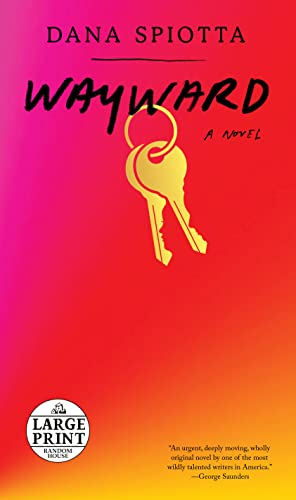
A NEW YORK TIMES NOTABLE BOOK OF THE YEAR • A “furious and addictive new novel” (The New York Times) about mothers and daughters, and one woman's midlife reckoning as she flees her suburban life.
“A virtuosic, singular and very funny portrait of a woman seeking sanity and purpose in a world gone mad.” —The New York Times Book Review
“Riddled with insights into aging, womanhood, and discontent, Wayward is as elegant as it is raw, and almost as funny as it is sad.” —Philadelphia Inquirer
“A comic, vital new novel.” —The New Yorker
Samantha Raymond's life has begun to come apart: her mother is ill, her teenage daughter is increasingly remote, and at fifty-two she finds herself staring into "the Mids"—that hour of supreme wakefulness between three and four in the morning in which women of a certain age suddenly find themselves contemplating motherhood, mortality, and, in this case, the state of our unraveling nation.
When she falls in love with a beautiful, decrepit house in a hardscrabble neighborhood in Syracuse, she buys it on a whim and flees her suburban life—and her family—as she grapples with how to be a wife, a mother, and a daughter, in a country that is coming apart at the seams.
Dana Spiotta's Wayward is a stunning novel about aging, about the female body, and about female complexity in contemporary America. Probing and provocative, brainy and sensual, it is a testament to our weird times, to reforms and resistance and utopian wishes, and to the beauty of ruins.
Die Inhaltsangabe kann sich auf eine andere Ausgabe dieses Titels beziehen.
Über die Autorin bzw. den Autor
DANA SPIOTTA's novel Stone Arabia was a National Book Critics Circle Award finalist. Her novel Eat the Document was a National Book Award finalist and won the Rosenthal Foundation Award from the American Academy of Arts and Letters. Her novel Lightning Field was a New York Times Notable Book of the year. She was a recipient of the Rome Prize in Literature, a Guggenheim Fellowship and a New York Foundation for the Arts Fellowship. Spiotta lives in Central New York with her husband and daughter.
Auszug. © Genehmigter Nachdruck. Alle Rechte vorbehalten.
2
The house sat high on a tiny lot on Highland Street, which ran atop a hill that bordered a long expanse of grass and trees. It looked like a small, sloping park, but it was actually a cemetery, the old graves scattered across the rise. Unless you were squeamish about graves—Sam wasn’t—the sloping green hill was quite pretty. Highland itself offered a wide view of downtown. You could see the steeples of churches, and you could see how the small city was in a valley surrounded by hills. You could even see the kidney shape of Onondaga Lake, although it was often partly obscured by low-hanging clouds. If you turned your head to the left, or if you looked out the side windows of the house, you could see Syracuse University up on another hill. You would locate it by the quilted low white bubble of the Carrier Dome (named for the nearly absent Carrier corporation—all that remained were a handful of jobs, the dome, and Carrier Circle, a treacherous traffic roundabout that Sam hated). Soon after you spotted the dome you would notice the various spired and turreted campus buildings.
The decision to leave her husband—the act of leaving, really—began the moment she made an offer on the house. It was a Sun-day; Sam woke up at five a.m., unable to continue sleeping. She attributed this unnecessarily early waking to the approach of menopause. Her period still came each month, but odd things had started changing in her body, even her brain. One of which was suddenly becoming awake at five a.m. on a Sunday, her mind shak-ing off sleep with unnegotiable clarity, as if she had already drunk a cup of coffee. And just as with coffee, she felt alert, an adrenal burst, but she could also feel the fatigue underneath it all, the wea-riness. That morning the wood floor was cold against her bare feet, but she couldn’t find her slippers. It was still dark. She tried not to wake her husband. She used her phone to illuminate the way to the bathroom. She peed, flushed, washed. She brushed her teeth without looking in the mirror. She pushed up the blinds to peek outside. The sky was gradually lightening with the dawn, and half a foot of snow had fallen overnight. It was one of those Syracuse March snow dumps. Everyone complained because it “should be spring,” but why say that when it never was spring in March in Syra-cuse. Besides, snow in March was often spectacular because of the spring light. The sunrise that was creeping up now cast a pink-and-gold glimmer, and a little crust of ice on top of the snow glittered from the sky and from the streetlamps. The trees, the roofs of the houses, even the salt-crusted cars looked beautiful. And like most spectacularly beautiful effects, it was almost too much, too dra-matic, nearly lurid. Sam loved the drama of a March snow. March meant the sky would be bright, blindingly bright, not the cloudy darkness of January or the dingy gray monotony of February, the worst month. As the day progressed, sharp shadows would be cast across the snow crust, your eyes would squint from the bright-ness, and, with no wind, you might unzip your coat. Syracuse in these moments could be a Colorado ski slope. March was differ-ent because the light brought the promise of spring, and the snow made everything lovely, freshly covered and pristine.
But here was the important part: Sam figured that she was the only person on earth who thought March snowstorms were won-derful, and this made her feel a bit proud of herself. Always she liked to imagine herself as subtly different from everyone else, enjoying the tension and mystique of being ordinary on the surface but with a radical, original interior life. For example, back when Sam used to shop the sales at the Talbots in DeWitt with the other subur-ban ladies of her class and age, she separated herself. Sure, Sam had discovered that the classic A-line or sheath dresses made of solid-colored ponte knits were so forgiving, so flattering (“flattering,” that tragic word) to a grotesque midlife misshapenness—a blur-riness, a squareness, really. But despite being there and shopping because of an “insider” email-blast notification of a super sale, Sam believed that she was different from the other women. Inside she was mocking the calibrated manipulations, mocking herself, not-ing the corporate branding and lifestyle implications of the preppy styles and colors. The classic plaids, the buttons on the sleeves, the ballerina flats evoking a tastefully understated sensibility. It even occurred to her that the other women could be having the same in-terior thoughts and that the idea of conformity—at least in modern America—was never consciously sought after. No one older than a teenager thought, I want this because everyone else has it. No, Sam knew that you were sold the idea that you could be independent-minded even as you bought what everyone else bought. You were allowed to keep a vain and precious sense of agency. This was the very secret to consumerism working in a sav vy, self-conscious cul-ture. Her sense of resistance was as manufactured as her need to buy flattering clothing. Nevertheless (!), Sam also believed that her having such self-critical, self-reflexive thoughts as she shopped set her apart from the other women. Surely. So she still believed herself to be (however stealthily) an eccentric person, not suited to conventions of thought or sensibility.
Lately this desire to be contrary to convention had taken on a new urgency well beyond clothes or matters of taste. An unruly, even perverse inclination animated her. It had been looking for a place to land, for something to fasten on. So now (not before), this odd inner state pushed her toward a highly destabilizing wildness (a recklessness) that she couldn’t suppress any longer.
She pulled on the same clothes she had worn the day before: stretched-out jeans and a black cowl-neck sweater. She no longer wanted to open her closet full of clothes. Why did she need so many, so much? In the last few months, things that used to capti-vate her no longer did.
She crept downstairs and made herself a coffee.
It was Sam’s habit to check out the real estate listings online. She had the bored-housewife pastime of attending open houses. She knew many of the other people there also had no intention to buy but had come to snoop into other people’s lives or to calculate land values or to imagine a fantasy life brought on by the frame of fresh architecture. This last impulse made sense to her. She had even wanted, at one point, to study architecture (and history, and women’s studies, and literature), but she had talked herself out of it and, in what she characterized to her friends as a retro move, she had gotten married and then pregnant instead. She settled for becoming an architectural amateur. And a “stay-at-home mom” (a term she found degrading, as if she were a prisoner under house arrest).
Unusual old structures (Syracuse had many) excited her: they were a visible-but-secret code, the past rendered in materials that could be seen and touched. For example, the abandoned People’s A ME Zion Church on East Fayette Street. Its tiny perfect form sat on a sturdy, intact limestone foundation. Paint-peeled crumbling white brick rose into a...
„Über diesen Titel“ kann sich auf eine andere Ausgabe dieses Titels beziehen.
Weitere beliebte Ausgaben desselben Titels

Suchergebnisse für Wayward: A novel (Random House Large Print)

Beispielbild für diese ISBN
Wayward Random House Large Pri
Verlag:
Random House Large Print, 2021
ISBN 10: 0593414446
ISBN 13: 9780593414446
Gebraucht
Softcover
Anbieter: World of Books (was SecondSale), Montgomery, IL, USA
Verkäuferbewertung 5 von 5 Sternen

Zustand: Good. Good condition ex-library book with usual library markings and stickers. Bestandsnummer des Verkäufers 00086388304
Gebraucht kaufen
EUR 3,16
Versand gratis
Versand innerhalb von USA
Versand innerhalb von USA
Anzahl: 1 verfügbar
Beispielbild für diese ISBN
Wayward : A Novel
Anbieter: Better World Books, Mishawaka, IN, USA
Verkäuferbewertung 5 von 5 Sternen
Zustand: Good. 39. Former library copy. Pages intact with minimal writing/highlighting. The binding may be loose and creased. Dust jackets/supplements are not included. Includes library markings. Stock photo provided. Product includes identifying sticker. Better World Books: Buy Books. Do Good. Bestandsnummer des Verkäufers 40887115-75
Gebraucht kaufen
EUR 6,26
Versand gratis
Versand innerhalb von USA
Versand innerhalb von USA
Anzahl: 2 verfügbar
Beispielbild für diese ISBN
Wayward : A Novel
Anbieter: Better World Books, Mishawaka, IN, USA
Verkäuferbewertung 5 von 5 Sternen
Zustand: Very Good. 39. Former library copy. Pages intact with possible writing/highlighting. Binding strong with minor wear. Dust jackets/supplements may not be included. Includes library markings. Stock photo provided. Product includes identifying sticker. Better World Books: Buy Books. Do Good. Bestandsnummer des Verkäufers 40886474-75
Gebraucht kaufen
EUR 6,26
Versand gratis
Versand innerhalb von USA
Versand innerhalb von USA
Anzahl: 1 verfügbar
Beispielbild für diese ISBN
Wayward
Verlag:
Random House Large Print Publishing, 2021
ISBN 10: 0593414446
ISBN 13: 9780593414446
Gebraucht
Paperback
Anbieter: ThriftBooks-Dallas, Dallas, TX, USA
Verkäuferbewertung 5 von 5 Sternen
Paperback. Zustand: Good. No Jacket. Former library book; Pages can have notes/highlighting. Spine may show signs of wear. ~ ThriftBooks: Read More, Spend Less. Bestandsnummer des Verkäufers G0593414446I3N10
Gebraucht kaufen
EUR 6,47
Versand gratis
Versand innerhalb von USA
Versand innerhalb von USA
Anzahl: 1 verfügbar
Beispielbild für diese ISBN
Wayward
Verlag:
Random House Large Print Publishing, 2021
ISBN 10: 0593414446
ISBN 13: 9780593414446
Gebraucht
Paperback
Anbieter: ThriftBooks-Atlanta, AUSTELL, GA, USA
Verkäuferbewertung 5 von 5 Sternen
Paperback. Zustand: Good. No Jacket. Former library book; Pages can have notes/highlighting. Spine may show signs of wear. ~ ThriftBooks: Read More, Spend Less. Bestandsnummer des Verkäufers G0593414446I3N10
Gebraucht kaufen
EUR 6,47
Versand gratis
Versand innerhalb von USA
Versand innerhalb von USA
Anzahl: 1 verfügbar
Beispielbild für diese ISBN
Wayward: A novel (Random House Large Print)
Verlag:
Random House Large Print, 2021
ISBN 10: 0593414446
ISBN 13: 9780593414446
Gebraucht
Softcover
Anbieter: Wonder Book, Frederick, MD, USA
Verkäuferbewertung 5 von 5 Sternen
Zustand: Good. Good condition. A copy that has been read but remains intact. May contain markings such as bookplates, stamps, limited notes and highlighting, or a few light stains. Bestandsnummer des Verkäufers G08E-01808
Gebraucht kaufen
EUR 6,75
Versand gratis
Versand innerhalb von USA
Versand innerhalb von USA
Anzahl: 1 verfügbar
Beispielbild für diese ISBN
Wayward: A novel (Random House Large Print)
Verlag:
Random House Large Print, 2021
ISBN 10: 0593414446
ISBN 13: 9780593414446
Gebraucht
Softcover
Anbieter: Wonder Book, Frederick, MD, USA
Verkäuferbewertung 5 von 5 Sternen
Zustand: Very Good. Very Good condition. Large Print edition. A copy that may have a few cosmetic defects. May also contain light spine creasing or a few markings such as an owner's name, short gifter's inscription or light stamp. Bestandsnummer des Verkäufers A12A-07053
Gebraucht kaufen
EUR 6,75
Versand gratis
Versand innerhalb von USA
Versand innerhalb von USA
Anzahl: 1 verfügbar