
Verwandte Artikel zu Empire of Pain: The Secret History of the Sackler Dynasty
Inhaltsangabe
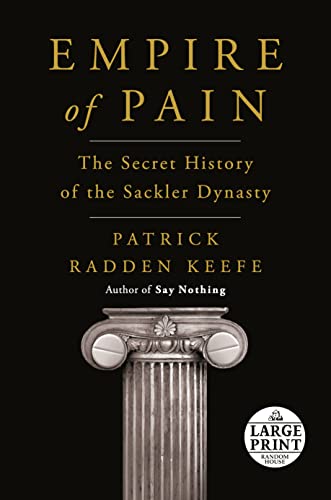
NATIONAL BOOK CRITICS CIRCLE NOMINEE • A NEW YORK TIMES NOTABLE BOOK OF THE YEAR • NEW YORK TIMES BEST SELLER • A grand, devastating portrait of three generations of the Sackler family, famed for their philanthropy, whose fortune was built by Valium and whose reputation was destroyed by OxyContin. From the prize-winning and bestselling author of Say Nothing
The history of the Sackler dynasty is rife with drama—baroque personal lives; bitter disputes over estates; fistfights in boardrooms; glittering art collections; Machiavellian courtroom maneuvers; and the calculated use of money to burnish reputations and crush the less powerful. The Sackler name has adorned the walls of many storied institutions—Harvard, the Metropolitan Museum of Art, Oxford, the Louvre. They are one of the richest families in the world, known for their lavish donations to the arts and the sciences. The source of the family fortune was vague, however, until it emerged that the Sacklers were responsible for making and marketing a blockbuster painkiller that was the catalyst for the opioid crisis.
Empire of Pain begins with the story of three doctor brothers, Raymond, Mortimer and the incalculably energetic Arthur, who weathered the poverty of the Great Depression and appalling anti-Semitism. Working at a barbaric mental institution, Arthur saw a better way and conducted groundbreaking research into drug treatments. He also had a genius for marketing, especially for pharmaceuticals, and bought a small ad firm.
Arthur devised the marketing for Valium, and built the first great Sackler fortune. He purchased a drug manufacturer, Purdue Frederick, which would be run by Raymond and Mortimer. The brothers began collecting art, and wives, and grand residences in exotic locales. Their children and grandchildren grew up in luxury.
Forty years later, Raymond’s son Richard ran the family-owned Purdue. The template Arthur Sackler created to sell Valium—co-opting doctors, influencing the FDA, downplaying the drug’s addictiveness—was employed to launch a far more potent product: OxyContin. The drug went on to generate some thirty-five billion dollars in revenue, and to launch a public health crisis in which hundreds of thousands would die.
This is the saga of three generations of a single family and the mark they would leave on the world, a tale that moves from the bustling streets of early twentieth-century Brooklyn to the seaside palaces of Greenwich, Connecticut, and Cap d’Antibes to the corridors of power in Washington, D.C. Empire of Pain chronicles the multiple investigations of the Sacklers and their company, and the scorched-earth legal tactics that the family has used to evade accountability.
Empire of Pain is a masterpiece of narrative reporting and writing, exhaustively documented and ferociously compelling. It is a portrait of the excesses of America’s second Gilded Age, a study of impunity among the super elite and a relentless investigation of the naked greed and indifference to human suffering that built one of the world’s great fortunes.
Die Inhaltsangabe kann sich auf eine andere Ausgabe dieses Titels beziehen.
Über die Autorin bzw. den Autor
Patrick Radden Keefe is a staff writer at The New Yorker and the author, most recently, of the New York Times bestseller Say Nothing: A True Story of Murder and Memory in Northern Ireland, which received the National Book Critics Circle Award for Nonfiction, was selected as one of the ten best books of 2019 by The New York Times Book Review, The Washington Post, the Chicago Tribune and The Wall Street Journal, and was named one of the “10 Best Nonfiction Books of the Decade” by Entertainment Weekly. His previous books are The Snakehead and Chatter. His work has been recognized with a Guggenheim Fellowship, the National Magazine Award for Feature Writing and the Orwell Prize for Political Writing. He is also the creator and host of the eight-part podcast Wind of Change.
Auszug. © Genehmigter Nachdruck. Alle Rechte vorbehalten.
Chapter 1
A Good Name
Arthur Sackler was born in Brooklyn, in the summer of 1913, at a moment when Brooklyn was burgeoning with wave upon wave of immigrants from the Old World, new faces every day, the unfamiliar music of new tongues on the street corners, new buildings going up left and right to house and employ these new arrivals, and everywhere this giddy, bounding sense of becoming. As the firstborn child of immigrants himself, Arthur came to share the dreams and ambitions of that generation of new Americans, to understand their energy and their hunger. He vibrated with it, practically from the cradle. He was born Abraham but would cast off that old-world name in favor of the more squarely American-sounding Arthur. There’s a photo, taken in 1915 or 1916, of Arthur as a toddler, sitting upright in a patch of grass while his mother, Sophie, reclines behind him like a lioness. Sophie is dark-haired, dark-eyed, and formidable. Arthur stares straight at the camera, a cherub in short pants, his ears sticking out, his eyes steady and preternaturally serious, as though he already knows the score.
Sophie Greenberg had emigrated from Poland just a few years earlier. She was a teenager when she arrived in Brooklyn in 1906 and met a mild-mannered man nearly twenty years her senior named Isaac Sackler. Isaac was an immigrant himself, from Galicia, in what was then still the Austrian Empire; he had come to New York with his parents and siblings, arriving on a ship in 1904. Isaac was a proud man. He was descended from a line of rabbis who had fled Spain for central Europe during the Inquisition, and now he and his young bride would build a new beachhead in New York. Isaac went into business with his brother, operating a small grocery store at 83 Montrose Avenue in Williamsburg. They called it Sackler Bros. The family lived in an apartment in the building. Three years after Arthur was born, Isaac and Sophie had a second boy, Mortimer, and four years after that, a third, Raymond. Arthur was devoted to his little brothers and fiercely protective of them. For a time, when they were small, all three brothers shared a bed.
Isaac did well enough in the grocery business that the family soon moved to Flatbush. A bustling neighborhood that felt like the heart of the borough, Flatbush was considered middle class, even upper middle class, compared with the far reaches of immigrant Brooklyn, like Brownsville and Canarsie. Real estate was the great benchmark in New York, even then, and the new address signified that Isaac Sackler had made something of himself in the New World, achieving a degree of stability. Flatbush felt like a place you graduated to, with tree-lined streets and solid, spacious apartments. One of Arthur’s contemporaries went so far as to remark that to Brooklyn Jews of that era it could seem that other Jews who lived in Flatbush were “practically Gentiles.” With his earnings from the grocery business, Isaac invested in real estate, purchasing tenement buildings and renting out apartments. But Isaac and Sophie had dreams for Arthur and his brothers, dreams that stretched beyond Flatbush, beyond even Brooklyn. They had a sense of providence. They wanted the Sackler brothers to leave their mark on the world.
If Arthur would later seem to have lived more lives than anyone else could possibly squeeze into one lifetime, it helped that he had an early start. He began working when he was still a boy, assisting his father in the grocery store. From an early age, he evinced a set of qualities that would propel and shape his life—a singular vigor, a roving intelligence, an inexhaustible ambition. Sophie was clever, but not educated. At seventeen she had gone to work in a garment factory, and she would never fully master written English. Isaac and Sophie spoke Yiddish at home, but they encouraged their sons to assimilate. They kept kosher, but rarely attended synagogue. Sophie’s parents lived with the family, and there was a sense, not uncommon in any immigrant enclave, that all the accumulated hopes and aspirations of the older generations would now be invested in these American-born kids. Arthur in particular felt the weight of those expectations: he was the pioneer, the firstborn American son, and everyone staked their dreams on him.
The vehicle for achieving those dreams would be education. One fall day in 1925, Artie Sackler (he went by Artie) arrived at Erasmus Hall High School on Flatbush Avenue. He was young for his class—he had just turned twelve—having tested into a special accelerated program for bright students. Artie was not one to be easily cowed, but Erasmus was an intimidating institution. Built by the Dutch in the eighteenth century, the original structure was a two-story wooden schoolhouse. In the first years of the twentieth century, the school expanded, around that ancient schoolhouse, to include a quadrangle in the style of Oxford University with castle-like neo-Gothic buildings clad in ivy and adorned with gargoyles. This expansion was designed to accommodate the great surge of immigrant children in Brooklyn. The faculty and students at Erasmus saw themselves as occupying the vanguard of the American experiment and took the notion of upward mobility and assimilation seriously, providing a first-class public education. The school had science labs and taught Latin and Greek. Some of the teachers had PhDs.
But Erasmus was also enormous. With some eight thousand students, it was one of the biggest high schools in the country, and most of the students were just like Arthur Sackler—the eager offspring of recent immigrants, children of the Roaring Twenties, their eyes bright, their hair pomaded to a sheen. They surged into the corridors, the boys dressed in suits and red ties, the girls in dresses with red ribbons in their hair. When they met under the great vaulted entrance arch during the lunch hour, it looked, in the words of one of Arthur’s classmates, like a “Hollywood cocktail party.”
Arthur loved it. In history class, he found that he admired and related to the Founding Fathers, and particularly Thomas Jefferson. Like Jefferson, Artie had eclectic interests—art, science, literature, history, sports, business; he wanted to do everything—and Erasmus put a great emphasis on extracurriculars. There must have been a hundred clubs, a club for practically everything. On a late afternoon in winter, when classes had ended for the day and dark had fallen, the whole school was lit up, windows blazing around the quad, and as you walked the corridors, you would hear the sounds of one club or another being convened: “Mr. Chairman! Point of order!”
In later life, when he spoke of these early years at Erasmus, Arthur would talk about “the big dream.” Erasmus was a great stone temple to American meritocracy, and most of the time it seemed that the only practical limitation on what he could expect to get out of life would be what he was personally prepared to put into it. Sophie would prod him about school: “Did you ask a good question today?” Arthur had grown up to be gangly and broad-shouldered, with a square face, blond hair, and eyes that were blue and nearsighted. He had tremendous stamina, and he needed it. In addition to his studies, he joined the student newspaper as an editor and found an opening in the school’s publishing office, selling advertising for school publications. Rather than accept a standard pay arrangement, Arthur proposed that he receive a small commission on any ad sale he made. The administration agreed, and soon Arthur was making money.
This was a lesson he learned early, one that would inform his later life in important ways: Arthur Sackler liked to bet on himself, going to great lengths in order to devise a scheme in which...
„Über diesen Titel“ kann sich auf eine andere Ausgabe dieses Titels beziehen.
Suchergebnisse für Empire of Pain: The Secret History of the Sackler Dynasty

Foto des Verkäufers
Empire of Pain: The Secret History of the Sackler Dynasty
Verlag:
Random House Large Print, 2021
ISBN 10: 0593416287
ISBN 13: 9780593416280
Gebraucht
Softcover
Anbieter: Zoom Books East, Glendale Heights, IL, USA
Verkäuferbewertung 5 von 5 Sternen

Zustand: good. Book is in good condition and may include underlining highlighting and minimal wear. The book can also include "From the library of" labels. May not contain miscellaneous items toys, dvds, etc. . We offer 100% money back guarantee and 24 7 customer service. Bestandsnummer des Verkäufers ZEV.0593416287.G
Gebraucht kaufen
EUR 8,09
Versand gratis
Versand innerhalb von USA
Versand innerhalb von USA
Anzahl: 1 verfügbar
Beispielbild für diese ISBN
Empire of Pain: The Secret History of the Sackler Dynasty
Verlag:
Random House Large Print, 2021
ISBN 10: 0593416287
ISBN 13: 9780593416280
Gebraucht
paperback
Anbieter: HPB Inc., Dallas, TX, USA
Verkäuferbewertung 5 von 5 Sternen
paperback. Zustand: Very Good. Connecting readers with great books since 1972! Used books may not include companion materials, and may have some shelf wear or limited writing. We ship orders daily and Customer Service is our top priority! Bestandsnummer des Verkäufers S_413638036
Gebraucht kaufen
EUR 6,22
EUR 3,23 Versand
Versand innerhalb von USA
Versand innerhalb von USA
Anzahl: 1 verfügbar
Beispielbild für diese ISBN
Empire of Pain: The Secret History of the Sackler Dynasty
Verlag:
Random House Large Print, 2021
ISBN 10: 0593416287
ISBN 13: 9780593416280
Gebraucht
Paperback
Anbieter: HPB-Diamond, Dallas, TX, USA
Verkäuferbewertung 5 von 5 Sternen
Paperback. Zustand: Very Good. Connecting readers with great books since 1972! Used books may not include companion materials, and may have some shelf wear or limited writing. We ship orders daily and Customer Service is our top priority! Bestandsnummer des Verkäufers S_469701377
Gebraucht kaufen
EUR 7,76
EUR 3,23 Versand
Versand innerhalb von USA
Versand innerhalb von USA
Anzahl: 1 verfügbar
Foto des Verkäufers
Empire of Pain: The Secret History of the Sackler Dynasty
Verlag:
Random House Large Print, 2021
ISBN 10: 0593416287
ISBN 13: 9780593416280
Gebraucht
Softcover
Anbieter: ebooks Keystone, Reading, PA, USA
Verkäuferbewertung 4 von 5 Sternen

Zustand: good. This book is in good condition, with minimal signs of wear and tear. Bestandsnummer des Verkäufers GWKV.0593416287.G
Gebraucht kaufen
EUR 9,76
EUR 2,59 Versand
Versand innerhalb von USA
Versand innerhalb von USA
Anzahl: 1 verfügbar
Foto des Verkäufers
Empire of Pain: The Secret History of the Sackler Dynasty
Verlag:
Random House Large Print, 2021
ISBN 10: 0593416287
ISBN 13: 9780593416280
Gebraucht
Softcover
Anbieter: Goodwill of Silicon Valley, SAN JOSE, CA, USA
Verkäuferbewertung 4 von 5 Sternen
Zustand: good. Supports Goodwill of Silicon Valley job training programs. The cover and pages are in Good condition! Any other included accessories are also in Good condition showing use. Use can include some highlighting and writing, page and cover creases as well as other types visible wear. Bestandsnummer des Verkäufers GWSVV.0593416287.G
Gebraucht kaufen
EUR 9,76
EUR 3,44 Versand
Versand innerhalb von USA
Versand innerhalb von USA
Anzahl: 1 verfügbar
Beispielbild für diese ISBN
Empire of Pain : The Secret History of the Sackler Dynasty
Anbieter: Better World Books, Mishawaka, IN, USA
Verkäuferbewertung 5 von 5 Sternen
Zustand: Good. 39. Former library copy. Pages intact with minimal writing/highlighting. The binding may be loose and creased. Dust jackets/supplements are not included. Includes library markings. Stock photo provided. Product includes identifying sticker. Better World Books: Buy Books. Do Good. Bestandsnummer des Verkäufers 39415713-6
Gebraucht kaufen
EUR 14,31
Versand gratis
Versand innerhalb von USA
Versand innerhalb von USA
Anzahl: 1 verfügbar
Beispielbild für diese ISBN
Empire of Pain : The Secret History of the Sackler Dynasty
Anbieter: Better World Books: West, Reno, NV, USA
Verkäuferbewertung 5 von 5 Sternen
Zustand: Good. 39. Former library copy. Pages intact with minimal writing/highlighting. The binding may be loose and creased. Dust jackets/supplements are not included. Includes library markings. Stock photo provided. Product includes identifying sticker. Better World Books: Buy Books. Do Good. Bestandsnummer des Verkäufers 39415713-6
Gebraucht kaufen
EUR 14,31
Versand gratis
Versand innerhalb von USA
Versand innerhalb von USA
Anzahl: 1 verfügbar
Beispielbild für diese ISBN
Empire of Pain: The Secret History of the Sackler Dynasty
Verlag:
Random House Large Print Publishing May 2021, 2021
ISBN 10: 0593416287
ISBN 13: 9780593416280
Gebraucht
Paper Back
Anbieter: A Cappella Books, Inc., Atlanta, GA, USA
Verkäuferbewertung 5 von 5 Sternen
Paper Back. Zustand: Good. Front cover creased. Bestandsnummer des Verkäufers 387153
Gebraucht kaufen
EUR 15,54
Versand gratis
Versand innerhalb von USA
Versand innerhalb von USA
Anzahl: 1 verfügbar
Beispielbild für diese ISBN
Empire of Pain: The Secret History of the Sackler Dynasty
Verlag:
Random House Large Print, 2021
ISBN 10: 0593416287
ISBN 13: 9780593416280
Gebraucht
paperback
Anbieter: Textbooks_Source, Columbia, MO, USA
Verkäuferbewertung 5 von 5 Sternen
paperback. Zustand: Good. Large type / Large print. Ships in a BOX from Central Missouri! May not include working access code. Will not include dust jacket. Has used sticker(s) and some writing or highlighting. UPS shipping for most packages, (Priority Mail for AK/HI/APO/PO Boxes). Bestandsnummer des Verkäufers 006654153U
Gebraucht kaufen
EUR 14,61
EUR 3,44 Versand
Versand innerhalb von USA
Versand innerhalb von USA
Anzahl: 1 verfügbar
Foto des Verkäufers
Empire of Pain : The Secret History of the Sackler Dynasty
Verlag:
Random House Large Print, 2021
ISBN 10: 0593416287
ISBN 13: 9780593416280
Gebraucht
Softcover
Anbieter: GreatBookPrices, Columbia, MD, USA
Verkäuferbewertung 5 von 5 Sternen
Zustand: good. May show signs of wear, highlighting, writing, and previous use. This item may be a former library book with typical markings. No guarantee on products that contain supplements Your satisfaction is 100% guaranteed. Twenty-five year bookseller with shipments to over fifty million happy customers. Bestandsnummer des Verkäufers 42263498-5
Gebraucht kaufen
EUR 15,80
EUR 2,28 Versand
Versand innerhalb von USA
Versand innerhalb von USA
Anzahl: 1 verfügbar