
Verwandte Artikel zu Best of Friends
Inhaltsangabe
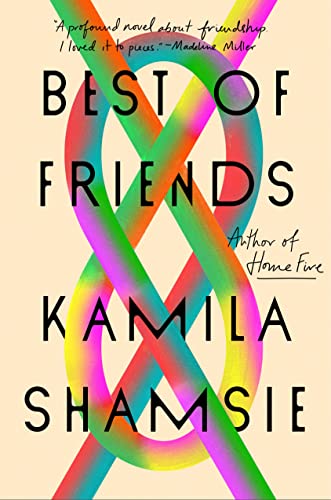
“A profound novel about friendship. I loved it to pieces.” —Madeline Miller
“A shining tour de force about a long friendship’s respects, disrespects, loyalties and moralities.” —Ali Smith
From the acclaimed author of Home Fire, the moving and surprising story of a lifelong friendship and the forces that bring it to the breaking point
Zahra and Maryam have been best friends since childhood in Karachi, even though—or maybe because—they are unlike in nearly every way. Yet they never speak of the differences in their backgrounds or their values, not even after the fateful night when a moment of adolescent impulse upends their plans for the future.
Three decades later, Zahra and Maryam have grown into powerful women who have each cut a distinctive path through London. But when two troubling figures from their past resurface, they must finally confront their bedrock differences—and find out whether their friendship can survive.
Thought-provoking, compassionate, and full of unexpected turns, Best of Friends offers a riveting take on an age-old question: Does principle or loyalty make for the better friend?
Die Inhaltsangabe kann sich auf eine andere Ausgabe dieses Titels beziehen.
Über die Autorin bzw. den Autor
Kamila Shamsie is the author of several previous novels, most recently Home Fire, which won the Women’s Prize for Fiction, was longlisted for the Booker Prize, and was a finalist for the International Dublin Literary Award, the Costa Novel Award, and the DSC Prize for South Asian Literature, among other honors. She was raised in Karachi and lives in London.
Auszug. © Genehmigter Nachdruck. Alle Rechte vorbehalten.
First day back at school. The sky heavy with monsoon clouds, the schoolyard clustered with students within striding distance of shelter: the kikar trees planted along the boundary wall or the neem tree partway up the path from gate to school building; the many bougainvillea-framed doorways carved into the building's yellow stone facade; the area of the playing field beneath the jutting balconies on the first and second floors. Only a few boys, with daring to prove, roamed the most exposed parts of the yard, shirtsleeves rolled up, hands in pockets. Zahra, standing beside the archway that housed the brass bell, was using her height to look over the heads of all the girls and most of the boys, searching.
The school day hadn't officially started yet, but students in gray-and-white uniforms were already resettling into their formations from the previous term. The cool kids. The thuggish boys. The couples. The judgmental girls. The invisible boys. Zahra had invented these categories after watching a string of teen-centered Hollywood movies on pirated videos, but it did little to make up for the inadequacy of Karachi school life. Without detention, how could there be The Breakfast Club? Without a school prom, how could there be Pretty in Pink? Without the freedom required to make truancy possible, how could there be Ferris Bueller's Day Off ? But the one area where the failure was that of the movies, not of Karachi, was when it came to friendship-it was almost always a sub-plot to romance, never the heart of a story. Except The Outsiders, but that was boys, which meant it was really about how girls caused trouble and led to fights and burning buildings and death.
From where she stood, Zahra had a clear view of the school gate. For most of the day, buses and rickshaws and vans and other aging vehicles clogged up the streets of Saddar, perhaps heading to Empress Market or the electronics stores that populated the area, but twice a weekday, sleek air-conditioned cars joined in the melee to ferry students to and from the most prestigious of Karachi's schools.
There she was. The Mercedes, sleekest of sleeks, drove right up to the gate and Maryam stepped out and walked into the school grounds. A different Maryam, a different walk. The plumpness that had been on her face seemed to have descended elsewhere over the course of the summer, though it was hard to know exactly what was going on beneath the sack-like gray kameez she was wearing. Maryam stopped to say something to one of the older boys, and as they were talking she tugged at her kameez with what was clearly meant to be an absentminded air. The fabric pulled taut over new breasts, a new waist. The older boy kept on speaking to her as though nothing had happened, but when she walked past him, heading to Zahra, he turned to observe her all the way down the length of the path.
Other things had changed too. The wavy shoulder-length hair was artfully tousled rather than wild, the messy eyebrows reshaped into two curved lines. But the smile was the same old Maryam smile that greeted Zahra every time Maryam returned from her family's summer trips to London. And her outstretched hand held a cassette that was always her belated birthday present to her best friend-a mixtape that she had recorded off the radio, with the best of the London charts.
"Do you see what's happened to me?" she said.
"Is it your mother or your tailor who's having difficulty accepting it?" Zahra said, gesturing to the kameez.
"Hard to say. Master Sahib stitches what he thinks my mother wants. Mother says he's easily offended; we can't go back and say it's all wrong or he'll stop doing our clothes and he's the only one to get my sari blouses right."
"Adulthood is so complicated."
They smiled at each other, confident of the futures ahead of them in which they'd never face such petty dilemmas. They had barely moved on to swapping notes about the summer apart when Saba approached, with that smile of hers as if she were holding some forbidden delight in her mouth that she was willing neither to swallow nor to reveal. They knew all of each other's smiles, the three girls; at fourteen, they were ten years into what might loosely be called friendship, though Zahra had once looked up from a dictionary to inform Maryam that what the two of them had with each other was friendship, and what they had with the other six girls and twenty-two boys in class was merely "propinquity"-a relationship based on physical proximity. "If you moved to Alaska tomorrow, we'd still be best friends for the rest of our lives," she had told Maryam, who was the only person in the world toward whom Zahra displayed extravagant feelings.
Now there was Saba, standing in front of them, allowing them to cajole her into giving up the secret that she had just heard from her aunt-Mrs. Hilal, the biology teacher-to the rest of them. The school's bomb alarm was going to be complemented with a riot alarm. There would be drills throughout the term to ensure the students didn't confuse the first with the second. You wouldn't want seven hundred students evacuating the building when they were supposed to be inside with doors and windows firmly shut. The school had never known either bombs or riots, but Saba conveyed the news of the anticipated disaster, and the possible mix-up over alarms, with relish.
"My parents are going to get even more hysterical if they hear that," Maryam said, dragging out the word even. "The day we got back from London they hired armed guards for our house because all these expats over there kept telling them how dangerous Karachi is. Give me dangerous and keep your boiled cabbage, Londoners. Now no one can come indoors without having to go through some ridiculous procedure of guards calling up the house to make sure they're acceptable, and if someone's on the phone and they can't get through, then one of the guards has to run inside-not that they ever run, it's the slowest crawl. You don't worry, Zahra. I gave them a picture of you and said if anyone tries to stop you from entering I'll have them fired."
"Lucky," Zahra said, and Maryam grinned. She liked nothing better than to be compared to Lucky Santangelo, heroine of the Jackie Collins novels, composed in equal parts of courage, ruthlessness, and loyalty. Saba made a little face and Zahra recognized this expression too: it was the one that said Saba didn't see why Maryam continued to be best friends with Zahra and share private jokes with her when Saba, like Maryam, belonged to that subgroup of students whose parents were part of the "social set" and who went abroad for their summer holidays and swam at the same private members' club.
"Maybe it's a good idea for the school to have some kind of plan in case the worst happens," Zahra said, glancing toward the high boundary walls, shards of glass embedded at the top to prevent anyone from climbing over. Last summer, car bombs had killed more than seventy people in Saddar-not far from this school, one of the explosions shattering all the windows of the shop where Zahra and her mother had been buying new school uniforms the previous week. For days after, she'd imagined pieces of glass piercing her throat and eyes. Maryam had been in London at the time and when she'd returned she'd said, "That was awful; thank god it was during the school holidays," as if to suggest that no one they knew could have been anywhere around Saddar at such a time of year.
The school bell rang, sending them to the playing field, where ragged columns of students had started to form. The soil was damp from yesterday's rain, and there was one large puddle in the middle of the field, into which some of the rowdier Class 9 boys were stomping to try to splash any girls walking past.
Maryam wasn't the only one in their class to have changed over the summer. There were boys who...
„Über diesen Titel“ kann sich auf eine andere Ausgabe dieses Titels beziehen.
Suchergebnisse für Best of Friends

Beispielbild für diese ISBN
Best of Friends: A Novel
Anbieter: World of Books (was SecondSale), Montgomery, IL, USA
Verkäuferbewertung 5 von 5 Sternen

Zustand: Good. Item in good condition. Textbooks may not include supplemental items i.e. CDs, access codes etc. Bestandsnummer des Verkäufers 00086173684
Gebraucht kaufen
EUR 4,41
Versand gratis
Versand innerhalb von USA
Versand innerhalb von USA
Anzahl: 5 verfügbar
Beispielbild für diese ISBN
Best of Friends: A Novel
Anbieter: World of Books (was SecondSale), Montgomery, IL, USA
Verkäuferbewertung 5 von 5 Sternen
Zustand: Very Good. Item in very good condition! Textbooks may not include supplemental items i.e. CDs, access codes etc. Bestandsnummer des Verkäufers 00102410137
Gebraucht kaufen
EUR 4,41
Versand gratis
Versand innerhalb von USA
Versand innerhalb von USA
Anzahl: 1 verfügbar
Foto des Verkäufers
Best of Friends: A Novel
Anbieter: ZBK Books, Carlstadt, NJ, USA
Verkäuferbewertung 5 von 5 Sternen
Zustand: good. Fast & Free Shipping â" Good condition. It may show normal signs of use, such as light writing, highlighting, or library markings, but all pages are intact and the book is fully readable. A solid, complete copy that's ready to enjoy. Bestandsnummer des Verkäufers ZWV.0593421825.G
Gebraucht kaufen
EUR 4,42
Versand gratis
Versand innerhalb von USA
Versand innerhalb von USA
Anzahl: 1 verfügbar
Foto des Verkäufers
Best of Friends: A Novel
Anbieter: Greenworld Books, Arlington, TX, USA
Verkäuferbewertung 5 von 5 Sternen
Zustand: very_good. Fast Free Shipping â" Very Good condition book with a firm cover and clean pages. Shows normal use and some light wear or limited notes markings. A solid, nice copy to enjoy. Bestandsnummer des Verkäufers GWV.0593421825.VG
Gebraucht kaufen
EUR 4,42
Versand gratis
Versand innerhalb von USA
Versand innerhalb von USA
Anzahl: 1 verfügbar
Beispielbild für diese ISBN
Best of Friends: A Novel
Anbieter: Books-FYI, Inc., Cadiz, KY, USA
Verkäuferbewertung 5 von 5 Sternen
hardcover. Zustand: Fine. Book may have a small bump on a corner or the cover may have some tiny scuff from moving and shelf life, but is in LIKE NEW, nearly perfect condiiton! All the pages are very nice and clean! Bestandsnummer des Verkäufers mon0000001926
Gebraucht kaufen
EUR 1,50
EUR 3,48 Versand
Versand innerhalb von USA
Versand innerhalb von USA
Anzahl: 1 verfügbar
Beispielbild für diese ISBN
Best of Friends: A Novel
Verlag:
Riverhead Books (edition ), 2022
ISBN 10: 0593421825
ISBN 13: 9780593421826
Gebraucht
Hardcover
Anbieter: BooksRun, Philadelphia, PA, USA
Verkäuferbewertung 5 von 5 Sternen
Hardcover. Zustand: Very Good. It's a well-cared-for item that has seen limited use. The item may show minor signs of wear. All the text is legible, with all pages included. It may have slight markings and/or highlighting. Bestandsnummer des Verkäufers 0593421825-11-1
Gebraucht kaufen
EUR 5,03
Versand gratis
Versand innerhalb von USA
Versand innerhalb von USA
Anzahl: 1 verfügbar
Beispielbild für diese ISBN
Best of Friends: A Novel
Anbieter: PlumCircle, West Mifflin, PA, USA
Verkäuferbewertung 5 von 5 Sternen
hardcover. Zustand: Very Good. Publisher overstock. May have remainder mark / minor shelfwear. 99% of orders arrive in 4-10 days. Discounted shipping on multiple books. Bestandsnummer des Verkäufers mon0001348527
Gebraucht kaufen
EUR 1,07
EUR 4,35 Versand
Versand innerhalb von USA
Versand innerhalb von USA
Anzahl: 1 verfügbar
Beispielbild für diese ISBN
Best of Friends: A Novel
Verlag:
Riverhead Books (edition ), 2022
ISBN 10: 0593421825
ISBN 13: 9780593421826
Gebraucht
Hardcover
Anbieter: BooksRun, Philadelphia, PA, USA
Verkäuferbewertung 5 von 5 Sternen
Hardcover. Zustand: Very Good. It's a well-cared-for item that has seen limited use. The item may show minor signs of wear. All the text is legible, with all pages included. It may have slight markings and/or highlighting. Bestandsnummer des Verkäufers 0593421825-8-1
Gebraucht kaufen
EUR 5,67
Versand gratis
Versand innerhalb von USA
Versand innerhalb von USA
Anzahl: 1 verfügbar
Beispielbild für diese ISBN
Best of Friends : A Novel
Verlag:
Penguin Publishing Group, 2022
ISBN 10: 0593421825
ISBN 13: 9780593421826
Gebraucht
Hardcover
Anbieter: Better World Books, Mishawaka, IN, USA
Verkäuferbewertung 5 von 5 Sternen
Zustand: Good. Former library copy. Pages intact with minimal writing/highlighting. The binding may be loose and creased. Dust jackets/supplements are not included. Includes library markings. Stock photo provided. Product includes identifying sticker. Better World Books: Buy Books. Do Good. Bestandsnummer des Verkäufers 42405205-6
Gebraucht kaufen
EUR 6,42
Versand gratis
Versand innerhalb von USA
Versand innerhalb von USA
Anzahl: 3 verfügbar
Beispielbild für diese ISBN
Best of Friends
Anbieter: ThriftBooks-Dallas, Dallas, TX, USA
Verkäuferbewertung 5 von 5 Sternen
Hardcover. Zustand: Very Good. No Jacket. Former library book; May have limited writing in cover pages. Pages are unmarked. ~ ThriftBooks: Read More, Spend Less. Bestandsnummer des Verkäufers G0593421825I4N10
Gebraucht kaufen
EUR 6,71
Versand gratis
Versand innerhalb von USA
Versand innerhalb von USA
Anzahl: 1 verfügbar