
Verwandte Artikel zu The Uninhabitable Earth (Adapted for Young Adults):...
Inhaltsangabe
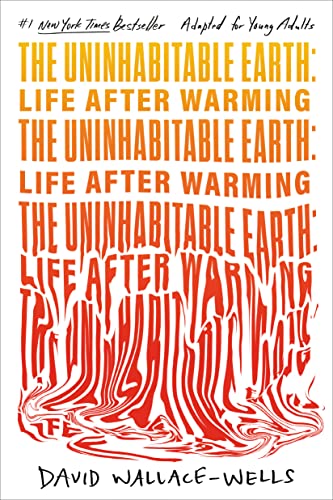
An exploration of the devastating effects of global warming—current and future—adapted for young adults from the #1 New York Times bestseller. This is not only an assessment on how the future will look to those living through it, but also a dire overview and an impassioned and hopeful call to action to change the trajectory while there is still time.
The climate crisis that our nation currently faces, from rising temperatures, unfathomable drought, devastating floods, unprecedented fires, just to name a few, are alarming precursors to what awaits us if we continue on our current path. In this adaptation for young adults from the #1 New York Times bestseller, journalist David Wallace-Wells tells it like it is, and it is much worse than anyone might think. Global warming is effecting the world, if left unchecked, it promises to transform global politics, the meaning of technology and the trajectory of human progress.
In sobering detail, Wallace-Wells lays out the mistakes and inaction of past and current generations that we see negatively affecting all lives today and more importantly how they will inevitably affect the future. But readers will also hear—loud and clear—his impassioned call to action, as he appeals to current and future generations, especially young people. As he states: “the solutions, when we dare to imagine them . . . are indeed motivating, if there is to be any chance of preserving even the hope for a happier future—relatively livable, relatively fulfilling, relatively prosperous, and perhaps more than only relatively just.”
Die Inhaltsangabe kann sich auf eine andere Ausgabe dieses Titels beziehen.
Über die Autorin bzw. den Autor
David Wallace-Wells is a columnist and deputy editor at New York magazine. He has been a national fellow at the New America Foundation and was previously the deputy editor of The Paris Review. He lives in New York City.
Auszug. © Genehmigter Nachdruck. Alle Rechte vorbehalten.
The world will be what we make it--perhaps what you make it. The timelines are indeed that short.
Consider the speed of change. The earth has experienced five mass extinctions before the one we are living through now, each so complete a wiping of the fossil record that it functioned as an evolutionary reset, the planet’s phylogenetic tree first expanding, then collapsing, at intervals, like a lung: 86 percent of all species dead 450 million years ago; 70 million years later, 75 percent; 125 million years later, 96 percent; 50 million years later, 80 percent; 135 million years after that, 75 percent again. All but one of these involved climate change produced by greenhouse gas. The most notorious was 250 million years ago; it began when carbon dioxide warmed the planet by five degrees Celsius, accelerated when that warming triggered the release of methane, another greenhouse gas, and ended with all but a sliver of life on Earth dead. We are currently adding carbon to the atmosphere at a considerably faster rate--by most estimates, at least ten times faster. The rate is one hundred times faster than at any point in human history before the beginning of industrialization. And there is already, right now, fully a third more carbon in the atmosphere than at any point in the last 800,000 years--perhaps in as long as 15 million years. There were no humans then. The oceans were more than a hundred feet higher.
Many perceive global warming as a sort of moral and economic debt, accumulated since the beginning of the Industrial Revolution and now come due after several centuries. In fact, more than half the carbon exhaled into the atmosphere by the burning of fossil fuels has been emitted in just the past three decades. The United Nations established its climate change framework in 1992, building a political consensus out of a scientific consensus and advertising it unmistakably to the world; this means we have now done as much damage to the environment knowingly as we ever managed in ignorance. Global warming may seem like a distended morality tale playing out over several centuries and inflicting a kind of Old Testament retribution on the great-great-grandchildren of those responsible, since it was carbon burning in eighteenth-century England that lit the fuse of everything that has followed. But that is a fable about historical villainy that acquits those of us alive today--unfairly. The majority of the burning has come since the 1994 premiere of Friends. A quarter of the damage has been done since Barack Obama was elected president, and Joe Biden vice president, in 2008. Since the end of World War II, the figure is about 90 percent. The story of the industrial world’s kamikaze mission is the story of a single lifetime--the planet brought from seeming stability to the brink of catastrophe in the years between a baptism or bar mitzvah and a funeral.
It is the lifetime of many of the scientists who first raised public alarm about climate change, some of whom, incredibly, remain working--that is how rapidly we have arrived at this promontory, staring down the likelihood of three degrees Celsius of warming by the year 2100. Four degrees is possible as well--perhaps more. According to some estimates, that would mean that whole regions of Africa and Australia and the United States, parts of South America north of Patagonia, and Asia south of Siberia would be rendered brutally uncomfortable by direct heat, desertification, and flooding. Certainly, it would make them inhospitable, and many more regions besides. Which means that, if the planet was brought to the brink of climate catastrophe within the lifetime of a single generation, the responsibility to avoid it belongs with a single generation, too. We all also know that second lifetime. It is ours.
I am not an environmentalist and don’t even think of myself as a nature person. I’ve lived my whole life in cities, enjoying gadgets built by industrial supply chains I hardly think twice about. I’ve never gone camping, not willingly anyway, and while I always thought it was basically a good idea to keep streams clean and air clear, I also always accepted the proposition that there was a trade-off between economic growth and its cost to nature--and figured, well, in most cases I’d probably go for growth. I’m not about to personally slaughter a cow to eat a hamburger, but I’m also not about to go vegan. In these ways--many of them at least--I am like every other American who has spent their life fatally complacent, and willfully deluded, about climate change, which is not just the biggest threat human life on the planet has ever faced but a threat of an entirely different category and scale. That is, the scale of human life itself.
A few years ago, I began collecting stories of climate change, many of them terrifying, gripping, uncanny narratives, with even the most small-scale sagas playing like fables: a group of Arctic scientists trapped when melting ice isolated their research center, on an island populated also by a group of polar bears; a Russian boy killed by anthrax released from a thawing reindeer carcass, which had been trapped in permafrost for many decades. My file of stories grew daily, but very few of the clips, even those drawn from new research published in the most pedigreed scientific journals, seemed to appear in the coverage about climate change the country watched on television and read in its newspapers. In those places, climate change was reported, of course, and even with some tinge of alarm. But the discussion of possible effects was misleadingly narrow, limited almost invariably to the matter of sea-level rise. Just as worrisome, the coverage was sanguine, all things considered. As recently as the 1997 signing of the landmark Kyoto Protocol, two degrees Celsius of global warming was considered the threshold of catastrophe: flooded cities, crippling droughts and heat waves, a planet battered daily by hurricanes and monsoons we used to call “natural disasters” but will soon normalize as simply “bad weather.” More recently, the foreign minister of the Marshall Islands offered another name for that level of warming: “genocide.”
This is not a book about the science of warming; it is about what warming means to the way we live on this planet. But what does that science say? It is complicated research, because it is built on two layers of uncertainty: what humans will do, mostly in emitting greenhouse gases, but also in how we adapt to the environment we have transformed and how the climate will respond, both through straightforward heating and a variety of more complicated and sometimes contradictory feedback loops. But even shaded by those uncertainty bars, it is also very clear research, in fact terrifyingly clear. The United Nations’ Intergovernmental Panel on Climate Change (IPCC) offers the gold-standard assessments of the state of the planet and the likely trajectory for climate change. In its latest report, the IPCC suggested the world was on track for about 3 degrees of warming, bringing the unthinkable collapse of the planet’s ice sheets not just into the realm of the real but into the present.
Because these numbers are so small, we tend to trivialize the differences between them--one, two, four, five. Human experience and memory offer no good analogy for how we should think of those thresholds, but, as with world wars or recurrences of cancer, you don’t want to see even one.
At two degrees of warming, the ice sheets will likely begin their collapse, 400 million more people could suffer from water scarcity, and major cities in the equatorial band of the planet will become lethally hot in summer. There would be thirty-two times more extreme heat waves in India, and each would last five times as long, exposing...
„Über diesen Titel“ kann sich auf eine andere Ausgabe dieses Titels beziehen.
Suchergebnisse für The Uninhabitable Earth (Adapted for Young Adults):...

Beispielbild für diese ISBN
The Uninhabitable Earth (Adapted for Young Adults): Life After Warming
Anbieter: World of Books (was SecondSale), Montgomery, IL, USA
Verkäuferbewertung 5 von 5 Sternen

Zustand: Good. Good condition ex-library book with usual library markings and stickers. Bestandsnummer des Verkäufers 00108444718
Gebraucht kaufen
EUR 3,82
Versand gratis
Versand innerhalb von USA
Versand innerhalb von USA
Anzahl: 1 verfügbar
Beispielbild für diese ISBN
The Uninhabitable Earth (Adapted for Young Adults): Life After Warming
Anbieter: World of Books (was SecondSale), Montgomery, IL, USA
Verkäuferbewertung 5 von 5 Sternen
Zustand: Good. Item in good condition. Textbooks may not include supplemental items i.e. CDs, access codes etc. Bestandsnummer des Verkäufers 00094498364
Gebraucht kaufen
EUR 5,83
Versand gratis
Versand innerhalb von USA
Versand innerhalb von USA
Anzahl: 1 verfügbar
Beispielbild für diese ISBN
The Uninhabitable Earth (Adapted for Young Adults): Life After Warming
Anbieter: ThriftBooks-Atlanta, AUSTELL, GA, USA
Verkäuferbewertung 5 von 5 Sternen
Paperback. Zustand: Very Good. No Jacket. Former library book; May have limited writing in cover pages. Pages are unmarked. ~ ThriftBooks: Read More, Spend Less. Bestandsnummer des Verkäufers G059348357XI4N10
Gebraucht kaufen
EUR 5,84
Versand gratis
Versand innerhalb von USA
Versand innerhalb von USA
Anzahl: 1 verfügbar
Foto des Verkäufers
The Uninhabitable Earth (Adapted for Young Adults): Life After Warming
Anbieter: Blue Vase Books, Interlochen, MI, USA
Verkäuferbewertung 5 von 5 Sternen
Zustand: good. The item shows wear from consistent use, but it remains in good condition and works perfectly. All pages and cover are intact including the dust cover, if applicable . Spine may show signs of wear. Pages may include limited notes and highlighting. May NOT include discs, access code or other supplemental materials. Bestandsnummer des Verkäufers BVV.059348357X.G
Gebraucht kaufen
EUR 5,85
Versand gratis
Versand innerhalb von USA
Versand innerhalb von USA
Anzahl: 1 verfügbar
Beispielbild für diese ISBN
The Uninhabitable Earth (Adapted for Young Adults): Life After Warming
Anbieter: Half Price Books Inc., Dallas, TX, USA
Verkäuferbewertung 5 von 5 Sternen
paperback. Zustand: Very Good. Connecting readers with great books since 1972! Used books may not include companion materials, and may have some shelf wear or limited writing. We ship orders daily and Customer Service is our top priority! Bestandsnummer des Verkäufers S_473484856
Gebraucht kaufen
EUR 2,67
EUR 3,24 Versand
Versand innerhalb von USA
Versand innerhalb von USA
Anzahl: 1 verfügbar
Beispielbild für diese ISBN
The Uninhabitable Earth (Adapted for Young Adults) : Life after Warming
Verlag:
Random House Children's Books, 2023
ISBN 10: 059348357X
ISBN 13: 9780593483572
Gebraucht
Softcover
Anbieter: Better World Books, Mishawaka, IN, USA
Verkäuferbewertung 5 von 5 Sternen
Zustand: Very Good. Former library copy. Pages intact with possible writing/highlighting. Binding strong with minor wear. Dust jackets/supplements may not be included. Includes library markings. Stock photo provided. Product includes identifying sticker. Better World Books: Buy Books. Do Good. Bestandsnummer des Verkäufers 50432394-6
Gebraucht kaufen
EUR 6,35
Versand gratis
Versand innerhalb von USA
Versand innerhalb von USA
Anzahl: 1 verfügbar
Beispielbild für diese ISBN
The Uninhabitable Earth (Adapted for Young Adults): Life After Warming
Anbieter: HPB-Diamond, Dallas, TX, USA
Verkäuferbewertung 5 von 5 Sternen
paperback. Zustand: Very Good. Connecting readers with great books since 1972! Used books may not include companion materials, and may have some shelf wear or limited writing. We ship orders daily and Customer Service is our top priority! Bestandsnummer des Verkäufers S_468207384
Gebraucht kaufen
EUR 3,46
EUR 3,24 Versand
Versand innerhalb von USA
Versand innerhalb von USA
Anzahl: 1 verfügbar
Beispielbild für diese ISBN
The Uninhabitable Earth (Adapted for Young Adults): Life After Warming
Anbieter: World of Books Inc, Montgomery, IL, USA
Verkäuferbewertung 2 von 5 Sternen

Paperback. Zustand: Good. An exploration of the devastating effects of global warming--current and future--adapted for young adults from the #1 New York Times bestseller. This is not only an assessment on how the future will look to those living through it, but also a dire overview and an impassioned and hopeful call to action to change the trajectory while there is still time. The climate crisis that our nation currently faces, from rising temperatures, unfathomable drought, devastating floods, unprecedented fires, just to name a few, are alarming precursors to what awaits us if we continue on our current path. In this adaptation for young adults from the #1 New York Times bestseller, journalist David Wallace-Wells tells it like it is, and it is much worse than anyone might think. Global warming is effecting the world, if left unchecked, it promises to transform global politics, the meaning of technology and the trajectory of human progress. In sobering detail, Wallace-Wells lays out the mistakes and inaction of past and current generations that we see negatively affecting all lives today and more importantly how they will inevitably affect the future. But readers will also hear--loud and clear--his impassioned call to action, as he appeals to current and future generations, especially young people. As he states: "the solutions, when we dare to imagine them . . . are indeed motivating, if there is to be any chance of preserving even the hope for a happier future--relatively livable, relatively fulfilling, relatively prosperous, and perhaps more than only relatively just.". Bestandsnummer des Verkäufers CIN059348357XG
Gebraucht kaufen
EUR 7,61
Versand gratis
Versand innerhalb von USA
Versand innerhalb von USA
Anzahl: 2 verfügbar
Beispielbild für diese ISBN
The Uninhabitable Earth: Life After Warming (Adapted for Young Adults)
Anbieter: BookOutlet, Jefferson City, TN, USA
Verkäuferbewertung 5 von 5 Sternen
Paperback. Zustand: New. Paperback. Publisher overstock, may contain remainder mark on edge. Bestandsnummer des Verkäufers 9780593483572B
Neu kaufen
EUR 5,32
EUR 2,80 Versand
Versand innerhalb von USA
Versand innerhalb von USA
Anzahl: Mehr als 20 verfügbar
Beispielbild für diese ISBN
The Uninhabitable Earth (Adapted for Young Adults): Life After Warming
Anbieter: Books From California, Simi Valley, CA, USA
Verkäuferbewertung 4 von 5 Sternen

paperback. Zustand: Very Good. Bestandsnummer des Verkäufers mon0003913280
Gebraucht kaufen
EUR 4,44
EUR 4,31 Versand
Versand innerhalb von USA
Versand innerhalb von USA
Anzahl: 1 verfügbar