
Verwandte Artikel zu Untamed Shore
Inhaltsangabe
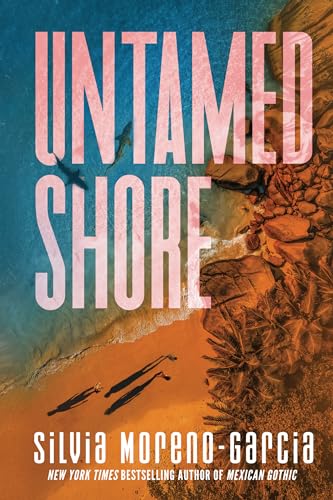
In this dark coming-of-age noir, a “Patricia Highsmith-like tale of grifts and con artists” (Crime Time), a young woman becomes embroiled in a web of lies and deceit—with potentially deadly consequences—from the New York Times bestselling author of Mexican Gothic and Velvet Was the Night
"Untamed Shore is a fever dream of a thriller, a coming-of-age tale set amidst disturbing and dangerous circumstances."—Book Page
Baja California, 1979: Viridiana spends her days under the harsh sun, watching the fishermen pulling in their nets and the dead sharks piled beside the seashore. Her head is filled with dreams of romance, travel, and a future beyond this drab town where her only option is to marry and have children.
When a wealthy American writer arrives with his wife and brother-in-law, Viridiana jumps at the offer of a job as his assistant, and she’s soon entangled in the glamorous foreigners’ lives. They offer excitement, and perhaps an escape from her humdrum existence. When one of them dies, Viridiana, eager to protect her new friends, lies—but soon enough, someone’s asking questions. It’s not long before Viridiana has questions of her own about the identities of her new acquaintances.
Sharks may be dangerous, but there are worse predators nearby, ready to devour a naïve young woman unwittingly entangled in a net of deceit.
Die Inhaltsangabe kann sich auf eine andere Ausgabe dieses Titels beziehen.
Über die Autorin bzw. den Autor
Silvia Moreno-Garcia is the author of the novels The Daughter of Doctor Moreau, Velvet Was the Night, Mexican Gothic, Gods of Jade and Shadow, and a bunch of other books. She has also edited several anthologies, including the World Fantasy Award–winning She Walks in Shadows (a.k.a. Cthulhu’s Daughters). She has been nominated for the Locus Award for her work as an editor and has won the British Fantasy Award and the Locus Award for her work as a novelist.
Auszug. © Genehmigter Nachdruck. Alle Rechte vorbehalten.
One
The beach smelled of death. Half a dozen sharks lay under the sun, waiting to be salted. Whenever Viridiana saw them, glistening belly-up in the midday heat, they reminded her of dominoes set upon a table before the game begins.
An angry shark can bite through tin and metal, the locals said; it could cut through the boats they took out to sea. And looking at the jaws hanging from the wooden rack, Viridiana might concur. But she liked the sharks, she even liked the stench of their livers roasting on a fire. It was a bitter, foul smell, but she had pleasant memories of her father cooking it, attempting to extract oil. He’d done things like that when she was young, trying to make himself comfortable in Desengaño, to leave his city roots behind. He eventually stopped. It was obvious he was a city boy, with his books and his diploma from the university under his arm, and no amount of shoving a shark’s liver across a pan was going to make him a fisherman. Besides, there was no point in trying to master the nets and the boats, anyway, since sharks were almost worthless.
Once upon a time, during World War II, fishermen could make a fortune selling shark livers, and many a fool in search of quick cash had steered his boat towards Baja California. Synthetic vitamins had killed that business. In Desengaño, stubborn fishermen still dragged the sharks out of the water, but many others dedicated themselves to hauling shrimp or an assortment of fish. The ones left chasing sharks sold them to merchants who inevitably passed them off as valuable “cod” fillets. No one would pay more than a pittance for shark meat, but shark meat wrapped in plastic and advertised as “genuine Norwegian cod” was worth the effort. Not that this helped the fishermen, since they sold the meat for a peso while the merchant sold it for fifteen in the city.
But people had to make a living.
Shark skin was sold to make boots, and the fishermen hung the sharks’ large jaws from a wooden rack, hoping tourists might purchase one, or else they might peddle the shark teeth dangling from strings.
There were not many tourists. The highway now brought Americans in their cars, pulling their boats behind them, dollars stuffed in their pockets, but Desengaño was out of the way. There was one hotel with two dozen rooms. The owner had a brother in Mexico City who owned a travel agency, and he convinced foreigners to take a trip to scenic Baja and funneled them into the hotel.
Desengaño was really nothing at all.
Viridiana stared at the sea, at the sharks. Reynier had asked her to stop by, but the Dutchman never woke before noon. She should have waited until later to leave home, but her mother had popped out another kid and it wailed day and night—a colicky monster.
Viridiana scratched her leg and looked at the shadows traced by the sun. She wasn’t wearing a watch, but there was no need for that here. You could figure the time by observing what the fishermen were doing by the seashore, or paying attention to the noises of the town. The church bell clanged early every morning and every evening to further mark the day. At nine Don Tito opened his tiendita, and everyone else followed suit, doors banging open or metal curtains going up. Around noon the doors banged shut again. They didn’t bother lowering the curtains; all the locals knew it was time for a nap. The bar in the hotel didn’t open until seven, but the cantina welcomed everyone at four even if the fishermen wouldn’t get there until eight. The bar catered to whatever foreigners were passing by and the more moneyed townspeople; the cantina took in fishermen, tradesmen, the local alcoholics who could spare the cash. By eleven, the pharmacy turned its sign off and the drunks stumbled past it, and stumbled home. Desengaño plunged into silence.
The shadows cast by the sharks’ jaws indicated it was time to get on her way. The few foreigners who had built permanent vacation houses lived outside the town proper. All of them except for Reynier, who was located a few streets from the town square. He had a large yellow house, which distinguished itself from the houses of the wealthier Mexicans in town—the doctor, the pharmacist—by its relative simplicity. It was neither faux-colonial nor boldly modern. Instead, it was made of wood—an oddity in a place where everything was stone, cement, or adobe—and had a gable roof, making it easy to spot. The Dutchman’s house was a landmark which you could use to map your steps.
Reynier didn’t bother locking the front door, and she let herself in, heading directly to his office. Reynier kept books in three different languages in the office, but they also spilled throughout the house. She had learned to speak English, French and Dutch thanks to these books.
Reynier sat in his big burgundy chair, dressed in one of his prim charcoal suits. He never succumbed to the desire for casual fashions; the 1970s, with their polyester and flared trousers, had not been acknowledged in his home. Reynier’s white beard was neatly trimmed, his face tanned and streaked with wrinkles. Since she was a child he had always been old, weathered like a tree trunk, but around the house, black-and-white photos testified to a blond youth.
She sat on the slim, elegant gray couch opposite him. The shades were drawn and a fan whirled above their heads. It was not quite cool inside his office, but it was as good as it got without air-conditioning. Some of the foreigners outside of Desengaño partook in that luxury. Reynier did not. In this, too, he was old-fashioned.
“I have a job for you,” Reynier said, with that deep, soothing voice. “There are people coming to stay at Milton’s house and they don’t speak a word of Spanish.”
Milton had been a long-time visitor to Desengaño. He came every spring, since before they finished the highway in ’72, seven years ago. But Milton passed away over Christmas.
“His kids?” she asked.
“No. They’re renting the house to friends. They’ll be here in two days. I’ll hand them the keys. I already sent Delfina and her daughter to clean the place up and air it out.”
All the regular visitors knew one another, and they all knew Reynier. He kept an eye on their houses for most of them: Reynier was the only one who stayed all year long. It wasn’t difficult, since the regulars had only half a dozen homes. Although Narciso Ferrer, the hotel owner, was always talking about how tourists would one day flow in plentiful numbers through the town, his prophecy had failed to materialize.
“How long will they be staying?”
“A few months. The man I spoke to, Ambrose, has a notion to write a book while he is here. He needs a personal assistant. So it wouldn’t be a weekend touring them through the coves. He wants someone to type notes for him and the like.”
This was different. When the tourist season was in full swing, Viridiana made a living as a guide. There was another guide in town, Alejandro, four years older than she was and the son-in-law of the hotel owner, which meant all business from there was siphoned to him. Viridiana was left to attract the attention of the young people who were camping on the beaches or the sport fishermen who rattled into town with campers in tow. Reynier tried to direct business her way when he could, and he also paid her to stop by once a week and speak to him in Spanish. To improve his language skills, he said, but they spent more time practicing Dutch or English, for her sake, than speaking any Spanish. He didn’t need the practice, anyway, he got by well...
„Über diesen Titel“ kann sich auf eine andere Ausgabe dieses Titels beziehen.
Suchergebnisse für Untamed Shore

Beispielbild für diese ISBN
Untamed Shore
Anbieter: World of Books (was SecondSale), Montgomery, IL, USA
Verkäuferbewertung 5 von 5 Sternen

Paperback. Zustand: Good. In this dark coming-of-age noir, a "Patricia Highsmith-like tale of grifts and con artists" (Crime Time), a young woman becomes embroiled in a web of lies and deceit--with potentially deadly consequences--from the New York Times bestselling author of Mexican Gothic and Velvet Was the Night "Untamed Shore is a fever dream of a thriller, a coming-of-age tale set amidst disturbing and dangerous circumstances."--Book Page Baja California, 1979: Viridiana spends her days under the harsh sun, watching the fishermen pulling in their nets and the dead sharks piled beside the seashore. Her head is filled with dreams of romance, travel, and a future beyond this drab town where her only option is to marry and have children. When a wealthy American writer arrives with his wife and brother-in-law, Viridiana jumps at the offer of a job as his assistant, and she's soon entangled in the glamorous foreigners' lives. They offer excitement, and perhaps an escape from her humdrum existence. When one of them dies, Viridiana, eager to protect her new friends, lies--but soon enough, someone's asking questions. It's not long before Viridiana has questions of her own about the identities of her new acquaintances. Sharks may be dangerous, but there are worse predators nearby, ready to devour a naïve young woman unwittingly entangled in a net of deceit. Bestandsnummer des Verkäufers 00107112807
Gebraucht kaufen
EUR 5,97
Versand gratis
Versand innerhalb von USA
Versand innerhalb von USA
Anzahl: 5 verfügbar
Beispielbild für diese ISBN
Untamed Shore
Anbieter: BooksRun, Philadelphia, PA, USA
Verkäuferbewertung 5 von 5 Sternen
Paperback. Zustand: Very Good. It's a well-cared-for item that has seen limited use. The item may show minor signs of wear. All the text is legible, with all pages included. It may have slight markings and/or highlighting. Bestandsnummer des Verkäufers 0593600525-11-1
Gebraucht kaufen
EUR 6,63
Versand gratis
Versand innerhalb von USA
Versand innerhalb von USA
Anzahl: 1 verfügbar
Beispielbild für diese ISBN
Untamed Shore
Anbieter: HPB-Emerald, Dallas, TX, USA
Verkäuferbewertung 5 von 5 Sternen
paperback. Zustand: Very Good. Connecting readers with great books since 1972! Used books may not include companion materials, and may have some shelf wear or limited writing. We ship orders daily and Customer Service is our top priority! Bestandsnummer des Verkäufers S_460436628
Gebraucht kaufen
EUR 4,13
EUR 3,34 Versand
Versand innerhalb von USA
Versand innerhalb von USA
Anzahl: 1 verfügbar
Foto des Verkäufers
Untamed Shore
Anbieter: Greenworld Books, Arlington, TX, USA
Verkäuferbewertung 5 von 5 Sternen
Zustand: good. Fast Free Shipping â" Good condition. It may show normal signs of use, such as light writing, highlighting, or library markings, but all pages are intact and the book is fully readable. A solid, complete copy that's ready to enjoy. Bestandsnummer des Verkäufers GWV.0593600525.G
Gebraucht kaufen
EUR 7,47
Versand gratis
Versand innerhalb von USA
Versand innerhalb von USA
Anzahl: 1 verfügbar
Beispielbild für diese ISBN
Untamed Shore
Anbieter: World of Books Inc, Montgomery, IL, USA
Verkäuferbewertung 4 von 5 Sternen

Paperback. Zustand: Good. In this dark coming-of-age noir, a "Patricia Highsmith-like tale of grifts and con artists" (Crime Time), a young woman becomes embroiled in a web of lies and deceit--with potentially deadly consequences--from the New York Times bestselling author of Mexican Gothic and Velvet Was the Night "Untamed Shore is a fever dream of a thriller, a coming-of-age tale set amidst disturbing and dangerous circumstances."--Book Page Baja California, 1979: Viridiana spends her days under the harsh sun, watching the fishermen pulling in their nets and the dead sharks piled beside the seashore. Her head is filled with dreams of romance, travel, and a future beyond this drab town where her only option is to marry and have children. When a wealthy American writer arrives with his wife and brother-in-law, Viridiana jumps at the offer of a job as his assistant, and she's soon entangled in the glamorous foreigners' lives. They offer excitement, and perhaps an escape from her humdrum existence. When one of them dies, Viridiana, eager to protect her new friends, lies--but soon enough, someone's asking questions. It's not long before Viridiana has questions of her own about the identities of her new acquaintances. Sharks may be dangerous, but there are worse predators nearby, ready to devour a naïve young woman unwittingly entangled in a net of deceit. Bestandsnummer des Verkäufers CIN0593600525G
Gebraucht kaufen
EUR 7,80
Versand gratis
Versand innerhalb von USA
Versand innerhalb von USA
Anzahl: 5 verfügbar
Beispielbild für diese ISBN
Untamed Shore
Anbieter: ThriftBooks-Dallas, Dallas, TX, USA
Verkäuferbewertung 5 von 5 Sternen
Paperback. Zustand: Fair. No Jacket. Readable copy. Pages may have considerable notes/highlighting. ~ ThriftBooks: Read More, Spend Less. Bestandsnummer des Verkäufers G0593600525I5N00
Gebraucht kaufen
EUR 7,99
Versand gratis
Versand innerhalb von USA
Versand innerhalb von USA
Anzahl: 1 verfügbar
Beispielbild für diese ISBN
Untamed Shore
Anbieter: Wonder Book, Frederick, MD, USA
Verkäuferbewertung 5 von 5 Sternen
Zustand: Very Good. Very Good condition. A copy that may have a few cosmetic defects. May also contain light spine creasing or a few markings such as an owner's name, short gifter's inscription or light stamp. Bestandsnummer des Verkäufers O12H-01427
Gebraucht kaufen
EUR 8,25
Versand gratis
Versand innerhalb von USA
Versand innerhalb von USA
Anzahl: 1 verfügbar
Beispielbild für diese ISBN
Untamed Shore
Anbieter: HPB-Diamond, Dallas, TX, USA
Verkäuferbewertung 5 von 5 Sternen
paperback. Zustand: Very Good. Connecting readers with great books since 1972! Used books may not include companion materials, and may have some shelf wear or limited writing. We ship orders daily and Customer Service is our top priority! Bestandsnummer des Verkäufers S_481215712
Gebraucht kaufen
EUR 5,36
EUR 3,34 Versand
Versand innerhalb von USA
Versand innerhalb von USA
Anzahl: 1 verfügbar
Beispielbild für diese ISBN
Untamed Shore
Anbieter: HPB-Ruby, Dallas, TX, USA
Verkäuferbewertung 5 von 5 Sternen
paperback. Zustand: Very Good. Connecting readers with great books since 1972! Used books may not include companion materials, and may have some shelf wear or limited writing. We ship orders daily and Customer Service is our top priority! Bestandsnummer des Verkäufers S_480039765
Gebraucht kaufen
EUR 6,60
EUR 3,34 Versand
Versand innerhalb von USA
Versand innerhalb von USA
Anzahl: 1 verfügbar
Foto des Verkäufers
Untamed Shore
Anbieter: Goodwill of Greater Milwaukee and Chicago, Racine, WI, USA
Verkäuferbewertung 5 von 5 Sternen
Zustand: good. Book is considered to be in good or better condition. The actual cover image may not match the stock photo. Hard cover books may show signs of wear on the spine, cover or dust jacket. Paperback book may show signs of wear on spine or cover as well as having a slight bend, curve or creasing to it. Book should have minimal to no writing inside and no highlighting. Pages should be free of tears or creasing. Stickers should not be present on cover or elsewhere, and any CD or DVD expected with the book is included. Book is not a former library copy. Bestandsnummer des Verkäufers SEWV.0593600525.G
Gebraucht kaufen
EUR 7,99
EUR 2,67 Versand
Versand innerhalb von USA
Versand innerhalb von USA
Anzahl: 1 verfügbar