
Verwandte Artikel zu The Making of Another Major Motion Picture Masterpiece:...
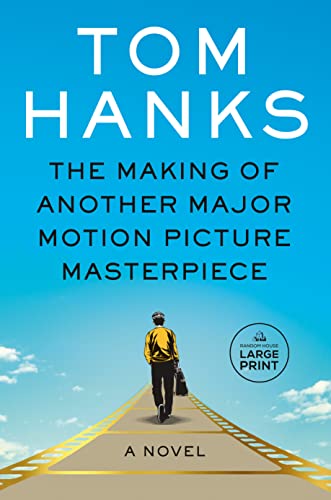
The Making of Another Major Motion Picture Masterpiece: A novel (Random House Large Print) - Softcover
Inhaltsangabe
NEW YORK TIMES BEST SELLER • AN NPR BEST BOOK OF THE YEAR • From the legendary actor and best-selling author: a novel about the making of a star-studded, multimillion-dollar superhero action film...and the humble comic books that inspired it. Funny, touching, and wonderfully thought-provoking, while also capturing the changes in America and American culture since World War II.
"Wild, ambitious and exceptionally enjoyable." —Matt Haig, best-selling author The Midnight Library, The Humans and Reasons to Stay Alive
Part One of this story takes place in 1947. A troubled soldier, returning from the war, meets his talented five-year-old nephew, leaves an indelible impression, and then disappears for twenty-three years.
Cut to 1970: The nephew, now drawing underground comic books in Oakland, California, reconnects with his uncle and, remembering the comic book he saw when he was five, draws a new version with his uncle as a World War II fighting hero.
Cut to the present day: A commercially successful director discovers the 1970 comic book and decides to turn it into a contemporary superhero movie.
Cue the cast: We meet the film’s extremely difficult male star, his wonderful leading lady, the eccentric writer/director, the producer, the gofer production assistant, and everyone else on both sides of the camera.
Bonus material: Interspersed throughout are three comic books that are featured in the story—all created by Tom Hanks himself—including the comic book that becomes the official tie-in to this novel’s "major motion picture masterpiece."
Die Inhaltsangabe kann sich auf eine andere Ausgabe dieses Titels beziehen.
Über die Autorin bzw. den Autor
TOM HANKS has won Academy Awards for best actor for Philadelphia and Forrest Gump. He has starred in, among many other films, Big, Sleepless in Seattle, Apollo 13, Saving Private Ryan, The Green Mile, Cast Away, Catch Me If You Can, Captain Phillips, Bridge of Spies, Sully, Toy Story, The Post, and It's a Beautiful Day in the Neighborhood. His writing has appeared in The New York Times, Vanity Fair, and The New Yorker. He is also the author of a best-selling collection of stories, Uncommon Type.
R. Sikoryak is a cartoonist and an author based in New York City. His illustrations have appeared in The New Yorker, The New York Times Book Review, and The Daily Show with Jon Stewart.
Auszug. © Genehmigter Nachdruck. Alle Rechte vorbehalten.
1 Backstory
A little over five years back, I had a message on my voice mail from one Al Mac-Teer—which I heard as Almick Tear—from a number in the 310 area code. This no-nonsense woman asked me to call her back regarding a thin little memoir I had written called A Stairway Down to Heaven about my years of tending bar in a small subterranean club that played live music way back in the ’80s. At the time, I was also, sort of, a freelance journalist in and around Pittsburgh, PA. And I wrote movie reviews. These days I teach Creative Writing, Common Literature, and Film Studies at Mount Chisholm College of the Arts in the hills of Montana. Bozeman is a gorgeous if stark drive away. I get very few voice mails from Los Angeles, California.
“My boss read your memoir,” Ms. Mac-Teer told me. “He says you write like he thinks.”
“Your boss is brilliant,” I told her, then asked, “Who is your boss?” When she told me she worked for Bill Johnson, that I had reached her on her cell as she was driving from her home in Santa Monica to her office in the Capitol Records Building in Hollywood for a meeting with him, I hollered, “You work for Bi-Bi-Bi-Bill JOHNSON? The movie director? Prove it.”
Some days later, I was on the phone with Bi-Bi-Bi-Bill Johnson himself, and we were talking about his line of work, one of the subjects I teach. When I told him I’d seen his entire filmography, he accused me of blowing smoke. When I rattled off many salient points from his movies, he told me to shut up, enough already. At that time, he was “noodling” a screenplay about music in the transformative years of the ’60s going into the ’70s—when bands evolved from matching outfits and three-minute songs for AM radio to LP side-long jams and the Jimi Hendrix Experience. The stories from my book were full of very personal details. Even though my era was twenty years after what he was “noodling”—our club booked unheralded jazz combos and Depeche Mode cover bands—the stuff that happens in live-music venues is timeless, universal. The fights, the drugs, the serious love, the fun sex, the fun love, the serious sex, the laughs and the screaming, the Who-Gets-In and Who-Gets-Bounced—the whole riotous scene of procedures both spoken and intuitive—were the human behaviors that he wanted to nail. He offered me money for my book—the nonexclusive rights to my story, meaning I could still sell the exclusive rights, if there should ever be an offer. Fat chance. Still, I made more money selling him the rights to my book than I did selling copies of the thing.
Bill went off to film Pocket Rockets but kept up with me through calls and many typewritten letters—missives of wandering topics, his Themes of the Moment. The Inevitability of War. Is jazz like math? Frozen yogurt flavors with what toppings? I wrote him back in fountain pen—typewriters? honestly!—because I can match anyone in idiosyncrasy.
I received a single-page letter from him that had only this typed on it:
What films do you hate—walk out of ? Why?
Bill
I wrote him right back.
I don’t hate any films. Movies are too hard to make to warrant hatred, even when they are turkeys. If a movie is not great, I just wait it out in my seat. It will be over soon enough. Walking out of a movie is a sin.
I’m guessing the US Postal Service needed two days to deliver my response, and a day was spent getting it to Bill’s eyeballs, because three days later Al Mac-Teer called me. Her boss wanted me to “get down here, pronto” and watch him make a movie. The term break was coming up, I had never been to Atlanta, and a movie director was inviting me to see the making of a movie. I teach Film Studies but had never witnessed one being made. I flew to Salt Lake City for the connecting flight.
“You said something I have always thought,” Bill said to me when I arrived on the set of Pocket Rockets, somewhere in the endless suburb that is greater Atlanta. “Sure, some movies don’t work. Some fail in their intent. But anyone who says they hated a movie is treating a voluntarily shared human experience like a bad Red-Eye out of LAX. The departure is delayed for hours, there’s turbulence that scares even the flight attendants, the guy across from you vomits, they can’t serve any food and the booze runs out, you’re seated next to twin babies with the colic, and you land too late for your meeting in the city. You can hate that. But hating a movie misses the damn point. Would you say you hated the seventh birthday party of your girlfriend’s niece or a ball game that went eleven innings and ended 1–0? You hate cake and extra baseball for your money? Hate should be saved for fascism and steamed broccoli that’s gone cold. The worst anyone—especially we who take Fountain—should ever say about someone else’s movie is Well, it was not for me, but, actually, I found it quite good. Damn a film with faint praise, but never, ever say you hate a movie. Anyone who uses the h-word around me is done. Gone. Of course, I wrote and directed Albatross. I may be a bit sensitive.”
I lingered on the set of Pocket Rockets for ten days and, over the summer, went to Hollywood for some of the film’s tedious Postproduction. Making movies is complicated, maddening, highly technical at times, ephemeral and gossamer at others, slow as molasses on a Wednesday but with a gun-to-the-head deadline on a Friday. Imagine a jet plane, the funds for which were held up by Congress, designed by poets, riveted together by musicians, supervised by executives fresh out of business school, to be piloted by wannabes with attention deficiencies. What are the chances that such an aeroplane is going to soar? There you have the making of a movie, at least as I saw it at the Skunk Works.
I was not on location for much of the making of A Cellar Full of Sound—which is what later became of some of my little book. My loss. Bill had me paid another bit of coin when the movie began shooting, more when the film came out—the man is generous. I saw the first public showing at the Telluride Film Festival, where he referred to it as “our movie.” In January, I rented a tuxedo and sat at a back table at what was then the Golden Globe Awards (at Merv Griffin’s Beverly Hilton Hotel, the very definition of a H’wood party). When my colleagues ask me about my weekend in Fantasyland, I tell them I didn’t get back to my hotel until five in the morning, very tipsy, dropped off by Al Mac-Teer and none other than Willa Sax—a.k.a. Cassandra Rampart—in her chauffeur-driven Cadillac Escalade. There was no other way I could sum up the experience in terms they’d understand. Willa Sex? No way! I’d prove it by showing them the Facebook photo she posted—there I am, with Al Mac-Teer, laughing our heads off with one of the most beautiful women in the world and her moody bodyguard.
COVID-19 had been dividing up our country into its Mask/No Mask politics and turned my job into online classes. Then came the Vaccine/Anti-Vax dialectic. When Al Mac-Teer called me with an invitation to join her, Bill, and his merry band to observe the full duration of his next film, I thought shooting a movie was neither legal nor possible. But her boss “had a thing” that looked like it was going to be “green-lit” and shot under “Guild protocols” and I was invited to “join the Unit” from the start of Cash Flow to the Final Dub.
“You’ll have an ID badge,” she explained. “You’ll be one of the crew and be tested...
„Über diesen Titel“ kann sich auf eine andere Ausgabe dieses Titels beziehen.
Suchergebnisse für The Making of Another Major Motion Picture Masterpiece:...

Foto des Verkäufers
The Making of Another Major Motion Picture Masterpiece: A novel (Random House Large Print)
Anbieter: Zoom Books East, Glendale Heights, IL, USA
Verkäuferbewertung 5 von 5 Sternen

Zustand: like_new. Book is in like new condition with minimal signs of wear. Pages are clean and free from notes or highlighting. Dust cover is intact. May not contain miscellaneous items toys, dvds, etc. . We offer 100% money back guarantee and 24 7 customer service. Bestandsnummer des Verkäufers ZEV.0593664000.LN
Gebraucht kaufen
EUR 4,00
Versand gratis
Versand innerhalb von USA
Versand innerhalb von USA
Anzahl: 1 verfügbar
Beispielbild für diese ISBN
The Making of Another Major Motion Picture Masterpiece: A novel (Random House Large Print)
Verlag:
Random House Large Print, 2023
ISBN 10: 0593664000
ISBN 13: 9780593664001
Gebraucht
Softcover
Anbieter: World of Books (was SecondSale), Montgomery, IL, USA
Verkäuferbewertung 5 von 5 Sternen
Zustand: Very Good. Item in very good condition! Textbooks may not include supplemental items i.e. CDs, access codes etc. Bestandsnummer des Verkäufers 00109921273
Gebraucht kaufen
EUR 5,42
Versand gratis
Versand innerhalb von USA
Versand innerhalb von USA
Anzahl: 1 verfügbar
Beispielbild für diese ISBN
The Making of Another Major Motion Picture Masterpiece: A novel (Random House Large Print)
Verlag:
Random House Large Print, 2023
ISBN 10: 0593664000
ISBN 13: 9780593664001
Gebraucht
Softcover
Anbieter: World of Books (was SecondSale), Montgomery, IL, USA
Verkäuferbewertung 5 von 5 Sternen
Zustand: Good. Good condition ex-library book with usual library markings and stickers. Bestandsnummer des Verkäufers 00109352794
Gebraucht kaufen
EUR 5,42
Versand gratis
Versand innerhalb von USA
Versand innerhalb von USA
Anzahl: 1 verfügbar
Beispielbild für diese ISBN
The Making of Another Major Motion Picture Masterpiece: A novel (Random House Large Print)
ISBN 10: 0593664000
ISBN 13: 9780593664001
Gebraucht
Paperback
Anbieter: BooksRun, Philadelphia, PA, USA
Verkäuferbewertung 5 von 5 Sternen
Paperback. Zustand: Very Good. Large type / Large print. It's a well-cared-for item that has seen limited use. The item may show minor signs of wear. All the text is legible, with all pages included. It may have slight markings and/or highlighting. Bestandsnummer des Verkäufers 0593664000-11-1
Gebraucht kaufen
EUR 5,75
Versand gratis
Versand innerhalb von USA
Versand innerhalb von USA
Anzahl: 1 verfügbar
Foto des Verkäufers
The Making of Another Major Motion Picture Masterpiece: A novel (Random House Large Print)
Anbieter: clickgoodwillbooks, Indianapolis, IN, USA
Verkäuferbewertung 4 von 5 Sternen

Zustand: acceptable. Used - Acceptable: All pages and the cover are intact, but shrink wrap, dust covers, or boxed set case may be missing. Pages may include limited notes, highlighting, or minor water damage but the text is readable. Item may be missing bundled media. Bestandsnummer des Verkäufers 3O6QYV000BAV_ns
Gebraucht kaufen
EUR 2,27
EUR 3,51 Versand
Versand innerhalb von USA
Versand innerhalb von USA
Anzahl: 1 verfügbar
Beispielbild für diese ISBN
The Making of Another Major Motion Picture Masterpiece
Anbieter: ThriftBooks-Dallas, Dallas, TX, USA
Verkäuferbewertung 5 von 5 Sternen
Paperback. Zustand: Very Good. No Jacket. Former library book; May have limited writing in cover pages. Pages are unmarked. ~ ThriftBooks: Read More, Spend Less. Bestandsnummer des Verkäufers G0593664000I4N10
Gebraucht kaufen
EUR 5,87
Versand gratis
Versand innerhalb von USA
Versand innerhalb von USA
Anzahl: 1 verfügbar
Beispielbild für diese ISBN
The Making of Another Major Motion Picture Masterpiece
Anbieter: ThriftBooks-Atlanta, AUSTELL, GA, USA
Verkäuferbewertung 5 von 5 Sternen
Paperback. Zustand: Good. No Jacket. Pages can have notes/highlighting. Spine may show signs of wear. ~ ThriftBooks: Read More, Spend Less. Bestandsnummer des Verkäufers G0593664000I3N00
Gebraucht kaufen
EUR 5,87
Versand gratis
Versand innerhalb von USA
Versand innerhalb von USA
Anzahl: 1 verfügbar
Beispielbild für diese ISBN
The Making of Another Major Motion Picture Masterpiece
Verlag:
Random House Large Print Publishing, 2023
ISBN 10: 0593664000
ISBN 13: 9780593664001
Gebraucht
Paperback
Anbieter: ThriftBooks-Atlanta, AUSTELL, GA, USA
Verkäuferbewertung 5 von 5 Sternen
Paperback. Zustand: Good. No Jacket. Former library book; Pages can have notes/highlighting. Spine may show signs of wear. ~ ThriftBooks: Read More, Spend Less. Bestandsnummer des Verkäufers G0593664000I3N10
Gebraucht kaufen
EUR 5,87
Versand gratis
Versand innerhalb von USA
Versand innerhalb von USA
Anzahl: 1 verfügbar
Beispielbild für diese ISBN
The Making of Another Major Motion Picture Masterpiece
Anbieter: ThriftBooks-Atlanta, AUSTELL, GA, USA
Verkäuferbewertung 5 von 5 Sternen
Paperback. Zustand: Very Good. No Jacket. Former library book; May have limited writing in cover pages. Pages are unmarked. ~ ThriftBooks: Read More, Spend Less. Bestandsnummer des Verkäufers G0593664000I4N10
Gebraucht kaufen
EUR 5,87
Versand gratis
Versand innerhalb von USA
Versand innerhalb von USA
Anzahl: 1 verfügbar
Beispielbild für diese ISBN
The Making of Another Major Motion Picture Masterpiece
Verlag:
Random House Large Print Publishing, 2023
ISBN 10: 0593664000
ISBN 13: 9780593664001
Gebraucht
Paperback
Anbieter: ThriftBooks-Dallas, Dallas, TX, USA
Verkäuferbewertung 5 von 5 Sternen
Paperback. Zustand: Good. No Jacket. Pages can have notes/highlighting. Spine may show signs of wear. ~ ThriftBooks: Read More, Spend Less. Bestandsnummer des Verkäufers G0593664000I3N00
Gebraucht kaufen
EUR 5,87
Versand gratis
Versand innerhalb von USA
Versand innerhalb von USA
Anzahl: 1 verfügbar