
Verwandte Artikel zu The Red Devil: To Hell With Cancer-- And Back
Inhaltsangabe
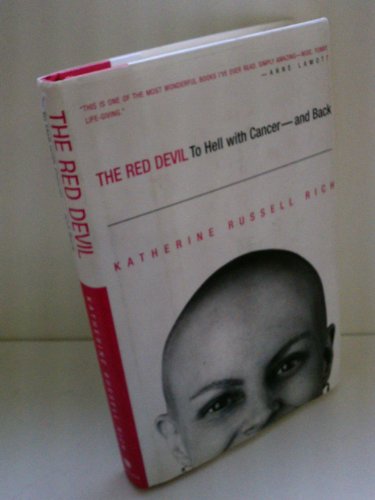
A cancer survivor describes her ten-year ordeal with the disease, offering an inspirational portrait of a surreal world in which she struggled with illness, treatments, exhaustion, and the medical establishment while trying to live a normal life
Die Inhaltsangabe kann sich auf eine andere Ausgabe dieses Titels beziehen.
Über die Autorin bzw. den Autor
Katherine Russell Rich lives in New York City.
Aus dem Klappentext
l is a bold, wickedly funny tale of illness, joy, and the improbable triumph of love in the midst of despair. <br><br>When Katherine Russell Rich was thirty-two, a newly divorced, high-powered magazine editor living a glamorous life in New York City, her ten-year (and still counting) ordeal with cancer began. Soon she was bald, scrambled, and living in two worlds simultaneously: the world of the ill, filled with treatments, exhaustion, and doctors as focused on avoiding malpractice suits as on healing; and the "normal" world, where dating, career, vacations, and 401(k) plans still matter.<br><br>Alternately wise and wise-cracking, Rich serves up vignettes from the surreal world only the ill know: the MS patient who crashes her support group, the alternative practitioner whose gifts come from extraterrestrials, the doctor who fires her patient, dating while bald, working without a brain, and smoking with cancer. Here is a woman who has been brought to her knees by disea
Auszug. © Genehmigter Nachdruck. Alle Rechte vorbehalten.
Part One
When we stand
on the low rungs
of the ladder of sorrow,
we cry.
When we come
to the middle
we're silent.
But when we climb
to the top
of the ladder
of sorrow,
we convert sadness into song.
-- ancient Hebrew poem
Critical Mass
I found the lump twenty minutes before breakfast, three weeks after my marriage broke up. I was taking a shower, soaping myself down, when my fingers slid into it and stopped. They pushed on a little, flew off, returned to confirm that, yes, there was something hard and alien in my left breast. After a pause, they resumed their investigation. But now my brain had seized up, and so the information my fingers were attempting to relay remained stalled, unprocessed, in touch. Perhaps that's why I retain such a strong sense memory of what they found: a mass the size of a pigeon's egg, a blob that felt like oatmeal packed in casing. I was puzzled--the thing hadn't, I swear, been there the day before--but not perplexed. I knew instantly what it was.
At work I phoned a friend. "Michelle," I whispered. "On top of everything, I found a lump in my breast. I can't do it: I can't go on!" Those were the days when I still liked hyperbole, before an excess of real drama killed my taste for the manufactured kind.
My friend soothed and reassured me; she presented the facts: All women find lumps; I was only thirty-two; the odds were this was absolutely nothing. The case she constructed was sure and ordered. "Yeah, you're right," I agreed, allowing myself to be seduced into calm, willing, temporarily, to forget my certainty, illogical as it was.
My evidence, had I spoken it, was this: My life was spinning to hell; my marriage had busted up at the end of August; I'd promptly moved eleven cartons of possessions into a sublet where I wasn't supposed to smoke but I did; and now, in September, I was about to take a new job. Of course that lump was cancer. What else was it going to be?
And those were my surefire arguments. If I wasn't going to bring them up, I certainly wasn't going to mention that, six months before, in a journal, I'd written, "I can't stay in this marriage any longer. If I do, I'll get cancer." Or how, not long after, I'd experienced some weird psychic breast cancer flash. "Diego, I'm not kidding, I'm getting the strongest feeling that somebody in one of our families has it," I'd told my husband. "To be safe, why don't you call your mother down in Buenos Aires and tell her to get a mammogram." Spooked, she rushed to get the test, which came back normal.
Nor did I mention another recent occurrence, but only, I would have told you then, because it had slipped my mind. Fear, I realize now, was blocking the memory of how, a few months earlier, in bed, my husband had frozen while caressing me. "I don't want to scare you," he said softly, "but I think I found a lump here." When he tried to locate it again, it wasn't there. I chalked the incident up to projectile hypochondria.
Diego and I were absolute opposites about a lot things, and illness was one of them. "Ah! I think I have a cancer!" he would announce, lying prostrate on the bed. "What a baby," I'd say, not at all amused or compassionate. My father was a Christian Scientist, and while my mother insisted on raising my brother, sister, and me Episcopalian, his beliefs suffused the house. We weren't expected to deny disease as he was, but we were strongly encouraged to rise above it. "It's just mortal error," my father would counsel me when I was laid low by some ailment. I didn't have a clue what he was talking about, but I did know that mortal error was the reason why, in tenth grade, for instance, shimmery with a fever from bronchitis, I was still expected to haul myself to school. Coming into the adult world, I assumed everyone was like this. Diego, for one, was not.
"I have a headache! I cannot move," he declared from the floor of the Denver airport on Christmas Eve, where he'd flung himself just as the extended family was about to transfer to a flight to Breckenridge for a ski vacation. Pedestrians stepped over him. My parents stared down, flabbergasted. They'd never seen behavior like this. I had, a couple of times.
"Just ignore him," I advised my mother.
"But Kathy," she said. "He really looks sick."
"He is," I sneered. "Sick in his head."
I'd met Diego when he was thirty-one and I was twenty-five, at a party he threw at his apartment on East Fourteenth Street. When I'd rung the bell, he'd opened the door and done a double take. I was pleased by his show of interest, but I had to look away, for if he was thunderstruck, I was more so. He was blond and all-boy, sexy like a rugby player, and though I'd heard from our mutual friend that he was Argentine, I noticed he spoke with a slight twang, like someone out of Texas.
The inflection puzzled me for a long time, till I realized he'd picked up his American listening to Bob Dylan. As for his English, he'd learned that while attending a private Irish school in Buenos Aires, after which he'd gone on to study architecture for a few years before being sidetracked by marriage, two sons, and a job at a radical newspaper. Journalism in the States can be a high-risk profession, but in Argentina in the seventies, it was flat-out dangerous, particularly when practiced at a left-wing publication. The far-right government was waging a Dirty War against anyone who disagreed with its positions, and journalists as a group were high on the hit list. Students and intellectuals were being dragged from their homes in the middle of the night and brought to detention centers, where they were tortured and frequently killed. After a number of Diego's friends had been disappeared, his name turned up in some wrong address books and the police detained him twice. In the year before he fled the country, he got used to sleeping with a pistol under his pillow.
„Über diesen Titel“ kann sich auf eine andere Ausgabe dieses Titels beziehen.
Suchergebnisse für The Red Devil: To Hell With Cancer-- And Back

Beispielbild für diese ISBN
The Red Devil: to Hell with Cancer - and Back: To Hell with Cancer - and Back
Anbieter: World of Books (was SecondSale), Montgomery, IL, USA
Verkäuferbewertung 5 von 5 Sternen

Hardback. Zustand: Very Good. Bestandsnummer des Verkäufers 00100931548
Gebraucht kaufen
EUR 4,52
Versand gratis
Versand innerhalb von USA
Versand innerhalb von USA
Anzahl: 2 verfügbar
Foto des Verkäufers
The Red Devil: To Hell with Cancer--and Back
Anbieter: Greenworld Books, Arlington, TX, USA
Verkäuferbewertung 5 von 5 Sternen
Zustand: very_good. Fast Free Shipping â" Very Good condition book with a firm cover and clean pages. Shows normal use and some light wear or limited notes markings. A solid, nice copy to enjoy. Bestandsnummer des Verkäufers GWV.0609603213.VG
Gebraucht kaufen
EUR 4,53
Versand gratis
Versand innerhalb von USA
Versand innerhalb von USA
Anzahl: 1 verfügbar
Beispielbild für diese ISBN
The Red Devil: To Hell with Cancer--and Back
Anbieter: BooksRun, Philadelphia, PA, USA
Verkäuferbewertung 5 von 5 Sternen
Hardcover. Zustand: Very Good. 1. With dust jacket. It's a well-cared-for item that has seen limited use. The item may show minor signs of wear. All the text is legible, with all pages included. It may have slight markings and/or highlighting. Bestandsnummer des Verkäufers 0609603213-11-1-29
Gebraucht kaufen
EUR 4,74
Versand gratis
Versand innerhalb von USA
Versand innerhalb von USA
Anzahl: 1 verfügbar
Beispielbild für diese ISBN
The Red Devil: to Hell with Cancer - and Back: To Hell with Cancer - and Back
Anbieter: World of Books Inc, Montgomery, IL, USA
Verkäuferbewertung 4 von 5 Sternen

Hardback. Zustand: Very Good. Bestandsnummer des Verkäufers CIN0609603213VG
Gebraucht kaufen
EUR 6,36
Versand gratis
Versand innerhalb von USA
Versand innerhalb von USA
Anzahl: 2 verfügbar
Beispielbild für diese ISBN
The Red Devil: To Hell with Cancer--and Back
Anbieter: Wonder Book, Frederick, MD, USA
Verkäuferbewertung 5 von 5 Sternen
Zustand: Very Good. Very Good condition. Good dust jacket. A copy that may have a few cosmetic defects. May also contain light spine creasing or a few markings such as an owner's name, short gifter's inscription or light stamp. Bestandsnummer des Verkäufers B08J-00446
Gebraucht kaufen
EUR 6,43
Versand gratis
Versand innerhalb von USA
Versand innerhalb von USA
Anzahl: 2 verfügbar
Beispielbild für diese ISBN
The Red Devil: To Hell with Cancer--and Back
Anbieter: Hawking Books, Edgewood, TX, USA
Verkäuferbewertung 4 von 5 Sternen
Zustand: Good. Ex-library book with usual markings. Meets or exceeds the good condition guidelines. Nice copy. Five star seller - Buy with confidence! Bestandsnummer des Verkäufers X0609603213X3
Gebraucht kaufen
EUR 6,52
Versand gratis
Versand innerhalb von USA
Versand innerhalb von USA
Anzahl: 1 verfügbar
Beispielbild für diese ISBN
The Red Devil: To Hell with Cancer--and Back
Anbieter: ThriftBooks-Atlanta, AUSTELL, GA, USA
Verkäuferbewertung 5 von 5 Sternen
Hardcover. Zustand: Good. No Jacket. Missing dust jacket; Pages can have notes/highlighting. Spine may show signs of wear. ~ ThriftBooks: Read More, Spend Less. Bestandsnummer des Verkäufers G0609603213I3N01
Gebraucht kaufen
EUR 6,69
Versand gratis
Versand innerhalb von USA
Versand innerhalb von USA
Anzahl: 1 verfügbar
Beispielbild für diese ISBN
The Red Devil: To Hell with Cancer--and Back
Anbieter: ThriftBooks-Dallas, Dallas, TX, USA
Verkäuferbewertung 5 von 5 Sternen
Hardcover. Zustand: Very Good. No Jacket. May have limited writing in cover pages. Pages are unmarked. ~ ThriftBooks: Read More, Spend Less. Bestandsnummer des Verkäufers G0609603213I4N00
Gebraucht kaufen
EUR 6,69
Versand gratis
Versand innerhalb von USA
Versand innerhalb von USA
Anzahl: 1 verfügbar
Beispielbild für diese ISBN
The Red Devil: To Hell with Cancer--and Back
Anbieter: ThriftBooks-Dallas, Dallas, TX, USA
Verkäuferbewertung 5 von 5 Sternen
Hardcover. Zustand: As New. No Jacket. Pages are clean and are not marred by notes or folds of any kind. ~ ThriftBooks: Read More, Spend Less. Bestandsnummer des Verkäufers G0609603213I2N00
Gebraucht kaufen
EUR 6,69
Versand gratis
Versand innerhalb von USA
Versand innerhalb von USA
Anzahl: 1 verfügbar
Beispielbild für diese ISBN
The Red Devil: To Hell with Cancer--and Back
Anbieter: HPB Inc., Dallas, TX, USA
Verkäuferbewertung 5 von 5 Sternen
hardcover. Zustand: Very Good. Connecting readers with great books since 1972! Used books may not include companion materials, and may have some shelf wear or limited writing. We ship orders daily and Customer Service is our top priority! Bestandsnummer des Verkäufers S_319219718
Gebraucht kaufen
EUR 3,68
EUR 3,35 Versand
Versand innerhalb von USA
Versand innerhalb von USA
Anzahl: 1 verfügbar