
Verwandte Artikel zu Dogs That Know When Their Owners Are Coming Home: And...
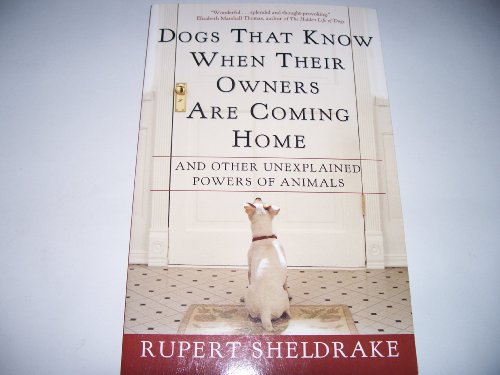
Dogs That Know When Their Owners Are Coming Home: And Other Unexplained Powers of Animals - Softcover
Inhaltsangabe
A thoughtful study of the psychic powers of animals provides anecdotal evidence of animals' telepathic communication, along with thought-provoking analyses of the unique relationships that exist between pet owners and their companions. Reprint. 75,000 first printing.
Die Inhaltsangabe kann sich auf eine andere Ausgabe dieses Titels beziehen.
Über die Autorin bzw. den Autor
RUPERT SHELDRAKE studied natural sciences at Cambridge and philosophy at Harvard, took a Ph.D. in biochemistry at Cambridge, and was a Fellow of Clare College, Cambridge. The author of several books and more than fifty scientific papers, he lives in London.
Aus dem Klappentext
know when it's time to go to the vet, even before the cat carrier comes out? How do dogs know when their owners are returning home at unexpected times? How can horses find their way back to the stable over completely unfamiliar terrain?
With a scientist's mind and an animal lover's compassion, world-renowned biologist Rupert Sheldrake presents a groundbreaking exploration of animal behavior that will profoundly change the way we think about animals -- and ourselves. After five years of extensive research involving thousands of people who have pets and work with animals, Dr. Sheldrake proves conclusively what many pet owners already know: there is a strong connection between humans and animals that defies present-day scientific understanding. This remarkable book deserves a place next to the most beloved and valuable books on animals, including When Elephants Weep, Dogs Never Lie About Love, and The Hidden Life of Dogs.
Auszug. © Genehmigter Nachdruck. Alle Rechte vorbehalten.
Part I
HUMAN-ANIMAL BONDS
Chapter 1
The Domestication of Animals
Many people love their pets and are loved by them. In this chapter I explore the evolution and the nature of human-animal bonds.
But first it is important to recognize that emotional bonds between people and animals are the exception rather than the rule. For every well-loved cat or dog, hundreds of domesticated animals are confined to intensive farming systems and research laboratories. In many Third World countries beasts of burden are often treated brutally. And traditional societies are not usually subscribers to modern ideals of animal welfare. Eskimos, for example, tend to treat their huskies harshly.
But in spite of all this exploitation, abuse, and neglect, many people form bonds with animals from childhood onward. Young children are commonly given teddy bears or other toy animals, and they like hearing stories about animals. Above all, most like keeping actual animals. The majority of pets live in households with children.
Hearing tales about frightening animals, including the wolf in "Little Red Riding Hood," and forming relationships with friendly ones seems to be a normal and fundamental aspect of human nature. Indeed our nature has been shaped throughout its evolutionary history by our interactions with animals, and all human cultures are enriched by songs, dances, rituals, myths, and stories about them.
The evolution of human-animal bonds
The earliest named hominid species, known from fossil remains, are Australopithecus ramidus and Australopithecus anamensis, dating back over 4 million years. The first stone tools were used about 2 1/2 million years ago, and signs of meat eating appear about a million years later, around the time that Homo erectus spread out of Africa into Eurasia (Figure 1.1). The use of fire may have begun around 700,000 years ago. Modern humans originated in Africa about 150,000 years ago. The first cave paintings, including many of animals, appeared about 30,000 years ago. The agricultural revolution began about 10,000 years ago, and the first civilizations and written scripts about 5,000 years ago.
Our ancestors lived as gatherers and hunters, with gathering far more important than hunting. The old image of man the hunter striding confidently out onto the African veldt is a myth. Only a small proportion of the food eaten by today's hunter-gatherers comes from animals hunted by the men; most comes from gathering done mainly by women. The exceptions are the hunter-gatherers of the plant-poor Arctic regions. Hominids and early Homo sapiens obtained small amounts of meat more by scavenging the kills left by more effective predators like big cats than by hunting for themselves. Big game hunting, as opposed to scavenging, may date back only some 70,000 to 90,000 years.
In hunter-gatherer cultures, human beings do not see themselves as separate from other animals but as intimately interconnected. The specialists in communication with the nonhuman world are shamans, and through their guardian spirits or power animals, shamans connect themselves with the powers of animals. There is a mysterious solidarity between people and animals. Shamans experience themselves as being guided by animals or as changing into animals, understanding their language, and sharing in their prescience and occult powers.
The earliest domesticated dogs
The first animals to be domesticated were dogs. Their ancestors, wolves, hunted in packs, just as men hunted, and from an early stage dogs were used in hunting as well as for guarding human settlements. Their domestication predated the development of agriculture.
The conventional view is the domestication of wolves began between 10,000 and 20,000 years ago. But recent evidence from the study of DNA in dogs and wolves points to a far earlier date for the first transformation of wolf to dog, over 100,000 years ago. This new evidence also suggests that wolves were domesticated several times, not just once, and that dogs have continued to crossbreed with wild wolves.
If this theory is confirmed, it means that our ancient companionship with dogs may have played an important part in human evolution. Dogs could have played a major role in the advances in human hunting techniques that occurred some 70,000 to 90,000 years ago.
The Australian veterinarian David Paxton goes so far as to suggest that people did not so much domesticate wolves as wolves domesticated people. Wolves may have started living around the periphery of human settlements as a kind of infestation. Some learned to live with human beings in a mutually helpful way and gradually evolved into dogs. At the very least, they would have protected human settlements, and given warnings by barking at anything approaching.
The wolves that evolved into dogs have been enormously successful in evolutionary terms. They are found everywhere in the inhabited world, hundreds of millions of them. The descendants of the wolves that remained wolves are now sparsely distributed, often in endangered populations.
From the Hardcover edition.
„Über diesen Titel“ kann sich auf eine andere Ausgabe dieses Titels beziehen.
Suchergebnisse für Dogs That Know When Their Owners Are Coming Home: And...

Beispielbild für diese ISBN
Dogs That Know When Their Owne
Anbieter: World of Books (was SecondSale), Montgomery, IL, USA
Verkäuferbewertung 5 von 5 Sternen

Zustand: Acceptable. Item in acceptable condition! Textbooks may not include supplemental items i.e. CDs, access codes etc. Bestandsnummer des Verkäufers 00108243834
Gebraucht kaufen
EUR 3,68
Versand gratis
Versand innerhalb von USA
Versand innerhalb von USA
Anzahl: 1 verfügbar
Beispielbild für diese ISBN
Dogs That Know When Their Owne
Anbieter: World of Books (was SecondSale), Montgomery, IL, USA
Verkäuferbewertung 5 von 5 Sternen
Zustand: Very Good. Item in very good condition! Textbooks may not include supplemental items i.e. CDs, access codes etc. Bestandsnummer des Verkäufers 00108288208
Gebraucht kaufen
EUR 3,68
Versand gratis
Versand innerhalb von USA
Versand innerhalb von USA
Anzahl: 1 verfügbar
Beispielbild für diese ISBN
Dogs That Know When Their Owne
Anbieter: World of Books (was SecondSale), Montgomery, IL, USA
Verkäuferbewertung 5 von 5 Sternen
Zustand: Good. Item in good condition. Textbooks may not include supplemental items i.e. CDs, access codes etc. Bestandsnummer des Verkäufers 00086424248
Gebraucht kaufen
EUR 3,68
Versand gratis
Versand innerhalb von USA
Versand innerhalb von USA
Anzahl: 18 verfügbar
Beispielbild für diese ISBN
Dogs That Know When Their Owners Are Coming Home: And Other Unexplained Powers of Animals
Anbieter: Your Online Bookstore, Houston, TX, USA
Verkäuferbewertung 5 von 5 Sternen
Paperback. Zustand: Good. Bestandsnummer des Verkäufers 0609805339-3-26395935
Gebraucht kaufen
EUR 3,69
Versand gratis
Versand innerhalb von USA
Versand innerhalb von USA
Anzahl: 1 verfügbar
Foto des Verkäufers
Dogs That Know When Their Owners Are Coming Home: And Other Unexplained Powers of Animals
Anbieter: 3Brothers Bookstore, Egg harbor township, NJ, USA
Verkäuferbewertung 5 von 5 Sternen
Zustand: good. Books may contain some notes and highlighting. Supplements such as Access Codes, Cd's Dust Jackets, etc. are not guaranteed with used book purchases. Bestandsnummer des Verkäufers EVV.0609805339.G
Gebraucht kaufen
EUR 3,84
Versand gratis
Versand innerhalb von USA
Versand innerhalb von USA
Anzahl: 1 verfügbar
Foto des Verkäufers
Dogs That Know When Their Owners Are Coming Home: And Other Unexplained Powers of Animals
Anbieter: 3Brothers Bookstore, Egg harbor township, NJ, USA
Verkäuferbewertung 5 von 5 Sternen
Zustand: very_good. Cover may have light wear, pages in very good condition and binding is sturdy; may have other light shelf wear or creases. May have notes or highlighting. Bestandsnummer des Verkäufers EVV.0609805339.VG
Gebraucht kaufen
EUR 4,07
Versand gratis
Versand innerhalb von USA
Versand innerhalb von USA
Anzahl: 1 verfügbar
Beispielbild für diese ISBN
Dogs That Know When Their Owners Are Coming Home: And Other Unexplained Powers of Animals
Verlag:
Three Rivers Press (edition Reprint), 2000
ISBN 10: 0609805339
ISBN 13: 9780609805336
Gebraucht
Paperback
Anbieter: BooksRun, Philadelphia, PA, USA
Verkäuferbewertung 5 von 5 Sternen
Paperback. Zustand: Very Good. Reprint. It's a well-cared-for item that has seen limited use. The item may show minor signs of wear. All the text is legible, with all pages included. It may have slight markings and/or highlighting. Bestandsnummer des Verkäufers 0609805339-11-1
Gebraucht kaufen
EUR 4,57
Versand gratis
Versand innerhalb von USA
Versand innerhalb von USA
Anzahl: 1 verfügbar
Foto des Verkäufers
Dogs That Know When Their Owners Are Coming Home: And Other Unexplained Powers of Animals
Anbieter: Greenworld Books, Arlington, TX, USA
Verkäuferbewertung 5 von 5 Sternen
Zustand: very_good. Fast Free Shipping â" Very Good condition book with a firm cover and clean pages. Shows normal use and some light wear or limited notes markings. A solid, nice copy to enjoy. Bestandsnummer des Verkäufers GWV.0609805339.VG
Gebraucht kaufen
EUR 4,73
Versand gratis
Versand innerhalb von USA
Versand innerhalb von USA
Anzahl: 1 verfügbar
Beispielbild für diese ISBN
Dogs That Know When Their Owners Are Coming Home: And Other Unexplained Powers of Animals
Anbieter: Evergreen Goodwill, Seattle, WA, USA
Verkäuferbewertung 5 von 5 Sternen
paperback. Zustand: Good. Bestandsnummer des Verkäufers mon0000821174
Gebraucht kaufen
EUR 1,82
EUR 3,52 Versand
Versand innerhalb von USA
Versand innerhalb von USA
Anzahl: 1 verfügbar
Beispielbild für diese ISBN
Dogs That Know When Their Owners Are Coming Home: And Other Unexplained Powers of Animals
Anbieter: World of Books Inc, Montgomery, IL, USA
Verkäuferbewertung 4 von 5 Sternen

Paperback. Zustand: Fair. With a scientist's mind and an animal lover's compassion, world-renowned biologist Rupert Sheldrake presents a groundbreaking exploration of animal behavior that will profoundly change the way we think about animals--and ourselves. How do cats know when it's time to go to the vet, even before the cat carrier comes out? How do dogs know when their owners are returning home at unexpected times? How can horses find their way back to the stable over completely unfamiliar terrain? After five years of extensive research involving thousands of people who have pets and work with animals, Dr. Sheldrake proves conclusively what many pet owners already know: there is a strong connection between humans and animals that defies present-day scientific understanding. Sheldrake compellingly demonstrates that we and our pets are social animals linked together by invisible bonds connecting animals to each other, to their owners, and to their homes in powerful ways. His provocative ideas about these social, or morphic, fields explain the uncanny behavior often observed in pets and help provide an explanation for amazing animal behavior in the wild, such as migration and homing. Dogs That Know When Their Owners Are Coming Home not only provides fascinating insight into animal, and human, behavior, but also teaches us to question the boundaries of conventional scientific thought, and shows that the very animals who are closest to us have much to teach us about biology, nature, and consciousness. Bestandsnummer des Verkäufers CIN0609805339A
Gebraucht kaufen
EUR 5,49
Versand gratis
Versand innerhalb von USA
Versand innerhalb von USA
Anzahl: 1 verfügbar