
Verwandte Artikel zu Rediscovering America: The Making of Mulitcultural...
Inhaltsangabe
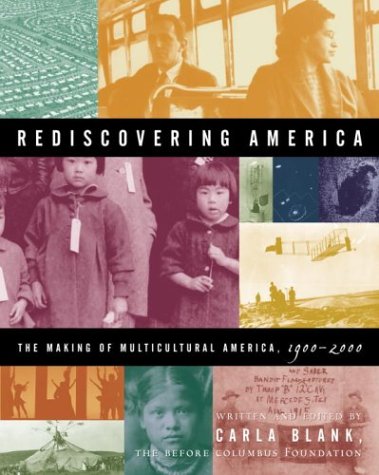
Tracing the development of multicultural America over the course of the twentieth century, this diverse history highlights the political, cultural, social, and cultural contributions of women, African Americans, Native Americans, immigrants, and others on the margins of traditional history. Original. 20,000 first printing.
Die Inhaltsangabe kann sich auf eine andere Ausgabe dieses Titels beziehen.
Über die Autorinnen und Autoren
CARLA BLANK is a writer, editor, and teacher who has lectured at the University of California Berkeley, Dartmouth College, and the University of Washington, among other places. The Before Columbus Foundation was founded in 1976 to promote and disseminate contemporary American multicultural literature. Its mandate is driven by the idea that America s diversity necessitates interaction and sharing in place of appropriation and antagonism.
Carla Blank is a teacher who has lectured at the University of California-Berkeley, Dartmouth College, and the University of Washington.
Aus dem Klappentext
In this vibrant, fact-packed romp through the last 100 years, Rediscovering America explores the lost history of America, highlighting and reintegrating the complex contributions of women, African, Asian, Hispanic, and Native Americans, immigrants, artists, renegades, rebels, rogues, and others normally cast to the margins of history books, but without whom there is no honest accounting of American history. In an accessible timeline format, it paints an inclusive picture of our recent past, without sentiment or favor, respecting the true richness and complexity of 100 years in the life of a nation.
Auszug. © Genehmigter Nachdruck. Alle Rechte vorbehalten.
THE NINETEENTH CENTURY
Before starting our timeline of the twentieth century, let's quickly put it into the context of the century that preceded it. At the end of the nineteenth century, when the United States was a newly established major power, European inventions, culture, and style heavily influenced our technological developments and tastes. But here are some of the breakthroughs in various disciplines that set the stage for the twentieth century.
The Nineteenth Century: Science
BY THE MIDDLE OF THE NINETEENTH century, the germ theory of disease (that many diseases are caused by tiny organisms) was becoming accepted as doctors noticed that various diseases could be spread from one person to another through contamination of a water supply or unwashed hands, and that the use of antiseptics in cleaning wounds prevented infection. This breakthrough was a major contributor to lengthening average life spans for both men and women in the twentieth century. The resultant population growth provided the dynamics to force major social and cultural changes in the twentieth century by simply meeting the ever-growing needs to support those lives: the needs for food, clothing, shelter, and the accelerating expectations for a better quality of life.
Many nineteenth-century discoveries were related to understanding the nature of electricity and established the connection between electricity and magnetism, providing a foundation for the discovery of the electron and the new practical technological applications, called electronics, that have shaped much of the twentieth century, including the inventions of electric motors, electric lighting, the telegraph, telephone, and radio, besides the twentieth century invention of television.
Essential keys to the science of genetics and its investigations of DNA were discovered in the nineteenth-century plant-breeding experiments of Austrian botanist Gregor Mendel and the theory of the evolution of species by natural selection as proposed by British naturalist Charles Darwin.
Nineteenth-century scientific developments also helped shape the aesthetic and intellectual content of the twentieth century, including inventions of the typewriter and typesetting machines, still and motion picture cameras and the movie projector, the phonograph, and Chicago architect Louis Sullivan's 1891 design of the first skyscraper.
The Nineteenth Century: Land, Demographics, Culture, and Law
THE SEEDS FOR MANY OF THE cultural changes to come were already sown by the turn of the century also. Although the U.S. Constitution had been amended and laws protecting racial equality were on the books at the end of the Civil War, by the beginning of the twentieth century these basic rights were already betrayed. Every Southern state had new laws in place that effectively disenfranchised and segregated African Americans, with Northern states allowing similar practices, if not writing them into law. In 1896 the Supreme Court legalized segregation in Plessy v. Ferguson, endorsing the Jim Crow era and its justification in "separate but equal" practices.
For Native peoples inhabiting the North American continent, land belonged to everyone, and could not be owned. European settlers saw these vast stretches of land as the central prized ingredient, the means to reaching the greatest potential for growth and development of wealth. This difference underlies the years of battles and the trail of treaties that mark the relationship between the U.S. government
and the continent's original inhabitants, the Native Americans. At the beginning of the 1800s, most European Americans lived east of the Appalachian Mountains. Native Americans still inhabited more than 80 percent of the remaining areas of what would become
the contiguous forty-eight states. As early as the 1803 purchase of the Louisiana Territory from the French for $15 million, President Thomas Jefferson was suggesting removing the native populations from their lands in that area to lands west of the Mississippi. President Andrew Jackson carried this proposal out in the 1830s, with the policy of forced removal of the so-called Five Civilized Tribes (the Chickasaw, Cherokee, Creek, Choctaw, and Seminole nations) from Alabama, Georgia, Florida, Louisiana, and Mississippi to the Oklahoma Territory. By the 1880s, all the Eastern tribes had been relocated to reservations. The treaties between the federal government and the tribes, whether honored or broken, left them without the right to vote, and in every other way legally separated from and without representation in the U.S. economic and political system. The passage of the Dawes Act of 1887, or Indian Allotment Act, sealed the basic direction of federal policies toward total assimilation and removal, by dissolving the reservation system. It replaced the system of tribal landholdings by breaking them up into 160-acre, individual family subdivisions, placing the remaining "surplus lands" up for sale and settlement by whites. This law was presented as a means to "civilize" Native Americans by teaching them the system of private property and giving them twenty-five years of full participation to learn how to manage their parcels. In 1881, Native Americans possessed 155 million acres. By 1900, Native Americans had lost 95 percent of the lands they held in 1800, holding on to only 77 million acres. In 1890, 300 Lakota people, mostly women and children, were massacred at Wounded Knee, South Dakota, by United States government troops during Ghost Dance religious services. All of these events would continue to echo throughout the twentieth century and beyond.
In 1819 the United States bought Florida from Spain for $5 million, under the Adams-Onis Treaty, which also established the borders between the Louisiana Territory and Spanish Texas. In 1821 Mexico gained its independence from Spain, and inherited the provinces north of the Rio Grande that included parts of Texas, southern Arizona, most of New Mexico, and Alta California. By 1830, 18,000 Anglo-Americans and more than 2,000 of their slaves settled in just the Texas area alone, buying land far more cheaply than they could in U.S.-held territories. By 1836, Anglo-Texans carried out armed resistance to Mexico's military rule under Antonio López de Santa Anna, and though Mexican forces wiped out Texan defenders at the battle of the Alamo, the Anglo settlers ultimately defeated the Mexican forces, declared the Republic of Texas to be independent of Mexico, and began to force Mexicans off their property. When Texas was officially annexed to the U.S. in 1846, an angered Mexican government continued to skirmish in border conflicts. These conflicts allowed the U.S. government to claim its right, under the Manifest Destiny doctrine, to invade Mexico in 1846, taking Mexico City in 1847. The Mexican government surrendered shortly thereafter, and by 1848 the two countries signed the Treaty of Guadalupe Hildalgo, which ended the war and ceded half of Mexico's lands to the U.S., including Texas, California, most of Arizona and New Mexico, and parts of Colorado, Utah, and Nevada. Mexican nationals were given one year to choose U.S. or Mexican citizenship, and approximately 75,000 chose to become U.S. citizens. When gold was discovered in California in 1848, Anglo-American settlers flooded that territory, and many tried to take land from the Californios (Hispanic Californians). Although Congress passed the California Land Act to help them prove their land ownership, many Californios lost their land. California became a state in 1850.
Once the territory of the continental U.S. was possessed, the United States began turning its attention toward gaining territories beyond its boundaries. In 1867 the United States Senate agreed to buy Alaska from Russia for $7.2 million. In 1893 the U.S. marines landed in...
„Über diesen Titel“ kann sich auf eine andere Ausgabe dieses Titels beziehen.
Suchergebnisse für Rediscovering America: The Making of Mulitcultural...

Foto des Verkäufers
Rediscovering America: The Making of Multicultural America, 1900-2000
Anbieter: -OnTimeBooks-, Phoenix, AZ, USA
Verkäuferbewertung 5 von 5 Sternen

Zustand: good. A copy that has been read, remains in good condition. All pages are intact, and the cover is intact. The spine and cover show signs of wear. Pages can include notes and highlighting and show signs of wear, and the copy can include "From the library of" labels or previous owner inscriptions. 100% GUARANTEE! Shipped with delivery confirmation, if you're not satisfied with purchase please return item! Ships via media mail. Bestandsnummer des Verkäufers OTV.0609807846.G
Gebraucht kaufen
EUR 6,29
Versand gratis
Versand innerhalb von USA
Versand innerhalb von USA
Anzahl: 1 verfügbar
Beispielbild für diese ISBN
Rediscovering America : The Making of Multicultural America, 1900-2000
Verlag:
Crown Publishing Group, The, 2003
ISBN 10: 0609807846
ISBN 13: 9780609807842
Gebraucht
Softcover
Anbieter: Better World Books, Mishawaka, IN, USA
Verkäuferbewertung 5 von 5 Sternen
Zustand: Good. Former library copy. Pages intact with minimal writing/highlighting. The binding may be loose and creased. Dust jackets/supplements are not included. Includes library markings. Stock photo provided. Product includes identifying sticker. Better World Books: Buy Books. Do Good. Bestandsnummer des Verkäufers 3357186-6
Gebraucht kaufen
EUR 6,93
Versand gratis
Versand innerhalb von USA
Versand innerhalb von USA
Anzahl: 1 verfügbar
Beispielbild für diese ISBN
Rediscovering America : The Making of Multicultural America, 1900-2000
Verlag:
Crown Publishing Group, The, 2003
ISBN 10: 0609807846
ISBN 13: 9780609807842
Gebraucht
Softcover
Anbieter: Better World Books, Mishawaka, IN, USA
Verkäuferbewertung 5 von 5 Sternen
Zustand: Very Good. Former library copy. Pages intact with possible writing/highlighting. Binding strong with minor wear. Dust jackets/supplements may not be included. Includes library markings. Stock photo provided. Product includes identifying sticker. Better World Books: Buy Books. Do Good. Bestandsnummer des Verkäufers 13155111-6
Gebraucht kaufen
EUR 6,93
Versand gratis
Versand innerhalb von USA
Versand innerhalb von USA
Anzahl: 1 verfügbar
Beispielbild für diese ISBN
Rediscovering America: The Making of Multicultural America, 1900-2000
Anbieter: ThriftBooks-Dallas, Dallas, TX, USA
Verkäuferbewertung 5 von 5 Sternen
Paperback. Zustand: Very Good. No Jacket. May have limited writing in cover pages. Pages are unmarked. ~ ThriftBooks: Read More, Spend Less. Bestandsnummer des Verkäufers G0609807846I4N00
Gebraucht kaufen
EUR 7,25
Versand gratis
Versand innerhalb von USA
Versand innerhalb von USA
Anzahl: 1 verfügbar