
Verwandte Artikel zu Northern Borders: A Novel: A Literary Coming-of-Age...
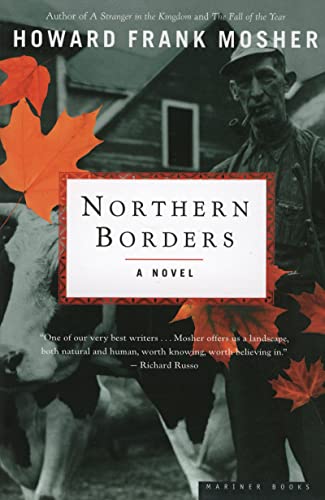
Northern Borders: A Novel: A Literary Coming-of-Age Tale of Boyhood Secrets in 1940s Vermont - Softcover
Inhaltsangabe
Northern Borders is Mosher’s nostalgic novel of life in northern Vermont’s Kingdom County, as told by a man remembering his boyhood. In 1948 six-year-old Austen Kittredge III leaves his widowed father to live with his paternal grandparents on their farm in the township of Lost Nation. Escapades at the county fair, doings at the annual family reunion and Shakespeare performance, and conflicts at the one-room schoolhouse are all recounted lovingly in this enchanting coming-of-age story filled with luminous memories and the deepest of childhood secrets, as a boy is molded into a man.
Die Inhaltsangabe kann sich auf eine andere Ausgabe dieses Titels beziehen.
Über die Autorin bzw. den Autor
HOWARD FRANK MOSHER is the author of ten books, including Waiting for Teddy Williams, The True Account, and A Stranger in the Kingdom, which, along with Disappearances, was corecipient of the New England Book Award for fiction. He lives in Vermont.
Auszug. © Genehmigter Nachdruck. Alle Rechte vorbehalten.
Northern Borders
By Howard Frank MosherHoughton Mifflin Harcourt Publishing Company
Copyright © 1994 Howard Frank Mosher
All rights reserved.
ISBN: 978-0-618-24009-8All rights reserved.
Contents
Title Page,
Table of Contents,
Copyright,
Dedication,
Epigraph,
Introduction,
The Farm in Lost Nation,
Hannibal Rex,
The Snow Owl,
The Green Mountain Whale,
Down the Coat,
Upland Game,
Lost Nation Calendar,
Family Reunion,
The Season of the Cluster Flies,
Northern Borders,
About the Author,
CHAPTER 1
The Farm in Lost Nation
When I was a boy living on my grandparents' Kingdom County farm, I sometimes amused myself by looking through an ancient family Bible in the farmhouse attic. This ponderous tome was a gloomy-looking affair if one ever existed. It weighed a good fifteen pounds, and it was bound tightly shut by a tarnished metal clasp which snapped open with the report of a pistol and never failed to startle me, alone in the remote, dim attic of my grandparents' vast old house.
Once this formidable mechanism had been breached, the Bible's contents were intriguing. Besides the Old and New Testaments, it contained a Kittredge family birth register illuminated in gilt; a death register edged in sable; a table of standard weights and measures from which I gleaned the invaluable information — it must have been invaluable because I still remember it today, some four decades later — that one country furlong is the equivalent of forty rods; a dozen or so remarkably well-preserved wildflowers collected by a distant aunt said to have died at eighteen of a broken heart; and several pages of genealogical charts inscribed with the biblical-sounding names of more ancestors than I'd ever dreamed one boy could lay claim to, beginning with my great-great-great-great-great-grandfather: the first Kittredge to venture up into the trackless mountain fastness that would become Kingdom County.
His name, aptly enough, was Sojourner Kittredge, and he was a Loyalist schoolteacher and part-time log sawyer who fled Connecticut and the American Revolution for Canada in the summer of 1775 with a lone red ox and a high-sided cart containing all his worldly possessions. Two arduous months later, my ancestor stopped for good on the headwaters of a small, fast, icy river, which he promptly named the Kingdom, in honor of his beloved mother empire. Unfortunately, there was one small difficulty with Sojourner's choice of a homestead. As my grandfather, who disliked all schoolteachers in general and those in our own family in particular, loved to tell me nearly two centuries later, the old Tory had put down stakes here as the result of a minute but fateful miscalculation. Since the Kingdom River drains north, toward the St. Lawrence, though by a circuitous and at times even contradictory route, he erroneously assumed that he had already reached Canada and sanctuary when in fact he'd fetched up instead in northern Vermont.
Not, you understand, that such a trifling technicality as a line on a map mattered a whit to the old expeditionary once he'd made up his mind to stay put. By the time Sojourner finally figured out where he actually was, the Revolution had been over for several years. He'd already established the first grammar school and sawmill in Lost Nation, as he wryly named our township. And by then he did not have the slightest intention of lighting out again for Canada or anyplace else, though for three generations afterward his descendants marched in the Independence Day parades in Kingdom Common wearing bright scarlet coats and carrying the Union Jack.
This is nearly all I know about my great-great-great-great-great-grandfather — except that in 1790 he astonished his neighbors and outraged his heirs by ceding the title to a ten-thousand-acre tract of woodland just south of the Canadian border to the state whose authority to govern any other part of the Kingdom he refused to acknowledge to his dying day. Sojourner's intention was for Vermont to use the donated property as the site of a college to educate the youth of its white settlers and native Abenakis alike. In exchange, he neither demanded nor received a single shilling. He requested only a written guarantee that every qualified graduate of the Lost Nation Atheneum, as he rather grandiosely called his one-room country school, be entitled to attend the proposed state college free of charge, for as long as the grammar school and college should both exist.
Of course the University of Vermont never did take advantage of my ancestor's offer. Instead it situated itself one hundred miles across the Green Mountains to the southwest, on the considerably more clement and accessible shores of Lake Champlain. Yet even after the university sold off its Kingdom real estate holdings to pay debts incurred during the Civil War, it continued to honor the agreement between Sojourner Kittredge and the state that he otherwise declined to recognize. All duly prepared graduates of Lost Nation Atheneum were entitled to attend the university at no expense to themselves; and it was partly as a result of this ancient pact that a Kittredge family decision was reached that I would receive the first eight years of my education at the tiny country schoolhouse established one hundred and seventy years ago by my forward-looking ancestor, and live during those years with my Kittredge grandparents on their farm in Lost Nation Hollow, spending some of my school vacations with my father in White River Junction, eighty miles to the south.
Other considerations influenced my father's decision to send me north to Kingdom County, however. No doubt the first, and most weighty, was that my mother had been dead for nearly a year at the time, and my father had concerns about raising me entirely on his own. As a child and teenager, my mother had waged a protracted and costly battle with tuberculosis, and throughout her brief adult life she continued to have periodic relapses. Several times since marrying my father and having me she had been forced to return to the famous Trudeau Institute at Saranac Lake, where she'd spent much of her youth; and for several months when I was two, she convalesced at a sanatorium in Tucson, Arizona, while my Grandmother Kittredge kept house for my father and took care of me in White River. I don't remember that my mother ever said much about her illness to me. I'm sure she made every effort not to. But from my grandmother and my two little aunts, Dad's sisters, I received at a very early age the alarming impression that Mom was much more sickly than she ever revealed. "Your mother is a poor frail soul if one ever existed," my grandmother told me frequently; and although it was terribly difficult for me to lose her when I was just five years old, I must say that even at that tender age, it came as more of a surprise than an outright shock.
From those early years, I vividly recall two things about my mother. Unlike most of the Kittredges, including my father and both of my grandparents, she laughed easily and frequently. And she loved to read to me, so that one of my very earliest and strongest childhood recollections is of sitting beside her on a rather battered green living room couch and looking at the pictures in the storybooks we went through together by the dozens, especially the marvelous old tales of the Brothers Grimm and Hans Christian Andersen, whose brilliantly-colored illustrations of the most hideous scenes and creatures imaginable I found deeply fascinating.
Because of my mother's huge medical bills,...
„Über diesen Titel“ kann sich auf eine andere Ausgabe dieses Titels beziehen.
Suchergebnisse für Northern Borders: A Novel: A Literary Coming-of-Age...

Beispielbild für diese ISBN
Northern Borders
Anbieter: World of Books (was SecondSale), Montgomery, IL, USA
Verkäuferbewertung 5 von 5 Sternen

Zustand: Good. Item in good condition. Textbooks may not include supplemental items i.e. CDs, access codes etc. Bestandsnummer des Verkäufers 00100854108
Gebraucht kaufen
EUR 4,17
Versand gratis
Versand innerhalb von USA
Versand innerhalb von USA
Anzahl: 8 verfügbar
Foto des Verkäufers
Northern Borders: A Novel
Anbieter: Zoom Books Company, Lynden, WA, USA
Verkäuferbewertung 5 von 5 Sternen
Zustand: very_good. Book is in very good condition and may include minimal underlining highlighting. The book can also include "From the library of" labels. May not contain miscellaneous items toys, dvds, etc. . We offer 100% money back guarantee and 24 7 customer service. Bestandsnummer des Verkäufers ZBV.0618240098.VG
Gebraucht kaufen
EUR 4,18
Versand gratis
Versand innerhalb von USA
Versand innerhalb von USA
Anzahl: 1 verfügbar
Beispielbild für diese ISBN
Northern Borders: A Novel
Verlag:
Mariner Books (edition Reprint), 2002
ISBN 10: 0618240098
ISBN 13: 9780618240098
Gebraucht
Paperback
Anbieter: BooksRun, Philadelphia, PA, USA
Verkäuferbewertung 5 von 5 Sternen
Paperback. Zustand: Very Good. Reprint. It's a well-cared-for item that has seen limited use. The item may show minor signs of wear. All the text is legible, with all pages included. It may have slight markings and/or highlighting. Bestandsnummer des Verkäufers 0618240098-11-18
Gebraucht kaufen
EUR 4,91
Versand gratis
Versand innerhalb von USA
Versand innerhalb von USA
Anzahl: 1 verfügbar
Beispielbild für diese ISBN
Northern Borders: A Novel
Verlag:
Mariner Books (edition Reprint), 2002
ISBN 10: 0618240098
ISBN 13: 9780618240098
Gebraucht
Paperback
Anbieter: BooksRun, Philadelphia, PA, USA
Verkäuferbewertung 5 von 5 Sternen
Paperback. Zustand: Very Good. Reprint. It's a well-cared-for item that has seen limited use. The item may show minor signs of wear. All the text is legible, with all pages included. It may have slight markings and/or highlighting. Bestandsnummer des Verkäufers 0618240098-11-1
Gebraucht kaufen
EUR 5,19
Versand gratis
Versand innerhalb von USA
Versand innerhalb von USA
Anzahl: 1 verfügbar
Foto des Verkäufers
Northern Borders: A Novel
Anbieter: Bay State Book Company, North Smithfield, RI, USA
Verkäuferbewertung 5 von 5 Sternen
Zustand: good. The book is in good condition with all pages and cover intact, including the dust jacket if originally issued. The spine may show light wear. Pages may contain some notes or highlighting, and there might be a "From the library of" label. Boxed set packaging, shrink wrap, or included media like CDs may be missing. Bestandsnummer des Verkäufers BSM.1A8XX
Gebraucht kaufen
EUR 5,26
Versand gratis
Versand innerhalb von USA
Versand innerhalb von USA
Anzahl: 1 verfügbar
Beispielbild für diese ISBN
Northern Borders: A Novel
Anbieter: Idaho Youth Ranch Books, Boise, ID, USA
Verkäuferbewertung 5 von 5 Sternen
Zustand: Very Good. A copy that has been read, but remains in excellent condition. Pages are intact and are not marred by notes or highlighting. The spine remains undamaged. There are no stickers on book or rips in dust cover. Bestandsnummer des Verkäufers C-03-04-04-0739
Gebraucht kaufen
EUR 2,25
EUR 3,47 Versand
Versand innerhalb von USA
Versand innerhalb von USA
Anzahl: 1 verfügbar
Beispielbild für diese ISBN
Northern Borders
Anbieter: ThriftBooks-Atlanta, AUSTELL, GA, USA
Verkäuferbewertung 5 von 5 Sternen
Paperback. Zustand: Very Good. No Jacket. May have limited writing in cover pages. Pages are unmarked. ~ ThriftBooks: Read More, Spend Less. Bestandsnummer des Verkäufers G0618240098I4N00
Gebraucht kaufen
EUR 5,82
Versand gratis
Versand innerhalb von USA
Versand innerhalb von USA
Anzahl: 1 verfügbar
Beispielbild für diese ISBN
Northern Borders
Anbieter: ThriftBooks-Dallas, Dallas, TX, USA
Verkäuferbewertung 5 von 5 Sternen
Paperback. Zustand: Good. No Jacket. Pages can have notes/highlighting. Spine may show signs of wear. ~ ThriftBooks: Read More, Spend Less. Bestandsnummer des Verkäufers G0618240098I3N00
Gebraucht kaufen
EUR 5,82
Versand gratis
Versand innerhalb von USA
Versand innerhalb von USA
Anzahl: 1 verfügbar
Beispielbild für diese ISBN
Northern Borders
Anbieter: ThriftBooks-Atlanta, AUSTELL, GA, USA
Verkäuferbewertung 5 von 5 Sternen
Paperback. Zustand: Good. No Jacket. Pages can have notes/highlighting. Spine may show signs of wear. ~ ThriftBooks: Read More, Spend Less. Bestandsnummer des Verkäufers G0618240098I3N00
Gebraucht kaufen
EUR 5,82
Versand gratis
Versand innerhalb von USA
Versand innerhalb von USA
Anzahl: 1 verfügbar
Beispielbild für diese ISBN
Northern Borders
Anbieter: ThriftBooks-Reno, Reno, NV, USA
Verkäuferbewertung 5 von 5 Sternen
Paperback. Zustand: Fair. No Jacket. Readable copy. Pages may have considerable notes/highlighting. ~ ThriftBooks: Read More, Spend Less. Bestandsnummer des Verkäufers G0618240098I5N00
Gebraucht kaufen
EUR 5,82
Versand gratis
Versand innerhalb von USA
Versand innerhalb von USA
Anzahl: 1 verfügbar