
Verwandte Artikel zu Silent Spring: The Classic Nonfiction Book on the Environmen...
Inhaltsangabe
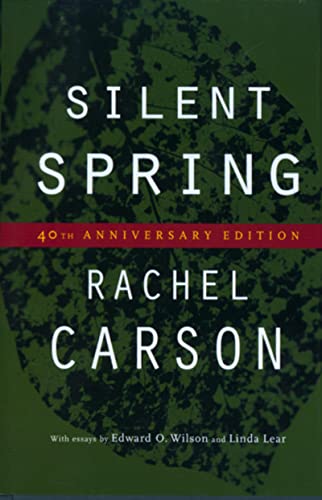
First published by Houghton Mifflin in 1962, Silent Spring alerted a large audience to the environmental and human dangers of indiscriminate use of pesticides, spurring revolutionary changes in the laws affecting our air, land, and water. “Silent Spring became a runaway bestseller, with international reverberations . . . [It is] well crafted, fearless and succinct . . . Even if she had not inspired a generation of activists, Carson would prevail as one of the greatest nature writers in American letters” (Peter Matthiessen, for Time’s 100 Most Influential People of the Century).
This edition celebrates Rachel Carson’s watershed book with a new introduction by the author and activist Terry Tempest Williams and a new afterword by the acclaimed Rachel Carson biographer Linda Lear, who tells the story of Carson’s courageous defense of her truths in the face of ruthless assault from the chemical industry in the year following the publication of Silent Spring and before her untimely death in 1964.
Die Inhaltsangabe kann sich auf eine andere Ausgabe dieses Titels beziehen.
Über die Autorin bzw. den Autor
Rachel Carson (1907–1964) spent most of her professional life as a marine biologist with the U.S. Fish and Wildlife Service. By the late 1950s, she had written three lyrical, popular books about the sea, including the best-selling The Sea Around Us, and had become the most respected science writer in America. She completed Silent Spring against formidable personal odds, and with it shaped a powerful social movement that has altered the course of history.
Auszug. © Genehmigter Nachdruck. Alle Rechte vorbehalten.
Excerpt
Introduction
by Linda Lear
Headlines in the New York Times in July 1962 captured the national
sentiment: "Silent Spring is now noisy summer." In the few months between
the New Yorker"s serialization of Silent Spring in June and its publication in
book form that September, Rachel Carson"s alarm touched off a national
debate on the use of chemical pesticides, the responsibility of science, and
the limits of technological progress. When Carson died barely eighteen
months later in the spring of 1964, at the age of fifty-six, she had set in
motion a course of events that would result in a ban on the domestic
production of DDT and the creation of a grass-roots movement demanding
protection of the environment through state and federal regulation. Carson"s
writing initiated a transformation in the relationship between humans and the
natural world and stirred an awakening of public environmental
consciousness.
It is hard to remember the cultural climate that greeted Silent
Spring and to understand the fury that was launched against its quietly
determined author. Carson"s thesis that we were subjecting ourselves to slow
poisoning by the misuse of chemical pesticides that polluted the environment
may seem like common currency now, but in 1962 Silent Spring contained
the kernel of social revolution. Carson wrote at a time of new affluence and
intense social conformity. The cold war, with its climate of
suspicion and intolerance, was at its zenith. The chemical industry, one of
the chief beneficiaries of postwar technology, was also one of the chief
authors of the nation"s prosperity. DDT enabled the conquest of insect pests
in agriculture and of ancient insect-borne disease just as surely as the
atomic bomb destroyed America"s military enemies and dramatically altered
the balance of power between humans and nature. The public endowed
chemists, at work in their starched white coats in remote laboratories, with
almost divine wisdom. The results of their labors were gilded with the
presumption of
beneficence. In postwar America, science was god, and science was male.
Carson was an outsider who had never been part of the scientific
establishment, first because she was a woman but also because her chosen
field, biology, was held in low esteem in the nuclear age. Her career path was
nontraditional; she had no academic affiliation, no institutional voice. She
deliberately wrote for the public rather than for a narrow scientific audience.
For anyone else, such independence would have been an enormous
detriment. But by the time Silent Spring was published, Carson"s outsider
status had become a distinct advantage. As the science establishment
would discover, it was impossible to dismiss her.
Rachel Carson first discovered nature in the company of her mother, a
devotee of the nature study movement. She wandered the banks of the
Allegheny River in the pristine village of Springdale, Pennsylvania, just north
of Pittsburgh, observing the wildlife and plants around her and particularly
curious about the habits of birds.
Her childhood, though isolated by poverty and family turmoil, was
not lonely. She loved to read and displayed an obvious talent for writing,
publishing her first story in a children"s literary magazine at the age of ten.
By the time she entered Pennsylvania College for Women (now Chatham
College), she had read widely in the English Romantic tradition and had
articulated a personal sense of mission, her "vision splendid." A dynamic
female zoology professor expanded her intellectual horizons by urging her to
take the daring step of majoring in biology rather than English. In doing so,
Carson discovered that science not only engaged her mind but gave
her "something to write about." She decided to pursue a career in science,
aware that in the 1930s there were few opportunities for women.
Scholarships allowed her to study at Woods Hole Biological
Laboratory, where she fell in love with the sea, and at Johns Hopkins
University, where she was isolated, one of a handful of women in marine
biology. She had no mentors and no money to continue in graduate school
after completing an M.A. in zoology in 1932. Along the way she worked as a
laboratory assistant in the school of public health, where she was lucky
enough to receive some training in experimental genetics. As employment
opportunities in science dwindled, she began writing articles about the
natural history of Chesapeake
Bay for the Baltimore Sun. Although these were years of financial and
emotional struggle, Carson realized that she did not have to choose between
science and writing, that she had the talent to do both.
From childhood on, Carson was interested in the long history of
the earth, in its patterns and rhythms, its ancient seas, its evolving life forms.
She was an ecologist—fascinated by intersections and connections but
always aware of the whole—before that perspective was accorded scholarly
legitimacy. A fossil shell she found while digging in the hills above the
Allegheny as a little girl prompted questions about the creatures of the
oceans that had once covered the area. At Johns Hopkins, an experiment
with changes in the salinity of water in an eel tank prompted her to study the
life cycle of those ancient fish that migrate from continental rivers to the
Sargasso Sea. The desire to understand the sea from a nonhuman
perspective led to her first book, Under the Sea-Wind, which featured a
common sea bird, the sanderling, whose life cycle, driven by ancestral
instincts, the rhythms of the tides, and the search for food, involves an
arduous journey from Patagonia to the Arctic Circle. From the outset Carson
acknowledged her "kinship with other forms of life" and always wrote to
impress that relationship on her readers.
Carson was confronted with the problem of environmental pollution
at a formative period in her life. During her adolescence the second wave of
the industrial revolution was turning the Pittsburgh area into the iron and steel
capital of the Western world. The little town of Springdale, sandwiched
between two huge coal-.red electric plants, was transformed into a grimy
wasteland, its air fouled by chemical emissions, its river polluted by industrial
waste. Carson could not wait to escape. She observed that the captains of
industry took no notice of the defilement of her hometown and no
responsibility for it. The experience made her forever suspicious of promises
of "better living through chemistry" and of claims that technology would create
a progressively brighter future.
In 1936 Carson landed a job as a part-time writer of radio scripts
on ocean life for the federal Bureau of Fisheries in Baltimore. By night she
wrote freelance articles for the Sun describing the pollution of the oyster beds
of the Chesapeake by industrial runoff; she urged changes in oyster seeding
and dredging practices and political regulation of the effluents pouring into the
bay. She signed her articles "R. L. Carson," hoping that readers would
assume that the writer was male and thus take her science seriously.
A year later Carson became a junior aquatic biologist for the
Bureau of Fisheries, one of only two professional women there, and began a
slow but steady advance through the ranks of the agency, which became the
U.S. Fish and Wildlife Service in 1939. Her literary talents were quickly
recognized, and she was assigned to edit other scientists" field reports, a
task she turned into an opportunity to broaden her scientific...
„Über diesen Titel“ kann sich auf eine andere Ausgabe dieses Titels beziehen.
Suchergebnisse für Silent Spring: The Classic Nonfiction Book on the Environmen...

Beispielbild für diese ISBN
Silent Spring
Verlag:
Houghton Mifflin Harcourt (edition Anniversary), 2002
ISBN 10: 061825305X
ISBN 13: 9780618253050
Gebraucht
Hardcover
Anbieter: BooksRun, Philadelphia, PA, USA
Verkäuferbewertung 5 von 5 Sternen

Hardcover. Zustand: Fair. Anniversary. The item might be beaten up but readable. May contain markings or highlighting, as well as stains, bent corners, or any other major defect, but the text is not obscured in any way. Bestandsnummer des Verkäufers 061825305X-7-1-13
Gebraucht kaufen
EUR 11,59
Versand gratis
Versand innerhalb von USA
Versand innerhalb von USA
Anzahl: 1 verfügbar
Beispielbild für diese ISBN
Silent Spring
Verlag:
Houghton Mifflin Harcourt, 2002
ISBN 10: 061825305X
ISBN 13: 9780618253050
Gebraucht
Hardcover
Anbieter: Half Price Books Inc., Dallas, TX, USA
Verkäuferbewertung 5 von 5 Sternen
Hardcover. Zustand: Very Good. Connecting readers with great books since 1972! Used books may not include companion materials, and may have some shelf wear or limited writing. We ship orders daily and Customer Service is our top priority! Bestandsnummer des Verkäufers S_481825025
Gebraucht kaufen
EUR 9,54
EUR 3,34 Versand
Versand innerhalb von USA
Versand innerhalb von USA
Anzahl: 1 verfügbar
Beispielbild für diese ISBN
Silent Spring
Verlag:
Houghton Mifflin Harcourt, 2002
ISBN 10: 061825305X
ISBN 13: 9780618253050
Gebraucht
Hardcover
Anbieter: Textbook Bookie, Little Rock, AR, USA
Verkäuferbewertung 5 von 5 Sternen
Hardcover. Zustand: Very Good. Book in Very Good condition. Bestandsnummer des Verkäufers 9780618253050-very_good
Gebraucht kaufen
EUR 9,18
EUR 3,79 Versand
Versand innerhalb von USA
Versand innerhalb von USA
Anzahl: 1 verfügbar
Foto des Verkäufers
Silent Spring: 40th Anniversary Edition
Verlag:
Houghton Mifflin Company, 2002
ISBN 10: 061825305X
ISBN 13: 9780618253050
Gebraucht
Hardcover
Anbieter: Henniker Book Farm and Gifts, Henniker, NH, USA
Verkäuferbewertung 5 von 5 Sternen
Hardcover. Zustand: Good+. Zustand des Schutzumschlags: Good+. Ex-library book with all the typical markings, stamps, pastedowns, etc as typical with a library book. If it were not a library book we would have classified this book as Very Good Condition.; Ex-Library; 8vo 8" - 9" tall; 378 pages. Bestandsnummer des Verkäufers 75023
Gebraucht kaufen
EUR 8,27
EUR 4,90 Versand
Versand innerhalb von USA
Versand innerhalb von USA
Anzahl: 1 verfügbar
Foto des Verkäufers
Silent Spring
Verlag:
Houghton Mifflin Harcourt, 2002
ISBN 10: 061825305X
ISBN 13: 9780618253050
Gebraucht
Hardcover
Anbieter: Goodwill Books, Hillsboro, OR, USA
Verkäuferbewertung 5 von 5 Sternen
Zustand: acceptable. Fairly worn, but readable and intact. If applicable: Dust jacket, disc or access code may not be included. Bestandsnummer des Verkäufers 3IIK3O007IRM_ns
Gebraucht kaufen
EUR 10,01
EUR 3,56 Versand
Versand innerhalb von USA
Versand innerhalb von USA
Anzahl: 1 verfügbar
Foto des Verkäufers
Silent Spring
Verlag:
Houghton Mifflin Harcourt, 2002
ISBN 10: 061825305X
ISBN 13: 9780618253050
Gebraucht
Hardcover
Anbieter: Goodwill of Central and Coastal Virginia, Richmond, VA, USA
Verkäuferbewertung 4 von 5 Sternen

Zustand: acceptable. Bestandsnummer des Verkäufers CCVV.061825305X.A
Gebraucht kaufen
EUR 9,73
EUR 5,12 Versand
Versand innerhalb von USA
Versand innerhalb von USA
Anzahl: 1 verfügbar
Beispielbild für diese ISBN
Silent Spring
Verlag:
Houghton Mifflin Harcourt, 2002
ISBN 10: 061825305X
ISBN 13: 9780618253050
Gebraucht
Hardcover
Anbieter: HPB Inc., Dallas, TX, USA
Verkäuferbewertung 5 von 5 Sternen
Hardcover. Zustand: Very Good. Connecting readers with great books since 1972! Used books may not include companion materials, and may have some shelf wear or limited writing. We ship orders daily and Customer Service is our top priority! Bestandsnummer des Verkäufers S_488469630
Gebraucht kaufen
EUR 11,93
EUR 3,34 Versand
Versand innerhalb von USA
Versand innerhalb von USA
Anzahl: 1 verfügbar
Beispielbild für diese ISBN
Silent Spring
Verlag:
Houghton Mifflin Harcourt, 2002
ISBN 10: 061825305X
ISBN 13: 9780618253050
Gebraucht
Hardcover
Anbieter: HPB-Ruby, Dallas, TX, USA
Verkäuferbewertung 5 von 5 Sternen
Hardcover. Zustand: Very Good. Connecting readers with great books since 1972! Used books may not include companion materials, and may have some shelf wear or limited writing. We ship orders daily and Customer Service is our top priority! Bestandsnummer des Verkäufers S_487484945
Gebraucht kaufen
EUR 11,93
EUR 3,34 Versand
Versand innerhalb von USA
Versand innerhalb von USA
Anzahl: 1 verfügbar
Beispielbild für diese ISBN
Silent Spring
Verlag:
Houghton Mifflin Harcourt (edition Anniversary), 2002
ISBN 10: 061825305X
ISBN 13: 9780618253050
Gebraucht
Hardcover
Anbieter: BooksRun, Philadelphia, PA, USA
Verkäuferbewertung 5 von 5 Sternen
Hardcover. Zustand: Very Good. Anniversary. It's a well-cared-for item that has seen limited use. The item may show minor signs of wear. All the text is legible, with all pages included. It may have slight markings and/or highlighting. Bestandsnummer des Verkäufers 061825305X-11-1
Gebraucht kaufen
EUR 16,81
Versand gratis
Versand innerhalb von USA
Versand innerhalb von USA
Anzahl: 1 verfügbar
Beispielbild für diese ISBN
Silent Spring
Verlag:
Houghton Mifflin Harcourt, 2002
ISBN 10: 061825305X
ISBN 13: 9780618253050
Gebraucht
Hardcover
Anbieter: GCCebooks, Salinas, CA, USA
Verkäuferbewertung 4 von 5 Sternen
Hardcover. Zustand: Acceptable. Anniversary. Bestandsnummer des Verkäufers mon-uacc-061825305X
Gebraucht kaufen
EUR 13,67
EUR 3,56 Versand
Versand innerhalb von USA
Versand innerhalb von USA
Anzahl: 1 verfügbar