
Verwandte Artikel zu The Best American Nonrequired Reading 2007: Student-Selected...
The Best American Nonrequired Reading 2007: Student-Selected Short Stories and Literary Writing from Small Magazines and Quarterlies (The Best American Series ®) - Softcover
Buch 3 von 9: The Best American: Nonrequired Reading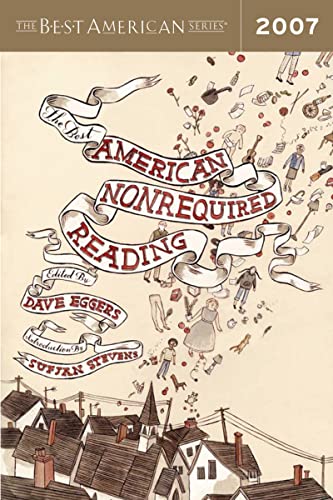
Inhaltsangabe
From "Q & A" by Dave Eggers A group of senators and assemblypersons were pressing The Best American Nonrequired Reading on a number of questions relating to the collection, so we decided to kill that stone in the shape of an introduction in the shape of a Q & A.
Who are they, the Nonrequired committee’s members who decide on things in this collection?
They are high school students from all over the San Francisco Bay Area.
Are they touched by some kind of divine light?
The question is a good one. There is rampant speculation on the subject.
Are they all great-looking and charming and well dressed?
Yes. All of them, and especially Felicia Wong, who can even make her own clothes.
I have a question about the process by which the entries in this collection are chosen. Is it scientific?
The process by which The Best American Nonrequired Reading is put together is not scientific. It is whatever one would consider the opposite of scientific.
Creationist?
Well, no, it’s not creationist either. The point is that we are probably a bit less top-to-bottom thorough than, say, the Army Corps of Engineers. Well, actually, scratch that. We are probably about exactly as thorough as the Army Corps of Engineers, in that we are intermittently thorough.
What is your opinion and the committee’s opinion of the state of short stories and small magazines and other periodicals?
This is a good time. It really is.
More specifically?
Not all of us Americans appreciate the fact that we have about 150 very good quarterlies in this country. Every state seems to have a very good quarterly, and about a hundred colleges have very good quarterlies — from the Kenyon Review to the University of Illinois’s Ninth Letter. So by our estimate there are about 150 very good quarterlies in this country. Maybe more. Now, the thing we don’t always appreciate here in America is that elsewhere in the world there are few to no quarterlies.
How does it feel to select something for the collection that you found in an unlikely place?
It feels so good. This year, for example, at the last moment we found “Humpies” by Mattox Roesch. It was published by Agni Online, and we all loved it, and here it is, ideally able to reach a new audience. We all took pleasure in finding that one; the mandate of the committee is to find the offbeat and the lesser-known and bring these pieces to our readers, most of whom have great skin and bad eyes.
Who are they, the Nonrequired committee’s members who decide on things in this collection?
They are high school students from all over the San Francisco Bay Area.
Are they touched by some kind of divine light?
The question is a good one. There is rampant speculation on the subject.
Are they all great-looking and charming and well dressed?
Yes. All of them, and especially Felicia Wong, who can even make her own clothes.
I have a question about the process by which the entries in this collection are chosen. Is it scientific?
The process by which The Best American Nonrequired Reading is put together is not scientific. It is whatever one would consider the opposite of scientific.
Creationist?
Well, no, it’s not creationist either. The point is that we are probably a bit less top-to-bottom thorough than, say, the Army Corps of Engineers. Well, actually, scratch that. We are probably about exactly as thorough as the Army Corps of Engineers, in that we are intermittently thorough.
What is your opinion and the committee’s opinion of the state of short stories and small magazines and other periodicals?
This is a good time. It really is.
More specifically?
Not all of us Americans appreciate the fact that we have about 150 very good quarterlies in this country. Every state seems to have a very good quarterly, and about a hundred colleges have very good quarterlies — from the Kenyon Review to the University of Illinois’s Ninth Letter. So by our estimate there are about 150 very good quarterlies in this country. Maybe more. Now, the thing we don’t always appreciate here in America is that elsewhere in the world there are few to no quarterlies.
How does it feel to select something for the collection that you found in an unlikely place?
It feels so good. This year, for example, at the last moment we found “Humpies” by Mattox Roesch. It was published by Agni Online, and we all loved it, and here it is, ideally able to reach a new audience. We all took pleasure in finding that one; the mandate of the committee is to find the offbeat and the lesser-known and bring these pieces to our readers, most of whom have great skin and bad eyes.
Die Inhaltsangabe kann sich auf eine andere Ausgabe dieses Titels beziehen.
Über die Autorin bzw. den Autor
DAVE EGGERS is the editor of McSweeney’s and a cofounder of 826 National, a network of nonprofit writing and tutoring centers for youth, located in seven cities across the United States. He is the author of four books, including What Is the What and How We Are Hungry.
Auszug. © Genehmigter Nachdruck. Alle Rechte vorbehalten.
Introduction How I Trumped Rudolf Steiner and Overcame the Tribulations of Illiteracy, One Snickers Bar at a Time
There are some things you tell no one, secrets packed and folded away in the far reaches of your mind admissions of mouth herpes, for example, or athlete’s foot, or a night spent in jail for drunk driving. These irreversible facts, like birth certificates and blood donor cards, we keep under cover in the fireproof safe-deposit box hidden in the closet, under the Ouija board and Christmas-tree stand and the packs of Nicorette gum. I’m a glutton for exhibitionism, so I’d like to reveal a dirty secret: I didn’t learn to read until third grade. As an elementary school kid at the Detroit Waldorf School, I was encouraged to learn at my own pace. For the uninformed, let me tell you a little about Rudolf Steiner, the founder of the Waldorf system. An Austrian philosopher, writer, and social theorist, Steiner developed an educational system that was holistic, noncompetitive, and emotionally balanced, emphasizing social health, artistic expression, and pluralism in the classroom. In practice, this meant there were no textbooks, workbooks, reader’s guides, or learning manuals only paint, clay, knitting needles, and sheep’s wool. I don’t recall a library or a science lab in our school. There were indoor planters, pieces of felt, animal costumes, and wax paper. The classrooms were decorated with satin drapes and paper lanterns. There were no parallel walls or right angles. Quiet nooks and secret hollows were constructed in the corners, quilted blankets and hand-woven shawls held up with rocking chairs and wood broomsticks. Every room was designed to imitate a tree house or a bear cave or an underground den where foxes slept through the winter, nuzzling their young. Learning was an amorphous metaphysical experience measured by the students’ creative whims beeswax one day, cotton string the next. There were no vocabulary exercises or math quizzes. The syllabus was hand drawn on the chalkboard, oil pastels in Renaissance colors simulating the seasons, sweeping rainbow illustrations of unicorns and magic owls and eavesdropping elves. The school did everything to blur all lines between fact and imagination, between art and science, between math and English, between student and teacher. For some, the disregard for standards was galvanizing. My peers took up the violin, spoke French, learned botany, identified plants and animals, mastered oil painting, weaving, and the classical guitar. But I was a slow learner, the youngest of five, easily distracted, unmotivated, listless, prone to daydreaming. I spent much of my time huddled by the radiator, keeping my beeswax warm, humming the theme to Star Search. The classroom’s lack of parallel surfaces coddled me in a fluid womb of sleep and thumb-sucking. I had trouble finding the restroom, so I peed in the cot. I had trouble finger- knitting, so I balled up the yarn and used it for a pillow. I had trouble making friends, so I imagined them: Peter the ox, Dora the talking skeleton, Herb the dietician. I lived in a world of fantasy and make-believe where reading and writing were banned by laws of my own creation. Years went by preschool, kindergarten, first grade, second grade the dreamy sweep of a Steiner childhood. I was shuffled from calligraphy class to recorder lessons to eurythmy, with the choose-yourown- adventure of progressive schooling. It didn’t matter that I was so far behind the other kids those bold, brassy, multicultural, bilingual children with their knitted vests and viola cases. I would catch up, the teachers said. I would come around someday. I would learn to read and write by the powers of the Maypole, the winter solstice, the constellations, and Orion’s enchanted belt.Waldorf teachers were less concerned with literacy and standardized testing the unpalatable concessions of the public school system than with watercolor pencils and cotton balls. For them, the real process of learning was to be stewed and simmered in a slow cooker, or kneaded and pulled in the baby’s bottom of bread dough. We learned not by worksheets and chapter guides but by watching seedling trees grow from teacups, the passing of the seasons, Baroque music, folk songs, and Nordic mythology. These things poked and prodded the child’s imagination, opening up vast moments of wonder, inspiring great works of art, cultivating joy, encouraging artistry and a lifetime of learning. Truth be told, I wasn’t learning anything. I rode the absent-minded wave for four nebulous years, whistling and waving my way through educational anarchy. By the time I finished second grade, it was clear something was wrong. I sttill couldn’t read or write. I had no friends. I had no ambitions. I was a Waldorf flunky. But by then it was too late. My parents’ mmmmmarriage began to crumble, along with the general downward slide of the times: Ronald Reagan, John Lennon, Mount St. Helens, to name a few. My parents started watching daytime TV, drank coffee till all hours of the night, ordered pizza, bleached their teeth, and shed their educational ideologies once and for all. They fought and kicked and threw dishes across the kitchen. Then they got divorced. That summer, I went to live with my father, who had moved to the remote upper reaches of northern Michigan, to a small logging town with a bait shop and a swing bridge and aMethodist church at the top of the hill, a quiet, historical village where people spoke with a southern drawl and wore overalls and chewed tobacco and drove tractortrailers to work at Kmart. My father apologized for everything for Waldorf, for watercolor pencils, for recorder lessons, for est training, for past-lives séances, for macrobiotics, for pot-smoking, for the ridiculous, holistic trial and error called parenting, of which he confessed to failing greatly. It’s time you became a man,” he told me. It’s time you learned to read.” So in the beginning of third grade, I was transferred to a public school, a cinderblock prison camp with metal lockers and industrial carpeting and fluorescent lights so severe they took all color out of your complexion. Right angles abounded. Maps of the USSR. Protractors. Carbon copies. Vending machines. The sterile metal surfaces of the modern age. Computers, textbooks, worksheets, MEAP, SAT, PTA, all the formidable abbreviations of public schooling. I clawed at the classroom windows like a hamster in a glass cage, desperate for fresh air. The other children raised on hot dogs and homogenized milk were pig-nosed, bucktoothed, albino bullies who spent their free time at the arcade downtown playing Dig Dug or Dungeons and Dragons. But at least they could read. I couldn’t even spell my own name, so I was beaten up at recess, tickled and punched behind the swings, left in a rumpled mess in the gravelly residue of the playground. After the first week of school, I was forced to take a series of multiple-choice tests reading comprehension, basic math, language arts each of which I failed, having artfully filled every blank with affectionate shades of the color wheel using my Swiss watercolor pencils. That’s when I was ordered to go to special ed. They sent me to a boxy trailer slumped behind the cafeteria with a stack of flash cards and a vocabulary book, highlighting useful, ordinary words that would help me navigate the everyday life of the working- class man. Apple pie. Toothpaste. Driver’s license. Checkbook. Garbage can. I recognized the letters, but I couldn’t piece them together into tangible, audible words. I was uninspired. Give me a ball of beeswax,” I begged, or a slab of clay, and I will shape the letters from the earth and choreograph a dance for each vowel while pulling the streamers of the Maypole around the schoolyard, singing...
There are some things you tell no one, secrets packed and folded away in the far reaches of your mind admissions of mouth herpes, for example, or athlete’s foot, or a night spent in jail for drunk driving. These irreversible facts, like birth certificates and blood donor cards, we keep under cover in the fireproof safe-deposit box hidden in the closet, under the Ouija board and Christmas-tree stand and the packs of Nicorette gum. I’m a glutton for exhibitionism, so I’d like to reveal a dirty secret: I didn’t learn to read until third grade. As an elementary school kid at the Detroit Waldorf School, I was encouraged to learn at my own pace. For the uninformed, let me tell you a little about Rudolf Steiner, the founder of the Waldorf system. An Austrian philosopher, writer, and social theorist, Steiner developed an educational system that was holistic, noncompetitive, and emotionally balanced, emphasizing social health, artistic expression, and pluralism in the classroom. In practice, this meant there were no textbooks, workbooks, reader’s guides, or learning manuals only paint, clay, knitting needles, and sheep’s wool. I don’t recall a library or a science lab in our school. There were indoor planters, pieces of felt, animal costumes, and wax paper. The classrooms were decorated with satin drapes and paper lanterns. There were no parallel walls or right angles. Quiet nooks and secret hollows were constructed in the corners, quilted blankets and hand-woven shawls held up with rocking chairs and wood broomsticks. Every room was designed to imitate a tree house or a bear cave or an underground den where foxes slept through the winter, nuzzling their young. Learning was an amorphous metaphysical experience measured by the students’ creative whims beeswax one day, cotton string the next. There were no vocabulary exercises or math quizzes. The syllabus was hand drawn on the chalkboard, oil pastels in Renaissance colors simulating the seasons, sweeping rainbow illustrations of unicorns and magic owls and eavesdropping elves. The school did everything to blur all lines between fact and imagination, between art and science, between math and English, between student and teacher. For some, the disregard for standards was galvanizing. My peers took up the violin, spoke French, learned botany, identified plants and animals, mastered oil painting, weaving, and the classical guitar. But I was a slow learner, the youngest of five, easily distracted, unmotivated, listless, prone to daydreaming. I spent much of my time huddled by the radiator, keeping my beeswax warm, humming the theme to Star Search. The classroom’s lack of parallel surfaces coddled me in a fluid womb of sleep and thumb-sucking. I had trouble finding the restroom, so I peed in the cot. I had trouble finger- knitting, so I balled up the yarn and used it for a pillow. I had trouble making friends, so I imagined them: Peter the ox, Dora the talking skeleton, Herb the dietician. I lived in a world of fantasy and make-believe where reading and writing were banned by laws of my own creation. Years went by preschool, kindergarten, first grade, second grade the dreamy sweep of a Steiner childhood. I was shuffled from calligraphy class to recorder lessons to eurythmy, with the choose-yourown- adventure of progressive schooling. It didn’t matter that I was so far behind the other kids those bold, brassy, multicultural, bilingual children with their knitted vests and viola cases. I would catch up, the teachers said. I would come around someday. I would learn to read and write by the powers of the Maypole, the winter solstice, the constellations, and Orion’s enchanted belt.Waldorf teachers were less concerned with literacy and standardized testing the unpalatable concessions of the public school system than with watercolor pencils and cotton balls. For them, the real process of learning was to be stewed and simmered in a slow cooker, or kneaded and pulled in the baby’s bottom of bread dough. We learned not by worksheets and chapter guides but by watching seedling trees grow from teacups, the passing of the seasons, Baroque music, folk songs, and Nordic mythology. These things poked and prodded the child’s imagination, opening up vast moments of wonder, inspiring great works of art, cultivating joy, encouraging artistry and a lifetime of learning. Truth be told, I wasn’t learning anything. I rode the absent-minded wave for four nebulous years, whistling and waving my way through educational anarchy. By the time I finished second grade, it was clear something was wrong. I sttill couldn’t read or write. I had no friends. I had no ambitions. I was a Waldorf flunky. But by then it was too late. My parents’ mmmmmarriage began to crumble, along with the general downward slide of the times: Ronald Reagan, John Lennon, Mount St. Helens, to name a few. My parents started watching daytime TV, drank coffee till all hours of the night, ordered pizza, bleached their teeth, and shed their educational ideologies once and for all. They fought and kicked and threw dishes across the kitchen. Then they got divorced. That summer, I went to live with my father, who had moved to the remote upper reaches of northern Michigan, to a small logging town with a bait shop and a swing bridge and aMethodist church at the top of the hill, a quiet, historical village where people spoke with a southern drawl and wore overalls and chewed tobacco and drove tractortrailers to work at Kmart. My father apologized for everything for Waldorf, for watercolor pencils, for recorder lessons, for est training, for past-lives séances, for macrobiotics, for pot-smoking, for the ridiculous, holistic trial and error called parenting, of which he confessed to failing greatly. It’s time you became a man,” he told me. It’s time you learned to read.” So in the beginning of third grade, I was transferred to a public school, a cinderblock prison camp with metal lockers and industrial carpeting and fluorescent lights so severe they took all color out of your complexion. Right angles abounded. Maps of the USSR. Protractors. Carbon copies. Vending machines. The sterile metal surfaces of the modern age. Computers, textbooks, worksheets, MEAP, SAT, PTA, all the formidable abbreviations of public schooling. I clawed at the classroom windows like a hamster in a glass cage, desperate for fresh air. The other children raised on hot dogs and homogenized milk were pig-nosed, bucktoothed, albino bullies who spent their free time at the arcade downtown playing Dig Dug or Dungeons and Dragons. But at least they could read. I couldn’t even spell my own name, so I was beaten up at recess, tickled and punched behind the swings, left in a rumpled mess in the gravelly residue of the playground. After the first week of school, I was forced to take a series of multiple-choice tests reading comprehension, basic math, language arts each of which I failed, having artfully filled every blank with affectionate shades of the color wheel using my Swiss watercolor pencils. That’s when I was ordered to go to special ed. They sent me to a boxy trailer slumped behind the cafeteria with a stack of flash cards and a vocabulary book, highlighting useful, ordinary words that would help me navigate the everyday life of the working- class man. Apple pie. Toothpaste. Driver’s license. Checkbook. Garbage can. I recognized the letters, but I couldn’t piece them together into tangible, audible words. I was uninspired. Give me a ball of beeswax,” I begged, or a slab of clay, and I will shape the letters from the earth and choreograph a dance for each vowel while pulling the streamers of the Maypole around the schoolyard, singing...
„Über diesen Titel“ kann sich auf eine andere Ausgabe dieses Titels beziehen.
Suchergebnisse für The Best American Nonrequired Reading 2007: Student-Selected...

Beispielbild für diese ISBN
The Best American Nonrequired Reading 2007: Student-Selected Short Stories and Literary Writing from Small Magazines and Quarterlies
Verlag:
Mariner Books (edition ), 2007
ISBN 10: 0618902813
ISBN 13: 9780618902811
Gebraucht
Paperback
Anbieter: BooksRun, Philadelphia, PA, USA
Verkäuferbewertung 5 von 5 Sternen

Paperback. Zustand: Very Good. It's a well-cared-for item that has seen limited use. The item may show minor signs of wear. All the text is legible, with all pages included. It may have slight markings and/or highlighting. Bestandsnummer des Verkäufers 0618902813-11-18
Gebraucht kaufen
EUR 5,51
Versand gratis
Versand innerhalb von USA
Versand innerhalb von USA
Anzahl: 1 verfügbar
Beispielbild für diese ISBN
The Best American Nonrequired Reading 2007 (The Best American Series ®)
Anbieter: Once Upon A Time Books, Siloam Springs, AR, USA
Verkäuferbewertung 4 von 5 Sternen

Paperback. Zustand: Good. This is a used book in good condition and may show some signs of use or wear . This is a used book in good condition and may show some signs of use or wear . Bestandsnummer des Verkäufers mon0001143991
Gebraucht kaufen
EUR 2,07
EUR 3,52 Versand
Versand innerhalb von USA
Versand innerhalb von USA
Anzahl: 1 verfügbar
Beispielbild für diese ISBN
The Best American Nonrequired Reading
Anbieter: ThriftBooks-Atlanta, AUSTELL, GA, USA
Verkäuferbewertung 5 von 5 Sternen
Paperback. Zustand: As New. No Jacket. Pages are clean and are not marred by notes or folds of any kind. ~ ThriftBooks: Read More, Spend Less. Bestandsnummer des Verkäufers G0618902813I2N00
Gebraucht kaufen
EUR 6,41
Versand gratis
Versand innerhalb von USA
Versand innerhalb von USA
Anzahl: 1 verfügbar
Beispielbild für diese ISBN
The Best American Nonrequired Reading
Anbieter: ThriftBooks-Dallas, Dallas, TX, USA
Verkäuferbewertung 5 von 5 Sternen
Paperback. Zustand: As New. No Jacket. Pages are clean and are not marred by notes or folds of any kind. ~ ThriftBooks: Read More, Spend Less. Bestandsnummer des Verkäufers G0618902813I2N00
Gebraucht kaufen
EUR 6,41
Versand gratis
Versand innerhalb von USA
Versand innerhalb von USA
Anzahl: 1 verfügbar
Beispielbild für diese ISBN
The Best American Nonrequired Reading 2007: Student-Selected Short Stories and Literary Writing from Small Magazines and Quarterlies
Anbieter: HPB Inc., Dallas, TX, USA
Verkäuferbewertung 5 von 5 Sternen
paperback. Zustand: Very Good. Connecting readers with great books since 1972! Used books may not include companion materials, and may have some shelf wear or limited writing. We ship orders daily and Customer Service is our top priority! Bestandsnummer des Verkäufers S_470107228
Gebraucht kaufen
EUR 3,22
EUR 3,34 Versand
Versand innerhalb von USA
Versand innerhalb von USA
Anzahl: 1 verfügbar
Beispielbild für diese ISBN
The Best American Nonrequired Reading 2007
Verlag:
HarperCollins Publishers, 2007
ISBN 10: 0618902813
ISBN 13: 9780618902811
Gebraucht
Softcover
Anbieter: Better World Books: West, Reno, NV, USA
Verkäuferbewertung 5 von 5 Sternen
Zustand: Good. reading Edition. Pages intact with minimal writing/highlighting. The binding may be loose and creased. Dust jackets/supplements are not included. Stock photo provided. Product includes identifying sticker. Better World Books: Buy Books. Do Good. Bestandsnummer des Verkäufers 3363585-6
Gebraucht kaufen
EUR 7,01
Versand gratis
Versand innerhalb von USA
Versand innerhalb von USA
Anzahl: 1 verfügbar
Beispielbild für diese ISBN
The Best American Nonrequired Reading 2007
Verlag:
HarperCollins Publishers, 2007
ISBN 10: 0618902813
ISBN 13: 9780618902811
Gebraucht
Softcover
Anbieter: Better World Books, Mishawaka, IN, USA
Verkäuferbewertung 5 von 5 Sternen
Zustand: Good. reading Edition. Pages intact with minimal writing/highlighting. The binding may be loose and creased. Dust jackets/supplements are not included. Stock photo provided. Product includes identifying sticker. Better World Books: Buy Books. Do Good. Bestandsnummer des Verkäufers 3363585-6
Gebraucht kaufen
EUR 7,01
Versand gratis
Versand innerhalb von USA
Versand innerhalb von USA
Anzahl: 1 verfügbar
Beispielbild für diese ISBN
Best American Non-Required Reading: null: 2007
Anbieter: World of Books Inc, Montgomery, IL, USA
Verkäuferbewertung 4 von 5 Sternen
Paperback. Zustand: Good. From "Q & A" by Dave Eggers A group of senators and assemblypersons were pressing The Best American Nonrequired Reading on a number of questions relating to the collection, so we decided to kill that stone in the shape of an introduction in the shape of a Q & A. Who are they, the Nonrequired committee's members who decide on things in this collection? They are high school students from all over the San Francisco Bay Area. Are they touched by some kind of divine light? The question is a good one. There is rampant speculation on the subject. Are they all great-looking and charming and well dressed? Yes. All of them, and especially Felicia Wong, who can even make her own clothes. I have a question about the process by which the entries in this collection are chosen. Is it scientific? The process by which The Best American Nonrequired Reading is put together is not scientific. It is whatever one would consider the opposite of scientific. Creationist? Well, no, it's not creationist either. The point is that we are probably a bit less top-to-bottom thorough than, say, the Army Corps of Engineers. Well, actually, scratch that. We are probably about exactly as thorough as the Army Corps of Engineers, in that we are intermittently thorough. What is your opinion and the committee's opinion of the state of short stories and small magazines and other periodicals? This is a good time. It really is. More specifically? Not all of us Americans appreciate the fact that we have about 150 very good quarterlies in this country. Every state seems to have a very good quarterly, and about a hundred colleges have very good quarterlies -- from the Kenyon Review to the University of Illinois's Ninth Letter. So by our estimate there are about 150 very good quarterlies in this country. Maybe more. Now, the thing we don't always appreciate here in America is that elsewhere in the world there are few to no quarterlies. How does it feel to select something for the collection that you found in an unlikely place? It feels so good. This year, for example, at the last moment we found "Humpies" by Mattox Roesch. It was published by Agni Online, and we all loved it, and here it is, ideally able to reach a new audience. We all took pleasure in finding that one; the mandate of the committee is to find the offbeat and the lesser-known and bring these pieces to our readers, most of whom have great skin and bad eyes. Bestandsnummer des Verkäufers CIN0618902813G
Gebraucht kaufen
EUR 7,34
Versand gratis
Versand innerhalb von USA
Versand innerhalb von USA
Anzahl: 7 verfügbar
Beispielbild für diese ISBN
The Best American Nonrequired Reading 2007
Anbieter: Half Price Books Inc., Dallas, TX, USA
Verkäuferbewertung 5 von 5 Sternen
paperback. Zustand: Very Good. Connecting readers with great books since 1972! Used books may not include companion materials, and may have some shelf wear or limited writing. We ship orders daily and Customer Service is our top priority! Bestandsnummer des Verkäufers S_477418784
Gebraucht kaufen
EUR 4,17
EUR 3,34 Versand
Versand innerhalb von USA
Versand innerhalb von USA
Anzahl: 1 verfügbar
Beispielbild für diese ISBN
The Best American Nonrequired Reading 2007: Student-Selected Short Stories and Literary Writing from Small Magazines and Quarterlies
Anbieter: HPB-Emerald, Dallas, TX, USA
Verkäuferbewertung 5 von 5 Sternen
paperback. Zustand: Very Good. Connecting readers with great books since 1972! Used books may not include companion materials, and may have some shelf wear or limited writing. We ship orders daily and Customer Service is our top priority! Bestandsnummer des Verkäufers S_480548033
Gebraucht kaufen
EUR 4,17
EUR 3,34 Versand
Versand innerhalb von USA
Versand innerhalb von USA
Anzahl: 1 verfügbar