
Verwandte Artikel zu Igneous Rocks and Processes: A Practical Guide
Inhaltsangabe
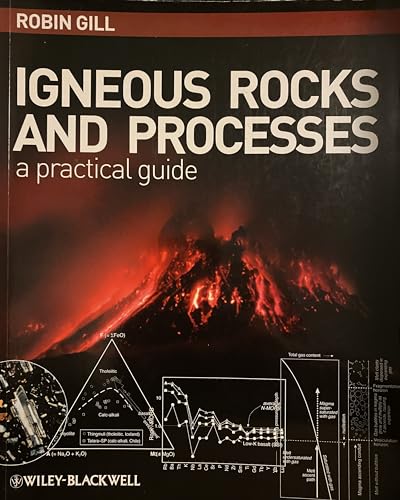
This book is for geoscience students taking introductory or intermediate-level courses in igneous petrology, to help develop key skills (and confidence) in identifying igneous minerals, interpreting and allocating appropriate names to unknown rocks presented to them. The book thus serves, uniquely, both as a conventional course text and as a practical laboratory manual.
Following an introduction reviewing igneous nomenclature, each chapter addresses a specific compositional category of magmatic rocks, covering definition, mineralogy, eruption/ emplacement processes, textures and crystallization processes, geotectonic distribution, geochemistry, and aspects of magma genesis. One chapter is devoted to phase equilibrium experiments and magma evolution; another introduces pyroclastic volcanology. Each chapter concludes with exercises, with the answers being provided at the end of the book.
Appendices provide a summary of techniques and optical data for microscope mineral identification, an introduction to petrographic calculations, a glossary of petrological terms, and a list of symbols and units. The book is richly illustrated with line drawings, monochrome pictures and colour plates.
Additional resources for this book can be found at: http://www.wiley.com/go/gill/igneous.
Die Inhaltsangabe kann sich auf eine andere Ausgabe dieses Titels beziehen.
Über die Autorin bzw. den Autor
Robin Gill has lectured in igneous petrology and geochemistry at the University of London for 22 years, and before that held postdoctoral posts at the Universities of Manchester, Western Ontario and Oxford. He is author of Chemical Fundamentals of Geology (Springer) and editor of Modern Analytical Geochemistry (Addison Wesley Longman).
Von der hinteren Coverseite
This book is for geoscience students taking introductory or intermediate-level courses in igneous petrology, and helps them develop key skills (and confidence) in identifying igneous minerals, and in interpreting – and allocating appropriate names to – unknown rocks presented to them. The book thus serves, uniquely, both as a conventional course text <i>and</i> as a practical laboratory manual. <p>Following an introduction reviewing igneous nomenclature, each chapter addresses a specific compositional category of magmatic rocks, covering definition, mineralogy, eruption/ emplacement processes, textures and crystallization processes, geotectonic distribution, geochemistry<b>,</b> and aspects of magma genesis. One chapter is devoted to phase equilibrium experiments and magma evolution; another introduces pyroclastic volcanology. Each chapter concludes with exercises, answers being provided at the end of the book.</p> <p>Appendices provide a summary of techniques and optical data for microscope mineral identification, an introduction to petrographic calculations, a glossary of petrological terms, and a list of symbols and units. The book is richly illustrated with line drawings, monochrome pictures and colour plates.</p>
Aus dem Klappentext
This book is for geoscience students taking introductory or intermediate-level courses in igneous petrology, and helps them develop key skills (and confidence) in identifying igneous minerals, and in interpreting - and allocating appropriate names to - unknown rocks presented to them. The book thus serves, uniquely, both as a conventional course text and as a practical laboratory manual.
Following an introduction reviewing igneous nomenclature, each chapter addresses a specific compositional category of magmatic rocks, covering definition, mineralogy, eruption/ emplacement processes, textures and crystallization processes, geotectonic distribution, geochemistry, and aspects of magma genesis. One chapter is devoted to phase equilibrium experiments and magma evolution; another introduces pyroclastic volcanology. Each chapter concludes with exercises, answers being provided at the end of the book.
Appendices provide a summary of techniques and optical data for microscope mineral identification, an introduction to petrographic calculations, a glossary of petrological terms, and a list of symbols and units. The book is richly illustrated with line drawings, monochrome pictures and colour plates.
Auszug. © Genehmigter Nachdruck. Alle Rechte vorbehalten.
Igneous Rocks and Processes
A Practical GuideBy Robin GillJohn Wiley & Sons
Copyright © 2010 John Wiley & Sons, LtdAll right reserved.
ISBN: 978-0-632-06377-2
Chapter One
An introduction to magmas and magmatic rocks
WHY STUDY MAGMATIC ROCKS?
The purpose of this book is to stimulate the reader's interest in magmatic rocks and processes, to develop key skills of describing, classifying and naming such rocks, and to show how much we can learn about igneous processes from careful, informed interpretation of rock textures, mineralogy and geochemistry. The book is aimed primarily at the intermediate-level student of geology who already has a basic knowledge of igneous rocks, but anyone starting from scratch should find that the opening chapter and relevant boxes – together with the Glossary – provide the minimum introduction they require. The emphasis throughout the book will be on practical investigation, mainly by means of the polarizing microscope; basic mineral-identification data have therefore been included to provide – between one set of covers – all that the student needs during a typical igneous practical class.
The logical place to begin any 'ig. pet.' course is to ask what purpose the petrologist, geologist or volcanologist hopes to accomplish in studying igneous rocks. Why do we do it? What kinds of things do we hope to learn? What answers are we trying to find? Such questions should always engage the mind of a petrologist who embarks on a petrographic or geochemical study; petrological science has moved on a long way from the early days when merely describing an igneous rock was an end in itself. In real life, a petrologist may study a suite of igneous rocks with one or more objectives in mind, including:
• understanding eruptive processes;
• assessing from previously erupted products the hazard presented by a volcano to surrounding communities;
• investigating magma evolution in a subvolcanic magma chamber;
• documenting the structure and formation of oceanic or continental crust;
• inferring past tectonic environments (e.g. mid-ocean ridge, island arc) from the compositions of ancient igneous rocks;
• understanding the formation of economic mineral deposits associated with igneous rocks.
• establishing the absolute age of a succession of sedimentary and volcanic rocks (igneous rocks being easier to date isotopically than sedimentary rocks);
• identifying the source from which a magma has originated, and under what conditions melting occurred (i.e. investigating 'magma genesis');
• identifying from erupted magmatic rocks the character and distribution of geochemical domains in the underlying mantle, and their evolution in time.
In every such investigation, there is likely to be a role for carefully describing the igneous rocks involved, but the ultimate goal is usually to learn about magmatic processes, or the conditions under which those processes operate. That goal – of studying igneous rocks to learn about process – will come up again and again in this book, because understanding what goes on in magmatic systems is the modern petrologist's principal aim in life.
Igneous rocks can tell us not only about processes taking place on the Earth's surface at the present time, but also:
• about processes that have taken place earlier in Earth history, and
• about processes that operate in parts of the Earth that are not directly accessible to us, for example in a magma chamber that originally lay 5km below an active volcano (but whose contents – or erupted products – are now exposed at the surface).
Today, anyone working with igneous rocks has to apply a range of skills, including the analysis of field relationships, hand-specimen identification in the field, the description and interpretation of thin sections, the allocation of informative rock names, the quantitative interpretation of rock and mineral analyses (often including trace elements and isotope ratios), and the interpretation of experimental equilibria and phase diagrams. This book provides a basic introduction to all but the first of these practical and interpretive skills. The book is not intended to take the place of advanced texts dealing with theories of igneous petrogenesis.
The remainder of this chapter is devoted to introducing the basic vocabulary that will be needed for a clear explanation of igneous rocks.
WHAT IS 'MAGMA'?
Igneous rocks are those that form from molten products of the Earth's interior. Petrologists use two words for molten rock. Magma is the more general term that embraces mixtures of melt and any crystals that may be suspended in it. A good example would be flowing lava which contains crystals suspended in the melt (Fig. 1.1): the term magma refers to the entire assemblage, embracing both solid and liquid states of matter present in the lava. Melt, on the other hand, refers to the molten state on its own, excluding any solid material which might be suspended in or associated with it. The difference becomes clearer if one considers how one would chemically analyse the distinct chemical compositions of the magma and melt, once the lava flow had solidified (Fig. 1.1). The magma composition could be estimated by crushing up a sample of the solidified lava, including both phenocrysts and groundmass (ensuring they are present in representative proportions). Analysing the melt composition, however, would require the groundmass or glassy matrix – the solidified equivalent of the melt between the phenocrysts to be physically separated out and analysed on its own.
In fact, 'magma' may be used in a still broader sense. An ascending magma body, as it approaches the surface, commonly contains gas bubbles as well as phenocrysts, bubbles formed by gas that has escaped from the melt due to the fall in pressure that accompanies ascent (see Box 1.4). The term 'magma' is generally understood to embrace melt, crystals and any gas bubbles present (Fig. 1.1). Once erupted on the surface, on the other hand, and having lost some of its gas content to the atmosphere, the molten material is more appropriately called 'lava'. Determining a representative chemical analysis of the original magma composition, including the gaseous component, would however be difficult: as the melt solidified and contracted on cooling, the gaseous contents of the vesicles would escape to the atmosphere (and they would in any case be lost during crushing of the rock prior to analysis). Determining the concentrations of these volatile magma constituents – from the solid rock that the magma eventually becomes – therefore requires a different analytical approach that will be discussed later.
Magmas are originally formed by melting deep within the Earth (Chapter 2). The initial melting event most commonly takes place in the mantle, though passage of hot magma into or through the continental crust may cause additional melting to occur there as well, adding to the chemical and petrological complexity of continental magmatic rocks. In oceanic and continental areas, mantle-derived magmas are liable to undergo cooling and partial crystallization in storage reservoirs (magma chambers) within the crust (Chapter 3), and such processes widen considerably the diversity of magma compositions that eventually erupt at the surface.
THE DIVERSITY OF NATURAL MAGMA COMPOSITIONS
What do we mean by...
„Über diesen Titel“ kann sich auf eine andere Ausgabe dieses Titels beziehen.
Suchergebnisse für Igneous Rocks and Processes: A Practical Guide

Beispielbild für diese ISBN
Igneous Rocks and Processes: A Practical Handbook: A Practical Guide
Anbieter: AwesomeBooks, Wallingford, Vereinigtes Königreich
Verkäuferbewertung 5 von 5 Sternen

Hardcover. Zustand: Very Good. Igneous Rocks and Processes: A Practical Handbook: A Practical Guide This book is in very good condition and will be shipped within 24 hours of ordering. The cover may have some limited signs of wear but the pages are clean, intact and the spine remains undamaged. This book has clearly been well maintained and looked after thus far. Money back guarantee if you are not satisfied. See all our books here, order more than 1 book and get discounted shipping. Bestandsnummer des Verkäufers 7719-9780632063772
Gebraucht kaufen
EUR 35,35
EUR 4,92 Versand
Versand von Vereinigtes Königreich nach USA
Versand von Vereinigtes Königreich nach USA
Anzahl: 2 verfügbar
Beispielbild für diese ISBN
Igneous Rocks and Processes: A Practical Guide
Anbieter: Phatpocket Limited, Waltham Abbey, HERTS, Vereinigtes Königreich
Verkäuferbewertung 5 von 5 Sternen
Zustand: Good. Your purchase helps support Sri Lankan Children's Charity 'The Rainbow Centre'. Ex-library, so some stamps and wear, but in good overall condition. Our donations to The Rainbow Centre have helped provide an education and a safe haven to hundreds of children who live in appalling conditions. Bestandsnummer des Verkäufers Z1-U-025-02816
Gebraucht kaufen
EUR 32,04
EUR 12,70 Versand
Versand von Vereinigtes Königreich nach USA
Versand von Vereinigtes Königreich nach USA
Anzahl: 3 verfügbar
Beispielbild für diese ISBN
Igneous Rocks and Processes: A Practical Handbook: A Practical Guide
Verlag:
Wiley-Blackwell 01/n /28 J, 2010
ISBN 10: 0632063777
ISBN 13: 9780632063772
Gebraucht
Hardcover
Anbieter: Bahamut Media, Reading, Vereinigtes Königreich
Verkäuferbewertung 4 von 5 Sternen

Hardcover. Zustand: Very Good. Shipped within 24 hours from our UK warehouse. Clean, undamaged book with no damage to pages and minimal wear to the cover. Spine still tight, in very good condition. Remember if you are not happy, you are covered by our 100% money back guarantee. Bestandsnummer des Verkäufers 6545-9780632063772
Gebraucht kaufen
EUR 45,19
EUR 8,33 Versand
Versand von Vereinigtes Königreich nach USA
Versand von Vereinigtes Königreich nach USA
Anzahl: 1 verfügbar
Foto des Verkäufers
Igneous Rocks and Processes: A Practical Guide
Anbieter: Studibuch, Stuttgart, Deutschland
Verkäuferbewertung 5 von 5 Sternen
hardcover. Zustand: Befriedigend. Seiten; 9780632063772.4 Gewicht in Gramm: 3. Bestandsnummer des Verkäufers 680011
Gebraucht kaufen
EUR 6,99
EUR 62,30 Versand
Versand von Deutschland nach USA
Versand von Deutschland nach USA
Anzahl: 1 verfügbar
Beispielbild für diese ISBN
Igneous Rocks and Processes: A Practical Guide
Anbieter: YESIBOOKSTORE, MIAMI, FL, USA
Verkäuferbewertung 5 von 5 Sternen
paperback. Zustand: As New. Bestandsnummer des Verkäufers 0632063777-VB
Gebraucht kaufen
EUR 113,01
Versand gratis
Versand innerhalb von USA
Versand innerhalb von USA
Anzahl: 1 verfügbar
Beispielbild für diese ISBN
Igneous Rocks and Processes: A Practical Guide
Anbieter: GoldBooks, Denver, CO, USA
Verkäuferbewertung 5 von 5 Sternen
Paperback. Zustand: new. New Copy. Customer Service Guaranteed. Bestandsnummer des Verkäufers 76L34_61_0632063777
Neu kaufen
EUR 226,60
EUR 4,91 Versand
Versand innerhalb von USA
Versand innerhalb von USA
Anzahl: 1 verfügbar