
Verwandte Artikel zu Soma: Poems
Inhaltsangabe
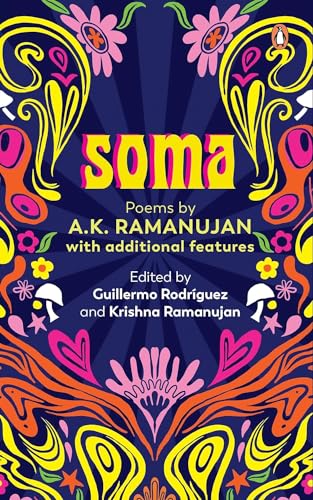
For A.K. Ramanujan, who infused his diverse knowledge of Indian literatures and traditions into his poetry, the idea of Soma, the mysterious plant used by Vedic priests to extract ambrosia, fed his creativity.
Sifting through Ramanujan’s archives, the editors discovered a series of unpublished ‘Soma poems’ whose style and theme set them apart from his earlier work. This volume includes these poems beside essays and an interview that contextualizes them. It also contains a foreword written by the poet and critic A.K. Mehrotra.
Krishna Ramanujan’s essay ‘Hummel’s Miracle: The Search for Soma’ explores the connections between the poems and the quest for the plant’s identity from the 1960s to the present. ‘The “Ordinary Mystery” Trip: Soma in A.K. Ramanujan’s Poetry’ by Guillermo Rodriguez dives deep into Ramanujan’s layered perspective on Soma. ‘The Post-Vedic History of the Soma Plant’, by Wendy Doniger, which influenced Ramanujan’s perception of Soma, originally published in 1968, is reprinted here with a special preface. The interview conducted in Chicago in 1982 between Malayali poet K. Ayyappa Paniker and Ramanujan offers a peek into Ramanujan’s perspectives on poetry and translation.
While Soma focuses on A.K. Ramanujan’s experimental poems and his creative mindset as an expatriate in America in the 1970s and early 1980s, it also provides a glimpse into a fascinating period in Western Indology when Indian philosophies and traditions were debated, some of which became so ingrained that they influence contemporary culture to this day.
Die Inhaltsangabe kann sich auf eine andere Ausgabe dieses Titels beziehen.
Über die Autorin bzw. den Autor
A K Ramanujan (1929-1993), born in Mysore, India, received his B.A. with Honors in English Language and Literature from Mysore University in 1949, and his M.A. the following year. For the next eight years, he was a lecturer in English successively in S.N. College, Quilon (Kerala), Thiagarajar College, Madurai (Tamil Nadu), Lingaraj College, Belgaum (Karnataka), and M.S. University, Baroda (Gujarat). In 1958, he received graduate diplomas in linguistics from Deccan College, Poona.
The following year Ramanujan came to the United States on a Fulbright fellowship, enrolling at Indiana University, which awarded him a Ph.D. in linguistics in 1963. He joined the faculty of the University of Chicago in 1962 as assistant professor, and was appointed professor in 1968. At the time of his death, he was the William H. Colvin Professor in the Department of South Asian Languages and Civilizations, the Department of Linguistics, and the Committee on Social Thought. He also taught as a visiting professor at Harvard University, University of California at Berkeley, University of Wisconsin, Madison, and University of Michigan.
Ramanujan received many honors and prizes, including the Padma Shri awarded by the Government of India in 1976 for contributions to Indian literature and linguistics, and a MacArthur Prize Fellowship in 1983. In 1988, he delivered the Radhakrishnan Memorial Lectures at All Soul's College, Oxford. He was elected to the American Academy of Arts and Sciences in 1990. In 1999, he was posthumously given the Sahitya Akademi Award in English for The Collected Poems.
He was the author or translator of twenty-three books, including eight posthumous works, and he co-authored and edited various other seminal publications. While still alive, he published seven volumes of original poetry in English and Kannada, and landmark translations of verse from Tamil (ancient Sangam classics and medieval Alvar saints) and Kannada, including his famous book of poetry from medieval Kannada mystics, Speaking of Siva (Penguin, 1973), which was nominated for the National Book Award in the USA. His translation of U.R. Ananthamurthy's Kannada novel Samskara is considered a classic. His last published book during his lifetime was Folktales from India, Oral Tales from Twenty-two Languages (Pantheon, 1991).
Mere biodata, however, cannot convey the magnitude of Ramanujan's talents—as teacher, scholar, poet, literary critic, and translator-nor how deeply he influenced a whole generation of poets, translators and scholars, and enriched the lives of all who came to know him.
Guillermo Rodriguez, an active promoter of Indo-Spanish cultural relations, is the founding director of Casa de la India, a pioneering cultural center in Spain, which has become the model for India's cultural diplomacy abroad. A passionate traveler, it was during a visit to India in the early 1990s that he chanced upon Indian poetry in the translations of A.K. Ramanujan, awakening his interest in the life and works of the poet-scholar.
Krishna Ramanujan is a science writer at Cornell University in Ithaca, New York. Coupled with life-long literary interests, he has worked as a writer for Earthwatch Radio, NASA and Cornell University. He has published more than 2,000 news stories on topics related to climate change, ecology, biology and genetics. He is the son of AK Ramanujan.
Auszug. © Genehmigter Nachdruck. Alle Rechte vorbehalten.
Hummel’s Miracle:
The Search for Soma
Krishna Ramanujan
I
In August of 1971, in the afterglow of the psychedelic
sixties, my father, the poet–scholar A.K. Ramanujan,
swallowed a capsule of the hallucinogen mescaline. As he
told me, perhaps some fifteen years later, he had found
two capsules in his coat pocket, which a friend had given
him. In his telling, he made the whole episode sound
casual, claiming he had pocketed the pills and forgotten
about them. He said he discovered them that day and
popped one on a kind of whim. Then he fell asleep. When
he awoke, still lying down, the evening sunlight shone
on his arm, and the hairs were golden. ‘I was the man
with the golden arm,’ he told me. Over the next twentyfour
hours, he recorded his experience in fragmented,
confused and overwhelmingly sensorial verse. By the end
of this episode, his writing, like tributaries flowing into a
river, had found a main channel, and he began composing
lines that led to a series of poems on the theme of Soma,1
which he explored for the next decade.
I wouldn’t say my father was interested in the
recreational use of drugs, but he was drawn to
experimentation, for the sake of ideas and poetry. He
lived with a kind of conflict (one of many) between his
Brahminic roots and the desire to be a modern man of
the world. By the time he first left India in 1959, he was
extremely well-read in western thought and poetry.
The mescaline episode came on the heels of the 1960s,
when interest in psychedelics and associated freedoms
were particularly relevant.2 It was also in 1968 that
mycologist R. Gordon Wasson published his book, Soma:
Divine Mushroom of Immortality.3 Wasson’s theory—that
Soma was a psychedelic mushroom (not technically a
plant)—made a big splash and was widely discussed and
debated. We know my father had read Wasson’s book, or
at the very least he was aware of the argument, because
he refers to the mushroom theory in an essay4 and in his
Soma poems.5
Soma is at once a god, a plant and an exhilarating and
euphoric drink made by pressing the plant’s juices, which
priests drank for sacrificial rituals. It is also central to the
Vedic religion. Of the 1028 hymns of the Rig Veda, 1146
are dedicated to Soma; an entire Mandala7 is devoted to
it. Soma is also the subject of a great mystery, as the Rig
Veda never identifies the species used to make the drink.
Wasson proposed that a mushroom called fly agaric,
Amanita muscaria,8 was used to make the Soma drink.
He also argued, with interpretations of the Rig Veda,
that Soma was specifically hallucinogenic, though the
description was later tweaked as ‘entheogenic’ to clarify
its use as a psychoactive substance for religious or spiritual
purposes. Though the Soma plant’s identity had been
extensively investigated for centuries, Wasson’s thesis
was perhaps the most comprehensive argument up to that
time. The book included an essay by Wendy Doniger
(Wendy Doniger O’Flaherty, at the time)9 that was the
first to catalogue the prior two-century history (from
1784 to 1967) of attempts by linguists, mythologists and
Indologists, anthropologists, historians and ethnobotanists
to identify Soma. Doniger’s thorough accounting presents
140 theories in chronology on the identity of Soma.10
Of its many meanings, Soma is called the Lord of
Speech, ‘a generator of hymns, a leader of poets, a seer
among priests’.11 The Vedas mention the kavis, poets who
composed hymns under the spell of Vak, the Goddess of
Speech.12 The drink inspires poets; it ‘procreates’ thought.
Soma is in opposition to alcohol (sura), as the Sathapatha
Brahmana states, ‘Soma is truth, prosperity, light; and
sura untruth, misery, darkness.’13 It is believed that
priests composed hymns of the Rig Veda after drinking
Soma;14 the ability to create a hymn under the influence
was one criterion that scholars used for identifying the
Soma plant: its effects must leave the poet with enough
lucidity to compose.
Along with my father’s interest in Aldous Huxley’s
Doors of Perception, and the British writer’s hallucinogenic
experiences, which were tape recorded with a doctor
present,15 I cannot doubt that AKR’s mescaline notes were
influenced by what he regarded as Soma, serving as a kind
of experiment to achieve poetic inspiration via a mindaltering
hallucinogen. In this way, perhaps, his effort at
imitating the composing practices of Vedic priests was a
moment when a dichotomy between his Brahmin roots
and his pull to experience a modern and western world
came together.
„Über diesen Titel“ kann sich auf eine andere Ausgabe dieses Titels beziehen.
Suchergebnisse für Soma: Poems

Beispielbild für diese ISBN
Soma
Anbieter: GreatBookPrices, Columbia, MD, USA
Verkäuferbewertung 5 von 5 Sternen

Zustand: New. Bestandsnummer des Verkäufers 46658010-n
Neu kaufen
EUR 14,88
EUR 2,35 Versand
Versand innerhalb von USA
Versand innerhalb von USA
Anzahl: 17 verfügbar
Foto des Verkäufers
Soma
Verlag:
Penguin Random House India, IN, 2023
ISBN 10: 0670098043
ISBN 13: 9780670098040
Neu
Hardcover
Anbieter: Rarewaves USA, HEBRON, KY, USA
Verkäuferbewertung 5 von 5 Sternen
Hardback. Zustand: New. Bestandsnummer des Verkäufers LU-9780670098040
Foto des Verkäufers
Soma
Anbieter: GreatBookPrices, Columbia, MD, USA
Verkäuferbewertung 5 von 5 Sternen
Zustand: As New. Unread book in perfect condition. Bestandsnummer des Verkäufers 46658010
Gebraucht kaufen
EUR 16,19
EUR 2,35 Versand
Versand innerhalb von USA
Versand innerhalb von USA
Anzahl: 17 verfügbar
Beispielbild für diese ISBN
Soma: Poems by A.K. Ramanujan
Anbieter: Majestic Books, Hounslow, Vereinigtes Königreich
Verkäuferbewertung 4 von 5 Sternen

Zustand: New. Bestandsnummer des Verkäufers 397885036
Neu kaufen
EUR 12,36
EUR 7,71 Versand
Versand von Vereinigtes Königreich nach USA
Versand von Vereinigtes Königreich nach USA
Anzahl: 10 verfügbar
Beispielbild für diese ISBN
Soma: Poems
Anbieter: Black Cat Books, Shelter Island, NY, USA
Verkäuferbewertung 4 von 5 Sternen
Hardcover. Zustand: Very Good. Zustand des Schutzumschlags: Very Good. Hardbound in dust jacket. Minor wear to dust jacket edges, otherwise very good. Bestandsnummer des Verkäufers 92044
Gebraucht kaufen
EUR 16,50
EUR 4,45 Versand
Versand innerhalb von USA
Versand innerhalb von USA
Anzahl: 1 verfügbar
Beispielbild für diese ISBN
Soma: Poems by A.K. Ramanujan
Anbieter: Books Puddle, Woodside, NY, USA
Verkäuferbewertung 4 von 5 Sternen
Zustand: New. Bestandsnummer des Verkäufers 26398492083
Neu kaufen
EUR 17,91
EUR 3,55 Versand
Versand innerhalb von USA
Versand innerhalb von USA
Anzahl: 10 verfügbar
Beispielbild für diese ISBN
Soma: Poems by A.K. Ramanujan
Anbieter: Biblios, Frankfurt am main, HESSE, Deutschland
Verkäuferbewertung 4 von 5 Sternen
Zustand: New. Bestandsnummer des Verkäufers 18398492089
Neu kaufen
EUR 11,79
EUR 9,95 Versand
Versand von Deutschland nach USA
Versand von Deutschland nach USA
Anzahl: 10 verfügbar
Foto des Verkäufers
Soma
Verlag:
Penguin Random House India, IN, 2023
ISBN 10: 0670098043
ISBN 13: 9780670098040
Neu
Hardcover
Anbieter: Rarewaves.com USA, London, LONDO, Vereinigtes Königreich
Verkäuferbewertung 5 von 5 Sternen
Hardback. Zustand: New. Bestandsnummer des Verkäufers LU-9780670098040
Neu kaufen
EUR 22,59
Versand gratis
Versand von Vereinigtes Königreich nach USA
Versand von Vereinigtes Königreich nach USA
Anzahl: 9 verfügbar
Beispielbild für diese ISBN
Soma: Poems
Anbieter: Kennys Bookshop and Art Galleries Ltd., Galway, GY, Irland
Verkäuferbewertung 5 von 5 Sternen
Zustand: New. 2023. hardcover. . . . . . Bestandsnummer des Verkäufers V9780670098040
Neu kaufen
EUR 21,87
EUR 9,50 Versand
Versand von Irland nach USA
Versand von Irland nach USA
Anzahl: 17 verfügbar
Beispielbild für diese ISBN
Soma: Poems
Anbieter: Kennys Bookstore, Olney, MD, USA
Verkäuferbewertung 5 von 5 Sternen
Zustand: New. 2023. hardcover. . . . . . Books ship from the US and Ireland. Bestandsnummer des Verkäufers V9780670098040
Neu kaufen
EUR 27,39
EUR 9,34 Versand
Versand innerhalb von USA
Versand innerhalb von USA
Anzahl: 17 verfügbar