
Verwandte Artikel zu The Cases That Haunt Us: From Jack the Ripper to Jonbenet...
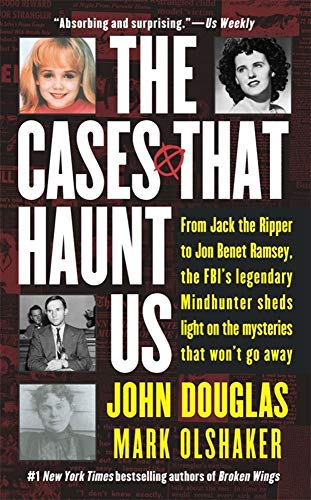
The Cases That Haunt Us: From Jack the Ripper to Jonbenet Ramsey, the FBI's Legendary Mindhunter Sheds Light on the Mysteries That Won't Go away - Softcover
Inhaltsangabe
Did Lizzie Borden murder her own father and stepmother? Was Jack the Ripper actually the Duke of Clarence? Who killed JonBenet Ramsey? #1 New York Times bestselling author and legendary FBI criminal profiler John Douglas, along with author and filmmaker Mark Olshaker—the team behind the famous Mindhunter series—explore those tantalizing questions and more in this mesmerizing work of detection.
Violent. Provocative. Shocking. Call them what you will…but don't call them open and shut.
In The Cases That Haunt Us, Douglas and Olshaker explore the mysteries that both their legions of fans and law enforcement professionals ask about most. With uniquely gripping analysis, the authors reexamine and reinterpret the accepted facts, evidence, and victimology of the most notorious murder cases in the history of crime, including the Lindbergh baby kidnapping, The Zodiac Killer, and the Whitechapel murders. The cases touch a nerve deep within us because of the personalities involved, their senseless depravity, the nagging doubts about whether justice was done, or because, in some instances, no suspect has ever been identified or caught.
Taking a fresh and penetrating look at each case, the authors reexamine and reinterpret accepted facts and victimology using modern profiling and the techniques of criminal analysis developed by Douglas within the FBI. The Cases That Haunt Us not only offers convincing and controversial conclusions, it deconstructs the evidence and widely held beliefs surrounding each case and rebuilds them—with fascinating, surprising, and haunting results.
Die Inhaltsangabe kann sich auf eine andere Ausgabe dieses Titels beziehen.
Über die Autorinnen und Autoren
John Douglas is the legendary FBI criminal profiler and former Chief of the FBI’s Behavioral Sciences Unit where he researched, investigated, and conducted interviews of some of America’s most violent criminals. Over the past half-century, he either directly worked on or had overall supervision in over 5,000 violent crime cases. He is one of the foremost experts of the criminal mind, its methods, and motivations. Douglas is a veteran of the United States Air Force and holds a doctorate degree in Education, and lives with his wife, Pamela, in the Washington, DC, area.
Mark Olshaker is an Emmy Award–winning documentary filmmaker and author of thirteen nonfiction books and five novels, including Einstein’s Brain and The Edge. His books with former FBI Special Agent and criminal profiling pioneer John Douglas, beginning with Mindhunter and most recently When a Killer Calls, have sold millions of copies and have been translated into many languages. Mindhunter was recently adapted by David Fincher into a critically acclaimed and award-winning dramatic series on Netflix. Olshaker and his wife, Carolyn, an attorney, live in the Washington, DC, area.
Von der hinteren Coverseite
Did Lizzie Borden murder her own father and stepmother? Was Jack the Ripper actually the Duke of Clarence? Who killed JonBenet Ramsey? #1 New York Times bestselling author and legendary FBI criminal profiler John Douglas, along with author and filmmaker Mark Olshaker―the team behind the famous Mindhunter series―explore those tantalizing questions and more in this mesmerizing work of detection.
Violent. Provocative. Shocking. Call them what you will…but don't call them open and shut.
In The Cases That Haunt Us, Douglas and Olshaker explore the mysteries that both their legions of fans and law enforcement professionals ask about most. With uniquely gripping analysis, the authors reexamine and reinterpret the accepted facts, evidence, and victimology of the most notorious murder cases in the history of crime, including the Lindbergh baby kidnapping, The Zodiac Killer, and the Whitechapel murders. The cases touch a nerve deep within us because of the personalities involved, their senseless depravity, the nagging doubts about whether justice was done, or because, in some instances, no suspect has ever been identified or caught.
Taking a fresh and penetrating look at each case, the authors reexamine and reinterpret accepted facts and victimology using modern profiling and the techniques of criminal analysis developed by Douglas within the FBI. The Cases That Haunt Us not only offers convincing and controversial conclusions, it deconstructs the evidence and widely held beliefs surrounding each case and rebuilds them―with fascinating, surprising, and haunting results.
Auszug. © Genehmigter Nachdruck. Alle Rechte vorbehalten.
CHAPTER ONE
Jack the Ripper
In the dark realm of serial killers, this is ground zero: the point from which virtually all history and all discussions begin.
By modern standards, the ghostly predator who haunted the shadowy streets of London’s East End between August and November of 1888 was nothing much to write home about. Sadly, many of his successors—people I and my colleagues have had to hunt—have been far more devastatingly productive in the number of lives they took, and even the gruesome creativity with which they took them. But none other has so quickly captured and so long dominated the public’s fascination as Jack the Ripper: the Whitechapel Murderer, the personification of mindless brutality, of nameless, motiveless evil.
Why this one? Why him (although some still steadfastly maintain it was a her)? There are several reasons. For one, the crimes—a series of fatal stabbings that escalated into total mutilation—were concentrated in a small geographic area, directed at a specific type of preferred victim. For another, though there had been isolated sexually based killings in England and the European continent in the past, this was the first time most Victorians had ever faced or had to deal emotionally with such a phenomenon. Add to this a social reform movement and a newly energetic and outspoken press eager to call attention to the appalling living conditions in the East End, and you have all the ingredients for what became, literally, one of the biggest crime stories of all time.
The reasons why these murders continue to fascinate above all others, even in this modern age with our seemingly endless succession of “crimes of the century,” are equally strong, though, as we will quickly learn, often based on misimpression. In spite of their barbarism, they represent a real-life mystery from the era of Sherlock Holmes—the bygone romantic era of high Victorian society, gaslights and swirling London fog, though where the killings actually took place had little real relationship to Victorian splendor, and each crime was actually committed on a night without fog. On only one of the nights was it even raining. In fact, at the same time the Ripper murders were terrorizing the desperate East End, a melodrama based on Robert Louis Stevenson’s The Strange Case of Dr. Jekyll and Mr. Hyde was thrilling audiences at the Lyceum Theatre in the fashionable and comfortable West End. Together these two events, one safely fanciful and the other horrifyingly real, gave many their first dawning awareness of the potential for inherent evil in so-called ordinary or normal people.
And despite a tremendous allocation of manpower and resources on the parts of two police forces at the time, and the efforts of countless “Ripperologists” in the more than 110 years since then, the crimes remain unsolved, tantalizing us with their profound mystery (though if we were working them today, I feel confident we could crack them in relatively short order). Some of the suspects and motives are very “sexy”—far out of the range of the normal serial killer—including not only the royal physician but also the two men in direct line to the throne!
And as important as any other reason for the continuing fascination is that powerfully evocative and terrifying name by which the unknown subject—or UNSUB, as we refer to him in my business—was called. Although here again, I maintain that this was not the identity he chose for himself.
But whatever the misconceptions or qualifications, we have to acknowledge that Jack the Ripper created the myth, the evil archetype, of the serial killer.
As a criminal investigative analyst and the first full-time profiler for the FBI, I’d often speculated about the identity of Jack the Ripper. But it wasn’t until 1988, the hundredth anniversary of the Whitechapel murders, that I actually approached the case as I would one that was brought to me at the Investigative Support Unit at Quantico from a local law enforcement agency.
The occasion was a two-hour television program, The Secret Identity of Jack the Ripper, set to be broadcast live from Los Angeles in October and hosted by British actor, writer, and director Peter Ustinov, with feeds from experts in London at the crime scenes themselves and at Scotland Yard, the headquarters of London’s Metropolitan Police. When the producers approached me about participating in the program and constructing a profile of the killer, I decided it was worth a try for a couple of reasons. First, I thought the profile might be useful in training new agents. Second, it’s difficult to resist matching wits, even a century later, with the most famous murderer in history. And third, since it was a hundred years after the fact, no negative consequences were possible other than making a fool of myself on national television, a fear I’d long since gotten over. Unlike with the scores of “real” cases I was dealing with every day, no one was going to die if I was wrong or gave the police bad information. More than a decade later, I still believe in the analysis I did, with an interesting and important addition, which we’ll get to later.
I captioned the profile the way I would an actual one that would become part of a case file:
UNSUB; AKA JACK THE RIPPER;
SERIES OF HOMICIDES
LONDON, ENGLAND
1888
NCAVC—HOMICIDE (CRIMINAL INVESTIGATIVE ANALYSIS)
The FBI, like most government agencies, is addicted to acronyms. The one on the last line, NCAVC, stands for National Center for the Analysis of Violent Crime, the overall program established in 1985 and located at the FBI Academy to encompass a bunch of other acronyms including, but not limited to, the BSU, or Behavioral Science Unit (teaching and research); ISU, the Investigative Support Unit, which carries out the actual consulting, profiling, and criminal investigative analysis; and VICAP, the Violent Criminal Apprehension Program computer database on multiple offenders. During my tenure as chief of ISU, we and other operational entities, such as HRT, the Hostage Rescue Team, were pulled in under the umbrella of CIRG, the Critical Incident Response Group. And after I retired in 1995, my unit was, for a time, absorbed into a new group, CASCU, the Child Abduction and Serial Crimes Unit. Anyway, you get the idea.
I cautioned the producers the same way everyone in my unit had been trained to caution the police and law enforcement agencies around the United States and the world with whom we dealt: our work can only be as good as the case information provided to us. Many of the tools we’d have to work with today—fingerprints, DNA and other blood markers, extensive crime-scene photography—were not available in 1888, so I’d have to do without them in developing my analysis. But then, as now, I would still begin with the known facts of the crimes.
Like most serial murders, the case is complicated, with multiple victims and leads that go off in many directions. It is therefore useful to go into the case narrative in some detail, just as we would if we were receiving it from a local law enforcement agency seeking our assistance. So we’ll relate the details—anything that might be important to the profile—and analyze each element at the proper point in the decision-making process. In that way, we can see something of how the analytical decisions in mindhunting are made and on what they are based. By the time we present the profile, you should have some background and perspective for understanding the choices and conclusions I’ve come to. We can then apply this process to all of the subsequent cases we’ll consider. The more a profiler knows of...
„Über diesen Titel“ kann sich auf eine andere Ausgabe dieses Titels beziehen.
Suchergebnisse für The Cases That Haunt Us: From Jack the Ripper to Jonbenet...

Beispielbild für diese ISBN
The Cases That Haunt Us: From Jack the Ripper to Jonbenet Ramsey, the FBI's Legendary Mindhunter Sheds Light on the Mysteries That Won't Go away
Anbieter: World of Books (was SecondSale), Montgomery, IL, USA
Verkäuferbewertung 5 von 5 Sternen

Zustand: Good. The #1 New York Times bestselling authors of Mindhunter revisit eight of the most infamous true crime cases of all time--from Jack the Ripper and the Zodiac Killer to JonBenet Ramsey--in this updated 25th anniversary edition exploring unsolved murders, FBI criminal profiling, and forensic science. Violent. Provocative. Shocking. Call them what you want.but don't call them open and shut. Did Lizzie Borden murder her own father and stepmother? Who killed JonBenet Ramsey, and why? In this updated edition, legendary FBI criminal profiler John Douglas and Emmy Award-winning filmmaker and journalist Mark Olshaker--the team behind the famous Mindhunter series--explore these tantalizing questions and more in this mesmerizing work of detection. Using modern forensic science and criminal profiling techniques developed by Douglas within the FBI, The Cases That Haunt Us challenges conventional theories, dissects investigative missteps, and exposes the societal biases that have shaped some of history's most notorious murder investigations. From the Boston Strangler to the Zodiac Killer, these are the eight cases that just won't go away because of their senseless depravity, the doubts about whether justice was done, or because, in some instances, no suspect has ever been identified or caught. The Cases That Haunt Us not only offers convincing and controversial conclusions, it deconstructs the evidence and widely held beliefs surrounding each case and rebuilds them--with fascinating, surprising, and haunting results. Bestandsnummer des Verkäufers 00109205027
Gebraucht kaufen
EUR 4,05
Versand gratis
Versand innerhalb von USA
Versand innerhalb von USA
Anzahl: 2 verfügbar
Beispielbild für diese ISBN
The Cases That Haunt Us: From Jack the Ripper to Jonbenet Ramsey, the FBI's Legendary Mindhunter Sheds Light on the Mysteries That Won't Go away
Anbieter: World of Books (was SecondSale), Montgomery, IL, USA
Verkäuferbewertung 5 von 5 Sternen
Zustand: Fair. The #1 New York Times bestselling authors of Mindhunter revisit eight of the most infamous true crime cases of all time--from Jack the Ripper and the Zodiac Killer to JonBenet Ramsey--in this updated 25th anniversary edition exploring unsolved murders, FBI criminal profiling, and forensic science. Violent. Provocative. Shocking. Call them what you want.but don't call them open and shut. Did Lizzie Borden murder her own father and stepmother? Who killed JonBenet Ramsey, and why? In this updated edition, legendary FBI criminal profiler John Douglas and Emmy Award-winning filmmaker and journalist Mark Olshaker--the team behind the famous Mindhunter series--explore these tantalizing questions and more in this mesmerizing work of detection. Using modern forensic science and criminal profiling techniques developed by Douglas within the FBI, The Cases That Haunt Us challenges conventional theories, dissects investigative missteps, and exposes the societal biases that have shaped some of history's most notorious murder investigations. From the Boston Strangler to the Zodiac Killer, these are the eight cases that just won't go away because of their senseless depravity, the doubts about whether justice was done, or because, in some instances, no suspect has ever been identified or caught. The Cases That Haunt Us not only offers convincing and controversial conclusions, it deconstructs the evidence and widely held beliefs surrounding each case and rebuilds them--with fascinating, surprising, and haunting results. Bestandsnummer des Verkäufers 00098737878
Gebraucht kaufen
EUR 4,05
Versand gratis
Versand innerhalb von USA
Versand innerhalb von USA
Anzahl: 10 verfügbar
Foto des Verkäufers
The Cases That Haunt Us
Anbieter: Zoom Books East, Glendale Heights, IL, USA
Verkäuferbewertung 5 von 5 Sternen
Zustand: very_good. Book is in very good condition and may include minimal underlining highlighting. The book can also include "From the library of" labels. May not contain miscellaneous items toys, dvds, etc. . We offer 100% money back guarantee and 24 7 customer service. Bestandsnummer des Verkäufers ZEV.0671017063.VG
Gebraucht kaufen
EUR 4,06
Versand gratis
Versand innerhalb von USA
Versand innerhalb von USA
Anzahl: 3 verfügbar
Foto des Verkäufers
The Cases That Haunt Us
Anbieter: Zoom Books Company, Lynden, WA, USA
Verkäuferbewertung 5 von 5 Sternen
Zustand: very_good. Book is in very good condition and may include minimal underlining highlighting. The book can also include "From the library of" labels. May not contain miscellaneous items toys, dvds, etc. . We offer 100% money back guarantee and 24 7 customer service. Bestandsnummer des Verkäufers ZBV.0671017063.VG
Gebraucht kaufen
EUR 4,06
Versand gratis
Versand innerhalb von USA
Versand innerhalb von USA
Anzahl: 3 verfügbar
Foto des Verkäufers
The Cases That Haunt Us
Anbieter: Zoom Books East, Glendale Heights, IL, USA
Verkäuferbewertung 5 von 5 Sternen
Zustand: good. Book is in good condition and may include underlining highlighting and minimal wear. The book can also include "From the library of" labels. May not contain miscellaneous items toys, dvds, etc. . We offer 100% money back guarantee and 24 7 customer service. Bestandsnummer des Verkäufers ZEV.0671017063.G
Gebraucht kaufen
EUR 4,06
Versand gratis
Versand innerhalb von USA
Versand innerhalb von USA
Anzahl: 5 verfügbar
Foto des Verkäufers
The Cases That Haunt Us
Anbieter: Dream Books Co., Denver, CO, USA
Verkäuferbewertung 5 von 5 Sternen
Zustand: acceptable. This copy has clearly been enjoyedâ"expect noticeable shelf wear and some minor creases to the cover. Binding is strong, and all pages are legible. May contain previous library markings or stamps. Bestandsnummer des Verkäufers DBV.0671017063.A
Gebraucht kaufen
EUR 4,54
Versand gratis
Versand innerhalb von USA
Versand innerhalb von USA
Anzahl: 2 verfügbar
Beispielbild für diese ISBN
The Cases That Haunt Us
Verlag:
Pocket Books (edition Reprint), 2001
ISBN 10: 0671017063
ISBN 13: 9780671017064
Gebraucht
Mass Market Paperback
Anbieter: BooksRun, Philadelphia, PA, USA
Verkäuferbewertung 5 von 5 Sternen
Mass Market Paperback. Zustand: Fair. Reprint. The item might be beaten up but readable. May contain markings or highlighting, as well as stains, bent corners, or any other major defect, but the text is not obscured in any way. Bestandsnummer des Verkäufers 0671017063-7-1
Gebraucht kaufen
EUR 5,08
Versand gratis
Versand innerhalb von USA
Versand innerhalb von USA
Anzahl: 2 verfügbar
Foto des Verkäufers
The Cases That Haunt Us
Anbieter: Greenworld Books, Arlington, TX, USA
Verkäuferbewertung 5 von 5 Sternen
Zustand: acceptable. Fast Free Shipping â" A well-loved copy with text fully readable and cover pages intact. May display wear such as writing, highlighting, bends, folds or library marks. Still a complete and usable book. Bestandsnummer des Verkäufers GWV.0671017063.A
Gebraucht kaufen
EUR 5,24
Versand gratis
Versand innerhalb von USA
Versand innerhalb von USA
Anzahl: 3 verfügbar
Foto des Verkäufers
The Cases That Haunt Us
Anbieter: Greenworld Books, Arlington, TX, USA
Verkäuferbewertung 5 von 5 Sternen
Zustand: very_good. Fast Free Shipping â" Very Good condition book with a firm cover and clean pages. Shows normal use and some light wear or limited notes markings. A solid, nice copy to enjoy. Bestandsnummer des Verkäufers GWV.0671017063.VG
Gebraucht kaufen
EUR 5,40
Versand gratis
Versand innerhalb von USA
Versand innerhalb von USA
Anzahl: 1 verfügbar
Beispielbild für diese ISBN
The Cases That Haunt Us
Verlag:
Pocket Books, 2001
ISBN 10: 0671017063
ISBN 13: 9780671017064
Gebraucht
Mass Market Paperback
Anbieter: HPB Inc., Dallas, TX, USA
Verkäuferbewertung 5 von 5 Sternen
Mass Market Paperback. Zustand: Very Good. Connecting readers with great books since 1972! Used books may not include companion materials, and may have some shelf wear or limited writing. We ship orders daily and Customer Service is our top priority! Bestandsnummer des Verkäufers S_450343922
Gebraucht kaufen
EUR 2,30
EUR 3,34 Versand
Versand innerhalb von USA
Versand innerhalb von USA
Anzahl: 1 verfügbar