
Verwandte Artikel zu Walking Through Mirrors
Inhaltsangabe
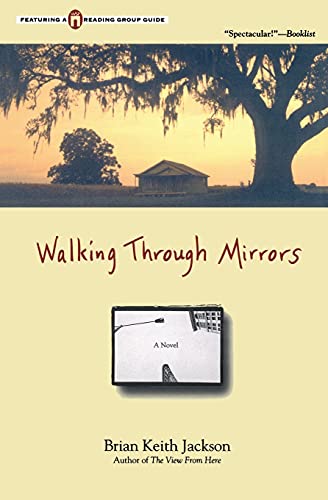
In his breathtaking debut, The View From Here, Brian Keith Jackson took us inside the heart of black family life in the rural South. Now, in a novel that resonates with pure emotion, he sends photographer Jeremy Bishop back to Elsewhere, Louisiana, for the funeral that marks the end of his father's life -- and the true beginning of his own.
His grandmother, Mama B, called him Patience. Jeremy was, she said, the most agreeable child. He would have liked to tell her that, even while growing up, his hidden wants festered deep inside him. His mother died just hours after his birth, and he was raised by Mama B and his Aunt Jess after his father disappeared. Even after his dad returned one day with his new family, Jeremy kept his distance. But it is a decade later, and Jeremy, now a successful New York photographer, gets a phone call from Louisiana. It is time for Jeremy Bishop to journey the long way home to help bury his father. In the graveyard where his father's body will be laid to rest; in a stranger's appearance at the wake; in a suicide; a murder; and finally inside a cardboard box that had belonged to his father, Jeremy will find himself in ways he never imagined. Conjuring Jeremy's youth in flashbacks as textured as the denim patch on his grandmother's rocking chair, Jackson weaves together past and present in a novel at once astonishing and universally human.
Die Inhaltsangabe kann sich auf eine andere Ausgabe dieses Titels beziehen.
Über die Autorin bzw. den Autor
Brian Keith Jackson, is an American novelist, essayist, and culture writer based in Harlem, New York.
Von der hinteren Coverseite
In his breathtaking debut, The View From Here, Brian Keith Jackson took us inside the heart of black family life in the rural South. Now, in a novel that resonates with pure emotion, he sends photographer Jeremy Bishop back to Elsewhere, Louisiana, for the funeral that marks the end of his father's life -- and the true beginning of his own.
His grandmother, Mama B, called him Patience. Jeremy was, she said, the most agreeable child. He would have liked to tell her that, even while growing up, his hidden wants festered deep inside him. His mother died just hours after his birth, and he was raised by Mama B and his Aunt Jess after his father disappeared. Even after his dad returned one day with his new family, Jeremy kept his distance. But it is a decade later, and Jeremy, now a successful New York photographer, gets a phone call from Louisiana. It is time for Jeremy Bishop to journey the long way home to help bury his father. In the graveyard where his father's body will be laid to rest; in a stranger's appearance at the wake; in a suicide; a murder; and finally inside a cardboard box that had belonged to his father, Jeremy will find himself in ways he never imagined. Conjuring Jeremy's youth in flashbacks as textured as the denim patch on his grandmother's rocking chair, Jackson weaves together past and present in a novel at once astonishing and universally human.
Auszug. © Genehmigter Nachdruck. Alle Rechte vorbehalten.
Chapter One
It was a breath before the birth of day, a time when even movement was still. A timid New York winter had fooled the daffodils, making them sprout prematurely, and buds hung from upon high, coating branches in need of color. How well the trees know change -- if only people could be so wise.
The hint of spring turned Jeremy Bishop's thoughts to a familiar place: home. His second thought, the one that sneaked in, was alien: Father.
He retreated to his rocking chair, keeping his eyes on the blur of yellow blossoms. The rocker had become his home away from home. His bedrock. He had bought it his first week in New York at the Chelsea Flea Market, where plentiful pockets can acquire a sense of history. He'd lugged it from housesit to sublet to every apartment he had slumbered in, in doing so, making each of them home. No matter the surroundings, the rocker was always the focus, stability when weary and worry combed his waylaid brow.
He watched Central Park put on its day face and contemplated what those two words, home and father, meant to him.
Home.
Father.
They were far from one and the same, and rarely, if ever, did the two waft in on the same thought. Now he would have to think of them together. Home was where he was going and it was "father" who had called him there.
As his rocking slowed, he became aware of the minutes that had passed. The hands on the clock indicated it was nearing ten-thirty, almost time for his car to arrive. He knew he had to get out of the rocker, which would deprive him of its comfort. He hesitated a moment, basking in the hug of the chair, and pressed his hands on his thighs, leaving behind its embrace. The car would be waiting.
It all began with a phone call. Yesterday. Tuesday. He had been at his photography studio doing a shoot, making the day no different than most, for ultimately, his life as a photographer was catch-as-catch-can over a cocktail or a phone call. But this call changed the realm of focus. Though he finished the session, he was certain he would never look at the prints. The pictures would remind him of that moment in time, developing memories he had pushed to a stop.
"Studio," said Doug, Jeremy's assistant, answering the phone. "Bishop! Telephone."
"Take a message. I want to finish this roll."
"She says it's important."
"Isn't it always?" said Jeremy, still focusing on his subject and without the slightest bit of irritation; camera clicking, filaments flashing in cadence with his words. "Who is it?"
"Carol."
"Carol who?"
"Bishop."
Flash. Flash. Flash.
He stopped shooting, but his finger remained firmly pressed on the shutter button, advancing the film toward images now lost on him. When his finger released the button, the false light stilled and the camera came down to graze his side.
He walked toward Doug, looking at him as though this was some sort of prank, yet no laughter presented itself. He took the receiver and for a moment, stared at the pinholes, wondering what words would prick through them, puncturing the day.
"Hello?" said Jeremy, and although that word, said face-to-face, is usually posed as a cordial statement, an introduction, his tone made the word what it truly means when said over the phone -- a question seeking information.
"Jeremy. It's Carol. I got this number from your Aunt Jessica."
"Yes, Carol; that's fine," said Jeremy without the slightest semblance of emotion. "Listen, I'm in the middle of a shoot right now. Can I -- "
"Jeremy -- "
" -- call you back?"
"Jeremy, your father died this morning."
The silence that followed was not associated with a moment of reflection. It was the kind that came when saying nothing was better than saying something prematurely.
Their conversation continued as the bustle of the studio continued around him. The contrast was mind boggling, like that of rapid eye movement or a strobe light's slowing motion, but the camera in one hand and the receiver in the other kept him aware, yet disconnected. He told Carol he'd fly down tomorrow, and then he hung up the phone. As he stood there, all of his yesterdays became today -- and not all of them were like this, a spring one.
"Is everything okay?" asked Doug. "Hello? Earth to Jeremy."
"What? Oh, yeah," he said, finally separating Doug's words from Carol's. "Could you reschedule my appointments for the next few days, please? I should be back by Monday. Then call the travel agent and -- "
"Is something the matter?"
"What are you, my mother? Could you just do it?"
"Yassah, massa."
"Look. Sorry. It was about my father."
"Father?" asked Doug, a bit surprised. "You've never mentioned your father. For some reason, I just assumed he was dead."
Jeremy looked at Doug, but he didn't say the words.
He was returning home, yet he had always wondered exactly what that was. "Home is home is home," he remembered Charles saying. For Jeremy, home was where the largest amount of memories existed, a place you're free to flee, and he did it well. Now he was going back there, but would going back mean moving forward?
"You must plow your own rows, mindful of pebbles 'long the way." That's what he heard Mama B saying as he stood behind the rocker in his filled yet barren apartment. In times such as these, it was her spirit that kept him going. Now and always, he plowed on.
A deep breath.
Another. Then he held it as if it were the life it possessed.
He released the rocker, and the sound of its sway filled his ears, drowning out the faint hum of electricity. He took one long look around, extending his gaze beyond the open space in which he stood to the other rooms, confined by either drywall or exposed brick. He could see every one of the rooms without being in them, as though looking at blueprints and filling in the thin blue outlines with the things he'd acquired over the years. The gaze was that of someone seeing something for the first -- or last -- time. He again looked at the rocker, which had stopped moving and now stood stalwart.
Then he began the journey.
When the elevator opened, the doorman came to get his bag.
"I've got it, Jimmy."
"Off on another trip, Mr. B?"
"Yep."
"Well, have a good one."
"I'll try."
Whenever he left the building, he could depend on some exchange with Jimmy, always ending with his saying "I'll try." Some things never change. Today it was pleasing to have some sense of certainty.
The driver put the luggage into the trunk and Jeremy settled into the backseat. He hadn't slept and his bloated face had yet to regain its normally firm shape. His sunglasses, centered on his face, became another reflection, providing a sepia view.
"Would ya like a paper or magazine? I've got the Times or the Post," said the driver, attempting to scope out what sort of passenger Jeremy would be. "I always say, 'tween the two, you can kinda get an idea of what's goin' on. One makes ya feel smart; the other makes you glad ya are. 'Course, I leave it up to you to decide which'n does what."
Still no answer from the backseat.
"D'ya mind music?"
Still no answer.
The driver had seen many like this and had often found himself thinking, So dat's how it's gonna be, Mr. Big Shot? Mr. Just-Get-Me-Where-I'm-Going-and-Don't-Talk-to-Me?
But those thoughts were inaccurate on this journey. Jeremy wasn't that sort of passenger at all. Yes, he took car services and had his moods, but ignoring wasn't something he practiced often.
"Do you have a paper I can borrow?" asked Jeremy.
"Yes, sir."
"Please, don't call me sir." The driver could have easily been his father, in age if nothing more.
"Whatevah ya say," said the driver, glancing back at Jeremy. "I offered ya one earlier. Used some of my best material, too."
"Sorry. My mind was elsewhere."
"Really? Where's that?"
"Far away,...
„Über diesen Titel“ kann sich auf eine andere Ausgabe dieses Titels beziehen.
Suchergebnisse für Walking Through Mirrors

Beispielbild für diese ISBN
Walking Through Mirrors
Anbieter: BooksRun, Philadelphia, PA, USA
Verkäuferbewertung 5 von 5 Sternen

Paperback. Zustand: Fair. The item might be beaten up but readable. May contain markings or highlighting, as well as stains, bent corners, or any other major defect, but the text is not obscured in any way. Bestandsnummer des Verkäufers 0671568949-7-1
Gebraucht kaufen
EUR 3,91
Versand gratis
Versand innerhalb von USA
Versand innerhalb von USA
Anzahl: 1 verfügbar
Foto des Verkäufers
Walking Through Mirrors
Anbieter: Zoom Books Company, Lynden, WA, USA
Verkäuferbewertung 5 von 5 Sternen
Zustand: very_good. Book is in very good condition and may include minimal underlining highlighting. The book can also include "From the library of" labels. May not contain miscellaneous items toys, dvds, etc. . We offer 100% money back guarantee and 24 7 customer service. Bestandsnummer des Verkäufers ZBV.0671568949.VG
Gebraucht kaufen
EUR 4,23
Versand gratis
Versand innerhalb von USA
Versand innerhalb von USA
Anzahl: 1 verfügbar
Beispielbild für diese ISBN
Walking Through Mirrors
Anbieter: ThriftBooks-Atlanta, AUSTELL, GA, USA
Verkäuferbewertung 5 von 5 Sternen
Paperback. Zustand: Good. No Jacket. Pages can have notes/highlighting. Spine may show signs of wear. ~ ThriftBooks: Read More, Spend Less. Bestandsnummer des Verkäufers G0671568949I3N00
Gebraucht kaufen
EUR 5,84
Versand gratis
Versand innerhalb von USA
Versand innerhalb von USA
Anzahl: 1 verfügbar
Beispielbild für diese ISBN
Walking Through Mirrors
Anbieter: St Vincent de Paul of Lane County, Eugene, OR, USA
Verkäuferbewertung 5 von 5 Sternen
Zustand: Good. PAGES ARE YELLOWING. paperback 100% of proceeds go to charity! Good condition with all pages in tact. Item shows signs of use and may have cosmetic defects. Bestandsnummer des Verkäufers N-07-4843
Gebraucht kaufen
EUR 3,58
EUR 3,47 Versand
Versand innerhalb von USA
Versand innerhalb von USA
Anzahl: 1 verfügbar
Beispielbild für diese ISBN
Walking Through Mirrors
Anbieter: HPB Inc., Dallas, TX, USA
Verkäuferbewertung 5 von 5 Sternen
paperback. Zustand: Very Good. Connecting readers with great books since 1972! Used books may not include companion materials, and may have some shelf wear or limited writing. We ship orders daily and Customer Service is our top priority! Bestandsnummer des Verkäufers S_479323676
Gebraucht kaufen
EUR 6,45
EUR 3,26 Versand
Versand innerhalb von USA
Versand innerhalb von USA
Anzahl: 1 verfügbar
Beispielbild für diese ISBN
Walking Through Mirrors
Verlag:
Washington Square Press, 1999
ISBN 10: 0671568949
ISBN 13: 9780671568948
Gebraucht
Softcover
Anbieter: Better World Books, Mishawaka, IN, USA
Verkäuferbewertung 5 von 5 Sternen
Zustand: Very Good. Pages intact with possible writing/highlighting. Binding strong with minor wear. Dust jackets/supplements may not be included. Stock photo provided. Product includes identifying sticker. Better World Books: Buy Books. Do Good. Bestandsnummer des Verkäufers 2408460-6
Gebraucht kaufen
EUR 9,86
Versand gratis
Versand innerhalb von USA
Versand innerhalb von USA
Anzahl: 1 verfügbar
Beispielbild für diese ISBN
Walking Through Mirrors
Anbieter: Lakeside Books, Benton Harbor, MI, USA
Verkäuferbewertung 5 von 5 Sternen
Zustand: New. Brand New! Not Overstocks or Low Quality Book Club Editions! Direct From the Publisher! We're not a giant, faceless warehouse organization! We're a small town bookstore that loves books and loves it's customers! Buy from Lakeside Books! Bestandsnummer des Verkäufers OTF-S-9780671568948
Neu kaufen
EUR 12,22
EUR 3,47 Versand
Versand innerhalb von USA
Versand innerhalb von USA
Anzahl: Mehr als 20 verfügbar
Foto des Verkäufers
Walking Through Mirrors
Anbieter: GreatBookPrices, Columbia, MD, USA
Verkäuferbewertung 5 von 5 Sternen
Zustand: New. Bestandsnummer des Verkäufers 733675-n
Neu kaufen
EUR 13,42
EUR 2,30 Versand
Versand innerhalb von USA
Versand innerhalb von USA
Anzahl: Mehr als 20 verfügbar
Foto des Verkäufers
Walking Through Mirrors (Paperback or Softback)
Verlag:
Atria Books 8/1/1999, 1999
ISBN 10: 0671568949
ISBN 13: 9780671568948
Neu
Paperback or Softback
Anbieter: BargainBookStores, Grand Rapids, MI, USA
Verkäuferbewertung 5 von 5 Sternen
Paperback or Softback. Zustand: New. Walking Through Mirrors. Book. Bestandsnummer des Verkäufers BBS-9780671568948
Beispielbild für diese ISBN
Walking Through Mirrors
Verlag:
Washington Square Press, 1999
ISBN 10: 0671568949
ISBN 13: 9780671568948
Gebraucht
Paperback
Anbieter: Robinson Street Books, IOBA, Binghamton, NY, USA
Verkäuferbewertung 4 von 5 Sternen

Paperback. Zustand: As New. Prompt Shipment, shipped in Boxes, Tracking PROVIDEDFirst thus. Fine. Bestandsnummer des Verkäufers bing39933
Gebraucht kaufen
EUR 12,11
EUR 8,27 Versand
Versand innerhalb von USA
Versand innerhalb von USA
Anzahl: 1 verfügbar