
Verwandte Artikel zu Men of Mathematics (Touchstone Book)
Inhaltsangabe
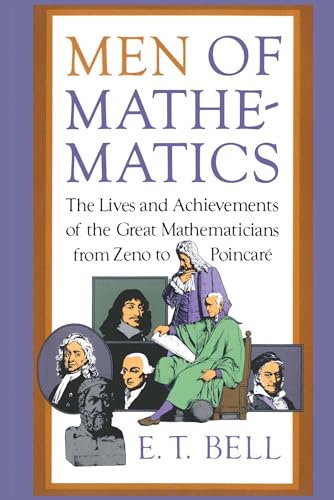
From one of the greatest minds in contemporary mathematics, Professor E.T. Bell, comes a witty, accessible, and fascinating look at the beautiful craft and enthralling history of mathematics.
Men of Mathematics provides a rich account of major mathematical milestones, from the geometry of the Greeks through Newton’s calculus, and on to the laws of probability, symbolic logic, and the fourth dimension. Bell breaks down this majestic history of ideas into a series of engrossing biographies of the great mathematicians who made progress possible—and who also led intriguing, complicated, and often surprisingly entertaining lives.
Never pedantic or dense, Bell writes with clarity and simplicity to distill great mathematical concepts into their most understandable forms for the curious everyday reader. Anyone with an interest in math may learn from these rich lessons, an advanced degree or extensive research is never necessary.
Die Inhaltsangabe kann sich auf eine andere Ausgabe dieses Titels beziehen.
Über die Autorin bzw. den Autor
E.T. Bell was the former President of the Mathematical Association of America and a former Vice President of the American Mathematical Society of the American Association for the Advancement of Science. He won the Bôcher Prize of the American Mathematical Society for his research work. His twelve published books include The Purple Sapphire (1924), Algebraic Arithmetic (1927), Debunking Science, and Queen of the Sciences (1931), Numerology (1933), and The Search for Truth (1934).
Dr. Bell died in December 1960, just before the publication of his latest book, The Last Problem.
Von der hinteren Coverseite
From one of the greatest minds in contemporary mathematics, Professor E.T. Bell, comes a witty, accessible, and fascinating look at the beautiful craft and enthralling history of mathematics.
Men of Mathematics provides a rich account of major mathematical milestones, from the geometry of the Greeks through Newton’s calculus, and on to the laws of probability, symbolic logic, and the fourth dimension. Bell breaks down this majestic history of ideas into a series of engrossing biographies of the great mathematicians who made progress possible―and who also led intriguing, complicated, and often surprisingly entertaining lives.
Never pedantic or dense, Bell writes with clarity and simplicity to distill great mathematical concepts into their most understandable forms for the curious everyday reader. Anyone with an interest in math may learn from these rich lessons, an advanced degree or extensive research is never necessary.
Auszug. © Genehmigter Nachdruck. Alle Rechte vorbehalten.
CHAPTER ONE
Introduction
This section is headed Introduction rather than Preface (which it really is) in the hope of decoying habitual preface-skippers into reading -- for their own comfort -- at least the following paragraphs down to the first row of stars before going on to meet some of the great mathematicians. I should like to emphasize first that this book is not intended, in any sense, to be a history of mathematics, or any section of such a history.
The lives of mathematicians presented here are addressed to the general reader and to others who may wish to see what sort of human beings the men were who created modern mathematics. Our object is to lead up to some of the dominating ideas governing vast tracts of mathematics as it exists today and to do this through the lives of the men responsible for those ideas.
Two criteria have been applied in selecting names for inclusion: the importance for modern mathematics of a man's work; the human appeal of the man's life and character. Some qualify under both heads, for example Pascal, Abel, and Galois; others, like Gauss and Cayley, chiefly under the first, although both had interesting lives. When these criteria clash or overlap in the case of several claimants to remembrance for a particular advance, the second has been given precedence as we are primarily interested here in mathematicians as human beings.
Of recent years there has been a tremendous surge of general interest in science, particularly physical science, and its bearing on our rapidly changing philosophical outlook on the universe. Numerous excellent accounts of current advances in science, written in as un-technical language as possible, have served to lessen the gap between the professional scientist and those who must make their livings at something other than science. In many of these expositions, especially those concerned with relativity and the modern quantum theory, names occur with which the general reader cannot be expected to be familiar -- Gauss, Cayley, Riemann, and Hermite, for instance. With a knowledge of who these men were, their part in preparing for the explosive growth of physical science since 1900, and an appreciation of their rich personalities, the magnificent achievements of science fall into a truer perspective and take on a new significance.
The great mathematicians have played a part in the evolution of scientific and philosophic thought comparable to that of the philosophers and scientists themselves. To portray the leading features of that part through the lives of master mathematicians, presented against a background of some of the dominant problems of their times, is the purpose of the following chapters. The emphasis is wholly on modern mathematics, that is, on those great and simple guiding ideas of mathematical thought that are still of vital importance in living, creative science and mathematics.
It must not be imagined that the sole function of mathematics -- "the handmaiden of the sciences" -- is to serve science. Mathematics has also been called "the Queen of the Sciences." If occasionally the Queen has seemed to beg from the sciences she has been a very proud sort of beggar, neither asking nor accepting favors from any of her more affluent sister sciences. What she gets she pays for. Mathematics has a light and wisdom of its own, above any possible application to science, and it will richly reward any intelligent human being to catch a glimpse of what mathematics means to itself. This is not the old doctrine of art for art's sake; it is art for humanity's sake. After all, the whole purpose of science is not technology -- God knows we have gadgets enough already; science also explores depths of a universe that will never, by any stretch of the imagination, be visited by human beings or affect our material existence. So we shall attend also to some of the things which the great mathematicians have considered worthy of loving understanding for their intrinsic beauty.
Plato is said to have inscribed "Let no man ignorant of geometry enter here" above the entrance to his Academy. No similar warning need be posted here, but a word of advice may save some overconscientious reader unnecessary anguish. The gist of the story is in the lives and personalities of the creators of modern mathematics, not in the handful of formulas and diagrams scattered through the text. The basic ideas of modern mathematics, from which the whole vast and intricate complexity has been woven by thousands of workers, are simple, of boundless scope, and well within the understanding of any human being with normal intelligence. Lagrange (whom we shall meet later) believed that a mathematician has not thoroughly understood his own work till he has made it so clear that he can go out and explain it effectively to the first man he meets on the street.
This of course is an ideal and not always attainable. But it may be recalled that only a few years before Lagrange said this the Newtonian "law" of gravitation was an incomprehensible mystery to even highly educated persons. Yesterday the Newtonian "law" was a commonplace which every educated person accepted as simple and true; today Einstein's relativistic theory of gravitation is where Newton's "law" was in the early decades of the eighteenth century; to-morrow or the day after Einstein's theory will seem as "natural" as Newton's "law" seemed yesterday. With the help of time Lagrange's ideal is not unattainable.
Another great French mathematician, conscious of his own difficulties no less than his readers', counselled the conscientious not to linger too long over anything hard but to "Go on, and faith will come to you." In brief, if occasionally a formula, a diagram, or a paragraph seems too technical, skip it. There is ample in what remains.
Students of mathematics are familiar with the phenomenon of "slow development," or subconscious assimilation: the first time something new is studied the details seem too numerous and hopelessly confused, and no coherent impression of the whole is left on the mind. Then, on returning after a rest, it is found that everything has fallen into place with its proper emphasis -- like the development of a photographic film. The majority of those who attack analytic geometry seriously for the first time experience something of the sort. The calculus on the other hand, with its aims clearly stated from the beginning, is usually grasped quickly. Even professional mathematicians often skim the work of others to gain a broad, comprehensive view of the whole before concentrating on the details of interest to them. Skipping is not a vice, as some of us were told by our puritan teachers, but a virtue of common sense.
As to the amount of mathematical knowledge necessary to understand everything that some will wisely skip, I believe it may be said honestly that a high school course in mathematics is sufficient. Matters far beyond such a course are frequently mentioned, but wherever they are, enough description has been given to enable anyone with high school mathematics to follow. For some of the most important ideas discussed in connection with their originators -- groups, space of many dimensions, non-Euclidean geometry, and symbolic logic, for example -- less than a high school course is ample for an understanding of the basic concepts. All that is needed is interest and an undistracted head. Assimilation of some of these invigorating ideas of modem mathematical thought will be found as refreshing as a drink of cold water on a hot day and as inspiring as any art.
To facilitate the reading, important definitions have been repeated where necessary, and frequent references to earlier chapters have been included from time to time.
The chapters need not be read consecutively. In fact, those with a speculative or...
„Über diesen Titel“ kann sich auf eine andere Ausgabe dieses Titels beziehen.
Suchergebnisse für Men of Mathematics (Touchstone Book)

Beispielbild für diese ISBN
Men of Mathematics
Anbieter: World of Books (was SecondSale), Montgomery, IL, USA
Verkäuferbewertung 5 von 5 Sternen

Paperback. Zustand: Good. Synopsis coming soon. Bestandsnummer des Verkäufers 00097322131
Gebraucht kaufen
EUR 3,82
Versand gratis
Versand innerhalb von USA
Versand innerhalb von USA
Anzahl: 10 verfügbar
Beispielbild für diese ISBN
Men of Mathematics Touchstone
Anbieter: World of Books (was SecondSale), Montgomery, IL, USA
Verkäuferbewertung 5 von 5 Sternen
Zustand: Acceptable. Item in acceptable condition! Textbooks may not include supplemental items i.e. CDs, access codes etc. Bestandsnummer des Verkäufers 00088313053
Gebraucht kaufen
EUR 3,83
Versand gratis
Versand innerhalb von USA
Versand innerhalb von USA
Anzahl: 5 verfügbar
Beispielbild für diese ISBN
Men of Mathematics (Touchstone Book)
Anbieter: Your Online Bookstore, Houston, TX, USA
Verkäuferbewertung 5 von 5 Sternen
Paperback. Zustand: Good. Bestandsnummer des Verkäufers 0671628186-3-18738944
Gebraucht kaufen
EUR 3,83
Versand gratis
Versand innerhalb von USA
Versand innerhalb von USA
Anzahl: 1 verfügbar
Foto des Verkäufers
Men of Mathematics (Touchstone Book)
Anbieter: Dream Books Co., Denver, CO, USA
Verkäuferbewertung 5 von 5 Sternen
Zustand: good. Gently used with minimal wear on the corners and cover. A few pages may contain light highlighting or writing, but the text remains fully legible. Dust jacket may be missing, and supplemental materials like CDs or codes may not be included. May be ex-library with library markings. Ships promptly! Bestandsnummer des Verkäufers DBV.0671628186.G
Gebraucht kaufen
EUR 3,87
Versand gratis
Versand innerhalb von USA
Versand innerhalb von USA
Anzahl: 2 verfügbar
Beispielbild für diese ISBN
Men of Mathematics (Touchstone Books)
Anbieter: More Than Words, Waltham, MA, USA
Verkäuferbewertung 5 von 5 Sternen
Zustand: Good. A sound copy with only light wear. Overall a solid copy at a great price! Bestandsnummer des Verkäufers WAL-L-4h-001860
Gebraucht kaufen
EUR 1,25
EUR 3,55 Versand
Versand innerhalb von USA
Versand innerhalb von USA
Anzahl: 1 verfügbar
Beispielbild für diese ISBN
Men of Mathematics
Anbieter: World of Books Inc, Montgomery, IL, USA
Verkäuferbewertung 4 von 5 Sternen

Paperback. Zustand: Fair. Synopsis coming soon. Bestandsnummer des Verkäufers CIN0671628186A
Gebraucht kaufen
EUR 5,65
Versand gratis
Versand innerhalb von USA
Versand innerhalb von USA
Anzahl: 5 verfügbar
Beispielbild für diese ISBN
Men of Mathematics
Anbieter: World of Books Inc, Montgomery, IL, USA
Verkäuferbewertung 4 von 5 Sternen
Paperback. Zustand: Good. Synopsis coming soon. Bestandsnummer des Verkäufers CIN0671628186G
Gebraucht kaufen
EUR 5,65
Versand gratis
Versand innerhalb von USA
Versand innerhalb von USA
Anzahl: 10 verfügbar
Beispielbild für diese ISBN
Men of Mathematics (Touchstone Book)
Verlag:
Touchstone (edition Reissue), 1986
ISBN 10: 0671628186
ISBN 13: 9780671628185
Gebraucht
Paperback
Anbieter: BooksRun, Philadelphia, PA, USA
Verkäuferbewertung 5 von 5 Sternen
Paperback. Zustand: Fair. Reissue. The item might be beaten up but readable. May contain markings or highlighting, as well as stains, bent corners, or any other major defect, but the text is not obscured in any way. Bestandsnummer des Verkäufers 0671628186-7-18
Gebraucht kaufen
EUR 5,80
Versand gratis
Versand innerhalb von USA
Versand innerhalb von USA
Anzahl: 1 verfügbar
Foto des Verkäufers
Men of Mathematics (Touchstone Book)
Anbieter: Dream Books Co., Denver, CO, USA
Verkäuferbewertung 5 von 5 Sternen
Zustand: acceptable. This copy has clearly been enjoyedâ"expect noticeable shelf wear and some minor creases to the cover. Binding is strong, and all pages are legible. May contain previous library markings or stamps. Bestandsnummer des Verkäufers DBV.0671628186.A
Gebraucht kaufen
EUR 5,99
Versand gratis
Versand innerhalb von USA
Versand innerhalb von USA
Anzahl: 1 verfügbar
Foto des Verkäufers
Men of Mathematics (Touchstone Book)
Anbieter: Goodwill, Brooklyn Park, MN, USA
Verkäuferbewertung 4 von 5 Sternen
Zustand: good. The item has minimal writing and or highlighting inside. Bestandsnummer des Verkäufers MINV.0671628186.G
Gebraucht kaufen
EUR 2,57
EUR 3,55 Versand
Versand innerhalb von USA
Versand innerhalb von USA
Anzahl: 1 verfügbar