Inhaltsangabe
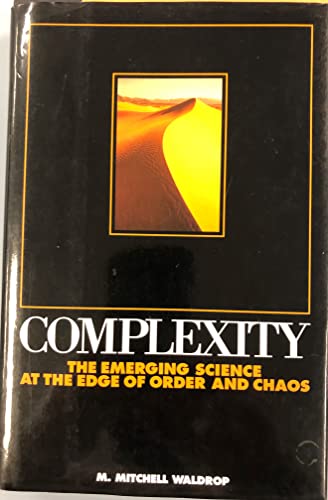
A look at the rebellious thinkers who are challenging old ideas with their insights into the ways countless elements of complex systems interact to produce spontaneous order out of confusion
Die Inhaltsangabe kann sich auf eine andere Ausgabe dieses Titels beziehen.
Reseña del editor
A look at the rebellious thinkers who are challenging old ideas with their insights into the ways countless elements of complex systems interact to produce spontaneous order out of confusion
Contraportada
In a rented convent in Santa Fe, a revolution has been brewing. The activists are not anarchists, but rather Nobel Laureates in physics and economics such as Murray Gell-Mann and Kenneth Arrow, and pony-tailed graduate students, mathematicians, and computer scientists down from Los Alamos. They've formed an iconoclastic think tank called the Santa Fe Institute, and their radical idea is to create a new science called complexity. These mavericks from academe share a deep impatience with the kind of linear, reductionist thinking that has dominated science since the time of Newton. Instead, they are gathering novel ideas about interconnectedness, coevolution, chaos, structure, and order - and they're forging them into an entirely new, unified way of thinking about nature, human social behavior, life, and the universe itself. They want to know how a primordial soup of simple molecules managed to turn itself into the first living cell - and what the origin of life some four billion years ago can tell us about the process of technological innovation today. They want to know why ancient ecosystems often remained stable for millions of years, only to vanish in a geological instant - and what such events have to do with the sudden collapse of Soviet communism in the late 1980s. They want to know why the economy can behave in unpredictable ways that economists can't explain - and how the random process of Darwinian natural selection managed to produce such wonderfully intricate structures as the eye and the kidney. Above all, they want to know how the universe manages to bring forth complex structures such as galaxies, stars, planets, bacteria, plants, animals, and brains. There are commonthreads in all of these queries, and these Santa Fe scientists seek to understand them. Complexity is their story: the messy, funny, human story of how science really happens. Here is the tale of Brian Arthur, the Belfast-born economist who stubbornly pushed his theories of economic change in the face of hostile orthodoxy. Here, too, are the stories of Stuart Kauffman, the physician-turned-theorist whose most passionate desire has been to find the principles of evolutionary order and organization that Darwin never knew about; John Holland, the affable computer scientist who developed profoundly original theories of evolution and learning as he labored in obscurity for thirty years; Chris Langton, the one-time hippie whose close brush with death in a hang-glider accident inspired him to create the new field of artificial life; and Santa Fe Institute founder George Cowan, who worked a lifetime in the Los Alamos bomb laboratory, until - at age sixty-three - he set out to start a scientific revolution. Most of all, however, Complexity is the story of how these scientists and their colleagues have tried to forge what they like to call "the sciences of the twenty-first century".
„Über diesen Titel“ kann sich auf eine andere Ausgabe dieses Titels beziehen.
Weitere beliebte Ausgaben desselben Titels

Suchergebnisse für Complexity: The Emerging Science at the Edge of Order...

Foto des Verkäufers
Complexity: The Emerging Science at the Edge of Order and Chaos
Anbieter: Zoom Books East, Glendale Heights, IL, USA
Verkäuferbewertung 5 von 5 Sternen

Zustand: acceptable. Book is in acceptable condition and shows signs of wear. Book may also include underlining highlighting. The book can also include "From the library of" labels. May not contain miscellaneous items toys, dvds, etc. . We offer 100% money back guarantee and 24 7 customer service. Bestandsnummer des Verkäufers ZEV.0671767895.A
Beispielbild für diese ISBN
Complexity: The Emerging Scien
Anbieter: World of Books (was SecondSale), Montgomery, IL, USA
Verkäuferbewertung 5 von 5 Sternen
Zustand: Good. Item in good condition. Textbooks may not include supplemental items i.e. CDs, access codes etc. Bestandsnummer des Verkäufers 00096010477
Beispielbild für diese ISBN
Complexity: The Emerging Science at the Edge of Order and Chaos
Anbieter: Wonder Book, Frederick, MD, USA
Verkäuferbewertung 5 von 5 Sternen
Zustand: Good. Good condition. Good dust jacket. A copy that has been read but remains intact. May contain markings such as bookplates, stamps, limited notes and highlighting, or a few light stains. Bestandsnummer des Verkäufers U12P-01165
Beispielbild für diese ISBN
Complexity: The Emerging Science at the Edge of Order and Chaos
Anbieter: Wonder Book, Frederick, MD, USA
Verkäuferbewertung 5 von 5 Sternen
Zustand: Very Good. Very Good condition. Very Good dust jacket. With remainder mark. A copy that may have a few cosmetic defects. May also contain light spine creasing or a few markings such as an owner's name, short gifter's inscription or light stamp. Bestandsnummer des Verkäufers Q08A-01809
Beispielbild für diese ISBN
Complexity: The Emerging Science at the Edge of Order and Chaos
Anbieter: ThriftBooks-Phoenix, Phoenix, AZ, USA
Verkäuferbewertung 5 von 5 Sternen
Hardcover. Zustand: Good. No Jacket. Pages can have notes/highlighting. Spine may show signs of wear. ~ ThriftBooks: Read More, Spend Less. Bestandsnummer des Verkäufers G0671767895I3N00
Beispielbild für diese ISBN
Complexity: The Emerging Science at the Edge of Order and Chaos
Anbieter: ThriftBooks-Atlanta, AUSTELL, GA, USA
Verkäuferbewertung 5 von 5 Sternen
Hardcover. Zustand: Good. No Jacket. Missing dust jacket; Pages can have notes/highlighting. Spine may show signs of wear. ~ ThriftBooks: Read More, Spend Less. Bestandsnummer des Verkäufers G0671767895I3N01
Beispielbild für diese ISBN
Complexity: The Emerging Science at the Edge of Order and Chaos
Anbieter: ThriftBooks-Atlanta, AUSTELL, GA, USA
Verkäuferbewertung 5 von 5 Sternen
Hardcover. Zustand: Fair. No Jacket. Missing dust jacket; Readable copy. Pages may have considerable notes/highlighting. ~ ThriftBooks: Read More, Spend Less. Bestandsnummer des Verkäufers G0671767895I5N01
Beispielbild für diese ISBN
Complexity: The Emerging Science at the Edge of Order and Chaos
Anbieter: ThriftBooks-Dallas, Dallas, TX, USA
Verkäuferbewertung 5 von 5 Sternen
Hardcover. Zustand: Good. No Jacket. Former library book; Pages can have notes/highlighting. Spine may show signs of wear. ~ ThriftBooks: Read More, Spend Less. Bestandsnummer des Verkäufers G0671767895I3N10
Beispielbild für diese ISBN
Complexity: The Emerging Science at the Edge of Order and Chaos
Anbieter: ThriftBooks-Atlanta, AUSTELL, GA, USA
Verkäuferbewertung 5 von 5 Sternen
Hardcover. Zustand: Good. No Jacket. Pages can have notes/highlighting. Spine may show signs of wear. ~ ThriftBooks: Read More, Spend Less. Bestandsnummer des Verkäufers G0671767895I3N00
Beispielbild für diese ISBN
Complexity: The Emerging Science at the Edge of Order and Chaos
Anbieter: ThriftBooks-Dallas, Dallas, TX, USA
Verkäuferbewertung 5 von 5 Sternen
Hardcover. Zustand: Fair. No Jacket. Readable copy. Pages may have considerable notes/highlighting. ~ ThriftBooks: Read More, Spend Less. Bestandsnummer des Verkäufers G0671767895I5N00