
Verwandte Artikel zu Vygotsky and Cognitive Science: Language and the Unification...
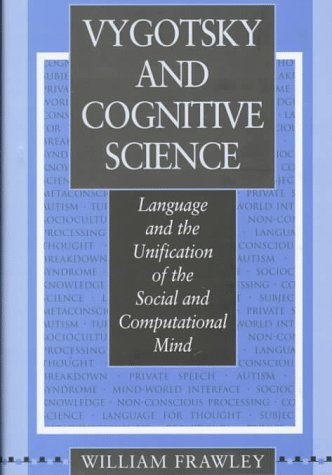
Vygotsky and Cognitive Science: Language and the Unification of the Social and Computational Mind - Hardcover
Inhaltsangabe
Is a human being a person or a machine? Is the mind a social construction or a formal device? It is both, William Frawley tells us, and by bringing together Vygotsky's sociocultural theory of the mind and cognitive science's computational model, he shows us how this not only can but must be. To do so, Frawley focuses on language, particularly on how the computational mind uses language to mediate the internal and the external during thought. By reconciling the linguistic device and the linguistic person, he argues for a Vygotskyan cognitive science.
Frawley begins by exploding the internalist/externalist dichotomy that presently drives cognitive science and falsely pits computationalism against socioculturalism. He replaces the reigning Platonic paradigm of computational mind-science with a framework based on an unusual, unified account of Wittgenstein, thus setting the stage for a Vygotskyan cognitive science centered on three aspects of mind: subjectivity, real-time operation, and breakdown. In this context, he demonstrates how computational psychology accommodates a critical aspect of Vygotskyan theory--private speech--as the mind's metacomputational regulator. An examination of certain congenital disorders (such as Williams Syndrome, Turner Syndrome, and autism) that disrupt speech further clarifies the issue of computational and cognitive control.
Die Inhaltsangabe kann sich auf eine andere Ausgabe dieses Titels beziehen.
Suchergebnisse für Vygotsky and Cognitive Science: Language and the Unification...

Beispielbild für diese ISBN
Vygotsky and Cognitive Science: Language and the Unification of the Social and Computational Mind
Verlag:
Harvard University Press, USA, 1997
ISBN 10: 0674943473
ISBN 13: 9780674943476
Gebraucht
Hardcover
Anbieter: ABOXABOOKS, Bristol, VT, USA
Verkäuferbewertung 5 von 5 Sternen

Hardcover. Zustand: Good. Moderate wear on jacket edges. Otherwise in very good condition. Bestandsnummer des Verkäufers 008355
Gebraucht kaufen
EUR 8,08
EUR 4,79 Versand
Versand innerhalb von USA
Versand innerhalb von USA
Anzahl: 1 verfügbar
Beispielbild für diese ISBN
Vygotsky and Cognitive Science: Language and the Unification of the Social and Computational Mind
ISBN 10: 0674943473
ISBN 13: 9780674943476
Neu
Hardcover
Erstausgabe
Anbieter: Alien Bindings, BALTIMORE, MD, USA
Verkäuferbewertung 4 von 5 Sternen

Hardcover. Zustand: New. Zustand des Schutzumschlags: New. First Edition. Brand New with crisp dust jacket. The covers look great. The binding is tight. The interior pages are clean and unmarked. Electronic delivery tracking will be issued free of charge. Bestandsnummer des Verkäufers 09631
Beispielbild für diese ISBN
Vygotsky and Cognitive Science : Language and the Unification of the Social and Computational Mind
Verlag:
Harvard University Press, 1997
ISBN 10: 0674943473
ISBN 13: 9780674943476
Gebraucht
Hardcover
Anbieter: Better World Books, Mishawaka, IN, USA
Verkäuferbewertung 5 von 5 Sternen
Zustand: Good. y First edition. Former library copy. Pages intact with minimal writing/highlighting. The binding may be loose and creased. Dust jackets/supplements are not included. Includes library markings. Stock photo provided. Product includes identifying sticker. Better World Books: Buy Books. Do Good. Bestandsnummer des Verkäufers 40533599-6
Gebraucht kaufen
EUR 17,01
Versand gratis
Versand innerhalb von USA
Versand innerhalb von USA
Anzahl: 1 verfügbar
Foto des Verkäufers
Vygotsky and Cognitive Science: Language and the Unification of the Social and Computational Mind
Verlag:
Harvard University Press, 1997
ISBN 10: 0674943473
ISBN 13: 9780674943476
Gebraucht
Hardcover
Erstausgabe
Anbieter: Yesterday's Muse, ABAA, ILAB, IOBA, Webster, NY, USA
Verkäuferbewertung 5 von 5 Sternen
Hard Cover. Zustand: Good. Zustand des Schutzumschlags: Very Good. First Edition. First edition. Minor tear to jacket spine base, jacket edges bumped. Pencil underlining and marginalia in Introduction only, ink name on front endpaper, page base lightly soiled. 1997 Hard Cover. 333 pp. Is a human being a person or a machine' Is the mind a social construction or a formal device' It is both, William Frawley tells us, and by bringing together Vygotsky's sociocultural theory of the mind and cognitive science's computational model, he shows us how this not only can but must be. To do so, Frawley focuses on language, particularly on how the computational mind uses language to mediate the internal and the external during thought. By reconciling the linguistic device and the linguistic person, he argues for a Vygotskyan cognitive science. Frawley begins by exploding the internalist/externalist dichotomy that presently drives cognitive science and falsely pits computationalism against socioculturalism. He replaces the reigning Platonic paradigm of computational mind-science with a framework based on an unusual, unified account of Wittgenstein, thus setting the stage for a Vygotskyan cognitive science centered on three aspects of mind: subjectivity, real-time operation, and breakdown. In this context, he demonstrates how computational psychology accommodates a critical aspect of Vygotskyan theory--private speech--as the mind's metacomputational regulator. An examination of certain congenital disorders (such as Williams Syndrome, Turner Syndrome, and autism) that disrupt speech further clarifies the issue of computational and cognitive control. Bestandsnummer des Verkäufers 2346016
Gebraucht kaufen
EUR 19,73
Versand gratis
Versand innerhalb von USA
Versand innerhalb von USA
Anzahl: 1 verfügbar
Foto des Verkäufers
Vygotsky and Cognitive Science: Language and the Unification of the Social and Computational Mind.
Verlag:
Harvard University Press, 1997
ISBN 10: 0674943473
ISBN 13: 9780674943476
Gebraucht
Hardcover
Anbieter: Kloof Booksellers & Scientia Verlag, Amsterdam, Niederlande
Verkäuferbewertung 4 von 5 Sternen
Zustand: as new. Cambridge, MA.:Harvard University Press, 1997. Hardcover. Dustjacket. 342 pp. - Is a human being a person or a machine? Is the mind a social construction or a formal device? It is both, William Frawley tells us, and by bringing together Vygotsky's sociocultural theory of the mind and cognitive science's computational model, he shows us how this not only can but must be. To do so, Frawley focuses on language, particularly on how the computational mind uses language to mediate the internal and external worlds during thought. By reconciling the linguistic device and the linguistic person, his book argues for a Vygotskyan cognitive science. Frawley begins by exploding the internalist/externalist dichotomy that presently drives cognitive science and falsely pits computationalism against socioculturalism. He replaces the reigning Platonic paradigm of computational mind-science with a framework based on an unusual account of Wittgenstein's philosophical struggle. He thus sets the stage for a Vygotskyan cognitive science centered on three aspects of mind: subjectivity, real-time operation, and breakdown. In this context, he demonstrates that a critical aspect of Vygotskyan theory - private speech - can be understood as the mind's metacomputational regulator. An examination of certain congenital disorders (such as Williams syndrome, Turner syndrome, and autism) that disrupt speech further clarifies the issue of computational and cognitive control. Condition : as new copy. ISBN 9780674943476. Keywords : PHILOSOPHY, Bestandsnummer des Verkäufers 290696
Gebraucht kaufen
EUR 20,95
EUR 30,00 Versand
Versand von Niederlande nach USA
Versand von Niederlande nach USA
Anzahl: 1 verfügbar