Inhaltsangabe
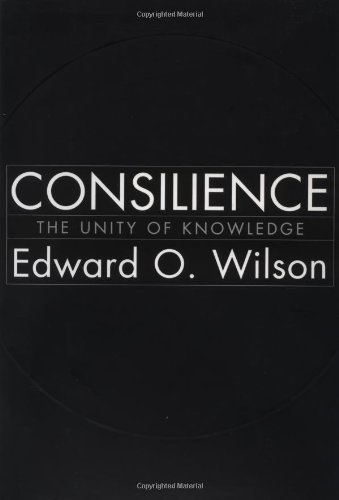
An expert on sociobiology and biodiversity argues for the fundamental unity of all knowledge in the face of the increasing fragmentation and specialization of knowledge over the past two centuries
Die Inhaltsangabe kann sich auf eine andere Ausgabe dieses Titels beziehen.
Über die Autorin bzw. den Autor
Edward O. Wilson was born in Birmingham, Alabama in 1929. He received his B.S. and M.S. in biology from the University of Alabama and, in 1955, his Ph.D. in biology from Harvard, where he has since taught, and where he has received both of its college-wide teaching awards. He is currently Research Professor and Honorary Curator in Entomology of the Museum of Comparative Zoology at Harvard. He is the author of two Pulitzer Prize-winning books, <i>OOn Human Natur</i>e (1978) and <i>The Ants</i>(1990, with Bert Hölldobler), as well as the recipient of many fellowships, honors, and awards, including the 1977 National Medal of Science, the Crafoord Prize from the Royal Swedish Academy of Sciences (1990), the International Prize for Biology from Japan (1993), and, for his conservation efforts, the Gold Medal of the Worldwide Fund for Nature (1990) and the Audubon Medal of the National Audubon Society (1995). He is on the Board of Directors of The Nature Conservancy, Conservation International, and the American Museum of Natural History, and gives many lectures throughout the world. He lives in Lexington, Massachusetts with his wife, Irene.
Auszug. © Genehmigter Nachdruck. Alle Rechte vorbehalten.
chapter 1
The Ionian Enchantment
I remember very well the time I was captured by the dream of unified learning. It was in the early fall of 1947, when at eighteen I came up from Mobile to Tuscaloosa to enter my sophomore year at the University of Alabama. A beginning biologist, fired by adolescent enthusiasm but short on theory and vision, I had schooled myself in natural history with field guides carried in a satchel during solitary excursions into the woodlands and along the freshwater streams of my native state. I saw science, by which I meant (and in my heart I still mean) the study of ants, frogs, and snakes, as a wonderful way to stay outdoors.
My intellectual world was framed by Linnaeus, the eighteenth-century Swedish naturalist who invented modern biological classification. The Linnaean system is deceptively easy. You start by separating specimens of plants and animals into species. Then you sort species resembling one another into groups, the genera. Examples of such groups are all the crows and all the oaks. Next you label each species with a two-part Latinized name, such as Corvus ossifragus for the fish crow, where Corvus stands for the genus--all the species of crows--and ossifragus for the fish crow in particular. Then on to higher classification, where similar genera are grouped into families, families into orders, and so on up to phyla and finally, at the very summit, the six kingdoms--plants, animals, fungi, protists, monerans, and archaea. It is like the army: men (plus women, nowadays) into squads, squads into platoons, platoons into companies, and in the final aggregate, the armed services headed by the joint chiefs of staff. It is, in other words, a conceptual world made for the mind of an eighteen-year-old.
I had reached the level of the Carolus Linnaeus of 1735 or, more accurately (since at that time I knew little of the Swedish master), the Roger Tory Peterson of 1934, when the great naturalist published the first edition of A Field Guide to the Birds. My Linnaean period was nonetheless a good start for a scientific career. The first step to wisdom, as the Chinese say, is getting things by their right names.
Then I discovered evolution. Suddenly--that is not too strong a word--I saw the world in a wholly new way. This epiphany I owed to my mentor Ralph Chermock, an intense, chain-smoking young assistant professor newly arrived in the provinces with a Ph.D. in entomology from Cornell University. After listening to me natter for a while about my lofty goal of classifying all the ants of Alabama, he handed me a copy of Ernst Mayr's 1942 Systematics and the Origin of Species. Read it, he said, if you want to become a real biologist.
The thin volume in the plain blue cover was one of the New Synthesis works, uniting the nineteenth-century Darwinian theory of evolution and modern genetics. By giving a theoretical structure to natural history, it vastly expanded the Linnaean enterprise. A tumbler fell somewhere in my mind, and a door opened to a new world. I was enthralled, couldn't stop thinking about the implications evolution has for classification and for the rest of biology. And for philosophy. And for just about everything. Static pattern slid into fluid process. My thoughts, embryonically those of a modern biologist, traveled along a chain of causal events, from mutations that alter genes to evolution that multiplies species, to species that assemble into faunas and floras. Scale expanded, and turned continuous. By inwardly manipulating time and space, I found I could climb the steps in biological organization from microscopic particles in cells to the forests that clothe mountain slopes. A new enthusiasm surged through me. The animals and plants I loved so dearly reentered the stage as lead players in a grand drama. Natural history was validated as a real science.
I had experienced the Ionian Enchantment. That recently coined expression I borrow from the physicist and historian Gerald Holton. It means a belief in the unity of the sciences--a conviction, far deeper than a mere working proposition, that the world is orderly and can be explained by a small number of natural laws. Its roots go back to Thales of Miletus, in Ionia, in the sixth century b.c. The legendary philosopher was considered by Aristotle two centuries later to be the founder of the physical sciences. He is of course remembered more concretely for his belief that all matter consists ultimately of water. Although the notion is often cited as an example of how far astray early Greek speculation could wander, its real significance is the metaphysics it expressed about the material basis of the world and the unity of nature.
The Enchantment, growing steadily more sophisticated, has dominated scientific thought ever since. In modern physics its focus has been the unification of all the forces of nature--electroweak, strong, and gravitation--the hoped-for consolidation of theory so tight as to turn the science into a "perfect" system of thought, which by sheer weight of evidence and logic is made resistant to revision. But the spell of the Enchantment extends to other fields of science as well, and in the minds of a few it reaches beyond into the social sciences, and still further, as I will explain later, to touch the humanities. The idea of the unity of science is not idle. It has been tested in acid baths of experiment and logic and enjoyed repeated vindication. It has suffered no decisive defeats. At least not yet, even though at its center, by the very nature of the scientific method, it must be thought always vulnerable. On this weakness I will also expand in due course.
Einstein, the architect of grand unification in physics, was Ionian to the core. That vision was perhaps his greatest strength. In an early letter to his friend Marcel Grossmann he said, "It is a wonderful feeling to recognize the unity of a complex of phenomena that to direct observation appear to be quite separate things." He was referring to his successful alignment of the microscopic physics of capillaries with the macroscopic, universe-wide physics of gravity. In later life he aimed to weld everything else into a single parsimonious system, space with time and motion, gravity with electromagnetism and cosmology. He approached but never captured that grail. All scientists, Einstein not excepted, are children of Tantalus, frustrated by the failure to grasp that which seems within reach. They are typified by those thermodynamicists who for decades have drawn ever closer to the temperature of absolute zero, when atoms cease all motion. In 1995, pushing down to within a few billionths of a degree above absolute zero, they created a Bose-Einstein condensate, a fundamental form of matter beyond the familiar gases, liquids, and solids, in which many atoms act as a single atom in one quantum
state. As temperature drops and pressure is increased, a gas condenses into a liquid, then a solid; then appears the Bose-Einstein condensate. But absolute, entirely absolute zero, a temperature that exists in imagination, has still not been attained.
On a far more modest scale, I found it a wonderful feeling not just to taste the unification metaphysics but also to be released from the confinement of fundamentalist religion. I had been raised a Southern Baptist, laid backward under the water on the sturdy arm of a pastor, been born again. I knew the healing power of redemption. Faith, hope, and charity were in my bones, and with millions of others I knew that my savior Jesus Christ would grant me eternal life. More pious than the average teenager, I read the Bible cover to cover, twice. But now at college, steroid-driven into moods of adolescent rebellion, I chose to doubt. I found it hard to accept that our deepest beliefs were set in stone by agricultural societies of the...
„Über diesen Titel“ kann sich auf eine andere Ausgabe dieses Titels beziehen.
Weitere beliebte Ausgaben desselben Titels

Suchergebnisse für Consilience: The Unity of Knowledge

Beispielbild für diese ISBN
Consilience: The Unity of Knowledge
Anbieter: World of Books (was SecondSale), Montgomery, IL, USA
Verkäuferbewertung 5 von 5 Sternen

Zustand: Good. Item in good condition. Textbooks may not include supplemental items i.e. CDs, access codes etc. Bestandsnummer des Verkäufers 00086970482
Gebraucht kaufen
EUR 3,49
Versand gratis
Versand innerhalb von USA
Versand innerhalb von USA
Anzahl: 16 verfügbar
Beispielbild für diese ISBN
Consilience: The Unity of Knowledge
Anbieter: World of Books (was SecondSale), Montgomery, IL, USA
Verkäuferbewertung 5 von 5 Sternen
Zustand: Acceptable. Item in acceptable condition! Textbooks may not include supplemental items i.e. CDs, access codes etc. Bestandsnummer des Verkäufers 00086799063
Gebraucht kaufen
EUR 3,49
Versand gratis
Versand innerhalb von USA
Versand innerhalb von USA
Anzahl: 4 verfügbar
Beispielbild für diese ISBN
Consilience: The Unity of Knowledge
Anbieter: Your Online Bookstore, Houston, TX, USA
Verkäuferbewertung 5 von 5 Sternen
Hardcover. Zustand: Good. Bestandsnummer des Verkäufers 0679450777-3-24039670
Gebraucht kaufen
EUR 3,50
Versand gratis
Versand innerhalb von USA
Versand innerhalb von USA
Anzahl: 1 verfügbar
Beispielbild für diese ISBN
Consilience: The Unity of Knowledge
Anbieter: Orion Tech, Kingwood, TX, USA
Verkäuferbewertung 5 von 5 Sternen
hardcover. Zustand: Fair. Bestandsnummer des Verkäufers 0679450777-4-31824545
Gebraucht kaufen
EUR 3,50
Versand gratis
Versand innerhalb von USA
Versand innerhalb von USA
Anzahl: 1 verfügbar
Foto des Verkäufers
Consilience: The Unity of Knowledge
Anbieter: ZBK Books, Carlstadt, NJ, USA
Verkäuferbewertung 5 von 5 Sternen
Zustand: acceptable. Fast & Free Shipping â" A well-used but reliable copy with all text fully readable. Pages and cover remain intact, though wear such as notes, highlighting, bends, or library marks may be present. Supplemental items like CDs or access codes may not be included. Bestandsnummer des Verkäufers ZWV.0679450777.A
Gebraucht kaufen
EUR 4,59
Versand gratis
Versand innerhalb von USA
Versand innerhalb von USA
Anzahl: 1 verfügbar
Foto des Verkäufers
Consilience: The Unity of Knowledge
Anbieter: Goodwill, Brooklyn Park, MN, USA
Verkäuferbewertung 5 von 5 Sternen
Zustand: good. All pages and cover are intact including the dust cover, if applicable . Spine may show signs of wear. Pages may include limited notes and highlighting. May include "From the library of" labels. Shrink wrap, dust covers, or boxed set case may be missing. Item may be missing bundled media. Bestandsnummer des Verkäufers MINV.0679450777.G
Gebraucht kaufen
EUR 1,59
EUR 3,42 Versand
Versand innerhalb von USA
Versand innerhalb von USA
Anzahl: 1 verfügbar
Beispielbild für diese ISBN
Consilience: The Unity of Knowledge
Anbieter: Wonder Book, Frederick, MD, USA
Verkäuferbewertung 5 von 5 Sternen
Zustand: Very Good. Very Good condition. Very Good dust jacket. A copy that may have a few cosmetic defects. May also contain light spine creasing or a few markings such as an owner's name, short gifter's inscription or light stamp. Bestandsnummer des Verkäufers P05B-03333
Gebraucht kaufen
EUR 5,58
Versand gratis
Versand innerhalb von USA
Versand innerhalb von USA
Anzahl: 2 verfügbar
Beispielbild für diese ISBN
Consilience: The Unity of Knowledge
Anbieter: Wonder Book, Frederick, MD, USA
Verkäuferbewertung 5 von 5 Sternen
Zustand: Good. Good condition. Very Good dust jacket. A copy that has been read but remains intact. May contain markings such as bookplates, stamps, limited notes and highlighting, or a few light stains. Bundled media such as CDs, DVDs, floppy disks or access codes may not be included. Bestandsnummer des Verkäufers I14J-02034
Gebraucht kaufen
EUR 5,58
Versand gratis
Versand innerhalb von USA
Versand innerhalb von USA
Anzahl: 1 verfügbar
Beispielbild für diese ISBN
Consilience : The Unity of Knowledge
Verlag:
Knopf Doubleday Publishing Group, 1998
ISBN 10: 0679450777
ISBN 13: 9780679450771
Gebraucht
Hardcover
Erstausgabe
Anbieter: Better World Books, Mishawaka, IN, USA
Verkäuferbewertung 5 von 5 Sternen
Zustand: Very Good. 1st. Used book that is in excellent condition. May show signs of wear or have minor defects. Bestandsnummer des Verkäufers 3386868-75
Gebraucht kaufen
EUR 5,86
Versand gratis
Versand innerhalb von USA
Versand innerhalb von USA
Anzahl: 1 verfügbar
Beispielbild für diese ISBN
Consilience : The Unity of Knowledge
Verlag:
Knopf Doubleday Publishing Group, 1998
ISBN 10: 0679450777
ISBN 13: 9780679450771
Gebraucht
Hardcover
Erstausgabe
Anbieter: Better World Books: West, Reno, NV, USA
Verkäuferbewertung 5 von 5 Sternen
Zustand: Good. 1st. Former library book; may include library markings. Used book that is in clean, average condition without any missing pages. Bestandsnummer des Verkäufers GRP105231961
Gebraucht kaufen
EUR 5,86
Versand gratis
Versand innerhalb von USA
Versand innerhalb von USA
Anzahl: 3 verfügbar