
Verwandte Artikel zu Freud Conflict and Culture
Inhaltsangabe
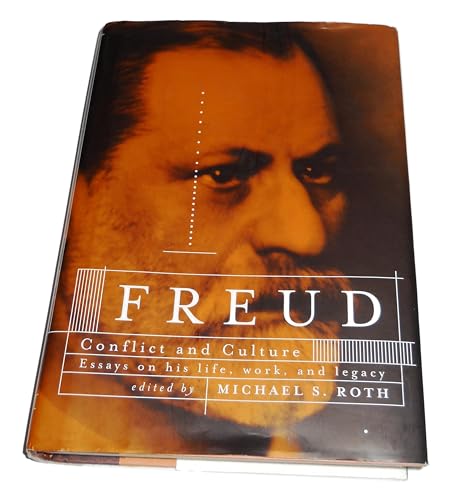
A companion volume to a forthcoming Library of Congress exhibition features a collection of provocative essays--by Oliver Sacks, Peter Gay, Robert Coles, Art Spiegelman, and other notable scholars, critics, and writers--on Freud, his theories, and his impact on modern psychoanalysis. 20,000 first printing.
Die Inhaltsangabe kann sich auf eine andere Ausgabe dieses Titels beziehen.
Über die Autorin bzw. den Autor
Michael S. Roth is Associate Director of the Getty Research Institute for the History of Art and the Humanities. His books include <b>Psycho-Analysis as History: Negation and Freedom in Freud</b> and <b>The Ironist's Cage: Memory, Trauma, and the Construction of History</b>.
Aus dem Klappentext
have had as decisive and fundamental an impact on the course of modern cultural history as Sigmund Freud. Freudian theory and psychoanalytic thinking inform the ways in which we perceive ourselves and our society, and remain vital and relevant to some of our most pressing societal issues and concerns, from drug abuse and aggression to gender and sexuality. Yet few figures have inspired such sustained controversy and intense debate as Freud has, and his theoretical and cultural legacies continue to be hotly contested.<br> The exhibition "Sigmund Freud: Conflict and Culture," mounted by the Library of Congress, explores the influence of Freud and psychoanalysis on twentieth-century culture and examines some of his central ideas concerning the individual and society. Contemporary evaluations, emerging from changes in scientific knowledge and ideological priorities, have changed the way we view Freud's contributions to our understanding of self and society. This volume
Auszug. © Genehmigter Nachdruck. Alle Rechte vorbehalten.
The couch and the desk: twin icons of Freud's career. For almost all of his professional life, he combined clinical work with writing, bridging the scientific and the literary. It was during his therapeutic work with patients that associations were gathered, observations made, and resistances encountered. And it was in the course of his writing that ideas were explored, tested, elaborated, or dropped. The couch and the desk, of course, can be situated in relation to different contexts. The cultural ferment and political crises of fin-de-siècle Vienna were part of Freud's daily existence, sometimes intruding dramatically on his personal and professional life while at other times forming a loose urban forum for the slow expansion of the psychoanalytic circle. The conservative establishment in Vienna and the cultural politics that struggled against it produced the hothouse in which would grow the modern movements in art, philosophy, and science. Psychoanalysis was surely part of these rebellions against the conventions of the turn of the century.
However, if much of Freud's work was done in Vienna, his concerns and approach to problems drew on intellectual traditions that went far beyond that immediate context. As Ilse Grubrich-Simitis and Michael Molnar note in their essays, Freud drew upon bodies of thought (some with little scientific credibility in his own time) far afield from medicine or neurology in an effort to address perplexing individual and societal issues. The founding myths of the Western tradition, and its classic texts, from those of the ancient Greeks to those of Shakespeare, remained deep resources for his thinking throughout his professional life. This is evident in his informal notes, as he took stabs at making sense of signs he could not yet read, to decipher codes for which he had not (yet) found a key.
These notes were often the beginning of writing projects which would lead Freud into uncharted waters: areas of inquiry that would require far more interpretation and speculation than attention to empirical evidence. He kept at it: trying to solve these riddles that had more than a medical dimension, that concerned the human condition most generally. As Patrick J. Mahony emphasizes in his essay, Freud was driven to work and driven by it, from listening to himself and those around him to looking at texts and pictures, and writing, always writing. Was anything not grist for this mill? It needed to turn. John Forrester emphasizes how it turned in a way that would implicate both reader and writer, inviting us--or daring us--to turn to our dreams and our wishes and learn to see them as expressive of a latent content we had hitherto ignored. This latent content could never be exhausted: it held countless traces of who we were, what we wanted, and who we desired to be.
Portrait of a Dream Reader
by John Forrester
The interpretations of dreams, Freud wrote in 1931, "contains the most valuable of all the discoveries it has been my good fortune to make. Insight such as this falls to one's lot but once in a lifetime." Critics and admirers agree. What are the ingredients of The Interpretation of Dreams that convince everyone of its importance?
The Interpretation of Dreams is many things: a scholarly treatise, an ingenious yet lucid set of rules for interpreting dreams, a bold scientific theory of dreams upon which is built a revolutionary psychology of the unconscious. But it is also a window on the inner life of its author and an intimate diary of the life and work of a cultured Jewish physician living in fin-de-siècle Vienna, who records with irony and humor the private lives of his cultivated and witty patients as well as his own. In an imperfectly though deliberately disguised manner, it charts an adventure, a quest in search of a scientific Holy Grail that will make its discoverer rich, honored, and famous forever. And finally, in prose of immense distinction, with its asides and reflections on the foibles, failings, and deep motivations of all human beings, it belongs to the tradition of moralist essays. The Interpretation of Dreams is all these things, yet it is also something more: it is the founding document of a new scientific movement much as, forty years before, Darwin's Origin of Species was.
Freud recognized these many facets and the tensions between them:
For this book has a further subjective significance for me personally--a significance which I only grasped after I had completed it. It was, I found, a portion of my own self-analysis, my reaction to my father's death--that is to say, to the most important event, the most poignant loss, of a man's life. Having discovered that this was so, I felt unable to obliterate the traces of the experience. To my readers, however, it will be a matter of indifference upon what material they learn to value and interpret dreams.
However autobiographical it may be, Freud claims, the book is still a work of science: the attendant personal dimension of the dreams and their analyses can be discounted by Freud's readers without loss of substance.
"How," Jacques Derrida astutely asks, "can an autobiographical writing, in the abyss of an unterminated self-analysis, give birth to a world-wide institution?" In complete contrast to the posture of indifference toward the author that Freud recommends a reader should adopt, there is an opposed view, which recognizes that precisely because the book is "a portion of my own self-analysis," it is exemplary and originary of psychoanalysis itself: the first self-analysis in history, and the epitome of all analyses. The dream book functions for the reader in much the same way as do all first-order scientific achievements, as described by Thomas Kuhn: as a paradigm or, better, as an exemplar of method, theory, and even of the inner life.
If, as many analysts claim, true self-analysis is impossible, then who was Freud's analyst? The two most obvious candidates are Wilhelm Fliess and Freud's patients (a collective analyst). Most have assumed that Freud's analysis was achieved through his intense friendship with Fliess, conducted primarily in Freud's letters to his "sole audience" in Berlin and supplemented by their occasional meetings. Freud's analysis was, as he himself described it in The Interpretation of Dreams, published at the end of 1899, based in part upon the methodical transcription of his dreams, which was meant for Fliess's eyes only. All through 1897, the letters to Fliess are brimming with advances in clinical and theoretical ideas, confessions of his dreams and his childhood, complaints about his body, and stories of his family. Then, in December of that year, Freud starts to write to Fliess in a new genre: "the Dr[eckology] [Shitology], in which I now deposit my novelties." Included in the "Dreckology" were dreams, which Freud asked Fliess to return so that they could be inserted, probably with little emendation, in the dream book.
In this way, the hypothesis that Fliess was Freud's analyst inexorably leads one to posit that every reader slips into Fliess's reading chair and becomes Freud's analyst. To be this analyst is to be the object of a transference, whose traces can be detected in the manner in which the writer invokes and calls upon Fliess's shade--the reader. The most telling pointer is the concept and function of the censor. The idea of the censor, so central to Freud's theory of the dream, developed hand in hand with Fliess's interventions qua censor in the composition of Freud's first draft in the spring of 1898. The first hint of the idea of censorship is the graphic and textual "Russian censorship" of foreign newspapers as they crossed the border in December 1897: "Words,...
„Über diesen Titel“ kann sich auf eine andere Ausgabe dieses Titels beziehen.
Suchergebnisse für Freud Conflict and Culture

Beispielbild für diese ISBN
Freud: Conflict and Culture: Essays on his life, work, and legacy
Anbieter: More Than Words, Waltham, MA, USA
Verkäuferbewertung 5 von 5 Sternen

Zustand: Good. . 9780345468901. Before placing your order for please contact us for confirmation on the book's binding. Check out our other listings to add to your order for discounted shipping. All orders guaranteed and ship within 24 hours. Bestandsnummer des Verkäufers BOS-K-08c-01745
Gebraucht kaufen
EUR 1,16
EUR 3,55 Versand
Versand innerhalb von USA
Versand innerhalb von USA
Anzahl: 1 verfügbar
Beispielbild für diese ISBN
Freud: Conflict and Culture: Essays on his life, work, and legacy
Anbieter: World of Books (was SecondSale), Montgomery, IL, USA
Verkäuferbewertung 5 von 5 Sternen
Zustand: Very Good. Item in very good condition! Textbooks may not include supplemental items i.e. CDs, access codes etc. Bestandsnummer des Verkäufers 00082614448
Gebraucht kaufen
EUR 4,80
Versand gratis
Versand innerhalb von USA
Versand innerhalb von USA
Anzahl: 4 verfügbar
Beispielbild für diese ISBN
Freud: Conflict and Culture: Essays on his life, work, and legacy
Anbieter: Open Books, Chicago, IL, USA
Verkäuferbewertung 5 von 5 Sternen
hardcover. Zustand: Very Good. Light edge wear. Spine is sun faded. Open Books is a nonprofit social venture that provides literacy experiences for thousands of readers each year through inspiring programs and creative capitalization of books. Bestandsnummer des Verkäufers mon0000826501
Gebraucht kaufen
EUR 1,59
EUR 3,55 Versand
Versand innerhalb von USA
Versand innerhalb von USA
Anzahl: 1 verfügbar
Beispielbild für diese ISBN
Freud: Conflict and Culture
Anbieter: World of Books Inc, Montgomery, IL, USA
Verkäuferbewertung 4 von 5 Sternen

Hardback. Zustand: Very Good. Bestandsnummer des Verkäufers CIN0679451161VG
Gebraucht kaufen
EUR 6,63
Versand gratis
Versand innerhalb von USA
Versand innerhalb von USA
Anzahl: 4 verfügbar
Beispielbild für diese ISBN
Freud: Conflict and Culture: Essays on his life, work, and legacy
Anbieter: ThriftBooks-Dallas, Dallas, TX, USA
Verkäuferbewertung 5 von 5 Sternen
Hardcover. Zustand: Very Good. No Jacket. Missing dust jacket; May have limited writing in cover pages. Pages are unmarked. ~ ThriftBooks: Read More, Spend Less. Bestandsnummer des Verkäufers G0679451161I4N01
Gebraucht kaufen
EUR 7,37
Versand gratis
Versand innerhalb von USA
Versand innerhalb von USA
Anzahl: 1 verfügbar
Beispielbild für diese ISBN
Freud: Conflict and Culture: Essays on his life, work, and legacy
Anbieter: ThriftBooks-Atlanta, AUSTELL, GA, USA
Verkäuferbewertung 5 von 5 Sternen
Hardcover. Zustand: As New. No Jacket. Pages are clean and are not marred by notes or folds of any kind. ~ ThriftBooks: Read More, Spend Less. Bestandsnummer des Verkäufers G0679451161I2N00
Gebraucht kaufen
EUR 7,37
Versand gratis
Versand innerhalb von USA
Versand innerhalb von USA
Anzahl: 1 verfügbar
Beispielbild für diese ISBN
Freud: Conflict and Culture : Essays on His Life, Work, and Legacy
Verlag:
Knopf Doubleday Publishing Group, 1998
ISBN 10: 0679451161
ISBN 13: 9780679451167
Gebraucht
Hardcover
Anbieter: Better World Books, Mishawaka, IN, USA
Verkäuferbewertung 5 von 5 Sternen
Zustand: Good. Pages intact with minimal writing/highlighting. The binding may be loose and creased. Dust jackets/supplements are not included. Stock photo provided. Product includes identifying sticker. Better World Books: Buy Books. Do Good. Bestandsnummer des Verkäufers 3387224-75
Gebraucht kaufen
EUR 8,53
Versand gratis
Versand innerhalb von USA
Versand innerhalb von USA
Anzahl: 1 verfügbar
Beispielbild für diese ISBN
Freud: Conflict and Culture : Essays on His Life, Work, and Legacy
Verlag:
Knopf Doubleday Publishing Group, 1998
ISBN 10: 0679451161
ISBN 13: 9780679451167
Gebraucht
Hardcover
Anbieter: Better World Books, Mishawaka, IN, USA
Verkäuferbewertung 5 von 5 Sternen
Zustand: Good. Former library copy. Pages intact with minimal writing/highlighting. The binding may be loose and creased. Dust jackets/supplements are not included. Includes library markings. Stock photo provided. Product includes identifying sticker. Better World Books: Buy Books. Do Good. Bestandsnummer des Verkäufers 8345328-6
Gebraucht kaufen
EUR 8,53
Versand gratis
Versand innerhalb von USA
Versand innerhalb von USA
Anzahl: 1 verfügbar
Beispielbild für diese ISBN
Freud: Conflict and Culture. Essays on his life, work, and legacy.
Verlag:
Alfred A. Knopf, New York, 1998
ISBN 10: 0679451161
ISBN 13: 9780679451167
Gebraucht
Hardcover
Erstausgabe
Anbieter: Henry Hollander, Bookseller, Los Angeles, CA, USA
Verkäuferbewertung 4 von 5 Sternen
Hardbound. Zustand: Very Good. First Edition. Octavo in dust jacket, x, 274 pp. b/w photos, notes, slected bibliography, index Foreword by James H. Billington. Bestandsnummer des Verkäufers 93088
Gebraucht kaufen
EUR 4,53
EUR 6,22 Versand
Versand innerhalb von USA
Versand innerhalb von USA
Anzahl: 1 verfügbar
Beispielbild für diese ISBN
Freud: Conflict and Culture: Essays on his life, work, and legacy
Anbieter: Roundabout Books, Greenfield, MA, USA
Verkäuferbewertung 4 von 5 Sternen
hardcover. Zustand: Very Good. Condition Notes: Clean, unmarked copy with some edge wear. Good binding. Dust jacket included if issued with one. We ship in recyclable American-made mailers. 100% money-back guarantee on all orders. Bestandsnummer des Verkäufers 1777540
Gebraucht kaufen
EUR 10,90
Versand gratis
Versand innerhalb von USA
Versand innerhalb von USA
Anzahl: 1 verfügbar