
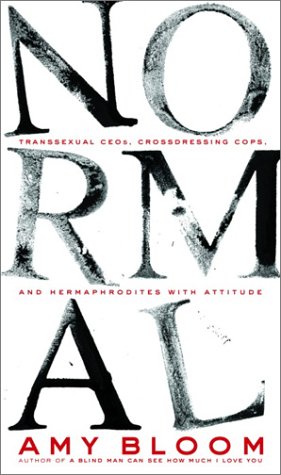
Verwandte Artikel zu Normal: Transsexual Ceos, Crossdressing Cops, and Hermaphrod...
Inhaltsangabe
Bloom takes us on a provocative, intimate journey into the lives of "people who reveal, or announce, that their gender is variegated rather than monochromatic" - female-to-male transsexuals, heterosexual crossdressers, and the intersexed. We meet Lyle Monelle and his mother, Jessie, who recognized early on that her little girl was in fact a boy and used her life savings to help Lyle make the transgender transition. On a Carnival cruise with a group of crossdressers and their spouses, we meet Peggy Rudd and her husband. "Melanie, "who devote themselves to the cause of "ordinary heterosexual men with an additional feminine dimension." And we meet Hale Hawbecker, "a regular, middle-of-the-road, white-bread guy" with a wife, kids, and a medical condition, the standard treatment for which would have changed his life and his gender.
Bloom shows the essential humanity in this infinite variety, allowing us to appreciate these people as they really are - both like and unlike everyone else - and inviting us "to see into these particular worlds and back out to the larger one we all share." Casting light into the dusty corners of our assumptions about sex, gender, and identity, about what it means to be male or female. Bloom reveals new facets to ideas about happiness, personality, and character, even as she brilliantly illumines the very concept of "normal."
Die Inhaltsangabe kann sich auf eine andere Ausgabe dieses Titels beziehen.
Über die Autorin bzw. den Autor
Amy Bloom is the author of A Blind Man Can See How Much I Love You, Come to Me, and a novel, Love Invents Us. Her work has appeared in The New Yorker, The Atlantic Monthly, and Harper s Bazaar, among other publications, and in many anthologies, including The Best American Short Stories; Prize Stories: The O. Henry Awards; and The Scribner Anthology of Contemporary Short Fiction. A practicing psychotherapist, she lives in Connecticut and teaches at Yale University.
Aus dem Klappentext
Amy Bloom has won a devoted readership and wide critical acclaim for fiction of rare humor, insight, grace, and eloquence, and the same qualities distinguish Normal, her first full-length work of nonfiction. In Normal, the National Book Critics Circle Award and National Book Award finalist explores sex and gender through portraits of people who are widely considered not normal.
A great many people, sick of news from the margins, worn out by the sand shifting beneath their assumptions, like to imagine Nature as a sweet, simple voice: tulips in spring, Vermont s leaves falling in autumn, Bloom writes. Nature is more like Aretha Franklin: vast, magnificent, capricious, occasionally hilarious, and infinitely varied.
Bloom takes us on a provocative, intimate journey into the lives of people who reveal, or announce, that their gender is variegated rather than monochromatic female-to-male transsexuals, heterosexual crossdressers, and the intersexed. We meet Lyle Monelle and his mother, Jessie, who recognized early on that her little girl was in fact a boy and used her life savings to help Lyle make the transgender transition. On a Carnival cruise with a group of crossdressers and their spouses, we meet Peggy Rudd and her husband, Melanie, who devote themselves to the cause of ordinary heterosexual men with an additional feminine dimension. And we meet Hale Hawbecker, a regular, middle-of-the-road, white-bread guy with a wife, kids, and a medical condition, the standard treatment for which would have changed his life and his gender.
Bloom shows the essential humanity in this infinite variety, allowing us to appreciate these people as they really are both like and unlike everyone else and inviting us to see into these particular worlds and back out to the larger one we all share. Casting light into the dusty corners of our assumptions about sex, gender, and identity, about what it means to be male or female, Bloom reveals new facets to ideas about happiness, personality, and character, even as she brilliantly illumines the very concept of normal.
Auszug. © Genehmigter Nachdruck. Alle Rechte vorbehalten.
THE BODY LIES
FEMALE-TO-MALE TRANSSEXUALS
What would you go through not to have to live the life of Kafka’s Gregor Samsa? Not to realize, early in childhood, that other people perceive a slight, unmistakable bugginess about you, which you find horrifying but they claim to find unremarkable? That glimpses of yourself in the mirror are upsetting and puzzling and to be avoided, since they show a self that is not you? That although you can ignore your shell much of the time and your playmates often seem to see you and not your cockroach exterior, teachers and relatives pluck playfully at your antennae with increasing frequency and suggest, not unkindly, that you might be more comfortable with the other insects? And when you say, or cry, that you are not a cockroach, your parents are sad, or concerned, or annoyed, but unwavering in their conviction—how could it be otherwise?—that you are a cockroach, and are becoming more cockroachlike every day. Would you hesitate to pay thirty thousand dollars and experience some sharp but passing physical misery in order to be returned to your own dear, soft, skin-covered self?
Approximately two people in every hundred thousand are diagnosed—first by themselves, then by endocrinologists, family doctors, psychiatrists, or psychologists—as high-intensity transsexuals, meaning that they will be motivated, whether or not they succeed, to have surgery that will bring their bodies into accord with the gender to which they have known themselves, since toddlerhood, to belong. Until a decade or so ago the clinical literature and the unreliable statistics suggested that for every four men seeking to become anatomically female, there was one woman seeking the opposite change. Now clinical evaluation centers report that the ratio is almost one to one.
In twenty years of practice as a clinical social worker, I met men who liked to wear women’s clothing, women who preferred sex in public conveyances to sex at home, men who were more attracted to shoes than to the people in them; I didn’t meet any transsexuals. I encountered transsexuals only the way most people do: in Renee Richards’s story, in Jan Morris’s Conundrum, in Kate Bornstein’s books, and on afternoon talk shows, where transsexuals are usually represented by startlingly pretty young women, sometimes holding hands with their engagingly shy, love-struck fiancés, sometimes accompanied by defensive, supportive wives turned best friends. I wondered, in the middle of the afternoon, where the female-to-male transsexuals were. Even if there were four times as many male-to-female transsexuals, there still had to be a few thousand of the other kind somewhere. But not in mainstream bookstores, not in magazines, not in front of talk-show audiences of middle-aged women standing up to applaud the guests’ ability to “look just like the real thing.”
I thought there must be a reason female-to-male transsexuals were invisible. I wondered if their physical transformations were so pitiful that no one could bear to interview them, if women who wished to be men were less interesting, less interview-worthy than men who wished to be women, or if these people were so floridly disturbed that even the talk-show hosts were ashamed to be seen with them.
Much of the early psychiatric literature about transsexu- als, from the pre–Christine Jorgensen 1940s until the late 1970s, leaned heavily toward psychoanalytic explanations and toward clinical descriptions that, however sympathetic to the unhappy patient, emphasized the bizarreness not of the biological condition but of the conviction that there was a biological condition. The next psychiatric wave emphasized “personality disorders” as the root of transsexuality, specifically the popularized borderline personality syndrome, with its inadequately formed sense of self and frightened yearning for symbiosis. In The Transsexual Empire (1979), Janice Raymond dismissed the biological reality of transsexuality and attacked transsexuals as agents and pawns of the patriarchy. Her overwrought theories about the meaning of transsexu- ality and the training and practice of surgeons who perform transsexual procedures read like the feminist equivalent of some of the Mafia–CIA–White Russian conspiracy theories of Kennedy’s assassination, but her essential point, that transsexuals are psychologically unstable victims of a society that overemphasizes the roles of sexual insignia and gender difference, made sense to me. If the people involved were less nuts and society were less rigid, it seemed, neither transsexuals nor the surgery they seek would exist.
Most of us can understand a wish, even a persistent wish, to belong to the other gender. History and fiction are full of examples, many charming, some heroic, of women who dressed as men throughout their lives. It’s the medical procedures that make transsexuals seem crazy: six months to two years of biweekly intramuscular injections of two hundred milligrams of Depo-Testosterone, which cause an outbreak of adolescent acne, the cessation of menstruation, and the development of male secondary sex characteristics; then a double mastectomy, in which most but not all of the breast tissue is removed, the nipple saved, and the chest recontoured for a more masculine, pectorally pronounced look; and then, a year to ten years later (depending on the patient’s wishes and financial resources), a hysterectomy and one of two possible genital surgeries: a phalloplasty (a surgery to create a full-size phallus and testicles) or a metoidioplasty (a surgery that frees the testosterone-enlarged clitoris to act as a small penis). In short: multiple, expensive, and traumatic surgeries to remove healthy tissue. Who would do this?
Lyle Monelle, a burly man of twenty-eight, lives with his mother, Jessie, in a trailer park in suburban Montana, a state in which I’d never imagined suburbs. The trailer park is neatly laid out beneath a shocking cobalt sky, and all the culs-de-sac have their own blue-and-white street signs, none of which are bent or rusted or facing the wrong way. The careful hand of people who are used to making do, doing without, and trying again is everywhere. Jessie and Lyle are watching for me from the trailer’s little porch, and they come toward the car like a couple of welcoming relatives.
The inside of the trailer looks familiar; it is the Montana twin of my late mother-in-law’s home in northern Minnesota. Sturdy, slightly bowed Herculon love seat and matching recliner in shades of orange; copper mallards hanging on the opposite wall, arching over the TV. The three of us finish two pitchers of iced tea during the afternoon’s conversation, and Lyle and Jessie allow themselves to be sad and occasionally puzzled by their own story, but not for long. All their painful stories are followed by moments of remembered grief but end in the genuine and ironic laughter of foxhole buddies; they know what they know, and they are not afraid anymore.
Lyle is older than I had thought he would be—he’s an adult. He was a patient of three of the people I’ve already interviewed—Dr. Donald Laub, a preeminent plastic surgeon known especially for female-to-male sex change surgery; Judy Van Maasdam, the counselor at Laub’s surgical center in Palo Alto; and Dr. Ira Pauly, a noted psychiatrist and when they told me about Lyle, they all focused on how young he was at the time of transition, much younger than most people who apply for surgery. Even though I knew better, I had half expected to meet a teenager. He was fourteen when he began hormone treatments, with medical approval, fifteen when he had his mastectomies, but twenty-three before he and his parents had enough money for the...
„Über diesen Titel“ kann sich auf eine andere Ausgabe dieses Titels beziehen.
Suchergebnisse für Normal: Transsexual Ceos, Crossdressing Cops, and Hermaphrod...

Beispielbild für diese ISBN
Normal: Transsexual CEOs, Crossdressing Cops, and Hermaphrodites with Attitude
Anbieter: World of Books (was SecondSale), Montgomery, IL, USA
Verkäuferbewertung 5 von 5 Sternen

Zustand: Very Good. Item in very good condition! Textbooks may not include supplemental items i.e. CDs, access codes etc. Bestandsnummer des Verkäufers 00099921215
Gebraucht kaufen
EUR 5,44
Versand gratis
Versand innerhalb von USA
Versand innerhalb von USA
Anzahl: 1 verfügbar
Beispielbild für diese ISBN
Normal: Transsexual CEOs, Crossdressing Cops, and Hermaphrodites with Attitude
Anbieter: World of Books (was SecondSale), Montgomery, IL, USA
Verkäuferbewertung 5 von 5 Sternen
Zustand: Good. Good condition ex-library book with usual library markings and stickers. Bestandsnummer des Verkäufers 00110084785
Gebraucht kaufen
EUR 5,44
Versand gratis
Versand innerhalb von USA
Versand innerhalb von USA
Anzahl: 1 verfügbar
Beispielbild für diese ISBN
Normal: Transsexual CEOs, Crossdressing Cops, and Hermaphrodites with Attitude
Verlag:
Random House (edition 1), 2002
ISBN 10: 067945652X
ISBN 13: 9780679456520
Gebraucht
Hardcover
Anbieter: BooksRun, Philadelphia, PA, USA
Verkäuferbewertung 5 von 5 Sternen
Hardcover. Zustand: Very Good. 1. With dust jacket. It's a well-cared-for item that has seen limited use. The item may show minor signs of wear. All the text is legible, with all pages included. It may have slight markings and/or highlighting. Bestandsnummer des Verkäufers 067945652X-8-1-29
Gebraucht kaufen
EUR 5,45
Versand gratis
Versand innerhalb von USA
Versand innerhalb von USA
Anzahl: 1 verfügbar
Beispielbild für diese ISBN
Normal: Transsexual CEOs, Crossdressing Cops, and Hermaphrodites with Attitude
Anbieter: HPB-Ruby, Dallas, TX, USA
Verkäuferbewertung 5 von 5 Sternen
hardcover. Zustand: Very Good. Connecting readers with great books since 1972! Used books may not include companion materials, and may have some shelf wear or limited writing. We ship orders daily and Customer Service is our top priority! Bestandsnummer des Verkäufers S_476759093
Gebraucht kaufen
EUR 3,66
EUR 3,35 Versand
Versand innerhalb von USA
Versand innerhalb von USA
Anzahl: 1 verfügbar
Beispielbild für diese ISBN
Normal: Transsexual CEOs, Crossdressing Cops, and Hermaphrodites with Attitude
Anbieter: HPB Inc., Dallas, TX, USA
Verkäuferbewertung 5 von 5 Sternen
hardcover. Zustand: Very Good. Connecting readers with great books since 1972! Used books may not include companion materials, and may have some shelf wear or limited writing. We ship orders daily and Customer Service is our top priority! Bestandsnummer des Verkäufers S_368072802
Gebraucht kaufen
EUR 3,66
EUR 3,35 Versand
Versand innerhalb von USA
Versand innerhalb von USA
Anzahl: 1 verfügbar
Beispielbild für diese ISBN
Normal: Transsexual CEOs, Crossdressing Cops, and Hermaphrodites with Attitude
Anbieter: St Vincent de Paul of Lane County, Eugene, OR, USA
Verkäuferbewertung 5 von 5 Sternen
Zustand: Good. FORMER LIBRARY COPY,MAY HAVE INDENTIFYING STAMPS AND/OR STICKERS BUT REMAINS IN FINE READABLE CONDITION. Former Library book. hardcover 100% of proceeds go to charity! Good condition with all pages in tact. Item shows signs of use and may have cosmetic defects. Bestandsnummer des Verkäufers 2BB-03-3926
Gebraucht kaufen
EUR 3,67
EUR 3,56 Versand
Versand innerhalb von USA
Versand innerhalb von USA
Anzahl: 1 verfügbar
Beispielbild für diese ISBN
Normal
Anbieter: World of Books Inc, Montgomery, IL, USA
Verkäuferbewertung 4 von 5 Sternen

Hardback. Zustand: Very Good. Amy Bloom has won a devoted readership and wide critical acclaim for fiction of rare humor, insight, grace, and eloquence, and the same qualities distinguish Normal, her first full-length work of nonfiction. In Normal, the National Book Critics Circle Award and National Book Award finalist explores sex and gender through portraits of people who are widely considered not normal. “A great many people, sick of news from the margins, worn out by the sand shifting beneath their assumptions, like to imagine Nature as a sweet, simple voice: tulips in spring, Vermont’s leaves falling in autumn,” Bloom writes. “Nature is more like Aretha Franklin: vast, magnificent, capricious, occasionally hilarious, and infinitely varied.” Bloom takes us on a provocative, intimate journey into the lives of “people who reveal, or announce, that their gender is variegated rather than monochromatic”—female-to-male transsexuals, heterosexual crossdressers, and the intersexed. We meet Lyle Monelle and his mother, Jessie, who recognized early on that her little girl was in fact a boy and used her life savings to help Lyle make the transgender transition. On a Carnival cruise with a group of crossdressers and their spouses, we meet Peggy Rudd and her husband, “Melanie,” who devote themselves to the cause of “ordinary heterosexual men with an additional feminine dimension.” And we meet Hale Hawbecker, “a regular, middle-of-the-road, white-bread guy” with a wife, kids, and a medical condition, the standard treatment for which would have changed his life and his gender. Bloom shows the essential humanity in this infinite variety, allowing us to appreciate these people as they really are—both like and unlike everyone else—and inviting us “to see into these particular worlds and back out to the larger one we all share.” Casting light into the dusty corners of our assumptions about sex, gender, and identity, about what it means to be male or female, Bloom reveals new facets to ideas about happiness, personality, and character, even as she brilliantly illumines the very concept of “normal.” Bestandsnummer des Verkäufers CIN067945652XVG
Gebraucht kaufen
EUR 7,28
Versand gratis
Versand innerhalb von USA
Versand innerhalb von USA
Anzahl: 1 verfügbar
Beispielbild für diese ISBN
Normal: Transsexual CEOs, Crossdressing Cops, and Hermaphrodites with Attitude
Anbieter: ThriftBooks-Atlanta, AUSTELL, GA, USA
Verkäuferbewertung 5 von 5 Sternen
Hardcover. Zustand: Very Good. No Jacket. Former library book; May have limited writing in cover pages. Pages are unmarked. ~ ThriftBooks: Read More, Spend Less. Bestandsnummer des Verkäufers G067945652XI4N10
Gebraucht kaufen
EUR 7,33
Versand gratis
Versand innerhalb von USA
Versand innerhalb von USA
Anzahl: 1 verfügbar
Beispielbild für diese ISBN
Normal: Transsexual CEOs, Crossdressing Cops, and Hermaphrodites with Attitude
Anbieter: ThriftBooks-Dallas, Dallas, TX, USA
Verkäuferbewertung 5 von 5 Sternen
Hardcover. Zustand: Very Good. No Jacket. May have limited writing in cover pages. Pages are unmarked. ~ ThriftBooks: Read More, Spend Less. Bestandsnummer des Verkäufers G067945652XI4N00
Gebraucht kaufen
EUR 7,33
Versand gratis
Versand innerhalb von USA
Versand innerhalb von USA
Anzahl: 1 verfügbar
Beispielbild für diese ISBN
Normal: Transsexual CEOs, Crossdressing Cops, and Hermaphrodites with Attitude
Anbieter: ThriftBooks-Dallas, Dallas, TX, USA
Verkäuferbewertung 5 von 5 Sternen
Hardcover. Zustand: Good. No Jacket. Pages can have notes/highlighting. Spine may show signs of wear. ~ ThriftBooks: Read More, Spend Less. Bestandsnummer des Verkäufers G067945652XI3N00
Gebraucht kaufen
EUR 7,33
Versand gratis
Versand innerhalb von USA
Versand innerhalb von USA
Anzahl: 1 verfügbar