
Verwandte Artikel zu Absalom, Absalom!: The Corrected Text (Modern Library)
Inhaltsangabe
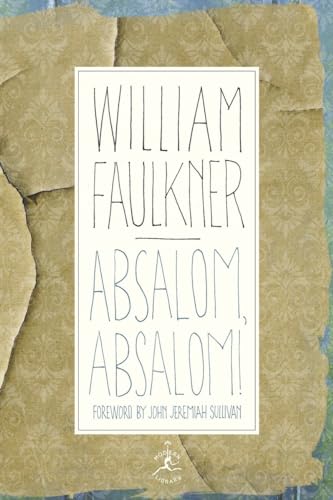
From the Modern Library’s new set of beautifully repackaged hardcover classics by William Faulkner—also available are Snopes, As I Lay Dying, The Sound and the Fury, Light in August, and Selected Short Stories
One of The Atlantic’s Great American Novels of the Past 100 Years
First published in 1936, Absalom, Absalom! is William Faulkner’s ninth novel and one of his most admired. It tells the story of Thomas Sutpen and his ruthless, single-minded attempt to forge a dynasty in Jefferson, Mississippi, in 1830. Although his grand design is ultimately destroyed by his own sons, a century later the figure of Sutpen continues to haunt young Quentin Compson, who is obsessed with his family legacy and that of the Old South. “Faulkner’s novels have the quality of being lived, absorbed, remembered rather than merely observed,” noted Malcolm Cowley. “Absalom, Absalom! is structurally the soundest of all the novels in the Yoknapatawpha series—and it gains power in retrospect.” This edition follows the text of Absalom, Absalom! as corrected in 1986 under the direction of Faulkner expert Noel Polk and features a new Foreword by John Jeremiah Sullivan.
Die Inhaltsangabe kann sich auf eine andere Ausgabe dieses Titels beziehen.
Über die Autorin bzw. den Autor
WILLIAM CUTHBERT FAULKNER was born in 1897 and raised in Oxford, Mississippi, where he spent most of his life. One of the towering figures of American literature, he is the author of The Sound and the Fury, Absalom, Absalom!, and As I Lay Dying, among many other remarkable books. Faulkner was awarded the Nobel Prize in 1950 and France’s Legion of Honor in 1951. He died in 1962.
Von der hinteren Coverseite
The story of Thomas Sutpen, an enigmatic stranger who came to Jefferson in the early 1830s to wrest his mansion out of the muddy bottoms of the north Mississippi wilderness. He was a man, Faulkner said, "who wanted sons and the sons destroyed him."
"From the Trade Paperback edition.
Auszug. © Genehmigter Nachdruck. Alle Rechte vorbehalten.
From a little after two oclock until almost sundown of the long still hot weary dead September afternoon they sat in what Miss Coldfield still called the office because her father had called it that-a dim hot airless room with the blinds all closed and fastened for forty-three summers because when she was a girl someone had believed that light and moving air carried heat and that dark was always cooler, and which (as the sun shone fuller and fuller on that side of the house) became latticed with yellow slashes full of dust motes which Quentin thought of as being flecks of the dead old dried paint itself blown inward from the scaling blinds as wind might have blown them. There was a wistaria vine blooming for the second time that summer on a wooden trellis before one window, into which sparrows came now and then in random gusts, making a dry vivid dusty sound before going away: and opposite Quentin, Miss Coldfield in the eternal black which she had worn for forty-three years now, whether for sister, father, or nothusband none knew, sitting so bolt upright in the straight hard chair that was so tall for her that her legs hung straight and rigid as if she had iron shinbones and ankles, clear of the floor with that air of impotent and static rage like children's feet, and talking in that grim haggard amazed voice until at last listening would renege and hearing-sense self-confound and the long-dead object of her impotent yet indomitable frustration would appear, as though by outraged recapitulation evoked, quiet inattentive and harmless, out of the biding and dreamy and victorious dust.
Her voice would not cease, it would just vanish. There would be the dim coffin-smelling gloom sweet and oversweet with the twice-bloomed wistaria against the outer wall by the savage quiet September sun impacted distilled and hyperdistilled, into which came now and then the loud cloudy flutter of the sparrows like a flat limber stick whipped by an idle boy, and the rank smell of female old flesh long embattled in virginity while the wan haggard face watched him above the faint triangle of lace at wrists and throat from the too tall chair in which she resembled a crucified child; and the voice not ceasing but vanishing into and then out of the long intervals like a stream, a trickle running from patch to patch of dried sand, and the ghost mused with shadowy docility as if it were the voice which he haunted where a more fortunate one would have had a house. Out of quiet thunderclap he would abrupt (man-horse-demon) upon a scene peaceful and decorous as a schoolprize water color, faint sulphur-reek still in hair clothes and beard, with grouped behind him his band of wild niggers like beasts half tamed to walk upright like men, in attitudes wild and reposed, and manacled among them the French architect with his air grim, haggard, and tatterran. Immobile, bearded and hand palm-lifted the horseman sat; behind him the wild blacks and the captive architect huddled quietly, carrying in bloodless paradox the shovels and picks and axes of peaceful conquest. Then in the long unamaze Quentin seemed to watch them overrun suddenly the hundred square miles of tranquil and astonished earth and drag house and formal gardens violently out of the soundless Nothing and clap them down like cards upon a table beneath the up-palm immobile and pontific, creating the Sutpen's Hundred, the Be Sutpen's Hundred like the oldentime Be Light. Then hearing would reconcile and he would seem to listen to two separate Quentins now-the Quentin Compson preparing for Harvard in the South, the deep South dead since 1865 and peopled with garrulous outraged baffled ghosts, listening, having to listen, to one of the ghosts which had refused to lie still even longer than most had, telling him about old ghost-times; and the Quentin Compson who was still too young to deserve yet to be a ghost but nevertheless having to be one for all that, since he was born and bred in the deep South the same as she was-the two separate Quentins now talking to one another in the long silence of notpeople in notlanguage, like this: It seems that this demon-his name was Sutpen-(Colonel Sutpen)-Colonel Sutpen. Who came out of nowhere and without warning upon the land with a band of strange niggers and built a plantation -(Tore violently a plantation, Miss Rosa Coldfield says)-tore violently. And married her sister Ellen and begot a son and a daughter which-(Without gentleness begot, Miss Rosa Coldfield says)-without gentleness. Which should have been the jewels of his pride and the shield and comfort of his old age, only-(Only they destroyed him or something or he destroyed them or something. And died)-and died. Without regret, Miss Rosa Coldfield says-(Save by her) Yes, save by her. (And by Quentin Compson) Yes. And by Quentin Compson.
"Because you are going away to attend the college at Harvard they tell me," she said. "So I dont imagine you will ever come back here and settle down as a country lawyer in a little town like Jefferson since Northern people have already seen to it that there is little left in the South for a young man. So maybe you will enter the literary profession as so many Southern gentlemen and gentlewomen too are doing now and maybe some day you will remember this and write about it. You will be married then I expect and perhaps your wife will want a new gown or a new chair for the house and you can write this and submit it to the magazines. Perhaps you will even remember kindly then the old woman who made you spend a whole afternoon sitting indoors and listening while she talked about people and events you were fortunate enough to escape yourself when you wanted to be out among young friends of your own age."
"Yessum," Quentin said. Only she dont mean that he thought. It's because she wants it told. It was still early then. He had yet in his pocket the note which he had received by the hand of a small negro boy just before noon, asking him to call and see her-the quaint, stiffly formal request which was actually a summons, out of another world almost-the queer archaic sheet of ancient good notepaper written over with the neat faded cramped script which, due to his astonishment at the request from a woman three times his age and whom he had known all his life without having exchanged a hundred words with her or perhaps to the fact that he was only twenty years old, he did not recognise as revealing a character cold, implacable, and even ruthless. He obeyed it immediately after the noon meal, walking the half mile between his home and hers through the dry dusty heat of early September and so into the house (it too somehow smaller than its actual size-it was of two storeys-unpainted and a little shabby, yet with an air, a quality of grim endurance as though like her it had been created to fit into and complement a world in all ways a little smaller than the one in which it found itself) where in the gloom of the shuttered hallway whose air was even hotter than outside, as if there were prisoned in it like in a tomb all the suspiration of slow heat-laden time which had recurred during the forty-three years, the small figure in black which did not even rustle, the wan triangle of lace at wrists and throat, the dim face looking at him with an expression speculative, urgent, and intent, waited to invite him in.
It's because she wants it told he thought so that people whom she will never see and whose names she will never hear and who have never heard her name nor seen her face will read it and know at last why God let us lose the War: that only through the blood of our men and the tears of our women could He stay this demon and efface his name and lineage from the earth. Then almost immediately he decided that neither was this the reason why she had sent the note, and sending it, why to him, since if she had merely wanted it told, written and even printed,...
„Über diesen Titel“ kann sich auf eine andere Ausgabe dieses Titels beziehen.
Suchergebnisse für Absalom, Absalom!: The Corrected Text (Modern Library)

Foto des Verkäufers
Absalom, Absalom! (Modern Library)
Anbieter: Goodwill of Central and Coastal Virginia, Richmond, VA, USA
Verkäuferbewertung 4 von 5 Sternen

Zustand: acceptable. Bestandsnummer des Verkäufers CCVV.0679600728.A
Gebraucht kaufen
EUR 4,00
EUR 4,92 Versand
Versand innerhalb von USA
Versand innerhalb von USA
Anzahl: 1 verfügbar
Beispielbild für diese ISBN
Absalom, Absalom! (Modern Library)
Anbieter: HPB-Emerald, Dallas, TX, USA
Verkäuferbewertung 5 von 5 Sternen

Hardcover. Zustand: Very Good. Connecting readers with great books since 1972! Used books may not include companion materials, and may have some shelf wear or limited writing. We ship orders daily and Customer Service is our top priority! Bestandsnummer des Verkäufers S_478882802
Gebraucht kaufen
EUR 7,06
EUR 3,22 Versand
Versand innerhalb von USA
Versand innerhalb von USA
Anzahl: 1 verfügbar
Beispielbild für diese ISBN
Absalom, Absalom!
Verlag:
Random House Publishing Group, 1993
ISBN 10: 0679600728
ISBN 13: 9780679600725
Gebraucht
Hardcover
Anbieter: Better World Books, Mishawaka, IN, USA
Verkäuferbewertung 5 von 5 Sternen
Zustand: Good. Pages intact with minimal writing/highlighting. The binding may be loose and creased. Dust jackets/supplements are not included. Stock photo provided. Product includes identifying sticker. Better World Books: Buy Books. Do Good. Bestandsnummer des Verkäufers 4378293-75
Gebraucht kaufen
EUR 11,02
Versand gratis
Versand innerhalb von USA
Versand innerhalb von USA
Anzahl: 2 verfügbar
Beispielbild für diese ISBN
Absalom, Absalom! (Modern Library)
Anbieter: Sequitur Books, Boonsboro, MD, USA
Verkäuferbewertung 5 von 5 Sternen
hardcover. Zustand: Good. Hardcover. Good binding and cover. Library stamps and markings. Bestandsnummer des Verkäufers 2607240011
Gebraucht kaufen
EUR 9,72
EUR 5,12 Versand
Versand innerhalb von USA
Versand innerhalb von USA
Anzahl: 1 verfügbar
Foto des Verkäufers
Absalom, Absalom!: The Corrected Text
Verlag:
Modern Library, New York, 2012
ISBN 10: 0679600728
ISBN 13: 9780679600725
Gebraucht
Hardcover
Anbieter: HOWLGLEN, Seven Valleys, PA, USA
Verkäuferbewertung 5 von 5 Sternen
Hardcover. Zustand: As New. Zustand des Schutzumschlags: Very Good. Book itself like new inside and out. Dust jacket neither faded nor price clipped with moderate shelving wear. 2016 printing. Bestandsnummer des Verkäufers ABE-1770303523981
Gebraucht kaufen
EUR 14,13
EUR 4,54 Versand
Versand innerhalb von USA
Versand innerhalb von USA
Anzahl: 1 verfügbar
Beispielbild für diese ISBN
Absalom, Absalom! : The Corrected Text
Anbieter: GreatBookPrices, Columbia, MD, USA
Verkäuferbewertung 5 von 5 Sternen
Zustand: As New. Unread book in perfect condition. Bestandsnummer des Verkäufers 413542
Gebraucht kaufen
EUR 16,46
EUR 2,27 Versand
Versand innerhalb von USA
Versand innerhalb von USA
Anzahl: Mehr als 20 verfügbar
Foto des Verkäufers
Absalom, Absalom! : The Corrected Text
Anbieter: GreatBookPrices, Columbia, MD, USA
Verkäuferbewertung 5 von 5 Sternen
Zustand: New. Bestandsnummer des Verkäufers 413542-n
Neu kaufen
EUR 18,06
EUR 2,27 Versand
Versand innerhalb von USA
Versand innerhalb von USA
Anzahl: Mehr als 20 verfügbar
Beispielbild für diese ISBN
Absalom, Absalom! Format: Hardcover
Anbieter: INDOO, Avenel, NJ, USA
Verkäuferbewertung 5 von 5 Sternen
Zustand: As New. Unread copy in mint condition. Bestandsnummer des Verkäufers RH9780679600725
Gebraucht kaufen
EUR 20,36
Versand gratis
Versand innerhalb von USA
Versand innerhalb von USA
Anzahl: Mehr als 20 verfügbar
Beispielbild für diese ISBN
Absalom, Absalom! Format: Hardcover
Anbieter: INDOO, Avenel, NJ, USA
Verkäuferbewertung 5 von 5 Sternen
Zustand: New. Bestandsnummer des Verkäufers 9780679600725
Neu kaufen
EUR 20,37
Versand gratis
Versand innerhalb von USA
Versand innerhalb von USA
Anzahl: Mehr als 20 verfügbar
Foto des Verkäufers
Absalom, Absalom! (Hardcover)
Verlag:
Random House USA Inc, New York, 1993
ISBN 10: 0679600728
ISBN 13: 9780679600725
Neu
Hardcover
Anbieter: Grand Eagle Retail, Bensenville, IL, USA
Verkäuferbewertung 5 von 5 Sternen
Hardcover. Zustand: new. Hardcover. From the Modern Librarys set of beautifully repackaged hardcover classics by William Faulkneralso available are Snopes, As I Lay Dying, The Sound and the Fury, Light in August, and Selected Short StoriesOne of The Atlantics Great American Novels of the Past 100 YearsFirst published in 1936, Absalom, Absalom! is William Faulkners ninth novel and one of his most admired. It tells the story of Thomas Sutpen and his ruthless, single-minded attempt to forge a dynasty in Jefferson, Mississippi, in 1830. Although his grand design is ultimately destroyed by his own sons, a century later the figure of Sutpen continues to haunt young Quentin Compson, who is obsessed with his family legacy and that of the Old South. Faulkners novels have the quality of being lived, absorbed, remembered rather than merely observed, noted Malcolm Cowley. Absalom, Absalom! is structurally the soundest of all the novels in the Yoknapatawpha seriesand it gains power in retrospect. This edition follows the text of Absalom, Absalom! as corrected in 1986 under the direction of Faulkner expert Noel Polk and features a new Foreword by John Jeremiah Sullivan. Quentin Compson gradually learns about a secret from the past that threatens to destroy the Sutpen family. Shipping may be from multiple locations in the US or from the UK, depending on stock availability. Bestandsnummer des Verkäufers 9780679600725