
Verwandte Artikel zu Playwrights at Work: Interviews with Albee, Beckett,...
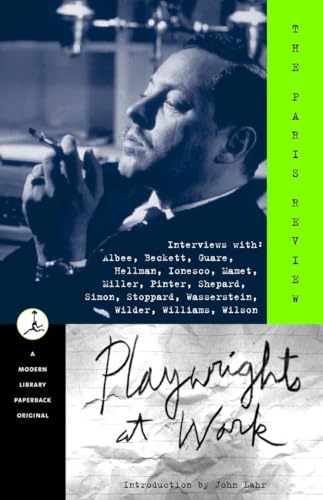
Playwrights at Work: Interviews with Albee, Beckett, Guare, Hellman, Ionesco, Mamet, Miller, Pinter, Shepard, Simon, Stoppard, Wasserstein, Wilder, Williams, Wilson (Modern Library (Paperback)) - Softcover
Inhaltsangabe
The third installment in the Modern Library's Paris Review "Writers at Work" series, this is an all-new gathering of interviews with the most important and compelling playwrights of our time. Their singular takes on their craft, their influences, their lives, the state of contemporary theater, and the tricks of the trade create an illuminating and unparalleled record of the life of the theater itself.
"At its best, theater is an antidote to the whiff of barbarity in the millennial air. 'My feeling is that people in a group, en masse, watching something, react differently, and perhaps more profoundly, than they do when they're alone in their living rooms,' Arthur Miller says here. In the dark, facing the stage, surrounded by others, the paying customer can let himself go; he is emboldened. The theatrical encounter allows a member of the public to think against received opinions. He can submerge himself in the extraordinary, admit his darkest, most infantile wishes, feel the pulse of the contemporary, hear the sludge of street talk turned into poetry. This enterprise can be joyous and dangerous; when the theater's game is good and tense, it is both."
--from the Introduction by John Lahr
Die Inhaltsangabe kann sich auf eine andere Ausgabe dieses Titels beziehen.
Über die Autorin bzw. den Autor
The Paris Review is a literary magazine featuring original writing, art, and in-depth interviews with famous writers.
George Plimpton (1927–2003) was the bestselling author and editor of more than thirty books, as well as editor of the Paris Review for its first fifty years. He wrote regularly for such magazines as Sports Illustrated and Esquire, and he appeared numerous times in films and on television.
John Lahr is the author of 15 books. Among them are his bestselling biographies of his father, Bert Lahr (Notes on a Cowardly Lion) and the playwright Joe Orton (Prick Up Your Ears, which was made into a feature film). His Dame Edna Everage and the Rise of Western Civilization: Backstage with Barry Humphries was awarded the British 1992 Roger Machell Prize for the best book on the performing arts. Lahr has twice won the ASCAP-Deems Taylor Award for excellence in writing about music. He has also twice won the George Jean Nathan Award for Dramatic Criticism, first in 1969, when he was drama critic for The Village Voice and Evergreen Review, and in 1995 for his work at The New Yorker. His stage adaptations have been performed at London's Royal National Theatre, in the West End, at the Royal Exchange in Manchester, and at the Mark Taper Forum in Los Angeles. His short film (directed by John Hancock) Sticky My Fingers, Fleet My Feet was nominated for an Academy Award. He lives in London.
Von der hinteren Coverseite
The third installment in the Modern Library's Paris Review "Writers at Work" series, this is an all-new gathering of interviews with the most important and compelling playwrights of our time. Their singular takes on their craft, their influences, their lives, the state of contemporary theater, and the tricks of the trade create an illuminating and unparalleled record of the life of the theater itself.
"At its best, theater is an antidote to the whiff of barbarity in the millennial air. 'My feeling is that people in a group, en masse, watching something, react differently, and perhaps more profoundly, than they do when they're alone in their living rooms, ' Arthur Miller says here. In the dark, facing the stage, surrounded by others, the paying customer can let himself go; he is emboldened. The theatrical encounter allows a member of the public to think against received opinions. He can submerge himself in the extraordinary, admit his darkest, most infantile wishes, feel the pulse of the contemporary, hear the sludge of street talk turned into poetry. This enterprise can be joyous and dangerous; when the theater's game is good and tense, it is both."
--from the Introduction by John Lahr
Auszug. © Genehmigter Nachdruck. Alle Rechte vorbehalten.
INTRODUCTION
by John Lahr
We need stories; but, as the twenty-first century begins, most of the stories we're told on television and in film are corporate creations, calculated to pick the pockets of the public. The theater's charm and its power is that it is the last bastion of the individual voice, where the secrets of the psyche and the sins of the society can be explored in community with others. "I regard the theater as the greatest of all art forms, the most immediate way in which a human being can share with another the sense of what it is to be a human being," Thornton Wilder tells The Paris Review in this volume. He goes on: "This supremacy of the theater derives from the fact that it is always 'now' on the stage." Ours is an age of perpetual distraction, a virtual reality which Wilder didn't live to see; "the now" is what a large part of the video-addicted public will pay anything to avoid. Entertainment has become atomized, inevitably, the cross-fertilization that is implied in the word civilization (whose root is the Latin for city) has been eroded by the new technology. The public has become habituated to its solitude; it has also grown increasingly uncomfortable in large groups. The onslaught of technological escape, which tickles the society to death, has weakened the appetite for active play. When all is provided, nothing need be sought. In the republic the result is a palpable psychic mutation--a passive, credulous, restless mass at once overexcited and underinformed. At its best, theater is an antidote to the whiff of barbarity in the millennial air. "My feeling is that people in a group, en masse, watching something, react differently, and perhaps more profoundly, than they do when they're alone in their living rooms," Arthur Miller says here. In the dark, facing the stage, surrounded by others, the paying customer can let himself go; he is emboldened. The theatrical encounter allows a member of the public to think against received opinions. He can submerge himself in the extraordinary, admit his darkest, most infantile wishes, feel the pulse of the contemporary, hear the sludge of street talk turned into poetry. This enterprise can be joyous and dangerous; when the theater's game is good and tense, it is both. "We live in what is, but we find a thousand ways not to face it," Thornton Wilder says. "Great theater strengthens our faculty to face it." The playwright has to call the story out of himself; the audience has to call the energy out of the actors. This responsibility has its excitements and its disappointments. Whether you talk, eat, make out, or leave a film, the performances remain the same; the movie happens without a public. The play needs an audience. So the paying customer enters the theater on his mettle; he has a certain unstated but real emotional responsibility to the group. He has to rouse himself from his inveterate entropy and to be alert. "The theater made everybody in the audience behave better, as if they were all in on the same secret," John Guare says in these Paris Review interviews, recalling the empowering magic of his childhood theatergoing. "I found it amazing that what was up on that stage could make these people who didn't know each other laugh, respond, gasp in exactly the same way at the same time."
A playwright is an altogether different literary species from a novelist, who marshals words merely onto the page. "What is so different about the stage is that you're just there, stuck--there are your characters stuck on the stage, you've got to live with them and deal with them," Harold Pinter says. The novelist never sees the reader walk out of his book. He is not writing in space and time; he doesn't have to coax a character he's created to speak the words as written. Consequently, a playwright is a raffish hybrid, a kind of cross between a recluse, a roughneck, and a con man. He lives both in his head and in the world. To ensure the life of his work, he has to be both a charmer and a killer. "You must keep people happy backstage because that affects what's onstage," John Guare says, describing what he privately refers to as "Diva Watch." "During a run, the playwright feels like the mayor of a small town filled with noble creatures who have to get out there and make it brand-new every night. When a production works, it's unlike any other joy in the world."
And when it falls, no failure is so public, so humiliating, and so instant. "Mr. William Randolph Hearst caused a little excitement by getting up in the middle of the first act and leaving with his party of ten," Lillian Hellman says, recalling the floperoo Days to Come. "I vomited in the back aisle. I did. I had to go home and change my clothes. I was drunk." The playwright learns quickly to develop a thick carcass, or at least to fake one. To succeed, the play has to surmount all sorts of obstacles--hurdles of money, casting, directing, rewriting--before it reaches the public. Because of this ferocious struggle, playwrights are a nervy, bumptious, competitive, often outrageous lot. As the reader will discover in these pages, they are also good, high-spirited company. For instance, speaking of The Sisters Rosensweig and aspects of herself in one of her characters, Wendy Wasserstein includes "the ability to get involved with a bisexual." She adds: "Hey--when's the mixer!" Eugene Ionesco describes the first night of The Bald Soprano, when members from the dadaist College de 'Pataphysique, to which he was a satrap, turned up at his opening wearing its highest decoration, La Gidouille, "which was a large turd to be pinned on your lapel.... The audience was shocked at the sight of so many big turds, and thought they were members of a secret cult." Sam Shepard recalls his contentious, alcoholic father going to see one of his plays for the first time, a New Mexico production of Buried Child, which was loosely based on the father's family. "In the second act he stood up and started to carry on with the actors, and then yelled, 'What a bunch of shit this is!'" Shepard explains. "The ushers tried to throw him out. He resisted, and in the end they allowed him to stay because he was the father of the playwright."
In a sense playwrights are masters of their own ceremonies--rituals whose style of provocation the public in time learns to follow and to enjoy. In The Bald Soprano and The Lesson Ionesco mounted a theatrical attack on bourgeois assumptions about psychology and language. "We achieved it above all by the dislocation of language," he tells The Paris Review. "Beckett destroys by language with silence. I do it with too much language, with characters talking at random, and by inventing words." The sense of unlearning---of making new paths in the public imagination--is part of theater's job description. "To have a play draw you in with humor and then make you crazy and send you out mixed up!" John Guare says, speaking of playwrights who influenced his ambition for mischief "When I got to Feydeau, to Strindberg, Pinter, Joe Orton, and the 'dis-ease' they created, I was home." It is Samuel Beckett who has taken theater to the outer limits of uncertainty--a revelation which occurred when Beckett returned to Dublin after World War II and found his mother almost unrecognizable from Parkinson's disease. In Lawrence Sheinberg's account of his meetings with Beckett, the playwright describes his intellectual volte-face. "The whole attempt at knowledge, it seemed to me, had come to nothing," Beckett tells him. "It was all haywire. What I had to do was investigate...
„Über diesen Titel“ kann sich auf eine andere Ausgabe dieses Titels beziehen.
Suchergebnisse für Playwrights at Work: Interviews with Albee, Beckett,...

Beispielbild für diese ISBN
Playwrights at Work Interviews
Anbieter: World of Books (was SecondSale), Montgomery, IL, USA
Verkäuferbewertung 5 von 5 Sternen

Zustand: Good. Item in good condition. Textbooks may not include supplemental items i.e. CDs, access codes etc. Bestandsnummer des Verkäufers 00107715891
Gebraucht kaufen
EUR 8,47
Versand gratis
Versand innerhalb von USA
Versand innerhalb von USA
Anzahl: 1 verfügbar
Beispielbild für diese ISBN
Playwrights at Work: Interviews with Albee, Beckett, Guare, Hellman, Ionesco, Mamet, Miller, Pinter, Shepard, Simon, Stoppard, Wasserstein, Wilder, Williams, Wilson (Modern Library (Paperback))
Verlag:
Random House Publishing Group, 2000
ISBN 10: 0679640215
ISBN 13: 9780679640219
Neu
Paperback
Anbieter: GoldBooks, Denver, CO, USA
Verkäuferbewertung 5 von 5 Sternen
Paperback. Zustand: new. New Copy. Customer Service Guaranteed. Bestandsnummer des Verkäufers 18H9_2_0679640215
Beispielbild für diese ISBN
Playwrights at Work: Interviews with Albee, Beckett, Guare, Hellman, Ionesco, Mamet, Miller, Pinter, Shepard, Simon, Stoppard, Wasserstein, Wilder, Williams, Wilson (Modern Library (Paperback))
Verlag:
Random House Publishing Group, 2000
ISBN 10: 0679640215
ISBN 13: 9780679640219
Gebraucht
paperback
Anbieter: Half Price Books Inc., Dallas, TX, USA
Verkäuferbewertung 5 von 5 Sternen
paperback. Zustand: Very Good. Connecting readers with great books since 1972! Used books may not include companion materials, and may have some shelf wear or limited writing. We ship orders daily and Customer Service is our top priority! Bestandsnummer des Verkäufers S_479485972
Gebraucht kaufen
EUR 7,10
EUR 3,23 Versand
Versand innerhalb von USA
Versand innerhalb von USA
Anzahl: 1 verfügbar
Beispielbild für diese ISBN
The Paris Review Playwrights At Work
Anbieter: Willis Monie-Books, ABAA, Cooperstown, NY, USA
Verkäuferbewertung 5 von 5 Sternen
Softcover. Zustand: Very Good. \; 432 pages. Bestandsnummer des Verkäufers 321127
Gebraucht kaufen
EUR 6,66
EUR 6,90 Versand
Versand innerhalb von USA
Versand innerhalb von USA
Anzahl: 1 verfügbar
Foto des Verkäufers
Playwrights At Work Interviews with Albee, Beckett, Guare, Hellman, Ionesco, Mamet, Miller, Pinter, Shepard, Simon, Stoppard, Wasserstein, Wilder, Williams, Wilson )
Verlag:
Modern Library, New York, NY, 2023
ISBN 10: 0679640215
ISBN 13: 9780679640219
Gebraucht
Paperback
Erstausgabe
Anbieter: True Oak Books, Highland, NY, USA
Verkäuferbewertung 5 von 5 Sternen
Paperback. Zustand: Very Good-. First Edition; Later Printing. 5.5 X 1.08 X 8.5 inches; 408 pages; B&W photographs. Very slightly cocked spine. Minor curl on book's body. Very Good condition otherwise. No other noteworthy defects. No markings. ; - Your satisfaction is our priority. We offer free returns and respond promptly to all inquiries. Your item will be packaged with care and ship on the same or next business day. Buy with confidence. Bestandsnummer des Verkäufers HVD-69732-A-0
Gebraucht kaufen
EUR 17,75
Versand gratis
Versand innerhalb von USA
Versand innerhalb von USA
Anzahl: 1 verfügbar
Foto des Verkäufers
Playwrights at Work: Interviews with Albee, Beckett, Guare, Hellman, Ionesco, Mamet, Miller, Pinter, Shepard, Simon, Stoppard, Wasserstein, Wilder, Williams, Wilson (Modern Library (Paperback))
Verlag:
Random House Publishing Group, 2000
ISBN 10: 0679640215
ISBN 13: 9780679640219
Gebraucht
Softcover
Anbieter: Solr Books, Lincolnwood, IL, USA
Verkäuferbewertung 5 von 5 Sternen
Zustand: very_good. This book is in Very good condition. There may be a few flaws like shelf wear and some light wear. Bestandsnummer des Verkäufers BCV.0679640215.VG
Gebraucht kaufen
EUR 11,41
EUR 6,88 Versand
Versand innerhalb von USA
Versand innerhalb von USA
Anzahl: 2 verfügbar
Beispielbild für diese ISBN
Playwrights at Work: Interviews with Albee, Beckett, Guare, Hellman, Ionesco, Mamet, Miller, Pinter, Shepard, Simon, Stoppard, Wasserstein, Wilder, Williams, Wilson (Modern Library (Paperback))
Verlag:
Random House Publishing Group, 2000
ISBN 10: 0679640215
ISBN 13: 9780679640219
Neu
Softcover
Anbieter: Lakeside Books, Benton Harbor, MI, USA
Verkäuferbewertung 5 von 5 Sternen
Zustand: New. Brand New! Not Overstocks or Low Quality Book Club Editions! Direct From the Publisher! We're not a giant, faceless warehouse organization! We're a small town bookstore that loves books and loves it's customers! Buy from Lakeside Books! Bestandsnummer des Verkäufers OTF-S-9780679640219
Neu kaufen
EUR 15,76
EUR 3,44 Versand
Versand innerhalb von USA
Versand innerhalb von USA
Anzahl: Mehr als 20 verfügbar
Foto des Verkäufers
Playwrights at Work : The Paris Review
Verlag:
Random House Publishing Group, 2000
ISBN 10: 0679640215
ISBN 13: 9780679640219
Neu
Softcover
Anbieter: GreatBookPrices, Columbia, MD, USA
Verkäuferbewertung 5 von 5 Sternen
Zustand: New. Bestandsnummer des Verkäufers 413430-n
Neu kaufen
EUR 16,95
EUR 2,28 Versand
Versand innerhalb von USA
Versand innerhalb von USA
Anzahl: Mehr als 20 verfügbar
Foto des Verkäufers
Playwrights at Work: Interviews with Albee, Beckett, Guare, Hellman, Ionesco, Mamet, Miller, Pinter, Shepard, Simon, Stoppard, Wasserstein, (Paperback or Softback)
Verlag:
Modern Library 6/11/2003, 2003
ISBN 10: 0679640215
ISBN 13: 9780679640219
Neu
Paperback or Softback
Anbieter: BargainBookStores, Grand Rapids, MI, USA
Verkäuferbewertung 5 von 5 Sternen
Paperback or Softback. Zustand: New. Playwrights at Work: Interviews with Albee, Beckett, Guare, Hellman, Ionesco, Mamet, Miller, Pinter, Shepard, Simon, Stoppard, Wasserstein, Book. Bestandsnummer des Verkäufers BBS-9780679640219
Foto des Verkäufers
Playwrights at Work: Interviews with Albee, Beckett, Guare, Hellman, Ionesco, Mamet, Miller, Pinter, Shepard, Simon, Stoppard, Wasserstein, Wilder, Williams, Wilson (Modern Library (Paperback))
Verlag:
Random House Publishing Group, 2000
ISBN 10: 0679640215
ISBN 13: 9780679640219
Gebraucht
Softcover
Anbieter: -OnTimeBooks-, Phoenix, AZ, USA
Verkäuferbewertung 5 von 5 Sternen
Zustand: very_good. Gently read. May have name of previous ownership, or ex-library edition. Binding tight; spine straight and smooth, with no creasing; covers clean and crisp. Minimal signs of handling or shelving. 100% GUARANTEE! Shipped with delivery confirmation, if you're not satisfied with purchase please return item! Ships USPS Media Mail. Bestandsnummer des Verkäufers OTV.0679640215.VG
Gebraucht kaufen
EUR 21,85
Versand gratis
Versand innerhalb von USA
Versand innerhalb von USA
Anzahl: 1 verfügbar